

There Cannot Be Anarchy: Justice Amanullah Emphasizes Need For Institutional Norms In Religious Management In Sabarimala Reference
Advocate Nizam Pasha, appearing for Peerzada of the Nizamuddin Dargah, submitted that if places of worship were stripped of their denominational protections, it would lead to an anomaly, such as 'Aarti' and 'Bhajans' in Mosques.

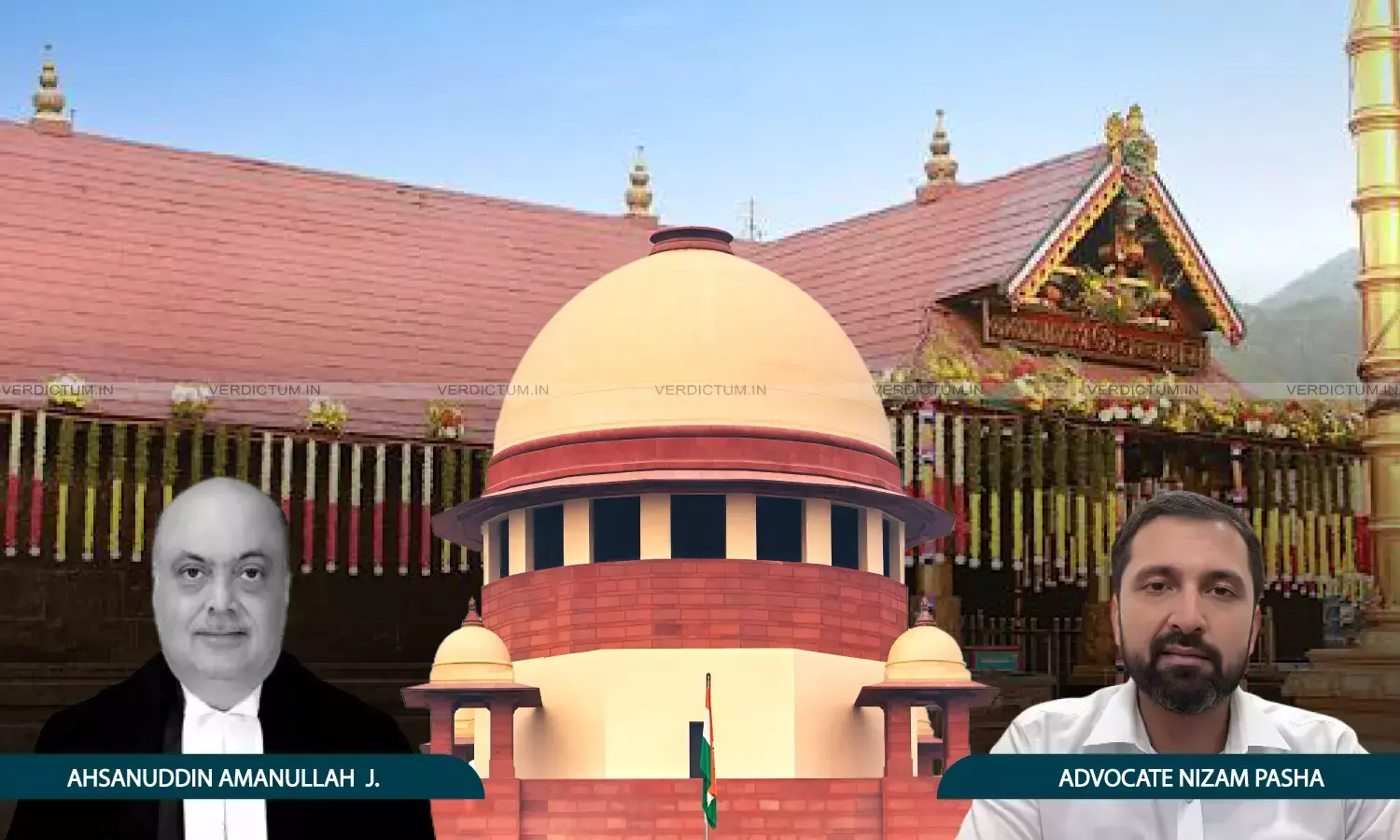
During the hearing of the Sabarimala Reference, Justice Ahsanuddin Amanullah highlighted the necessity of institutional norms, remarking that without a recognized body to regulate worship and sequences, religious spaces would descend into "anarchy."
Advocate Nizam Pasha, representing the Peerzada of the Nizamuddin Dargah, argued that "entry" is the critical meeting point between an individual’s right to worship and a community’s right to manage its internal affairs.
He contended that if places of worship were stripped of their denominational protections, it would lead to an "anomaly" where anyone could enter any shrine and perform rituals alien to that faith—such as conducting Aarti in a mosque.
The Bench comprising Chief Justice Surya Kant, with Justices B.V. Nagarathna, M.M. Sundresh, Ahsanuddin Amanullah, Aravind Kumar, A.G. Masih, Prasanna B. Varale, R. Mahadevan, and Joymalya Bagchi, was hearing review petitions and writ petitions arising out of the 2018 Sabarimala Judgment, which allowed women of all ages to enter into Lord Ayyappa's temple. The pleas were filed, inter alia, regarding the entry of Muslim women into mosques and dargahs, and the rights of Parsi women to enter Fire Temples if they have married outside their community and the legal validity of female genital mutilation within the Dawoodi Bohra community.
Advocate Nizam Pasha appeared for Syed Altamash Nizami, who is the Peerzada of Dargah of Hazrat Khwaja Nizamuddin Aulia. He submitted that they have filed an intervention application, as a writ petition was filed before the Delhi High Court pursuant to the judgment of the 5-Judge Bench in the present case. The original writ petition was filed by a law student who came to Delhi for an internship and visited the Dargah. The petitioner was stopped at the entry of the sanctum sanctorum of the Holy Dargah.
Justice Amanullah said, "If I have understood you correctly, you mean to say that the basic focus would be that the right is to manage everything...There is a modality to everything. There cannot be anarchy. Suppose there is a Dargah or temple; there will be elements associated with the entity, with the modality, how you worship, the sequence... Now, somebody has to do that. I walk in, I do whatever, and come back... all the gates are open 24 hours... So, who is that body who manages? That will come into protection because it has to be regulated... A person's entry cannot be banned. There cannot be any discrimination on the broader constitutional parameters, but therefore, for every institution, there has to be some norm. Now, who will decide these norms and who sets the norms? It cannot be that I decide my norm and you decide yours... There has to be a body, and that body has been given protection under Article 25."
To this, Pasha replied, "Therefore, there will be no place of worship which is devoid of the right under Article 26, because otherwise, if it's just an Article 25 right, then situations will arise where one might say that the Dargah is a place of worship where you may go to offer Namaz, but I have a right to do Aarti and Bhajan. Therefore, every place of worship will have a right of the community that manages that place of worship, which will be the right-holder. So, the only judicial inquiry is: who is the right-holder under Article 26? Is there a right under Article 26? That itself is the question."
He further added, "Otherwise, the anomaly Justice Amanullah pointed out would arise where a Dawoodi Bohra place of worship, because they are a denomination, will have certain rights... A Khoja place of worship, because they are a denomination, will have certain rights... A masjid formed by residents of a residential society or neighborhood, which is open to all Muslims, will have no right of management; therefore, anybody could enter and demand any right. So, Lordships, that right—that I cannot walk into and insist on giving the Azaan, irrespective of whether it is a denominational temple or not—and therefore, nobody can enter a masjid and ring bells and conduct bhajans, irrespective of whether it is a denominational mosque or not... The only question, therefore, is: who constitutes that community?"
Pasha argued that this case presented a stark example of a common struggle: whether an outsider can enter a place of worship and demand that matters of faith yield to their individual claims. He detailed the background of the Sufi system of belief, specifically the Chishtiya order, asserting that it clearly constitutes a religious denomination. Pasha countered the argument that such shrines lose their denominational character because they are visited by people of all backgrounds. He relied on the Devaru judgment, which held that permitting entry to non-adherents does not strip a place of worship of its specific denominational rights or identity.
Pasha submitted that Article 26(b) protects a collective’s right to internal management, while Article 25 covers the actual practice of faith. He argued that "entry" sits at the meeting point of these two rights. He explained that the Constitution-makers deliberately included the "throwing open" of institutions under Article 25(2)(b) as a specific caveat to religious freedom, primarily to address the constitutional imperative of Article 17 (Abolition of Untouchability).
Justice Ahsanuddin Amanullah remarked that the right to manage an institution was essential to prevent anarchy, noting that every temple or dargah required a structure and a sequence of worship. He observed that while regulations could not transgress broad constitutional parameters or engage in discrimination, every institution needed norms laid down by a recognized body. He emphasized that these norms could not be determined by individuals, as regulation was a necessary part of the protection granted to religious bodies.
On the last date of hearing, Senior Advocate Neeraj Kishan Kaul concluded his submissions by referencing an article by Shashi Tharoor. While Chief Justice Surya Kant reminded the counsel that personal opinions of eminent persons remain subjective, Kaul argued that "knowledge and wisdom" from any source, university, or country should be embraced. Justice B.V. Nagarathna interjected with a sharp, witty remark, clarifying that such openness does not extend to the misinformation frequently associated with "WhatsApp University".
Senior Advocate Mukul Rohatgi contended that the "morality" was never meant to create a restriction, because the moment it is an additional restriction via 'constitutional morality,' it will dilute the content of Articles 25 and 26. Therefore, constitutional morality has no place as a restriction in our Constitution."
Senior Advocate Gopal Subramanium argued that the judiciary possesses the authority to inquire into and determine the fundamental tenets of a faith.
Senior Advocate Rakesh Dwivedi emphasized that religion is inherently associational and existed long before the drafting of the Constitution. He argued that the framers recognized religious denominations not as creations of the State, but as vital entities that preserved the continuity of Indian civilization despite centuries of colonization and conflict.
Senior Advocate Gopal Sankaranarayanan argued that religious rights must be viewed through a "broad plane" of principle rather than the narrow facts of individual cases.
Senior Advocate J. Sai Deepak, representing the Pandalam Royal Family and various devotee organizations, contended that if a religious practice is inherently beyond the court's jurisdiction due to its sacred nature, the mere act of the State recognizing or "codifying" that practice through law does not suddenly grant the judiciary the power to review it.
Senior Advocate V. V. Giri submitted that the right to worship under Article 25(1) is not an absolute right of access, but one that must be "in sync" with the specific characteristics of the deity.
Senior Advocate Rajeev Dhavan, appearing for an intervenor, also argued for a fundamental shift in how the Indian State interacts with faith.
Senior Advocate Abhishek Manu Singhvi, representing Travancore Devaswom Board, contended that the exclusion of women aged 10–50 from the Sabarimala Temple is not an act of discrimination, but a valid classification rooted in the unique identity of the deity.
When Justice Joymalya Bagchi highlighted the "Eclipsing" of Individual Rights of a non-believer by denominational rules, Senior Advocate CS Vaidyanathan, appearing for devotees' organisations in Kerala, submitted that individual freedom of conscience cannot defeat the freedom of community or the denomination.
On April 8, 2026, concluding its submissions, Solicitor General Tushar Mehta argued that secular courts lack the "scholarly competence" to sit in judgment over the validity or rationality of religious faith. He also called for total abandonment of the "Constitutional Morality" doctrine as a basis for judicial review.
Justice B.V. Nagarathna pointed out that the challenge was not brought by devotees of Lord Ayyappa, but by the Indian Young Lawyers Association, a group with no direct association with the temple’s faith or practices.
On April 7, 2026, the 9-judge Constitution Bench of the Supreme Court, commenced the landmark hearing on the Sabarimala reference. Solicitor General (SG) Tushar Mehta, representing the Centre, led the arguments with a direct challenge to the 2018 verdict and the current judicial approach to religious practices.
Cause Title: Kantaru Rejeevaru Vs Indian Young Lawyers Association; Sabarimala Custom Protection Forum Vs Indian Young Lawyers Association [R.P.(C) No. 3358/2018 in W.P. (C) No. 373/2006]