

Sabarimala Review| Judgment Was Wrongly Decided & Deserves To Be Declared Wrong In Law: Centre Argues Denominational Autonomy Can't Be Tested On Touchstone Of Individual Dignity
SG Tushar Mehta submitted that Article 26(b) is not subordinate to other rights, though it must be read with Article 25(2)(b).

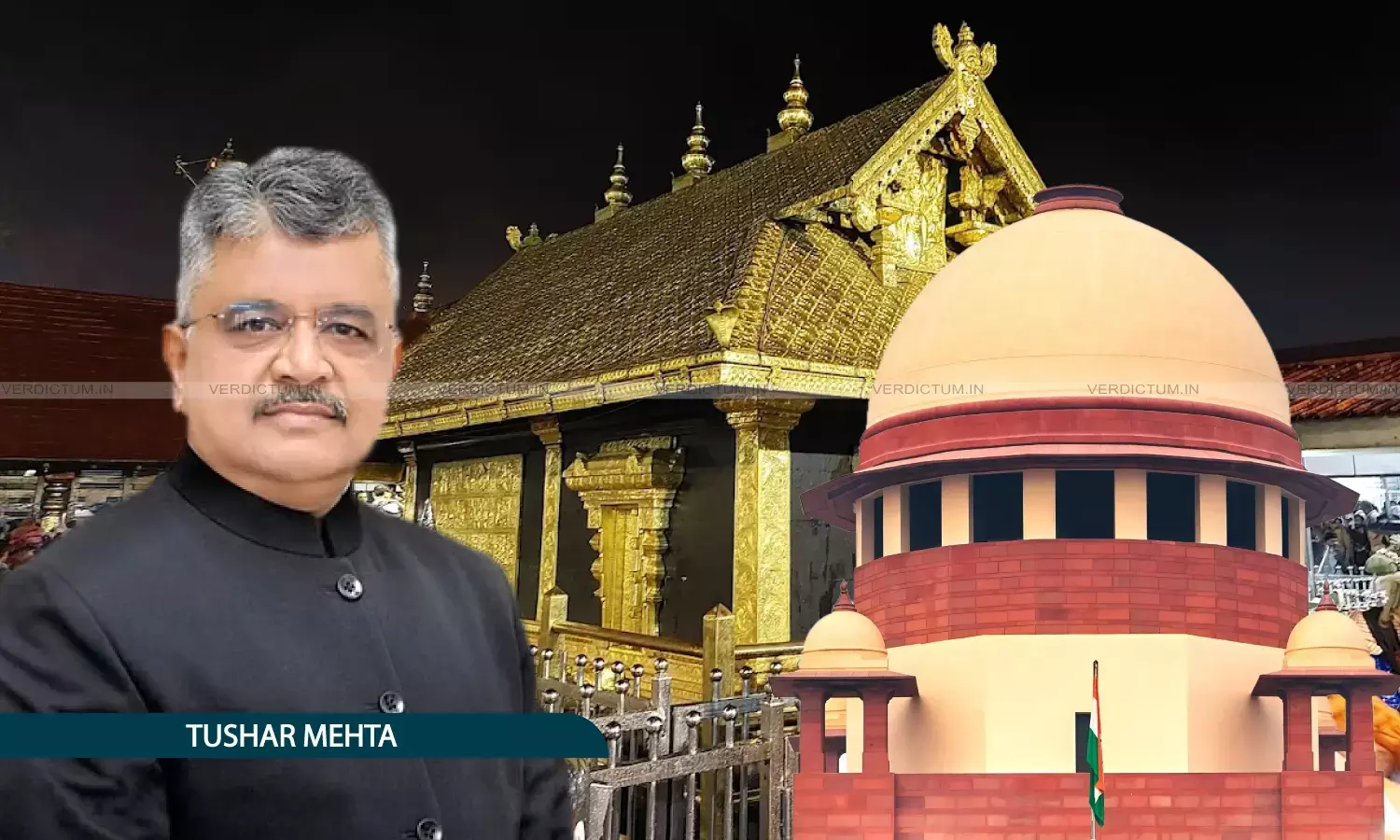
During the opening arguments of the 9-judge Bench in Sabarimala Review, Solicitor General Tushar Mehta submitted that the 2018 Sabarimala judgment was "wrongly decided" and "deserves to be declared a wrong law."
Mehta contended that while courts may verify the existence of a particular belief through judicial evidence, they lack the spiritual expertise to sit in judgment over the rationality or scientific basis of a faith’s core doctrines. He emphasized that religious practices—such as specific rituals or denominational restrictions—must be protected under the collective right to manage religious affairs, asserting that these internal tenets should not be dismantled by importing modern notions of patriarchy into a civilisational ethos that has traditionally revered the feminine.
The 9-Judge Bench comprising Chief Justice Surya Kant, with Justices B.V. Nagarathna, M.M. Sundresh, Ahsanuddin Amanullah, Aravind Kumar, A.G. Masih, R. Mahadevan, Prasanna B. Varale, and Joymalya Bagchi, was hearing review petitions and writ petitions arising out of the 2018 Sabarimala Judgment, which allowed women of all ages to enter into Lord Ayyappa's temple. The pleas were filed, inter alia, regarding the entry of Muslim women into mosques and dargahs, and the rights of Parsi women to enter Fire Temples if they have married outside their community and the legal validity of female genital mutilation within the Dawoodi Bohra community.
Solicitor General Tushar Mehta opened by stating that neither the Shirur Mutt nor the Sabarimala judgments fully explored the scope of Articles 25 and 26. He argued that the Constituent Assembly Debates provide essential, yet previously unnoticed, context for these provisions. He emphasized that Articles 25 and 26 must be interpreted through the lens of the Preamble, a perspective he claimed has been overlooked by earlier Benches. He then started his submissions on the evolution of the law involved.
While referring to Sri Venkataramana Devaruand Others vs The State of Mysore and Others (1957), Mehta submitted, "This is possibly the first and only judgment which reads Articles 25 and 26 together. What was under challenge was whether right of religious denomination guaranteed under Article 26(b) can be controlled by Article 25(2)(b)...I am not touching the Sabrimala part- right now...As My Lords are examining the questions of law, therefore not advisable to be coloured by sui generis, but though it is my case that it is wrongly decided and deserves to be declared a wrong law."
Plurality of Indian Faiths
He emphasized the sheer breadth and plurality of religions in India, noting that the country possessed a proud diversity of faiths, including Hinduism, Islam, and Christianity. He pointed out that there was significant internal plurality within each religion. While Hinduism could be described philosophically as a way of life, he stated that it functioned as a religion for constitutional purposes, containing various denominations and sub-denominations that remained referable to the broader Hindu fold.
The Solicitor General argued that similar internal plurality existed within Islam. He noted that while Islam was distinguished by a single holy book and the Prophet Muhammad, it was not a homogeneous class. He stated that the various denominations within Islam required examination to properly define what constituted a "denomination."
He further observed that a person could be an agnostic and still be a Hindu, describing Hinduism as a vast and layered structure. He listed the four Vedas, the Upavedas, the six Vedangas, and the Upangas, such as the Dharmashastra, as texts that prescribed various aspects of life. He also referenced the Puranas, the great epics, and the six recognized systems of philosophy, including Nyaya and Yoga, which traced their roots back to the Vedas.
The discussion touched upon different traditions, such as the Dashanami sampradaya, where the SG explained how specific names, tilaks, and salutations like "Alakh Niranjan" identified a person's specific category. He concluded that the "tenth category" of the religion acted as a residuary entry, encompassing non-believers, non-idol worshippers, and those who subscribed to philosophies like Charvaka, all of whom still fell within the expansive breadth of the religion.
He submitted, "Several issues arise, and the question would be whether the Court has the necessary expertise to go into these questions?...If one looks at Christianity, so there is the early Church, Eastern Orthodoxy, Roman Catholicism and Protestantism, and even within these, there are sub-denominations within a larger denomination. I have also mentioned Indian Christianity, year wise, how they have separated denominations. Here the doctrinal beliefs are safe and one holy book named as Bible, the founder is common, but there are principled differences, interpretative differences...Articles 25 and 26 can never be interpreted without looking at the Preamble. Your Lordships have consistently interpreted fundamental rights in the light of the Preamble...At least from the judgments that I have seen, and I will place some relevant paragraphs, this aspect has not been specifically noted."
"Essential Religious Practices" (ERP) Doctrine
Solicitor General argued that the doctrine of essential religious practices had been introduced unnecessarily. He questioned how a court could decide what was essential, asserting that such matters were rooted strictly in faith and belief. He submitted that determining essentiality would require a judicial review of religious scriptures, which he believed was impossible unless one attained a specific level of spiritual understanding.
He stated that neither the counsel nor the bench would be in a position to declare with certainty what the Prophet Muhammad, Lord Jesus, or the Vedas and Upanishads had said, nor how those teachings were meant to be understood. He pointed out that systems of faith and belief developed from these sources and often did not conflict with public order, morality, health, or Part III of the Constitution. Given this, he questioned how the Court could effectively examine the essentiality of a practice.
He indicated his intention to cite relevant material regarding the framing of Articles 25 and 26. He stated that he would show the historical roots of these provisions, as he believed this specific perspective had not been presented to the earlier Benches.
Gender, Patriarchy, and "Founding Mothers"
SG Tushar Mehta said, "Rajkumari Amrit Kaur and Dr. Hansa Mehta were two eminent women members of the Constituent Assembly. In this country we all have always not only treated women equally, but often at a higher pedestal. There are several recent judgments which refer to concepts such as patriarchy and gender stereotypes. I submit that these notions were not part of our civilisational ethos. We are, arguably, the only society which worships women. From the President of India to the Prime Minister, to judges of the Supreme Court, we bow before our female deities.Therefore, let us not import concepts of patriarchy and gender stereotypes into this discourse. These, I submit, were never inherent."
Justice Nagarathna said, "We call them the founding mothers of the Constitution."
"Both men and women both are equally entitled to all fundamental rights, which is taken care of in 14 and 15 (Articles 14 and 15)...it is intorduced as a religious freedom so that one religion may not take or to be understood to be given more rights than another religion...", Mehta said.
Justice Nagarathna said, "No religion is superior than the other".
"No religion is subservient...it is the manifestation of secularism...it has nothing to do with gender...", Mehta added.
Revisiting Constitutional Morality
The Solicitor General addressed the concept of "constitutional morality," characterizing it as a political doctrine that originally concerned how constitutional functionaries were expected to behave, especially during constitutional silence. He argued that while it was originally intended to define conventions for these functionaries, it had recently been moved away from its original meaning and treated as a standard for judicial review—an evolution he submitted was never the original conception.
He then shifted to the historical context of religious rights, submitting that certain provisions were era-specific and intended to ensure that sections of society previously denied the right to worship could be part of the broader Hindu fold. He argued that this inclusion had nothing to do with gender, as women were already entering temples at the time. He criticized the recent jurisprudence that sought to view every constitutional provision through a gender lens, asserting that Articles 14 and 15 already guaranteed equality and prohibited sex-based discrimination.
Regarding the phrasing of the Constitution, the Solicitor General highlighted that the word "section" was consciously introduced into Article 25 to reflect the vision of the framers. He noted that no previous judgment, including the Sabarimala decision, had adequately noticed or adverted to the expression "section thereof." He contended that the Sabarimala judgment had incorrectly denied protection under Articles 25 and 26 by concluding that the shrine was not a denomination simply because it formed part of the larger Hindu fold. To counter this, he cited examples like the Ajmer Dargah, Shirdi, and Tirupati Balaji, where people of all faiths or various Hindu traditions visit, yet the institutions remain referable to the faith of a specific section. He said that the fact that a shrine is visited by diverse groups does not mean it ceases to be a denomination entitled to constitutional protection.
Mehta submitted, "In case of Dargah Committee, 5 judges held it is a denomination, rightly held. The only problem with the dargah committee was that it introduced for the first time essential religious practice and goes to the extent of saying superstition is not protected- courts certainly can't decide...There are acts which prevent superstitions such as the Blackmagic Act etc."
Justice Amanullah said, "Are you suggesting that court may not go into the domain of Essential Religious Practice?"
Justice Bagchi remarked, "If your proposition is taken to a logical conclusion, courts are not experts in science, but evidence act empowers the court to examine the opinions of experts and becomes an expert of experts..."
Justice Sundresh added, "Probably the difference is that science is based on logic and reasoning, but religion is based on faith."
Justice Bagchi said, "There is difference between opinion on faith and faith perceived. One can have a particular faith, but whether opinion exists in that denomination is separate from the testing of what the faith itself is..it is a unique capsule which can be seen from fundamental duties. There can be a faith which scientific temper may not ravel but that may not be a question, but whether such faith existed within the members of a religious denomination can be an issue framed..."
Mehta said, "But not whether it is an essential religious practice or not."
Solicitor General argued that courts could examine the existence of a faith through evidence but could not evaluate its rationality or scientific basis. He submitted that beliefs in omnipotent powers often fall outside scientific explanation and should not be scrutinized by judicial review.
He maintained that the proper remedy for unscientific or illogical practices lay with the legislature via social reform, rather than the judiciary. He suggested that if a practice’s religious nature must be determined, it should occur in a civil suit with expert witnesses and evidence, rather than through affidavits in a writ petition.
He clarified that the court need not examine "essentiality" if a practice violates public order, morality, or health. Using human sacrifice as an example, he stated such practices could be rejected outright on those grounds alone without further religious inquiry.
When Mehta mentioned 'untouchability', Justice Nagarathna remarked, "There is no untouchability. I don't understand how Article 17, in the context of Sabarimala is being argued. Speaking as a women, there can't be a three-day 'untouchability' every month and on the fourth day, there is no untouchability...Speaking as a woman, Article 17 cannot apply for three days and then suddenly cease to exist on the fourth day."
Sabarimala as a Sui Generis Case
Solicitor General Tushar Mehta defended the restrictions at Sabarimala as a sui generis case, noting that the limitation applied only to a specific age group at one particular temple, while Lord Ayyappa temples across New Delhi and the world remained open to women of all ages. He argued that denominational practices must be respected and cannot always be tested against the touchstone of individual dignity or bodily autonomy. Drawing parallels to covering one's head at a mazaar or gurdwara, he submitted that such requirements are matters of faith rather than violations of personal choice.
Interplay between Articles 25 and 26
When questioned by Justice Nagarathna on the relevance of Article 26, the SG maintained that the temple should be recognized as a denominational institution entitled to protection. He addressed Justice Bagchi’s query regarding the absence of the "subject to other provisions" clause in Article 26, arguing that while Article 26 is not subordinate to other rights, it must be read harmoniously with Article 25.
The SG further distinguished the two provisions, explaining that Article 25 protects the "conscience" of individuals, whereas Article 26 protects the collective right of a denomination to manage its religious affairs. He said that because a denomination cannot possess a "conscience" in the individual sense, Article 26 focuses specifically on the outward manifestation and management of faith, belief, and worship.
SG Mehta analyzed the Shirur Mutt case alongside Ratilal Panachand Gandhi v. State of Bombay, noting they were delivered just two days apart by the same Bench and must be read harmoniously. He argued that Article 26(b) serves as a standalone provision, ensuring a denomination's right to manage its own religious affairs without state interference. He pointed out that the Mathadhipati (head of the Mutt) had well-defined property rights under the then-Article 19(1)(f), and the Mutt itself was recognized as a "religious denomination" under Article 26. The SG clarified that the argument to restrict "religion" to a strict sense (excluding secular activities) was originally an argument made by counsel at page 171 of the judgment, rather than a finding of the Court. He said that these precedents safeguard the core autonomy of religious institutions from overreaching secular regulations.
Solicitor General Tushar Mehta critiqued the Dargah Committee judgment for deviating from the Shirur Mutt precedent. He argued that the court erroneously replaced the concept of "integral parts of religion" with "essential parts," which invited judicial overreach by allowing courts to label certain beliefs as "superstition" and deny them protection.
He contended that what constitutes an essential part of a religion must be ascertained primarily by the doctrines of that religion itself. He emphasized that rituals—such as specific offerings of food, ceremonies at set hours, or daily recitals—remain religious in character even if they involve expenditure or the use of marketable commodities.
The SG clarified that Article 25(2)(a) allows the State to regulate economic, commercial, or political activities associated with religion, but not the religious practices themselves. He noted that while religious freedom is guaranteed, it remains subject to the limitations of public order, health, and morality.
Citing global precedents like the Jehovah’s Witnesses cases, he observed that even in countries with unrestricted religious freedom, courts have introduced limitations for social protection. He concluded that the original intent of the Indian Constitution was to protect denominational autonomy, a principle he argued was correctly upheld in Ratilal Gandhi but later diluted.
Solicitor General addressed the apparent conflict between Article 25(2)(b) and Article 26(b). He argued that this conflict must be resolved using the well-settled rule of harmonious construction, which ensures that effect is given to both provisions rather than allowing one to render the other "wholly nugatory."
He submitted that if the denominational right under Article 26(b) were treated as absolute, Article 25(2)(b) would become meaningless in its application to denominational temples. Conversely, if the right to temple entry under Article 25(2)(b) is upheld, full effect can still be given to Article 26(b) in all other religious matters. Therefore, he said that while Article 26(b) protects the general management of religious affairs, it must be read subject to the specific mandate of Article 25(2)(b) regarding the right of entry for worship.
Justice Sundresh remarked, "In a ligher vein, the bench could have probably decided what is public character, it would have really resolved the issue..."
Justice Bagchi said, "Mr Solicitor, please enlighten us on this Article 26(b) subject to other provisions of this part but sub-clause 2 does not have this subordinate clause, but sub-clause 2 is only an enabling provision. we know the idea of gurudnorm, fundamental right provision had higher prerogative than statutory enactment. If you see clause 2 from that perspective, non-obstante is 'nothing in this article' which is Article 25 and not Article 26. Whether a law made in enabling scope of clause 2(b) could not be tested envail on Article 26?"
Solicitor General remarked, "My worry is this, it is in isolation then something which is horribly wrong or shakes the conscience of the legislature, then making Article 26 absolute would thwart reformative actions also."
The hearing was over and will be continued tomorrow, i.e. April 8, 2026.
On February 16, the Court passed an order for commencing the 9-judge bench for the hearing of the issues referred in the Sabarimala review from April 7, 2026.
Written Submissions by the Parties
The State of Kerala has filed its submissions in the matter. It has been said that any judicial interference into long-standing religious practices must only occur after wide-ranging consultations with eminent religious scholars and reputed social reformers of that specific faith.
It was also said that a person not belonging to a religious denomination or religious group has sufficient interest in questioning a practice of that religious group or religious denomination by way of a public interest litigation.
The Travancore Devaswom Board (TDB) has also filed its Written Submissions in the Sabarimala case and has submitted before the Supreme Court that the Court is bound to accept the belief of the community, and it is not for the Court to sit in judgment on that belief.
The All India Muslim Personal Law Board has submitted that religions may have different practices related to different aspects within the same religion, and the courts must not attempt to judicially determine the nature of religious practices.
The Akhil Bhartiya Sant Samiti moved an intervention application seeking to safeguard the "lived realities" of Hindu traditions from judicial overreach. The Samiti, representing 127 sects of Sanatan Dharma, contended that secular courts lack the specialized expertise to determine "Essential Religious Practices" and argued that the fundamental right to equality under Article 14 cannot be used to dismantle the specific protections granted to religious faith under Article 25.
Cause Title: Kantaru Rejeevaru Vs Indian Young Lawyers Association; Sabarimala Custom Protection Forum Vs Indian Young Lawyers Association [R.P.(C) No. 3358/2018 in W.P. (C) No. 373/2006]