

Breaking| Supreme Court's Nine Judges Bench To Hear Review Of 2018 Sabarimala Judgment From April 7
During the hearing today, the Union stated that it is supporting the review petition in the Sabarimala case and opposing the entry of women into the temple.

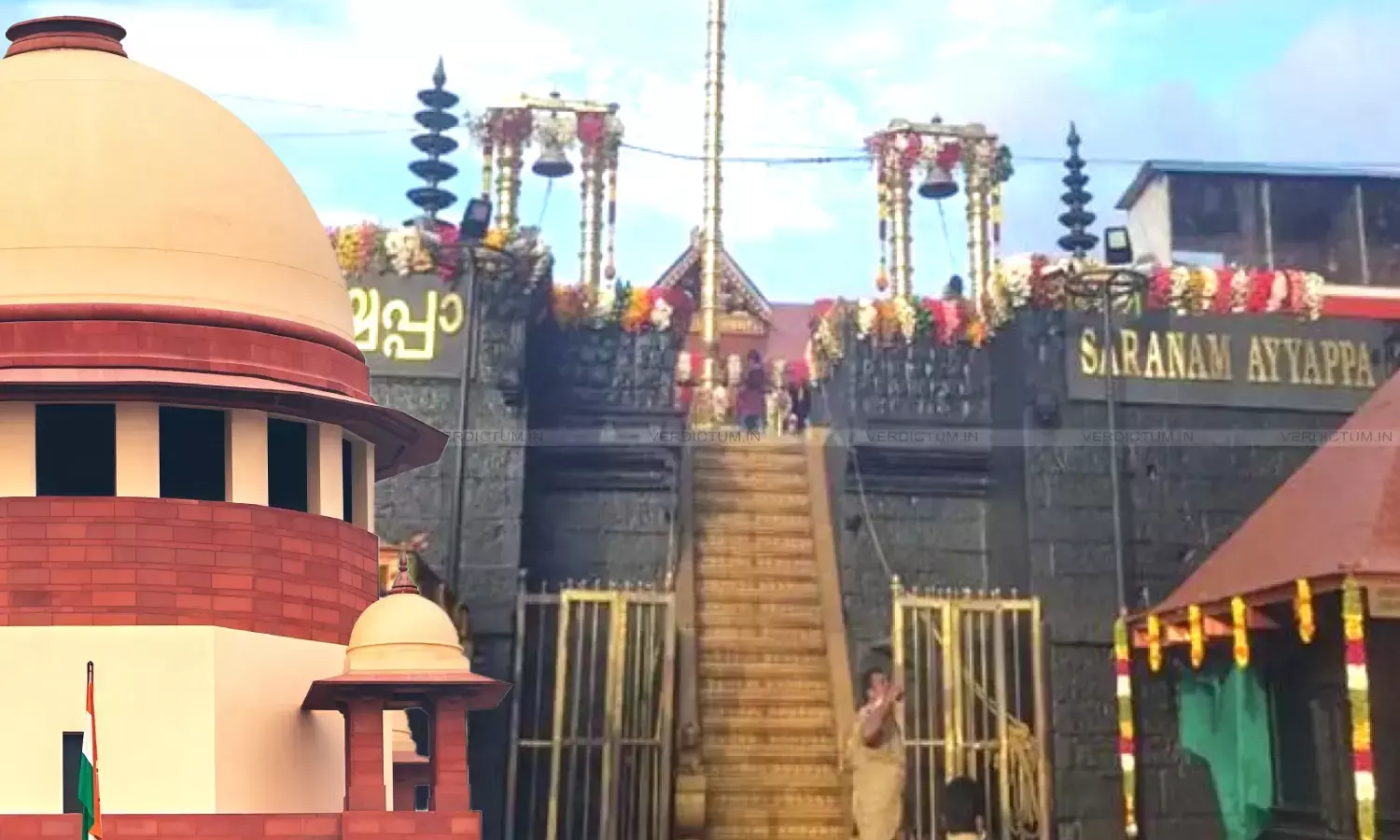
The Supreme Court, today, passed an order for commencing the 9-judge bench for the hearing of the issues referred in the Sabarimala review from April 7, 2026.
The Court was hearing review petitions and writ petitions arising out of the 2018 Sabarimala Judgment, which allowed women of all ages to enter into Lord Ayyappa's temple. The pleas were filed, inter alia, regarding the entry of Muslim women into mosques and dargahs, and the rights of Parsi women to enter Fire Temples if they have married outside their community and the legal validity of female genital mutilation within the Dawoodi Bohra community.
The Bench of Chief Justice Surya Kant, Justice Joymalya Bagchi and Justice Vipul M Pancholi said, "Objections were then raised to maintainability of the reference, which issue was conclusively determined by this court in February 2020, whereby the 9-judge Bench opined that this Court can refer questions to a larger Bench even in Review. Accordingly, the issue of the maintainability of reference has attained finality and need not detain us at this stage. That being so,...we may advert to the subsequent order dated 10.02.2020 passed by this Court, framing the following 7 questions to be determined by a 9-judge Bench...In this light, and with a view to finally laying to rest the questions of law that remain pending in these matters, we direct the parties to file their written submission on or before 14.03.2026...The 9-judge bench will begin hearing the Sabarimala Review Case on April 7, 2026, at 10:30 am. The review petitioners or the party supporting them shall be heard from April 7 to April 9."
Senior Advocate Abhishek Manusinghvi, Senior Advocate Maneka Guruswamy appeared for Petitioners supporting the entry of women in the Temple, Solicitor General Tushar Mehta appeared for the Union of India, and Senior Advocate Jaideep Gupta appeared for the State of Kerala.
The Court ordered, "The ones opposing the review shall be heard on April 14 to April 16. The rejoinder submissions, if any, will be heard on April 21, 2026, followed by the final and concluding submissions by the amicus, which is expected to be over by April 22. The parties shall adhere to the above time schedule. The nodal counsels in consultation with arguing counsel of the parties shall prepare the internal arrangement so that oral submissions from both sides can be heard within the stipulated timeline."
The court has set a timeline for the legal arguments and directed all parties involved to file their written submissions by March 14, 2026.
"Objection to maintainability was overruled. Questions are formulated...we will provide continuous hearing...if all of you say that matters are overlapping and are required to be heard together...we will do that...We will start one by one. We will take at serial no. 2 and provide continuous hearing", Chief Justice Kant said.
"We are supporting the review", Solicitor General Tushar Mehta said.
Senior Advocate CS Vaidyanathan said, "I am also supporting the review."
Senior Advocate Abhishek Manusinghvi said, "I suggest the parties should be one supporting the entry of women and the ones opposing the entry of women."
The Court ordered, "Mr Krishan Kumar Singh will be nodal counsel on behalf of the review petitioners. AOR Shivam Singh to assist Amicus K Parmeswar. Mr Shivam Singh shall prepare the written submissions keeping the stand taken by all parties. A 9-judge bench to be constituted by the Chief Justice through administrative order shall commence hearing on 7 April at 10.30 AM."
The Court also remarked that the 9-judge bench hearing is "more important than anything else" and instructed lawyers to clear their calendars for these dates.
Background
The Sabarimala issue, centred on the prohibition of women of "menstruating age" (10 to 50 years) from entering the Ayyappa shrine in Kerala, traces its origins back to centuries of oral tradition and custom. In 1991, the Kerala High Court upheld the restriction, ruling that the ban was a long-standing tradition and did not violate the Constitution. This remained the status quo for fifteen years until the Indian Young Lawyers Association filed a petition in the Supreme Court in 2006, arguing that the practice was discriminatory, violated the right to equality under Article 14, and infringed upon the right to worship under Article 25.
After years of shifting stances from various Kerala state governments, the Supreme Court referred the matter to a five-judge Constitution Bench in 2017. On September 28, 2018, the Court delivered a landmark 4:1 verdict striking down the ban. The majority opinion, led by then-CJI Dipak Misra, declared that "patriarchy cannot be allowed to trump devotion." However, Justice Indu Malhotra provided a lone, powerful dissent, suggesting that "notions of rationality cannot be invoked in matters of religion" and that the court should not interfere in the internal affairs of a religious community.
On January 2, 2019, when two women, Bindu Ammini and Kanakadurga, successfully entered the shrine under police protection, leading to widespread strikes and a purification ritual by the temple priests.
In 2019, in response to over 60 review petitions, the Supreme Court decided to refer the matter to a larger 9-judge bench. This bench was tasked with examining not just Sabarimala, but broader questions regarding the "essential religious practices" of various faiths, including women’s entry into mosques and the practice of female genital mutilation. In January 2020, the Supreme Court officially formed a 9-judge Constitution Bench to address the broader legal questions arising from the Sabarimala case.
The Court framed 7 issues for consideration:
"1. What is the scope and ambit of right to freedom of religion under Article 25 of the Constitution of India?
2. What is the inter-play between the rights of persons under Article 25 of the Constitution of India and rights of religious denomination under Article 26 of the Constitution of India?
3. Whether the rights of a religious denomination under Article 26 of the Constitution of India are subject to other provisions of Part III of the Constitution of India apart from public order, morality and health?
4. What is the scope and extent of the word 'morality' under Articles 25 and 26 of the Constitution of India and whether it is meant to include Constitutional morality?
5. What is the scope and extent of judicial review with regard to a religious practice as referred to in Article 25 of the Constitution of India?
6. What is the meaning of expression "Sections of Hindus" occurring in Article 25 (2) (b) of the Constitution of India?
7. Whether a person not belonging to a religious denomination or religious group can question a practice of that religious denomination or religious group by filing a PIL?"
Cause Title: Kantaru Rejeevaru Vs Indian Young Lawyers Association; Sabarimala Custom Protection Forum Vs Indian Young Lawyers Association [R.P.(C) No. 3358/2018 in W.P. (C) No. 373/2006]