

Consultation With Religious Scholars Must Precede Judicial Review Of Religious Practices: Kerala Tells Supreme Court In Sabarimala Case
The State's written submission argues that the "essentiality" of a practice is not a matter to be tested by modern reason alone, but by the deep-seated beliefs of the community.

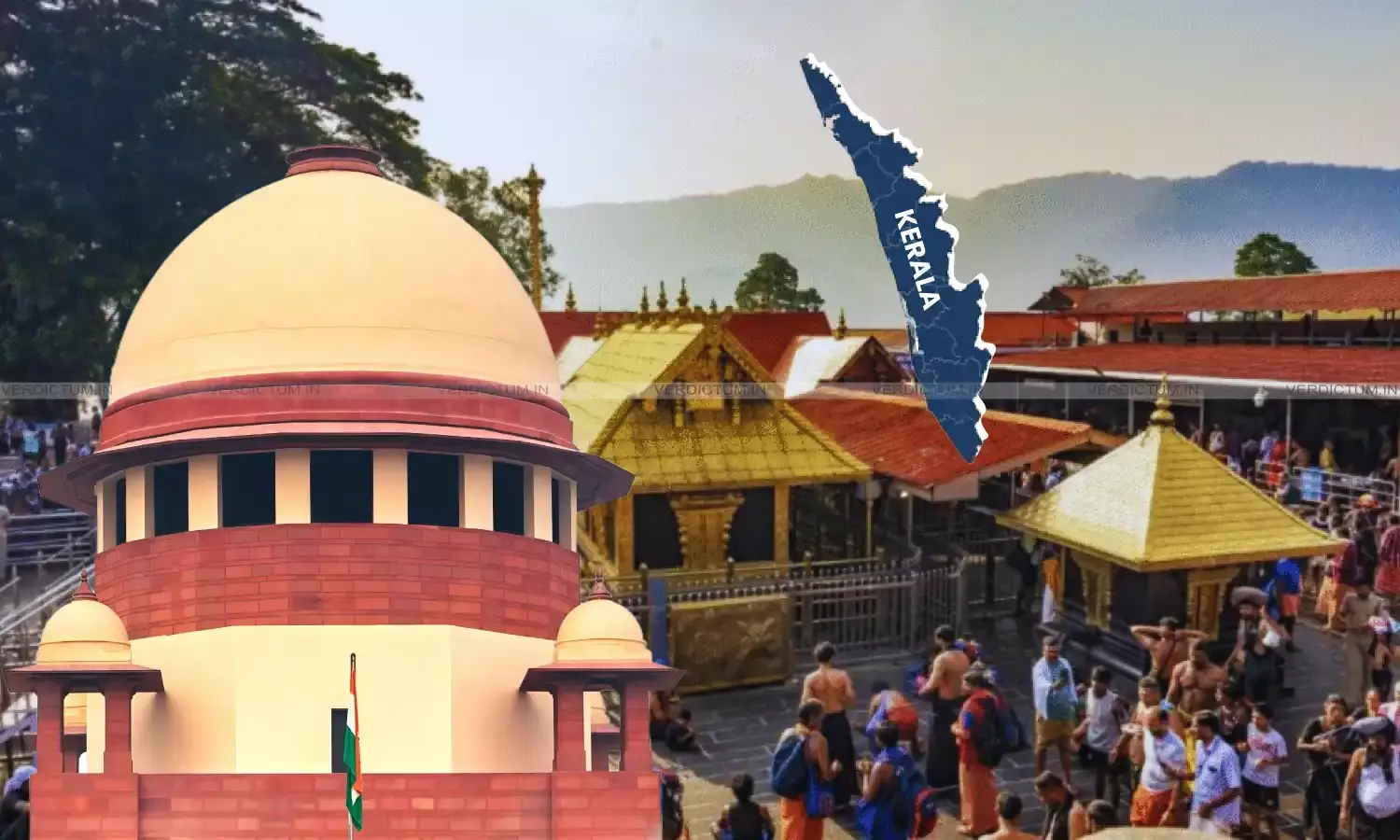
The State of Kerala has recently filed its written submission in the Sabarimala review and submits that any judicial interference into long-standing religious practices must only occur after wide-ranging consultations with eminent religious scholars and reputed social reformers of that specific faith.
The Supreme Court has recently passed an order for commencing the 9-judge bench for the hearing of the issues referred in the Sabarimala review from April 7, 2026. The Court will hear review petitions and writ petitions arising out of the 2018 Sabarimala Judgment, which allowed women of all ages to enter into Lord Ayyappa's temple.
The State emphasizes that the "essentiality" of a practice should be judged by the sincere beliefs of the community rather than purely through the lens of modern reason or sentiment.
For the issue of the scope and extent of judicial review with regard to a religious practice as referred to in Article 25, the State submits, "The State of Kerala is of the considered opinion that what is to be considered by the Court, in the matter of a Judicial review with regard to Article 25, should not be as to whether a particular religious practice or belief appeals to reason or sentiment, but should be as to whether the belief is genuinely and conscientiously held as part of the profession or practice of religion. Therefore, it would be expedient in the interests of justice that, as stated in paragraph 4 of the counter affidavit dated 13.11.2007, inter alia, for and on behalf of the State of Kerala, any judicial review in to any religious practice followed for so many years connected with the belief and values accepted by the people must be after wide consultation with and after soliciting views of eminent religious scholars and reputed social reformers of that religion. A decision in this regard should be rendered by the court after assessing the opinions of social reformers and religious scholars as an impartial authority. Previous experience in the matter of Sabarimala shrine and the response of devotees including women devotees would support the above submission."
The State argues that the court’s role is not to determine if a practice "appeals to reason," but to verify if the belief is "genuinely and conscientiously held" as an integral part of the religion. The State suggests that any judicial review of long-standing religious practices should only occur after wide consultation with eminent religious scholars and reputed social reformers acting as impartial authorities.
The State has previously, vide its counter affidavit, submitted, "Thus, Government is of the opinion that nobody should be prohibited from their right to worship, but considering the fact that the matter of entry to Sabarimala is a practice followed for so many years and connected with the belief and values accepted by the people and since there is a binding High Court judgment in this regard, Government felt that this Hon’ble Court may be requested to appoint an appropriate commission consisting of eminent scholars with authentic knowledge in Hinduism and reputed and uncorrupt social reformers to submit suggestions/views on the issue whether it is open to all women, irrespective of their age to enter the temple and make worship."
Later, an additional affidavit was also filed on behalf of the State of Kerala stating, inter alia, to the effect that the Writ Petition, seeking to change the beliefs and customs of devotees, was wholly misplaced and liable to be dismissed.
As regards the issues of the scope and ambit of right to freedom of religion under Article 25 of the Constitution of India, the State submitted, "The right guaranteed under Article 25 is an individual right, which, as no other fundamental right is, can be termed to be absolute. It cannot encroach upon the similar right of another person...The restrictions which may be imposed by the State upon right guaranteed by Article 25 are those imposed on the grounds of (i) public order, morality and health; (ii) other provisions of Part III of the Constitution; (iii) regulating non-religious activity associated with religious practice; (iv) social welfare and reform; (v) throwing open Hindu religious institutions of a public character to all classes of Hindus. It is no more res integra that the principle that has to be borne in mind, while interpreting Article 25, is to the effect that the real test of a true democracy is the ability of even an insignificant minority to find its identity under the country’s Constitution... The religious freedom guaranteed by Article 25 extends to acts done in furtherance of religion and contain a guarantee for rituals and observances, ceremonies and modes of worship, which are integral part of the religion."
While Article 25 guarantees individual freedom, the State clarifies that religious denominations under Article 26 cannot use their autonomy to bypass state laws intended for social welfare, reform, or the opening of public Hindu institutions to all classes.
It was submitted that in so far as the power of a State to make law to regulate or restrict any economic, financial, political for other secular activities which may be associated with (any) religious practice or providing for social welfare and reform or the throwing open Hindu religious institutions of a public character is not limited respectively to religious practices of individuals alone and entry to Hindu religious institutions other than those belonging to denominations or sections thereof, such laws are binding on religious practices of denominations also as well as entry to Hindu religious institutions of public character of denominations or sections thereof and they will not be able to take shelter under Article 26 for avoidance of the provisions of such laws.
The State of Kerala also submits its arguments regarding the issue of whether a person not belonging to a religious denomination or religious group can question a practice of that religious denomination or religious group by filing a PIL. It says that it cannot be stated as a rule that the followers of a religion or practitioners of a religious practice will always be socially disadvantaged.
"As stated above, the essentiality of a religious practice has to be primarily tested with regard to the tenets of that religion. it may not be a matter susceptible to adjudication by scales of it being appealing to reason or sentiment, but should be as to whether the belief is genuinely and conscientiously held as part of the profession or practice of religion. In deciding the question as to whether a given religious practice is an integral part of the religion or not, the test normally should be as to whether it is regarded as such by the community following the religion or not. In the aforementioned circumstances, it may not normally be held that a person not belonging to a religious denomination or religious group has sufficient interest in questioning a practice of that religious group or religious denomination by way of a public interest litigation, in relaxation of the principles of locus", it submits.
The State concludes by saying that in the matter of the gravest Human Rights violation being conducted in the name of religious practice, it can be said that a person not belonging to that religious denomination or religious group has sufficient interest to question such a 'religious practice'
The State highlights that a true democracy is measured by the ability of even "insignificant minorities" to find their identity and protect rituals, ceremonies, and modes of worship that are integral to their faith. Kerala contends that because religious practices are rooted in the tenets of the faith and the community's perception, an outsider—someone not belonging to that specific denomination—may not typically have "sufficient interest" or locus standi to challenge those practices.
Background
The Sabarimala issue, centred on the prohibition of women of "menstruating age" (10 to 50 years) from entering the Ayyappa shrine in Kerala, traces its origins back to centuries of oral tradition and custom. In 1991, the Kerala High Court upheld the restriction, ruling that the ban was a long-standing tradition and did not violate the Constitution. This remained the status quo for fifteen years until the Indian Young Lawyers Association filed a petition in the Supreme Court in 2006, arguing that the practice was discriminatory, violated the right to equality under Article 14, and infringed upon the right to worship under Article 25.
After years of shifting stances from various Kerala state governments, the Supreme Court referred the matter to a five-judge Constitution Bench in 2017. On September 28, 2018, the Court delivered a landmark 4:1 verdict striking down the ban. The majority opinion, led by then-CJI Dipak Misra, declared that "patriarchy cannot be allowed to trump devotion." However, Justice Indu Malhotra provided a lone, powerful dissent, suggesting that "notions of rationality cannot be invoked in matters of religion" and that the court should not interfere in the internal affairs of a religious community.
On January 2, 2019, when two women, Bindu Ammini and Kanakadurga, successfully entered the shrine under police protection, leading to widespread strikes and a purification ritual by the temple priests. In 2019, in response to over 60 review petitions, the Supreme Court decided to refer the matter to a larger 9-judge bench. This bench was tasked with examining not just Sabarimala, but broader questions regarding the "essential religious practices" of various faiths, including women’s entry into mosques and the practice of female genital mutilation.
In January 2020, the Supreme Court officially formed a 9-judge Constitution Bench to address the broader legal questions arising from the Sabarimala case.
The Court framed 7 issues for consideration:
"1. What is the scope and ambit of right to freedom of religion under Article 25 of the Constitution of India?
2. What is the inter-play between the rights of persons under Article 25 of the Constitution of India and rights of religious denomination under Article 26 of the Constitution of India?
3. Whether the rights of a religious denomination under Article 26 of the Constitution of India are subject to other provisions of Part III of the Constitution of India apart from public order, morality and health?
4. What is the scope and extent of the word 'morality' under Articles 25 and 26 of the Constitution of India and whether it is meant to include Constitutional morality?
5. What is the scope and extent of judicial review with regard to a religious practice as referred to in Article 25 of the Constitution of India?
6. What is the meaning of expression "Sections of Hindus" occurring in Article 25 (2) (b) of the Constitution of India?
7. Whether a person not belonging to a religious denomination or religious group can question a practice of that religious denomination or religious group by filing a PIL?"
Cause Title: Kantaru Rejeevaru Vs Indian Young Lawyers Association; Sabarimala Custom Protection Forum Vs Indian Young Lawyers Association [R.P.(C) No. 3358/2018 in W.P. (C) No. 373/2006]