

Not A Valid Ground For Judicial Review: Centre Attacks Doctrine Of Constitutional Morality, Calls It 'Vague Concept' Capable Of Elastic Interpretation
In Sabarimala Reference, Tushar Mehta argued that the Court's reliance on foreign academic theories to define judicial review is a "hazardous" departure from the Constitution's text.

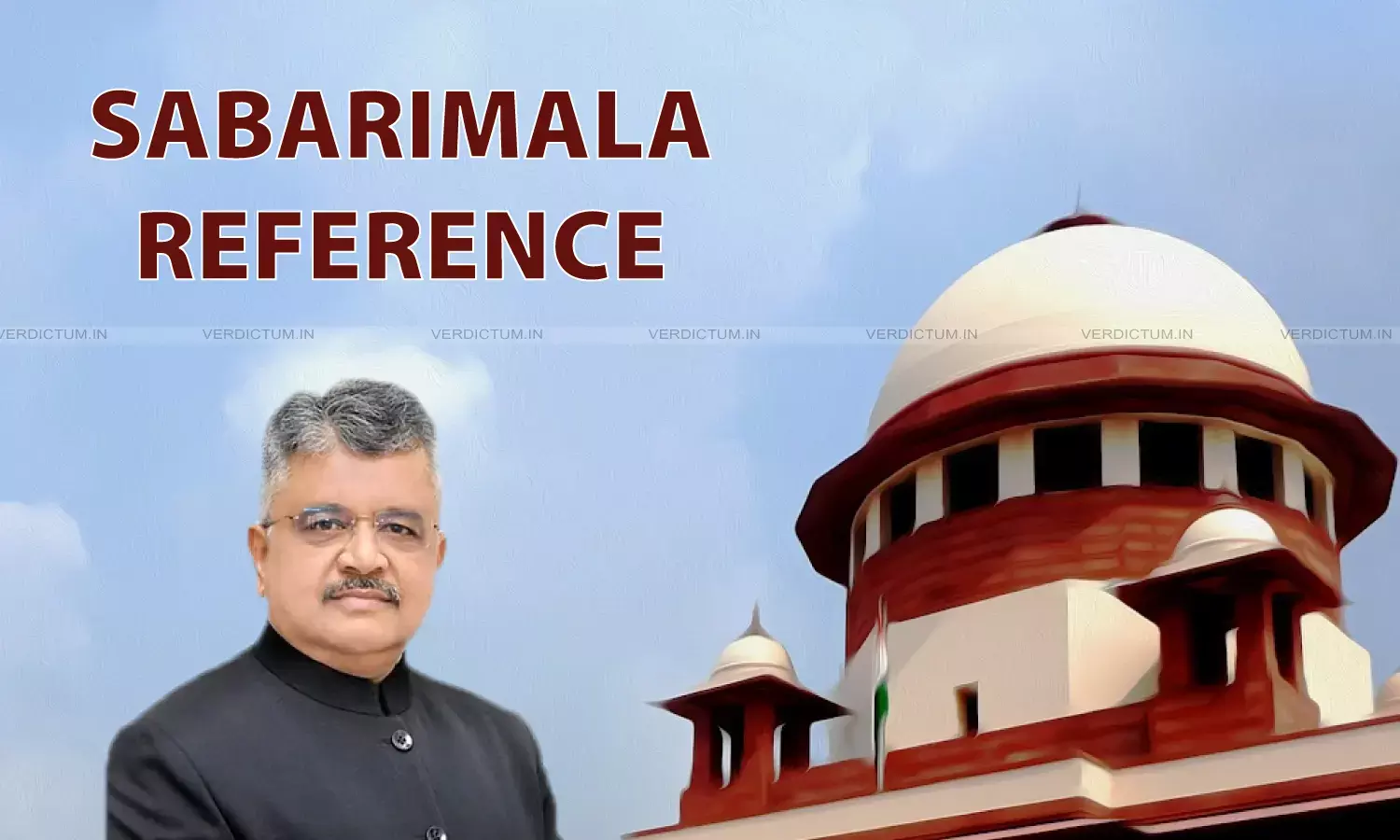
On the second day of the landmark Sabarimala reference hearing, Solicitor General Tushar Mehta called for total abandonment of the "Constitutional Morality" doctrine as a basis for judicial review.
He argued that the Courts should never test, either a legislative enactment or an administrative act, based on vague concepts that are capable of elastic interpretation, which is both subjective and individualistic.
Mehta contended that the 2018 Sabarimala verdict was rooted in a fundamental legal error. He argued that the term "morality" within Article 25 of the Constitution refers strictly to public or societal morality rather than the "vague and subjective" standard of constitutional morality, which he categorized as a convention for government functionaries rather than a tool to override sincere religious faith.
The 9-Judge Bench comprising Chief Justice Surya Kant, with Justices B.V. Nagarathna, M.M. Sundresh, Ahsanuddin Amanullah, Aravind Kumar, A.G. Masih, R. Mahadevan, Prasanna B. Varale, and Joymalya Bagchi, was hearing the issue: "What is the scope and extent of the word 'morality' under Articles 25 and 26 of the Constitution of India and whether it is meant to include Constitutional morality?"
By reading from the Constituent Assembly Debates, Mehta emphasized that Dr Ambedkar and the framers never intended for such a vague concept to be used to strike down enactments or religious practices.
Mehta said, "All judgments refer to the speech of Dr Ambedkar on 4th of November to test the Constitution Morality as a part of the Constitution of India...it is part of the Constitution, I am not saying that, but whether it is a test to examine the validity of a statute or an examination of the validity of an executive action."
"A large number of decisions are coming from the High Courts and this Court stating that [an act] is violative of constitutional morality. It is a subjective term. I am not taking sides, but something that constitutes constitutional morality in a particular provision for one Hon’ble Judge may perhaps not be so for another Judge. Therefore, your Lordships should never test either a legislative enactment or an administrative act based on vague concepts that are capable of elastic interpretation, which is both subjective and individualistic", he added.
During the hearing, Justice Bagchi proposed a dual-morality framework: while Constitutional Morality governs secular life, Societal Morality (informed by religious philosophy and cultural ethos) should govern the religious sphere. He questioned whether a secular democracy should force these two distinct identities—the citizen as a secular actor and the citizen as a believer—to be tested against the single, rigid standard of Constitutional Morality, especially if a practice is socially accepted and culturally consistent.
Solicitor General responded with a sharp rejection of the "Constitutional Morality" doctrine entirely. He argued that it is not a valid ground for judicial review, citing the view of a former Attorney General who described it as an "unfortunate concept" that should be discarded.
He said, "Constitutional morality is not a ground for judicial review. Our former AG has said that it is an unfortunate concept and must die as soon as possible."
Solicitor General said that the doctrine of Constitutional Morality in the 2018 Sabarimala verdict was a fundamental legal error. He contended that the terms "public order, morality, and health" in Article 25 must be understood as public morality—the shared values and ethical standards of a society—rather than the "vague and wrongly applied" concept of constitutional morality.
Mehta argued that Constitutional Morality is a principle belonging to political science, intended to guide how government functionaries behave (such as whether an official facing criminal charges should resign). He maintained that while these may be important constitutional conventions, they do not constitute a valid legal ground for a court to exercise judicial review over religious faith.
The Solicitor General anchored his arguments in the Constituent Assembly Debates, asserting that the "morality" mentioned in Article 25 refers strictly to societal morality—the shared ethical values of the community—rather than the abstract "constitutional morality" used in the 2018 Sabarimala verdict.
The SG specifically critiqued the 2018 Sabarimala judgment for dismissing societal values as "mob morality." He argued it is "absurd" for a court to tell a believer that their harmless faith is irrelevant simply because it doesn't align with a judge's interpretation of constitutional morality. He submitted that if a religious practice does not harm society or violate public order, the court should not use a subjective moral framework to override the sincere faith of millions.
He said, "Sabrimala continuously proceeds on the ground that morality means constitutional morality and social morality is only mob and therefore what is necessary is constitutional morality-therefore I am saying that as understood by constitutional framers, it is societal morality... Sabarimala says individual freedom, dignity, will take precedence over social interest because what is societal morality is merely mob morality."
When SG referred to State of Maharashtra v. India Hotel Association to discuss the concept of 'Morality', Justice BV Nagarathna remarked, "With the passage of time in Indian Society, what was considered to be immoral or obscene, no longer considered as immoral or obscene. That is the problem of India now...this is the problem in India...See the standard which were there in the 50s are not the standard here...You said the standards of 50s were narrow-minded, IT WAS NOT!...Narrow-minded cannot be the criticism...criticism now is it is narrow-minded, myopic, old-fashioned etc. This is the problem of Indian society."
Mehta replied, "That is transformative constitutionalism, which I have not been able to understand. I have been listening to this for some years, but in my limited understanding, I couldn't understand."
Justice Nagarathna said, "We are not on transformative constitutionalism, it's good for the constitution, you said public morality is also not stastic- that is what I tried to say."
He traced the emergence of this "new trend" back to the Naz Foundation case (Delhi High Court) and its eventual affirmation in Navtej Singh Johar. While those cases dealt with private consensual acts, Mehta argued that transplanting this doctrine into the realm of religious traditions—as seen in the Sabarimala judgment—is legally hazardous. He submitted that judicial review must be anchored in fixed constitutional text rather than fluid, subjective moralities that shift from one judge to the next.
Mehta argued that in a democracy, laws are inherently an expression of the "majoritarian will" because they are passed by elected representatives. He used this to challenge the idea of a judicially-defined "morality," questioning how the Court can impose an abstract moral standard that contradicts the laws enacted by the majority.
Mehta submitted that in cases like Navtej Johar, the doctrine was used to expand individual liberties. However, he contended that in Sabarimala, it was used as an "external yardstick" to dismantle a collective religious tradition. He urged the 9-judge Bench to examine Justice Chandrachud’s view, arguing that it essentially replaced the "morality" of the community with a judicial interpretation of "transformative" constitutional values, which he claims is a subjective and legally hazardous standard for reviewing faith-based practices.
Mehta addressed the specific limitations placed on religious freedom under Article 25(1). He noted that while the right is subject to "public order, morality, and health," neither public order nor public health is at risk by allowing women of the age group of 10 to 50 years into the Sabarimala temple. The core of the legal dispute, therefore, rests entirely on the interpretation of "morality."
Mehta argued that the term "public morality" must be understood through the unique history of the Indian Constitution. Because the Constitution was not imposed by an external force but was "adopted and given by the people to themselves," the values of the people and the values of the Constitution are inextricably linked. He submitted that public morality should be seen as synonymous with constitutional morality.
Solicitor General argued that a critical shift has occurred in Indian jurisprudence where "social morality"—the grounded ethical standards of the community—is being systematically replaced by the "vague term" of constitutional morality. He contended that the courts have begun imbuing this term with meanings that it historically never possessed.
By reading from the Navtej Singh Johar judgment (which decriminalized Section 377), Mehta illustrated how the doctrine of constitutional morality was elevated to a primary legal standard. His concern, however, is that while this doctrine may serve a purpose in protecting private individual liberties, its expansion into the realm of Article 26 allows courts to use an ill-defined and subjective yardstick to override the collective rights and sincere beliefs of religious denominations.
He expressed a deep professional and personal concern regarding the language used in the Joseph Shine judgment, specifically as it pertains to the standard of judicial review. While he clarified that he had no issue with the actual striking down of the adultery provision, he questioned the "doctrinal scope" the judgment gave to Constitutional Morality.
He specifically pointed to the judgment's use of the phrase "the woman question" in the context of sexual choice. Admitting a "limited understanding," he questioned how such a phrase could serve as a clear "statement of law." He suggested that while the Court likely intended to address "gender questions" or "gender justice," the use of such evocative, non-legal terminology introduces a level of subjectivity that makes it difficult for a lawyer to assist the court or predict legal outcomes.
He cited the inclusion of Katherine T. Bartlett’s "Feminist Legal Methods" in the Joseph Shine judgment by former Chief Justice DY Chandrachud. He pointed out that by quoting a Harvard Law Review article to define the standard of review, the Court has effectively elevated a specific feminist academic theory to the status of a law under Article 141, which now binds 1.4 billion Indians.
Mehta argued that this represents a dangerous departure from the Constitution’s text, replacing the "common morality" of the nation with a scholarly interpretation of constitutional morality that may not reflect the values of the broader populace.
Mehta contended that this reliance on external academic sources was directly mirrored in the Sabarimala verdict to justify the striking down of age-old traditions. He highlighted how the Court used Bartlett’s definition—which prioritizes an "indispensable" set of rights like non-discrimination and dignity over historical or common morality—to override the collective rights of the religious denomination. In his view, using such specialized academic frameworks to interpret the Constitution bypasses the democratic and representative nature of Indian law-making, leading to a "scholar-driven" jurisprudence rather than a "text-driven" one.
By asking the 9-judge Bench to review these passages, the SG is challenging the legitimacy of using "Transformative Constitutionalism" as a tool to restructure religious institutions. He maintained that while the pursuit of dignity and equality is vital, these goals must be achieved within the specific boundaries of Articles 25 and 26 as understood by the framers. He said that the current trend of using international academic theories to define "Constitutional Morality" creates an unpredictable legal environment where the sincere faith of citizens is subjected to the intellectual preferences of the presiding Bench.
He highlighted a specific concern regarding the sources the Court now relies upon to define Indian law. He pointed out that academic articles written by foreign individuals—some of whom he described as "unknown" in the Indian context—are being integrated into Supreme Court judgments as binding "statements of law." The Chief Justice even remarked on the trend, noting that scholars like Reva Siegel are being quoted as if they were a "second Ambedkar." Mehta argued that these academic views, once adopted under the banner of Constitutional Morality, bind 1.4 billion people despite originating from outside the Indian constitutional framework.
CJI said, "Seigal (Reva Siegel) has been quoted like second Ambedkar."
Mehta stated, "Articles of some unknown and becoming part of the judgment bind us and are accepted and followed by your lordships on grounds of constitutional morality. He is a practising lawyer in America."
Mehta then turned to a specific passage in the Joseph Shine judgment regarding the decriminalization of adultery. He noted the Court’s reasoning that even if adultery is considered "unconventional" or "unpopular" in society, it is protected by the right to privacy. The judgment suggests that the freedom to make choices includes the freedom to make choices that society deems immoral.
He highlighted that the Court drew this logic from Justice Blackmun’s dissent in Bowers v. Hardwick (a 1986 US Supreme Court case). Mehta’s critique was twofold: 1. He questioned the appropriateness of basing Indian fundamental rights on dissenting opinions from foreign jurisdictions. 2. He expressed concern that by defining "private choice" so broadly, the Court is elevating individual autonomy to a point where it can override the "common morality" that sustains social institutions like marriage or religious denominations.
CJI said, "Subjective view point of a professor, some writer whosoever may be, we have no fair idea about this, his eminence, but ultimately as such is not under question."
Justice Bagchi said, "What the Hon'ble Chief Justice is indicating, these are observations of one of the Hon'ble Justices, but the ratio based on which Joseph Shine declared adultery...It is an issue of gender discrimination where equality in general has not been respected in the law, women have been deemed to be property, not being sui generis...this is the fundamental ratio as we read it."
Justice Nagarathna remarked, "You can say the enforcement of fundamental rights need not be on the touchstone of Constitutional Morality. Constitutional morality is in the realm of constitutional governance; it is not in the realm...Need not be palatable to you, but it's not a subject matter as such."
Mehta, then, submitted, "There is something very serious, and I have a very serious objection. Nivedita Menon is quoted, JNU professor, known for her views that 'Indian state is illegally occupying two states'. I am not going into it but it has the status of being a part of SC judgment, which is a court of record..."
Chief Justice said, "If professors who have nothing to do with indian society have occupied so much space, what is wrong with an indian professor?"
Justice Nagarathna said, "Even without all this, the validity of the section could have been."
Mehta said, "I am not on validity; it remains invalid."
Solicitor General challenged the logic that views marital fidelity as a "patriarchal conception" used to shackle women’s agency. He argued that the expectation of fidelity is not gender-specific, stating, "It applies to me also, it applies to men also."
By framing fidelity as a mutual moral commitment rather than a tool of patriarchal control, Mehta sought to demonstrate that the Joseph Shine judgment—and by extension Sabarimala—used the "vague" doctrine of Constitutional Morality to delegitimize traditional social and religious values.
Chief Justice countered by focusing on the legal mechanics of the struck-down law. He noted that Section 497 was inherently unconstitutional because it was a "one-sided offence"—it punished the third-party man but not the woman, and it only allowed the husband of the woman to complain, treating the wife as property.
Mehta stated, "Fidelity out of marriage is termed by this Hon'ble court, which is a court of record, as a shackling of sexuality? I am arguing between social v constitutional morality- this is not the jurisprudence of our country."
The Solicitor General concluded his submissions on 'Constitutional Morality', and the hearing in the Sabarimala reference is continuing before the 9-JB Bench.
Cause Title: Kantaru Rejeevaru Vs Indian Young Lawyers Association; Sabarimala Custom Protection Forum Vs Indian Young Lawyers Association [R.P.(C) No. 3358/2018 in W.P. (C) No. 373/2006]