

There Is No Need To Attack Power Of Judicial Review: CJI Tells Senior Adv J Sai Deepak After He Submits That Courts Shouldn't Preside Over Codified Religious Practice
Senior Advocate J Sai Deepak appeared for the Pandalam Family and various devotee organisations.

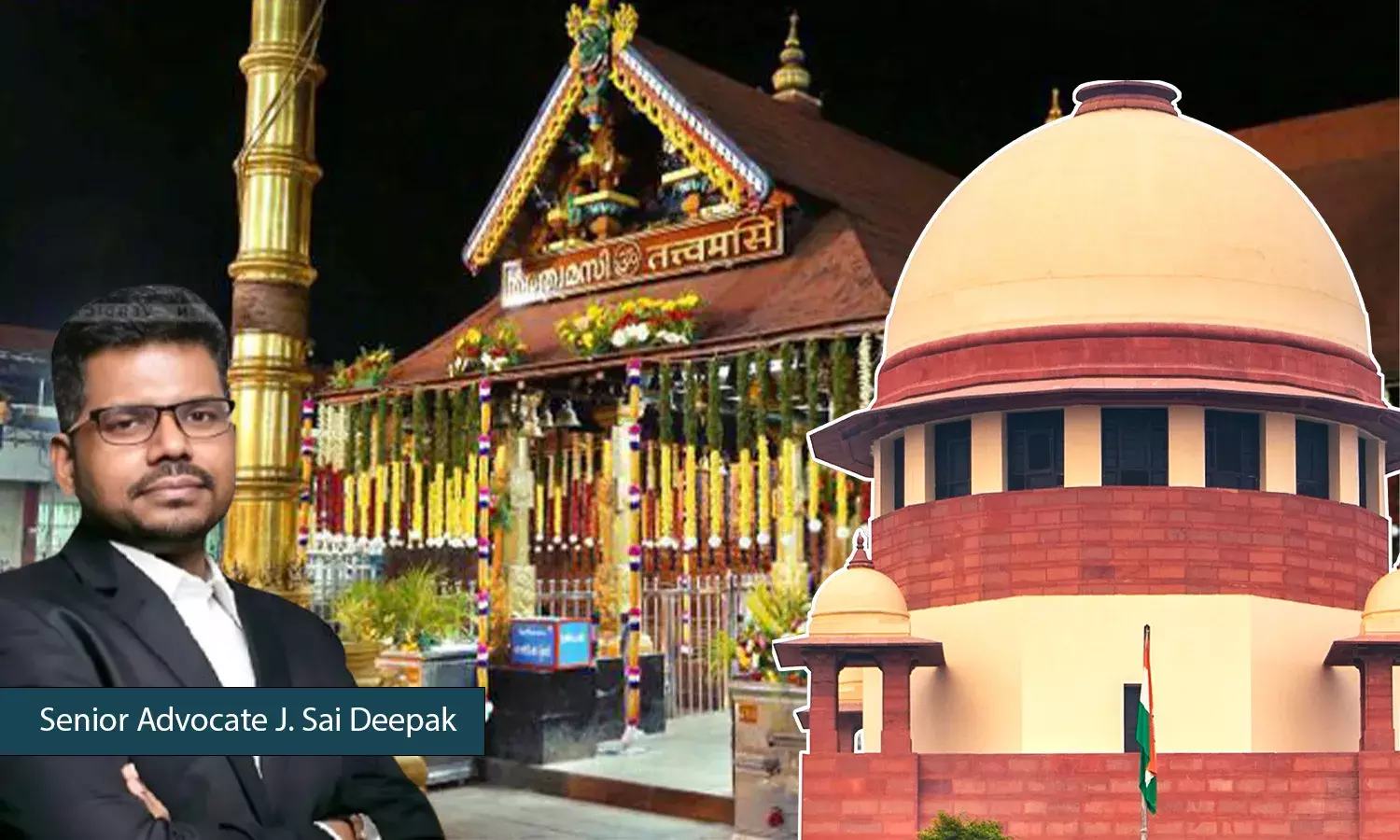
Senior Advocate J. Sai Deepak, representing the Pandalam Royal Family and various devotee organizations such as Chetana Conscience of Women, All India Organizations of Ayappa Temples, the Shirur Mutt, the Tantri of Sree Padmanabhaswamy Temple and the Chilkoor Balaji Temple, contended that if a religious practice is inherently beyond the court's jurisdiction due to its sacred nature, the mere act of the State recognizing or "codifying" that practice through law does not suddenly grant the judiciary the power to review it.
Applying the legal maxim "what cannot be done directly, cannot be done indirectly," he argued that legislation should not be used as a backdoor for courts to test the "rationality" of ancient religious traditions.
Responding to this, Chief Justice Surya Kant remarked, "The moment you explain the wing of the state or the executive, the power of judicial review automatically comes. If the State, in the name of social welfare, prohibits a religious practice, who will examine it?...The power of judicial review...there is no need to attack on that power so much. We understand that limitations are there...but to say that there is no power at all may also be very difficult as a proposition".
The Bench comprising Chief Justice Surya Kant, with Justices B.V. Nagarathna, M.M. Sundresh, Ahsanuddin Amanullah, Aravind Kumar, A.G. Masih, Prasanna B. Varale, R. Mahadevan, and Joymalya Bagchi, was hearing review petitions and writ petitions arising out of the 2018 Sabarimala Judgment, which allowed women of all ages to enter into Lord Ayyappa's temple. The pleas were filed, inter alia, regarding the entry of Muslim women into mosques and dargahs, and the rights of Parsi women to enter Fire Temples if they have married outside their community and the legal validity of female genital mutilation within the Dawoodi Bohra community.
Arguments on behalf of Senior Advocate J Sai Deepak
Senior Advocate J Sai Deepak, appeared for various review petitioners, such as Pandalam Kottaram Nirvahaka Sangham which is the administrative body representing the Pandalam Royal Family in Kerala, responsible for managing the affairs of the Pandalam Palace and its related traditions, particularly concerning the Sabarimala Ayyappa Temple. He also represented Chetana Conscience of Women, which stood in support of the Temple, All India Organizations of Ayappa Temples, the Shirur Mutt, the Tantri of Sree Padmanabhaswamy Temple and the Chilkoor Balaji Temple.
Sai Deepak argued that a holistic understanding of Part III of the Constitution was essential to resolving the relationship between Articles 25 and 26. He raised foundational questions regarding the nature, limits, and enforcement of these rights, specifically questioning where non-denominational institutions located their rights if Article 26 applied strictly to denominations.
He traced the history of these provisions, from the notes of Constitutional Adviser B.N. Rau and the drafts of K.T. Shah to the final text. He submitted that Article 25(2) was always conceived as a proviso to Article 25(1) rather than a qualification of Article 26. He emphasized that the phrase "nothing in this article" was a deliberate choice, signalling that the limitations in Article 25(2) operated only within the confines of Article 25 itself.
Furthermore, he contended that the State’s codification of a pre-existing religious practice did not automatically make that practice subject to judicial review. He argued that if a practice could not be constitutionally challenged in its original form, the mere act of the State recognizing it through legislation did not change its nature or make it amenable to court intervention.
Sai Deepak submitted, "The question of entertaining any writ petitions challenging the practices on the ground that it violates any of those subject to provisions, does not even arise simply because those powers are limited to the State."
Justice Nagarathna said, "If the State enables the State to make laws to bring in social reforms, for example, entry, now the question here is not...the controversy is not that the State has banned the entry as such...The state has made the law or the rule for 'Entry' because of the custom, there is a prohibition in the Kerala Act and rule..."
He replied, "Codification of a pre-existing religious practice by the State does not make that practice amenable to judicial review because it is not an exercise of rights under 25(1) and 25(2) where limitations are imposed...The submission is of judiciary cannot, or the Courts cannot preside over constitutional challenges to practice by way of a legislation that does not make it amenable to review: this is my humble submission...I am therefore applying the principle that what cannot be done directly can also not be done indirectly. So if you cannot get into the rationality of religious practice..."
Senior Advocate J. Sai Deepak argued that the rights afforded to religious denominations translated into various charitable, educational, and religious intents. He noted that Dr B.R. Ambedkar did not find this principle objectionable but instead rephrased it to ensure that no religious denomination would be disqualified from managing its own affairs.
He further contended that the expression "religious denomination" was never intended to be interpreted in a restrictive or narrow sense. Instead, he submitted that the term was effectively used as a synonym for "religious association," intended to provide collective religious freedom to all groups.
Sai Deepak explained that although the draft provisions underwent several renumberings and revisions during the drafting process, their underlying substance and spirit remained consistent. He concluded that this historical evolution also clarified the scope of the second portion of what eventually became Article 25(2)(b).
Sai Deepak asserted that Article 25(2), which allows for State intervention for social reform, was strictly intended as a limitation on the individual rights in Article 25(1) and was never meant to restrict the denominational rights under Article 26. He labelled any argument to the contrary as "ahistorical."
He further argued that the term "religious denomination" should be interpreted broadly to include any religious association of people bound by a common belief. He specifically challenged the "exacting requirements" established by the Supreme Court in the Shirur Mutt case, suggesting that no formal declaration or rigid criteria should be necessary for a group to exercise its rights.
In his view, Article 26 acts as a collective manifestation of the individual rights found in Article 25. Finally, he proposed a structural parallel within the Constitution: just as Article 19(1)(c) guarantees the general right to form associations and unions, Article 26 serves as the specific constitutional vehicle for forming and managing associations within a religious context.
Sai Deepak argued that Article 26 possesses its own internal limitations—public order, morality, and health—which are broad enough to address social reform without needing to borrow the specific "reform" mandate from Article 25(2). By maintaining this separation, he contended that the autonomy of a denomination remains intact.
He explained that a religious denomination actually holds two distinct "baskets" of rights. Because the word "person" in Article 25(1) includes bodies of persons, a denomination enjoys individual-style religious freedoms. However, it also holds institutional rights under Article 26. While the State can regulate a denomination's Article 25 rights for social welfare and reform, he asserted that the State cannot use that power as a "Trojan horse" to interfere with the internal religious management guaranteed by Article 26.
He emphasized that if the State oversteps this boundary, judicial review serves as the necessary remedy. Regarding "public morality," he agreed that Article 17 (the abolition of untouchability) must be considered an essential part of that moral framework, meaning no denomination could claim a right to practice untouchability. Finally, he cautioned against over-relying on comparisons with the Irish Constitution, noting that its explicitly religious foundation differs fundamentally from the Indian secular model.
Senior Advocate J. Sai Deepak said, "By the time the concept of denomination travels from Ireland to India, it cannot suddenly become a higher right. That is not the case. Because the anomaly it creates is that denominational institutions would then enjoy greater protection vis-à-vis the State compared to non-denominational institutions...That would militate against Article 14. We cannot interpret the Constitution in such a way. That is where my disagreement arises with Mr. Sankaranarayanan on this issue. If denominational institutions are given an elevated status, while non-denominational institutions are practically left without comparable constitutional protection, that would amount to a violation of Article 14."
Sai Deepak concluded, "My humble submission, the journey from 2018 September 28th till date is the journey of misplaced application of Constitutional morality, which is as opposed to applying the...position in terms of what the law says. When we go down the path of applying the ought position in terms of what the law must say, then we are entering the realm of policy."
On the last date of hearing, Senior Advocate Abhishek Manu Singhvi, representing Travancore Devaswom Board, contended before the 9-judge Bench that the exclusion of women aged 10–50 from the Sabarimala Temple is not an act of discrimination, but a valid classification rooted in the unique identity of the deity. He distinguished Sabarimala from approximately 999 other Ayyappa temples, noting that only this specific shrine depicts the Lord as a Naishtika Brahmachari (an eternal celibate student).
Previously, during the hearing of the Sabarimala Reference, when Justice Joymalya Bagchi highlighted the "Eclipsing" of Individual Rights of a non-believer by denominational rules, Senior Advocate CS Vaidyanathan, appearing for devotees' organisations in Kerala, submitted that individual freedom of conscience cannot defeat the freedom of community or the denomination.
On April 7, 2026, the 9-judge Constitution Bench of the Supreme Court, led by Chief Justice Surya Kant, commenced the landmark hearing on the Sabarimala reference. Solicitor General (SG) Tushar Mehta, representing the Centre, led the arguments with a direct challenge to the 2018 verdict and the current judicial approach to religious practices.
On April 8, 2026, concluding its submissions, Solicitor General Tushar Mehta argued that secular courts lack the "scholarly competence" to sit in judgment over the validity or rationality of religious faith. He also called for total abandonment of the "Constitutional Morality" doctrine as a basis for judicial review. He argued that the Courts should never test, either a legislative enactment or an administrative act, based on vague concepts that are capable of elastic interpretation, which is both subjective and individualistic.
Justice B.V. Nagarathna pointed out that the challenge was not brought by devotees of Lord Ayyappa, but by the Indian Young Lawyers Association, a group with no direct association with the temple’s faith or practices.
Cause Title: Kantaru Rejeevaru Vs Indian Young Lawyers Association; Sabarimala Custom Protection Forum Vs Indian Young Lawyers Association [R.P.(C) No. 3358/2018 in W.P. (C) No. 373/2006]