

It Is Assumed That Fertile Women Will Be Antithetical To The Very Manifestation Of Deity: Travancore Devaswom Board Submits In Sabarimala Reference
Senior Advocate Abhishek Manusinghvi concluded by warning against the doctrine of "Constitutional Morality," describing it as an "unruly horse" and a "dinosaur" that lacks manageable standards.

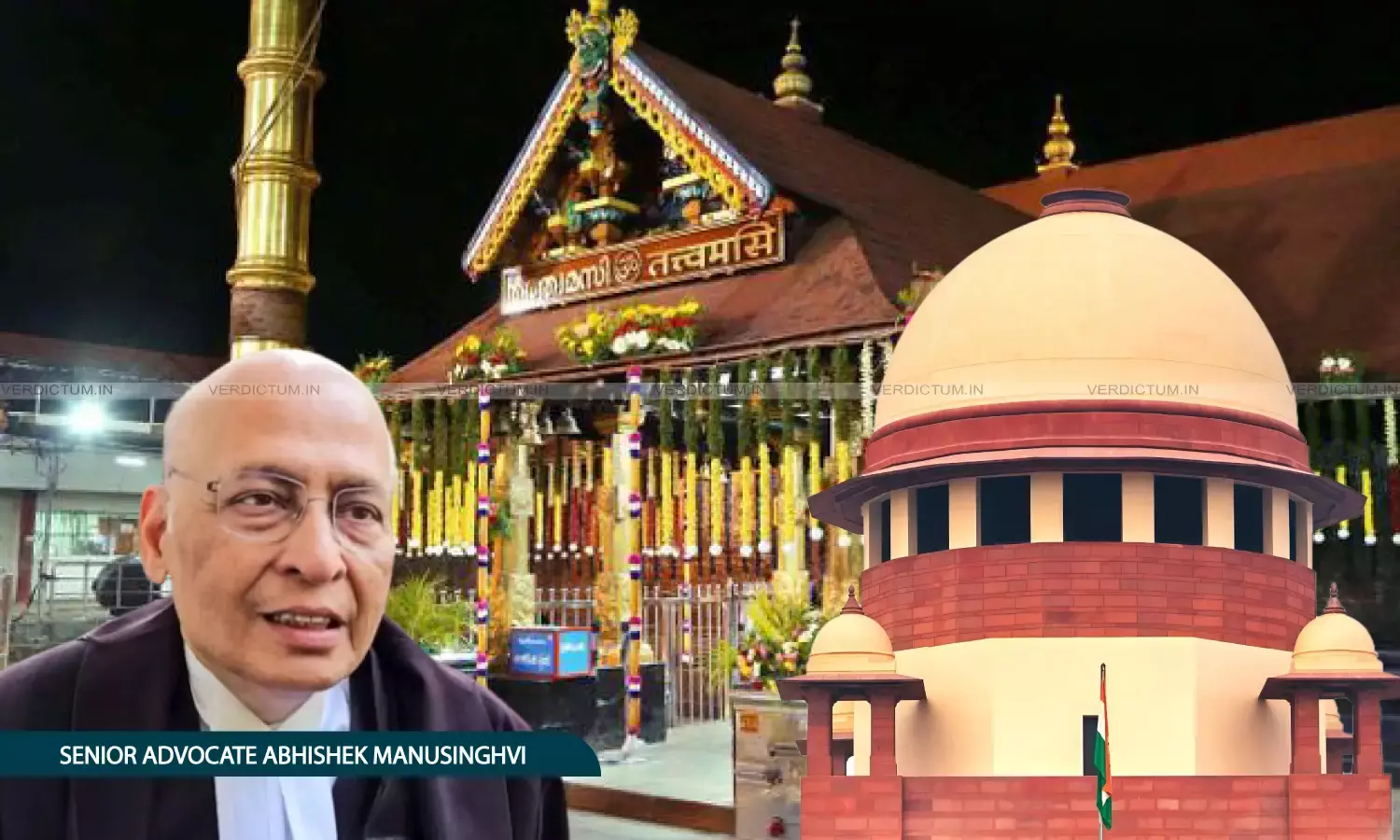
On day 4 of the Sabarimala Reference, Senior Advocate Abhishek Manu Singhvi, representing Travancore Devaswom Board, contended before the 9-judge Bench that the exclusion of women aged 10–50 from the Sabarimala Temple is not an act of discrimination, but a valid classification rooted in the unique identity of the deity.
He distinguished Sabarimala from approximately 999 other Ayyappa temples, noting that only this specific shrine depicts the Lord as a Naishtika Brahmachari (an eternal celibate student).
Singhvi argued that the presence of women of fertile age is "antithetical" to this specific manifestation, creating a direct and genuine nexus between the restriction and the temple's character.
Under Articles 14 and 15, he maintained, the classification must be judged against the nature of the deity rather than secular standards, emphasizing that devotees have ample opportunity to visit the Lord in other temples that do not observe this specific celibate vow.
The Bench comprising Chief Justice Surya Kant, with Justices B.V. Nagarathna, M.M. Sundresh, Ahsanuddin Amanullah, Aravind Kumar, A.G. Masih, Prasanna B. Varale, R. Mahadevan, and Joymalya Bagchi, was hearing review petitions and writ petitions arising out of the 2018 Sabarimala Judgment, which allowed women of all ages to enter into Lord Ayyappa's temple. The pleas were filed, inter alia, regarding the entry of Muslim women into mosques and dargahs, and the rights of Parsi women to enter Fire Temples if they have married outside their community and the legal validity of female genital mutilation within the Dawoodi Bohra community.
On the last date of hearing, during the hearing of the Sabarimala Reference today, when Justice Joymalya Bagchi highlighted the "Eclipsing" of Individual Rights of a non-believer by denominational rules, Senior Advocate CS Vaidyanathan, appearing for devotees' organisations in Kerala, submitted that individual freedom of conscience cannot defeat the freedom of community or the denomination.
On April 7, 2026, the 9-judge Constitution Bench of the Supreme Court, led by Chief Justice Surya Kant, commenced the landmark hearing on the Sabarimala reference. Solicitor General (SG) Tushar Mehta, representing the Centre, led the arguments with a direct challenge to the 2018 verdict and the current judicial approach to religious practices.
On April 8, 2026, concluding its submissions, Solicitor General Tushar Mehta argued that secular courts lack the "scholarly competence" to sit in judgment over the validity or rationality of religious faith. He also called for total abandonment of the "Constitutional Morality" doctrine as a basis for judicial review. He argued that the Courts should never test, either a legislative enactment or an administrative act, based on vague concepts that are capable of elastic interpretation, which is both subjective and individualistic.
Justice B.V. Nagarathna pointed out that the challenge was not brought by devotees of Lord Ayyappa, but by the Indian Young Lawyers Association, a group with no direct association with the temple’s faith or practices.
Today, Senior Advocate Abhishek Manusinghvi, appearing for Travancore Devaswom Board (TDB), started his submissions. The written submissions can be read here.
Singhvi submitted that although there are innumerable Ayyappa Temples in India (approx 1000), the Sabarimala Temple is supposed to depict “Naishtika Brahmacharya” viz. an eternal brahmachariya (celibate student).
He submitted, "If I am able to show that thsi exclusion of fertile females, between the age of 10-40, their denial is the direct nexus with the object and the identity and the manifestation of the deity...this is a valid classification...the validity of a classification between women of below 10 and above 50 on one hand and women between 10-50 has to be judged with what we are discussing...we are not discussing toy shop or restaurant...we are discussing some deity who has no connection...he is celibate eternal bramahachrya...it is assumed that fertile women in this age will be antithetical to the very manifestation and existence of the deity...these women can certainly visit Lord Ayappa in 999 other temples...if they are so concerned in PIL...So, when you apply these tests under Articles 14 and 15, the exclusion has to be seen as having a direct, valid, real and genuine nexus with the identity of the temple you are discussing."
First Issue: Scope and ambit of the right to freedom of religion under Article 25 of the Constitution
He, firstly, dealt with the first sub-issue, i.e. What is the scope and ambit of the right to freedom of religion under Article 25 of the Constitution of India?
He submitted, "Seshammal v. State of T.N. is significant for its detailed discussion of the principle that despite numerous rituals and ceremonies of the Hindu religion having little nexus with rationality and objectivity, they cannot be dismissed (on the basis of external standards) as either irrational or superstitious...that is the ratio of Seshammal...Mr. Vaidyanathan said that 16(5) was not looked at, therefore it needs to be looked at...I want to harmonise Seshammal with 16(5)...I am suggesting that Seshammal can be harmonised with 16(5) and the rest of the 16."
He then referred to Article 16 and submitted, "So this one word 'religion in 16(2) is excluded by putting 16(5)."
CJI Kant said, "So 16(5) is an exception to 16."
Singhvi submitted, "16(5) does not immunise...from the charge of discrimination those appointed on other discriminatory standards of race, caste, sex, descent, place of birth, provided the persons of the same religion and denomination as the institution...so suppose only hindus are aloowed then institution says that only hindus from the north will come not fromthe south...only hindus who profess a particular dispensation will come...that you can't do that...religion is immunised not the others...you protect the character but you don't protect from every other..."
Singhvi argued that religion, while difficult to define with precision, must at its core involve a cohesive commonality of beliefs and practices that bind a community together. He maintained that any judicial review of these customs must be extremely limited and should only apply a "subjective test" rooted in the community's own perspective.
The court's role, according to Singhvi, is not to determine the rationality of a practice, but simply to verify whether the belief is a genuine, existing part of that specific religion. He emphasized that as long as a belief is not "outlandish"—using the extreme example of cannibalism to illustrate a breaking point—it should not be subjected to external, objective tests imposed by judges or secular society.
Singhvi asserted that the protection of Article 25 extends beyond high theological concepts to include a large volume of rituals, ceremonies, and procedural practices. He contended that these external manifestations of faith are entitled to full constitutional protection regardless of how they might appear to a third-party observer.
Singhvi urged the Bench to recognize that the right to religion in India is inherently pluralistic and accommodates diversity that may not always align with modern social logic. He suggested that if the judiciary begins to apply external standards of "rationality" to religious practices, it risks eroding the very freedom of conscience it is meant to protect. By focusing on the "subjective test," Singhvi argued for a judicial approach that prioritizes the internal sincerity of the believer and the historical continuity of the denomination over evolving social or moral theories.
He submitted, "From the aforesaid jurisprudence, it is evident that there must be commonality in thought and worship to constitute religion. The common faith of the group/sect/community, in that they follow common religious tenets and there is a basic cord which connects them, would necessarily mean that the group/sect/denomination shares a common set of beliefs and practices...While Article 25 clearly vests in an individual the right to profess, practice and propagate religion, such individual rights cannot be allowed to extend to an area where it intrudes upon the mass of individual rights of all other adherents of that religion or denomination..."
He also referred to Sardar Syedna Taher Saifuddin Saheb v. State of Bombay, which held that every member of the community has the right, so long as he does not in any way interfere with the corresponding rights of others, to profess, practice and propagate his religion, and everyone is guaranteed his freedom of conscience.
He then discussed the second sub-point, i.e., "It is impermissible to add, modify or subtract from the specific constitutional text and accordingly, the additional derogation of ‘essentiality’ as engrafted by some judgments is entirely impermissible."
He read, "Evidently, the words ‘essential’ or ‘integral’ are not to be found in Article 25. There is, therefore, no qualification or condition for the nature or significance of the religious practice which is free to be professed, practiced and propagated by all persons. Thus, all persons have a Fundamental Right to profess, practice, and propagate all kinds of religious practices, essential or otherwise....To superimpose or carve out a narrower sub-set of religion as essential practices of religion is therefore untenable."
Justice Nagarathna asked, "For what purpose this essential religious practices test was propounded by this Court?...to mean that that is protected and nothing else?"
Singhvi submitted, "According to me, it is slightly loose language used in Dargah, which is picked up and taken as Doctrine...What they mean everywhere, possibly in Dargah, is that we are entitled to decide whether it is religion or not. We are entitled to decide whether it is religion or not. As I said, I profess a practice to have teleological approaches. Can it be that you will not accept it just because I tell you it is part of my religion? Is this religion called X supportive of this? That is a logical inquiry...That was perhaps by loose language or whatever, described as, is it an essential part of religion? So the test is, yes, by a subjective belief test, you must examine whether it is part of religion or not. So anybody can say anything outlandish."
Justice Nagarathna sought to clarify whether the "Essential Religious Practices" (ERP) test should be discarded specifically when the State seeks to regulate secular activities associated with religion under Article 25(2)(a).
Senior Advocate Singhvi responded by identifying what he termed a "false premise" in the current judicial approach: the notion that a court can acknowledge a practice as religious but then proceed to judge whether it is "essential" enough to merit protection. He argued that this path is inherently problematic, as it allows the judiciary to perform a qualitative audit of faith that the Constitution does not authorize.
Singhvi referred to Shirur Mutt and read from his submissions, "The submission of the Ld. Attorney General in the context of Articles 25(2)(a) and 26(d) was that “the word ‘religion’ should be taken in its strict etymological sense as distinguished from any kind of secular activity which may be connected in some way with religion but does not form an essential part of it” and further that “all secular activities, which may be associated with religion but do not really constitute an essential part of it, are amenable to State regulation”34. In this manner, the freedom under Article 25(1) was sought to be given a narrow interpretation by the Ld. Attorney General and a wide power was sought to be conferred on the State to regulate or restrict economic, financial, political and secular activities associated with religious practice (which was to mean any activity that does not form an essential part of the religion). This submission of the Ld. Attorney General, however, was rejected by the Supreme Court observing that..."
Justice Nagarathna offered an alternative constitutional framework, suggesting that perhaps anything falling outside the specific scope of Article 25(2)(b)—which allows for social reform and the "throwing open" of Hindu temples—must be absolutely protected.
Justice Bagchi asked, "Mr Singhvi just clarify on this that an activity, naturally religious, is completely covered by Article 25, but when an activity has both a flavour of religious practice and a secular aspect, how will the court decide? Will it fall in the religious category or non-religious activity?"
Singhvi answered, "It is an unfortunate headache which your lordships have to face sometimes..."
Justice Bagchi said, "You see that example in Shirur Mutt, that I have to purchase wheat, I have to purchase, let us say, sugar, to make offerings to God. So making offerings to God is definitely a religious act...But in what manner do I make this purchase? Whether it will be religious or not. Shirur Mutt connects it to religion."
Singhvi submitted that the test has to be a subjective-objective test and not an objective-objective test.
Singhvi proposed a refined "religious versus non-religious" framework to distinguish between protected faith and regulatable activities. He urged the 9-judge Bench to completely "eschew and eradicate" the essentiality test, arguing that judicial inquiry should instead follow a "subjective approach" viewed through the prism of the believer. While acknowledging that there is no universal formula for every dispute, Singhvi maintained that the court must protect the internal sincerity of the community while allowing the State to regulate purely secular mismanagement.
Singhvi argued that the right to religion is inherently pluralistic and must accommodate diverse indigenous belief systems, including atheistic traditions like Charvaka. By shifting the focus away from "essentiality" to the specific limits of the State's regulatory power, he proposed a middle path: upholding the collective autonomy of the denomination while ensuring that social hierarchies and secular crimes are not shielded under the guise of faith. He trusted that "judicial talent" could effectively sift the religious grain from the secular chaff on a case-by-case basis.
Singhvi emphasized that the 9-judge Bench must exercise extreme caution in "line-drawing," as its language will bind all future interpretations of landmark precedents like Shirur Mutt and Dargah Committee. He argued that while the core intention of an act—such as transporting pilgrims to a sacred site—may have a religious character, the administrative execution remains within the State's regulatory reach. For instance, while providing a bus to Sabarimala is a religious facility, the accounting, procurement, and potential malpractices involved in that purchase are secular matters subject to law.
Justice Nagarathna reinforced this boundary, noting that under Article 25(2)(a), the "religious practice" itself must remain untouched by the State. She clarified that while the State can regulate associated secular activities, it cannot interfere with the ritual or belief. Singhvi agreed, adding a final, sharp limit on judicial power: the Court cannot sit in judgment over the utility or wisdom of a ritual. He maintained that it is entirely outside the court's domain to label a religious practice as "wasteful" or irrational, as such a determination would violate the subjective autonomy of the faith.
He then referred to his submissions and read, "It is a common misconception to derive essentiality of a religious practice by reference to economic, commercial, or political activities or activities of a secular character. These activities are mentioned in case laws, especially Shirur Mutt (supra), Ratilal Gandhi (supra), etc., not for the purpose of determining the essentiality of religious practices, but as a contrast to them. In other words, these activities are cited precisely to illustrate what does not constitute a religious practice. In other words, Shirur Mutt (supra) draws a contrast between religious practices and non-religious practices. That is vastly different from saying that the same case supports only essential religious practices within the fold of religious practices itself. The case law does not undertake any such bifurcation within the domain of religious practices into essential and non-essential practices. Rather, the judgments contrast two distinct and non-overlapping spheres: one comprising religious practices, and the other comprising non-religious or secular activities. Examples of the latter would include maintaining ledger accounts for the administration of a temple or filing income-tax returns in the prescribed statutory form for a religious institution. At no point do these judgments divide religious practices themselves into essential and non-essential categories."
He then said that the only enquiry required to be undertaken before the freedom, qua a belief or practice, is accorded protection under Article 25 or 26 is: a. is the belief genuinely and conscientiously held by an individual as part of a group or denomination? and b. is it so held as being part of the profession or practice of a religion?
"Once the above tests are satisfied, the freedom qua a belief or practice is protected under Article 25 or 26, as the case may be. No outside authority has any right to say that these are not parts of religion inter alia because they are not essential, and it is not open to any secular authority of the State to restrict or prohibit them in any manner", he submitted.
"Do you mean that 25 (2)(b) is also excluded?", Justice Bagchi asked.
He argued that if an extreme belief is merely the whim of a "maverick or eccentric" individual and not part of a collective, institutional denomination, it fails to qualify as a religion at all and is rejected at the threshold. However, he maintained that if an established religion genuinely traces its lineage to a practice—no matter how abhorrent it might seem by external standards—the Court cannot stigmatize it based on subjective judicial notions. The only permissible filters are the explicit textual restrictions in Article 25: public order, morality, and health.
Singhvi cited the Digambar Jain tradition of monks practicing total nudity. He noted that while nudity is generally proscribed in modern society as obscene, it is a core, established practice of a religion dating back to the 6th Century BC. He argued that it would be unthinkable to abolish such a tradition based on an "external standard" that finds no warrant in the constitutional text. By this logic, as long as a practice is a bona fide part of an established faith, it remains protected unless it specifically violates the three constitutional caveats.
Justice Nagarathna synthesized this point by clarifying the distinction between different types of morality. She observed that in the context of Article 25, the standard for restriction is public morality—the traditionally understood standards of behavior—rather than the fluid and evolving concept of Constitutional morality.
He then submitted regarding the third issue that the beliefs and practices of the community have to be judged by the subjective belief of the community, and the Court is bound to accept the belief of the community, and it is not for the Court to sit in judgment on that belief. He summarised that once a belief or practice is found factually established in what is accepted as a religion, then any further judicial application of a supposed essentiality test would amount to engrafting into Article 25, an additional restriction/derogation on what has already been found to constitute religion, apart and distinct from the four derogations already listed after much care and caution by our founding fathers and mothers. Any hypothetical, absurd or reprehensible practice would frequently be excluded at the threshold by not finding the collectivity concerned to be a religion at all; other similarly reprehensible practices would fall foul of the four derogations already listed in Article 25, he added. However, if a seemingly or allegedly absurd or reprehensible practice does not fall foul of (f) or (g) above, then it cannot be struck down by courts, if it is otherwise found to exist as a custom, belief, and practice of the religion concerned, he said.
Singhvi emphasized that religious practices must be judged purely by a subjective test—the internal belief of the community—rather than an external, "rationalized" objective standard imposed by judges. He invoked Justice Indu Malhotra’s dissent (which he referred to in the context of the pending review) and the Ram Janmabhoomi judgment to argue that factually established religious beliefs should be immune to judicial reinterpretation. Singhvi contended that courts should not act as social reformers within the theological core of a faith, as doing so violates the constitutional spirit of pluralism.
Singhvi noted the paradox of Indian jurisprudence where "Federalism," a word absent from the constitutional text (except regarding the Federal Court), has become a pillar of the Basic Structure. He used this analogy to highlight the untapped potential of another Preamble word: Fraternity. He argued that while "Federalism" has been the subject of vast judicial attention, "Fraternity" remains the least discussed and, as Justice Nagarathna added, the "least understood" concept in Indian constitutional law.
Singhvi proposed that the resolution of the Sabarimala reference lies in the "cross-fertilization" of religious rights with the principle of Fraternity. He argued that Fraternity is the most vital Preamble value for interpreting Articles 25 and 26, as it safeguards the dignity of individuals while respecting the diverse, separate identities of religious communities.
Regarding the fourth issue of the permissible restrictions/derogations from the right to religion, found in Article 25, were arrived at after detailed and meticulous deliberations and any other explicit or implied dilution of the right by interposition of other judicial restrictions would breakdown the delicate and intricate system of checks and balances envisioned by the framers, he submitted that the derogations specified in Article 25(1) can, be effected only by “law” as defined in Article 13. Many speakers in the debates, including K.M. Munshi and Laxmi Maitra, articulated this facet and assumed “law” to be implicit in the structure of Article 25 (then Article 19 in the Constituent Assembly).
Freedom to profess, practice and propagate religion was treated as a fundamental constitutional virtue and an interpretation which allows derogation only by “law” would alone be consistent with the high status accorded to this right both during the debates and textually, he said.
"To allow derogation in respect of as vital and significant a fundamental right as the right to religion, by ad-hoc and mere subjective executive instructions, orders, and directions, not having the trappings of either law or delegated legislation, would render susceptible such an important fundamental right to dangerous executive invasion...The Lordships cannot be too loose with the word 'law', the Lordships have to be strict," he submitted.
He then discussed the fifth sub-issue, i.e. the rights of persons under Article 25 of the Constitution of India are to be read harmoniously with the “other provisions of this Part” and are to be balanced with the rights thereunder.
In this regard, he submitted, "The fact that the right under Article 25 is made subject to the other provisions of this part does not and obviously cannot mean that any individual exercise of right under any other provision of Part III can extinguish the Article 25 right completely...Nor can it mean that the exercise of rights under the other parts of Part-III can significantly reduce and attenuate these rights. The individual exercising other rights cannot either extinguish or dilute the right of the collective rights provided in Article 25."
He suggested that the only way to correctly interpret the constitutional language is to apply Article 25 on the one hand and other provisions of Part III on the other in a harmonious, reasonable, and balanced manner, while always remembering the anchor provided by the other three broad heads of derogation, namely health, public order, and morality.
He then discussed the objectives resolution dated 13th December 1946, tabled and discussed in December 1946 and adopted on 22nd January 1947, which propounded several rights and freedoms, including the freedom of religion and a proposal given by KM Munshi, i.e. the addition of the word 'compatible'.
He referred to the contrasting version propounded by Dr Ambedkar, though the Constituent Assembly Debates mainly discussed the Munshi version. Three days later, on 29th March 1947, the Sub-Committee on Fundamental Rights reformulated Article VI(d) (the counterpart of current Article 25 in the following terms:- “All persons are equally entitled to freedom of conscience and right freely to profess and practice religion in a manner compatible with public order, morality or health and with the other rights guaranteed by the Constitution."
He said that by 3rd April 1947, then Article 16 (counterpart of present Article 25) had largely assumed the shape and content of present-day Article 25(1).
"The whole Constitution versus this part, subject to versus compatible, and only law and order...morality and health...three evolutionary trajectories", he said.
"It is further interesting to note that despite the existence of the phase “subject to … the other provisions of this Chapter” from as early as April 1947, and despite detailed discussion of all substantive aspects of freedom of religion over the next two years, no discussion can be found as to the reason for the insertion of the phrase “subject to … the other provisions of this Chapter” nor for the scope and amplitude of coverage of this phrase", he submitted.
He concluded this part and said in view of the tabula rasa presented by the Constituent Assembly Debates on the rationale underlying use of this phrase, the reasoning given in the earlier part of this Section, as to how Article 25 must be harmonized with the other provisions of the Constitution and neither attenuated nor decimated, reflects the correct approach and ought to be adopted by this Nine-Judge Bench.
He referred to Khajamian Wakf Estates v. State of Madras & Anr., Acharya Maharajshri Narendra Prasadji Anandprasadji Maharaj & Ors. v. State of Gujarat & Ors., Sri Venkataramana Devaru & Ors. v. State of Mysore & Ors. and Adi Saiva Sivachariyargal Nala Sangam & Ors. v. Government of Tamil Nadu & Anr.
Justice Bagchi said, "We have to give some meaning to the word 'subject'...26 is unhindered by the word 'subject to others' whereas 25 is subject to others...we have to give a gradient difference".
Justice Sundresh then said, "In my view, there is no need for that, for the simple reasons that Article 25(b) says 'a person' or 'persons'...its a collective belief of the persons concerned...in Shirur Mutt also, they say we are not concerned with the place...we are concerned with the persons sentiments and their beliefs...26 operates on a different field...actually 26 is an exception to 25...if a religious denomination acts against the belief.. what is important is that it is about beliefs of people concerned..."
Second Issue: Interplay between the rights of persons under Article 25 and the rights of Religious Denominations under Article 26
He submitted that Article 25 (2)(b) has two parts. He said that the second part of Article 25(2)(b), i.e. "throwing open of Hindu religious institutions of a public character to all classes and sections of Hindus".
"According to me, this deals entirely with entry and access...and therefore harmonising this and saying all entry and access issues will be governed by Article 25(2)(b)...once you enter and have access,s 26(b) takes over", he said.
He submitted, "Pertinently, when evaluating legislation providing for social welfare and reform under Article 25(2)(b), the Court must bear in mind, as stated by Ayyangar J. in his concurring opinion in Sardar Syedna Taher Saifuddin Saheb, that such legislative action must not be such as to “reform” a religion out of existence or identity”...(reads from Syedna)...the 9-JB should not leave these four words.. ." cover the essentials of the creed of a religion"..."
Justice Bagchi said, "Mr Singhvi, by doing that,t you are bringing the expression that there will be some tenets, or practices essential and integral and some directorial and non-essentials...either you have to adopt Mr Vaidyanathan and say..."
Singhvi said, "Second part of 25(2)(b) I am disagreeing with my Ld. friend..."
While referring to Sardar Sydena precedent, he argued that social reform cannot be used to dismantle the "basic essentials" of a creed. He cautioned the Bench against allowing the State to use "reform" as a back-door entry to alter the theological identity of a faith, suggesting that even abhorrent practices like Sati were abolished primarily under the head of "public order" rather than a general power to rewrite religious tenets.
Justice Bagchi challenged Singhvi on whether his argument inadvertently brings back the "Essentiality Test." He suggested that to determine if a reform "defaces" a religion, a court must inevitably evaluate what is "essential" or "inalienable" to that faith. Singhvi responded by urging the 9-judge Bench to "clean up these creases" and move away from the "essentiality" label, which he viewed as a problematic judicial audit of faith. He resisted the term "inalienable" as just another synonym for essentiality, maintaining that the focus should remain on whether a practice is a bona fide part of the collective belief, rather than a judge-led ranking of its importance.
While referring to Ratilal Panachand Gandhi, he read, "A law, which takes away the right of administration altogether from the religious denomination and vests it in any other or secular authority, would amount to violation of the right which is guaranteed by Article 26(d) of the Constitution."
"All arguments as to why Article 26(b) should override Article 25(2)(b) were rejected. The principle of harmonious construction is pressed into service, and it was held that100 while for all matters Article 26(b) will apply, regarding entry into a temple Article 25(2)(b) will prevail", Singhvi submitted while reading Sri Venkatramana Devaru.
He concluded Issue No. 2 by submitting, "Denominations and even sections thereof, understood in the widest possible sense, are protected under Article 26. Management of affairs of denominations or sections thereof cannot be diluted or deprived by the legislature, which, however, can regulate administration of property associated with religion and religious practices...In case of a conflict between an individual right under Article 25(1) and the right of a denomination under Article 26, the right of the denomination would prevail as Article 25(1) is subject to other provisions of Part III, which includes Article 26."
For harmonising the provisions, he submitted, "Though laws made under Article 25(2)(b), facially appear to violate Article 26(b), harmonious construction is the only methodology available to give some meaning and scope both to Article 25 (2)(b) and Article 26(b)...Such harmony is arrived at by allowing Article 26(b) untrammelled supremacy regarding all other forms of religion and religious practices, but by creating a carve out when a law under Article 25 (2)(b) will prevail if it seeks to mandate access or social reform in certain situations."
He said even the latter carve out in favour of the law under Article (25)(2)(b) is subjected to further limitations imposed / imposable by Article 26(b) e.g. prohibitions qua access to the inner most sanctum sanctorum would still be protected under Article 26(b) notwithstanding a law to the contrary under Article (25)(2)(b).
Third Issue: Whether the rights of religious denomination under Article 26 are subject to other provisions of Part III apart from public order, morality and health
He submitted that it is evident from the language in the opening sentence of Article 26, in contrast to that in the opening sentence of Article 25(1), that Article 26 has not been made subject to the other provisions of Part III, unlike Article 25. An analysis of the Constituent Assembly Debates would reveal that the framers of the Constitution had consciously and intentionally not made Article 26 subject to the other provisions of Part III.
He quoted the original Article 19 (now Article 25) and Article 20 (now Article 26).
He submitted, "On 7th December 1948, draft Article 20 (now Article 26) was moved for adoption. At the threshold, Dr Ambedkar moved Amendment No. 614107 in the following terms: “That in the beginning of Article 20, the words ‘Subject to public order, moralityand health,’ be inserted.”
Justice Sundresh asked, "What is a religious denomination? How is it constituted? It is a bunch of believers...So article 25, including (2), will also apply...So when 25(2) applies to them, how do you say it does not apply to the denomination?... After denomination has life and existence due to the collective belief of those persons to give protection and preservation...How do you apply the law?... It has no independent excercise you see."
Singhvi said, "My lordships are putting 25(2)(b) in the left column and 26(b) in the right... that's the issue I believe Lordships are raising..."
Justice Sundresh said, "It goes without saying that what applies to 25 it applies also to 26, otherwise it does not make any sense..."
Singhavi replied, "..On entry, I have already argued in great detail that the second part of Article 25(2)(b) will prevail over Article 26(b). Crystal clear. There is no doubt about it. Whether I am at variance with Mr Vaidyanathan or not, I don't know. My argument is clear. I believe Mr Vaidyanathan took a different line. Second answer. On the first five words of Article 25(2)(b), if you make a law of social reform which does not eviscerate or hollow out the religion, then that will also prevail over Article 26(b). I hope I cannot be clearer than that. Again, refer to Syedna and the other judgments. Answer number three...If your Lordships were to go further and say that “other provisions of this Part”, not put in Article 26 (b), are implicit in Article 26, then I would say your Lordships would be wrong. It is not at all implicit in Article 26. 26 is consciously freed from the fetters of “other provisions of this Part”, which means the gamut of Articles 14 to 30 or 32, minus what is put inside. These are three clear answers."
Justice Nagarthan said, "So that means 25(2)(b) is only with the object of maintaining public order, morality and health...?"
"Further 26(b) is subject to the law "throwing open of Hindu religious institutions of a public character to all classes and sections of Hindus...fifth...first five words of 25(b) "providing for social welfare and reform"...if you argue that 26(b) will prevail over first part of 25(2)(b), I atleast don't agree...", Singhvi added.
Fourth Issue: Scope and extent of the word ‘morality’ under Articles 25 and 26 of the Constitution, and whether it is meant to include constitutional morality
Singhvi submitted, "1. Constitutional morality is not used in the Constitution anywhere. 2. Dr Ambedkar, whose passage is frequently quoted, used it to justify a question raised against him. Why are you providing such a detailed Constitutio? Why not a broad Constitution? He said that in a nascent republic like India, where constitutional morality may be in the topsoil but not embedded in the subsoil, it is necessary to provide details of administration, which over time will inculcate and create that morality which does not exist today...Totally different context...3. Constitutional morality was never contemplated as an additional ground of derogation. Namely, I am a petitioner today. I challenge a law before your Lordships, and I say forget Article 19(2), 19(3), 19(4), forget Article 25(1). In addition to all those derogations, decency, public order, and morality, I challenge this law because it does not satisfy constitutional morality. That cannot be a ground of invalidation of legislation. It cannot be. Unfortunately, it has been used in some judgments by simply following previous judgments."
Justice Nagarathna said, "Legislation cannot be struck down on the ground of constitutional morality...maybe Part III or on the ground of legislative incompetence."
Singhvi added, "4. The framers used the word 'morality' and not constitutional morality... It's a term of art...by adding a term of art, there is confusion created...point is Your Lordships were not concerned about 'Constitutional Morality'...if they were concerned about Dr Ambedkar's one sentence in a different concept, they would have put it there."
He then referred to K.A. Abbas v. Union of India, S. Rangarajan v. P. Jagjivan Ram, Indian Hotel & Restaurant Assn. (AHAR) v. State of Maharashtra, S. P. Gupta v. Union of India & Anr., Manoj Narula v. Union of India and His Holiness Kesavananda Bharati Sripadagalvaru v. State of Kerala & Anr.
Justice Bagchi asked Singhvi, "The idea of constitutional morality, when you apply it to Article 25, Article 26, is actually regulating non-state actors. Should we apply a test of constitutional morality when we examine the religious practices or management of religious affairs by non-state actors?"
Singhvi argued that religious traditions, which should be viewed through the subjective prism of the adherent, would be effectively dismantled if subjected to an external, modern moral standard. By introducing this fluid doctrine into Articles 25 and 26, Singhvi contended that the Court risks disturbing the finely tuned balance between institutional autonomy and individual rights established by the framers.
Chief Justice Surya Kant noted the significant risk inherent in applying Constitutional Morality to religious cases, pointing out that the doctrine lacks "manageable standards" for judicial review. He observed that its application depends entirely on "subjective and individual opinion," suggesting that such a fluid yardstick could lead to inconsistent and unpredictable rulings when used to judge deeply held faith-based practices.
Singhvi sharply underscored this concern, famously describing Constitutional Morality as an "unruly horse" and a "dinosaur" that the judiciary cannot effectively ride. He argued that the lack of textual definitions makes it a dangerous tool in an adjudicatory setting, as it allows for external, personal moralities to override the specific protections granted to religious denominations.
Singhvi then referred to the Objectives Resolution moved by Nehru on 13th December 1946, which is commonly considered to be the main pre-Constituent Assembly basis of a large part of the Fundamental Rights in Part III of the Constitution, referred to “public morality”.
He then referred to Supriyo @ Supriya Chakraborty v. Union of India, in which Chandrachud C.J., relying upon the Original Sabarimala Judgement, held that, “As for morality, it is settled law that Article 25 speaks of Constitutional Morality and not societal morality.” Singhvi suggested that this must be clarified and eliminated.
Fifth Issue: Scope and extent of judicial review of a religious practice as referred to in Article 25
As submitted by Singhvi, the scope of judicial review regarding religious practices must be strictly confined to the explicit textual derogations of Article 25(1)—public order, morality, and health—and must entirely eschew the "essentiality" or "integral" tests, which he characterizes as a "false premise" that leads to an impermissible judicial audit of faith.
Singhvi argued that the court's inquiry should be limited to a "subjective belief test," determining only whether a practice is genuinely and conscientiously held by the community as part of its religion, rather than testing it against external standards of logic or rationality. Under this framework, State intervention for "public order" is justified only through the "doctrine of three concentric circles," where an act demonstrably affects the community at large rather than being a mere matter of internal observance.
He asserted that judicial review must be exercised with "caution and restraint," ensuring that the court respects the autonomous domain of the Sampradaya and avoids replacing established religious traditions with subjective judicial notions of "constitutional morality."
Sixth Issue: Meaning of the expression "Sections of Hindus" occurring in Article 25(2)(b) of the Constitution
As submitted by Senior Advocate Abhishek Manu Singhvi, the expression “all classes and sections of Hindus” must be interpreted through its specific historical and social lineage, primarily aimed at the eradication of caste-based discrimination and untouchability. Drawing from the Constituent Assembly Debates, Singhvi noted that the inclusion of these words—moved by K.M. Munshi and expanded by Shrimati G. Durgabai—was intended to remove the "slur" of exclusion where certain castes were treated as an "abomination" while animals were permitted entry.
Singhvi further argued that this definition, while broad, must beharmonisedd with the rights of religious denominations under Article 26. Relying on Sri Venkatramana Devaru, he contended that while "public character" institutions include denominational temples, the power to "throw open" these temples under Article 25(2)(b) is a mandate for social equality rather than a tool to dismantle unique theological identities.
Seventh Issue: Whether a person not belonging to a religious denomination or religious group can question a practice of that religious denomination or religious group by filing a PIL
Singhvi raised the two sub-issues, i.e. 1. Can a person not belonging to a religious denomination or religious group question a practice of that denomination or group? 2. The frame of the proceedings, i.e., whether such questioning can at all be done in a PIL?
He submitted that the Supreme Court has delivered approximately 23 judgments (till 2025 end) on issues of religion under Articles 25 and 26 of the Constitution.
He submitted, "I am an individual having 25 rights, she is a denomination having 26 rights...either of our rights is intruded upon by someone else, by legislation, which I go into a writ or something...I am the challenger asserting the right, and he is the defender showing that rightly violated Singhvi's right as I come under public order, morality, etc...not one case is of this kind...lets turn this upside down...you don't have a challenger...you dont have a legislation...you have a supposed PIL Petitioner that look I believe this religious practice is not a good practice...now that chap who has a right under 25(6) is now the challenger...the Govt is the respondent...both of us are now respondents to the PIL's claim that according to the objective PIL collective consciousness standard this religious practice is bad...this destroys it."
Justice Nagarathna said, "See, a believer will never question it...who is the Petitioner?"
Singhvi said, "I am on (b) first...this is (a)."
Singhvi addressed the tension between Public Interest Litigation (PIL) and religious autonomy, acknowledging that while extreme cases—such as a religion mandating mass suicide—might justify judicial intervention, they must remain the rarest exceptions. In response to Justice Bagchi's hypothetical, Singhvi conceded that he could not argue for an absolute ban on PILs in the religious sphere. However, he warned that the threshold for entertaining such petitions must be "ten times higher" than a normal PIL to prevent the court from becoming a vehicle for the theological reinterpretation of faith.
He urged the 9-judge Bench to set a high bar for standing in religious PILs, ensuring that judicial power is used only to prevent clear violations of public order, morality, or health, rather than to adjudicate the nuances of "Essential Religious Practices" through the lens of outsiders.
Accordingly, the submissions were concluded, and the matter was adjourned.
Cause Title: Kantaru Rejeevaru Vs Indian Young Lawyers Association; Sabarimala Custom Protection Forum Vs Indian Young Lawyers Association [R.P.(C) No. 3358/2018 in W.P. (C) No. 373/2006]