

Individual Freedom Of Conscience Can't Defeat Freedom Of Denomination: Devotees Submit After Apex Court Highlighted "Eclipsing" Of Rights Of Non-Believer
On Day 3 of the hearing in Sabarimala Reference, Justice Joymalya Bagchi said that while a non-believer must subject themselves to the physical rules, they do not "give up" their internal right to disbelieve.

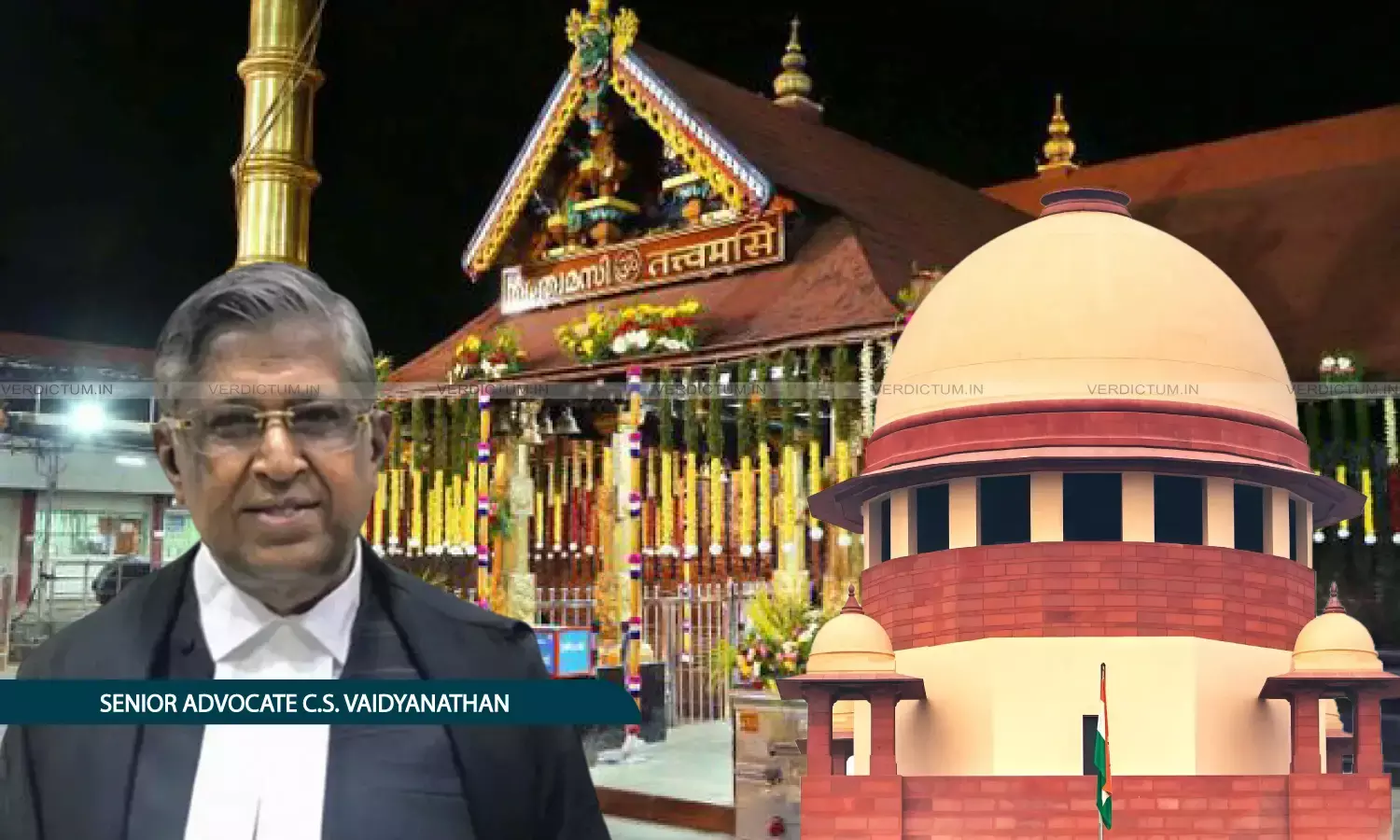
During the hearing of the Sabarimala Reference today, when Justice Joymalya Bagchi highlighted the "Eclipsing" of Individual Rights of a non-believer by denominational rules, Senior Advocate CS Vaidyanathan, appearing for devotees' organisations in Kerala, submitted that individual freedom of conscience cannot defeat the freedom of community or the denomination.
The Bench comprising Chief Justice Surya Kant, with Justices B.V. Nagarathna, M.M. Sundresh, Ahsanuddin Amanullah, Aravind Kumar, A.G. Masih, Prasanna B. Varale, R. Mahadevan, and Joymalya Bagchi, was hearing review petitions and writ petitions arising out of the 2018 Sabarimala Judgment, which allowed women of all ages to enter into Lord Ayyappa's temple. The pleas were filed, inter alia, regarding the entry of Muslim women into mosques and dargahs, and the rights of Parsi women to enter Fire Temples if they have married outside their community and the legal validity of female genital mutilation within the Dawoodi Bohra community.
The Court explored the practical reality of temple customs, illustrating how managerial rights under Article 26 often supersede individual preferences. Justice M.M. Sundresh and Chief Justice Surya Kant cited specific dress codes—such as the prohibition of shirts in Kerala’s Guruvayur temple and the requirement to cover one's head in North Indian Gurudwaras—as examples of rituals that all visitors must follow, regardless of their personal background.
Justice Joymalya Bagchi analyzed these examples through a constitutional lens, suggesting they demonstrate the superiority of Article 26(b) over an individual's personal choices when they enter a sacred space. He proposed that when a non-believer enters a temple, their right to "propagate" their non-belief is temporarily "eclipsed." By choosing to enter the domain of a religious denomination, the individual submits to its rules and rituals as a matter of order and respect for the institution's managerial rights.
However, Justice Bagchi made a vital distinction regarding the freedom of conscience. He said that while a non-believer must subject themselves to the physical rules (like a dress code), they do not "give up" their internal right to disbelieve. He noted that for a person to intellectually "contradict" a religious proposition, they may first need to "experience" it. Therefore, a non-believer’s interface with a temple is a physical submission to ritual, not a spiritual acceptance of the faith, ensuring that the core right to conscience under Article 25 remains intact even while the management's rules prevail.
Justice Bagchi said, "If a person is a non-believer, even if he goes to a temple or mutt managed by a denomination has to adhere to the religious affairs manifested through the rules...and then the real conflict is the propagation of a non-believer of his right becoming eclipse for the temporary period where he submits himself to the domain of the management of the affairs of religious denomination...But that does not mean the visitor gives up upon his freedom of conscience not to accept it but has to subject to it because if we hold otherwise that the non-believer can't interface then we would be eroding the non-believer of his core freedom of conscience even to profess because to profess if you look from the contradiction view, a person who has to contradict a proposition first experience the proposition...so going by that a non-believer may subject himself but need not to accept the religious."
Vaidyanathan replied, "Individual freedom of conscience and Article 25 cannot defeat the freedom of community or the denomination..."
On April 7, 2026, the 9-judge Constitution Bench of the Supreme Court, led by Chief Justice Surya Kant, commenced the landmark hearing on the Sabarimala reference. Solicitor General (SG) Tushar Mehta, representing the Centre, led the arguments with a direct challenge to the 2018 verdict and the current judicial approach to religious practices.
Yesterday, on April 8, 2026, concluding its submissions, Solicitor General Tushar Mehta, argued that secular courts lack the "scholarly competence" to sit in judgment over the validity or rationality of religious faith. He also called for total abandonment of the "Constitutional Morality" doctrine as a basis for judicial review. He argued that the Courts should never test, either a legislative enactment or an administrative act, based on vague concepts that are capable of elastic interpretation, which is both subjective and individualistic.
Justice B.V. Nagarathna pointed out that the challenge was not brought by devotees of Lord Ayyappa, but by the Indian Young Lawyers Association, a group with no direct association with the temple’s faith or practices.
Today, Solicitor General Tushar Mehta remarked, "Sabarimala judgment proceeds on the assumption that men are superior...and women are on the lower pedestal...I have given instances of temples where men are not allowed...there are temples where male priests are under a mandate to wash the feet of women devotees. There is one temple, Brahma Temple, the only temple, where married men are not allowed. There is one temple in Kerala, where the system is that men will go dressed as females...I have read it in a deal where men will go dressed as women, they go to beauty parlour and female family members help them dress wearing saree and only males go...so its not male or female centric religious female and this particular instance happens to be women centric..."
Arguments By Senior Advocate C. S. Vaidyanathan, representing Review Petitioners
Senior Advocate C. S. Vaidyanathan then started his arguments on behalf of the review petitioners, i.e. Nair Service Society, Ayappa Sewa Samajam, Kerala Kshetra Samrakshana Samiti (devotees' organisations in Kerala), etc.
While referring to the constitutional debates, he submitted, "Right is not conferred for the first time in the Constitution, right is pre-existing...it is only recognised."
Vaidyanathan argued that the protection of individual religious belief and collective practice is not just a localized mandate but is deeply rooted in global human rights jurisprudence. He invoked Article 18 of the International Covenant on Civil and Political Rights (ICCPR), which guarantees the right to freedom of thought, conscience, and religion, including freedom to manifest religion. He contended that these international instruments reinforce the principle that both the internal state of belief and its external, collective manifestation are fundamental to human liberty. He linked this to India’s own constitutional commitment to liberty of thought and expression, suggesting that the "religious rights" scheme in Articles 25 and 26 is consistent with these universal standards.
Vaidyanathan argued that this provision does not authorize the State to perform "religious reforms" but rather "social reforms."
Vaidyanathan submitted, "In the context in Sabarimala on right of women, Article 15 as it stands today was sought to be amended in constituent assembly debate to include places of worship and this amendment was rejected...amendment in regard to throwing open various places of worship...the amendment was rejected and the right to access to places of worship in only if at all by any legislation that can be made in pursuant to article 25(2)(b). We can't invoke the general prohibition of articles 15 and 16...Articles 29 and 30 also do not talk about gender or sex because we have in our history had institutions exclusively for girls and boys. There are today a large number of co educational institution...but no body wanted to make it compulsory that it should be co-educational so that part was kept...I am only giving an analogy."
He emphasized that even the concept of social justice under Article 17 (Untouchability) was historically targeted at "past unfortunate practices" related to caste, not the gender-based restrictions found in specific Sampradayas. He argued that the constitutional concepts of social justice and equality in religious settings were specifically designed for "Hindu religion of a public character" and were aimed at rectifying caste-based exclusion. He maintained that these provisions have "nothing to do with gender or sex," asserting that the 2018 judgment incorrectly conflated the struggle against untouchability with the exclusion of women of a certain age group based on a deity's specific attributes.
He concluded this segment by reiterating that Article 25(2)(b) is a "targeted social reform provision" and not a vehicle for "religious reform." By arguing that this provision was a specific response to caste-based exclusion, he suggested that the judiciary cannot "stretch" its meaning to mandate gender equality in a way that overrides the denominational rights protected under Article 26.
Vaidyanathan argued for a "decolonized" interpretation of Article 26, critiquing the traditional "Denomination Test" established in the 1954 Shirur Mutt case. He contended that the three mandatory conditions—common faith, common organization, and a distinctive name—were merely derived from an Oxford Dictionary definition rooted in Abrahamic religious structures, rather than a binding constitutional standard.
Vaidyanathan urged the Bench to instead rely on the authoritative Hindi version of the Constitution, which uses the term "Sampradaya." He maintained that this indigenous concept is far more fluid and inclusive of India's pluralistic "Dharmic" traditions, allowing for constitutional protection based on shared faith and custom without requiring the rigid, Western-style organizational hierarchy imposed by earlier judicial interpretations.
"We don't have a system of archbishops, pope, bishops and that kind of a theological structure", he said.
Justice Nagarathna said, "That means, in Hinduism, Hindus can belong to several sampradayas and can visit any temples. There is no bar, but if Hindus want to visit a particular temple, the sampradayas attached to that temple must be followed."
Vaidyanathan said, "Yes, I am very, very grateful...Take the case of Lord Ayyappa..."
Justice Nagarathna said, "We don't have that rigid system in Hinduism."
Vaidyanathan replied, "Interesting in Sabarimala, there is no distinction made that there is no bar to Christians or Muslims but they must have faith and belief in the divinity of the Ayyappa, and therefore have to follow 40 day vratam and whatever practices are enjoined on the believers and they go and approach. Nobody is prohibited, and therefore, this concept has not been understood. It is not necessary that religious denominations means that a person must belong to a particular religion and then it is a branch and sub branch...therefore that unfortunately is an erroneous understanding..."
Justice Nagarathna said, "You may belong to one sampradaya and belong to one mutt, nothing prevents you to go another mutt or temple which belongs to another sampradaya...but you must respect."
Vaidyanathan argued for the relative "autonomy" of Article 26 over the State's reform powers. While the Union of India (UOI) had earlier suggested that Articles 25 and 26 should be harmonized, Vaidyanathan took a stance, placing the managerial rights of a denomination on a higher pedestal than the State's power to reform.
Justice Aravind Kumar said, "So you admit Article 25(2) has to be read with Article 26?"
Vaidyanathan replied, "No."
Justice Aravind Kumar said, "Because the Union has canvassed it."
Vaidyanathan replied, "I am in disagreement."
Justice Bagchi remarked, "Mr. Vaidyanathan is putting Article 26(2) at a higher pedestal than Article 25(2)(b)."
To which Vaidyanathan replied, "Article 25(2) is an enabling power...it doesn't confer any right. It confers the power on the Parliament or Legislature to make a law...Therefore, we are comparing one provision which gives an enabling power...Article 26 which is a right which is given, which has to prevail."
Justice Kumar said, "If we accept this proposition, if Article 26 has to be construed virtually in extrusion to Article 25...If we construe it like that, then tomorrow there will be a situation where others will start asserting and say you will exclude XYZ, you cannot...this is where Part 3 steps in."
While referring to the 2018 Sabarimala Verdict, Vaidyanathan said, "It is my respectful submission that Justice Chandrachud asked the wrong question and got the wrong answer. He asked whether individual rights would prevail over group or collective rights, and he held wrongly that individual rights can prevail over collective religious rights..."
He also cited historical examples of the Syrian Orthodox Christians in Kerala resisting Portuguese conversion and the Irish Catholics' struggle against the British Crown, suggesting that these are deep-seated matters of identity that courts are ill-equipped to "decide" or override.
Vaidyanathan submitted that Article 26 is not subject to Article 25. He argued that the "non-obstante" or restrictive clauses found in Article 25 apply only to individual rights and do not "travel" to control the autonomous rights of a denomination.
He further dissected Article 25(2)(b) into two distinct parts: Social Welfare/Reform (like the prohibition of bigamy via the Hindu Code) and the Throwing Open of Temples. He noted that while the State can use the first part for broad reforms (like a Uniform Civil Code), the second part—temple entry—was historically specific to caste. He pointed out that prior to the Hindu Code, practices like bigamy were unrestricted, and while the law eventually prohibited them under the "social reform" banner, such power cannot be used to dismantle the specific ritualistic character of a denominational shrine.
Justice Joymalya Bagchi introduced the doctrine of "Horizontal Projection" (or horizontal application) of fundamental rights. Traditionally, fundamental rights are "vertical"—they are claims by a citizen against the State. However, Justice Bagchi questioned whether, in a conflict between an individual's right to conscience (Article 25) and a denomination's right to manage its affairs (Article 26), the rights become "horizontal"—meaning they apply directly between two private parties (the individual vs. the religious group).
Justice Bagchi suggested that when an individual enters a religious space, their right to "propagate" or "practice" their personal beliefs doesn't simply vanish; instead, it is "eclipsed" by the denomination’s right to maintain its specific rituals. However, he cautioned that this submission to temple rules is physical and temporary. If the law were to hold that a non-believer or a person with a different conscience must "accept" the religious tenets of the place they visit, it would erode the core of Article 25. He proposed that an individual can subject themselves to a ritual (like a dress code) without spiritually accepting the underlying belief, allowing both rights to co-exist horizontally.
Vaidyanathan disagreed with this horizontal framing. He argued that an individual’s right to conscience is independent but does not grant them the power to force a religious denomination to change its centuries-old practices to accommodate them. To Vaidyanathan, there is no "horizontal" conflict because the individual’s right to practice their own faith remains intact outside the denomination's doorstep; they simply cannot "import" their personal preferences into the autonomous domain of the Sampradaya.
Justice Joymalya Bagchi questioning if a conflict between an individual and a denomination represents a direct collision between two private entities rather than just a claim against the State. He suggested that when an individual’s right to propagate their belief is "eclipsed" by a temple's rituals, that individual must inherently possess the right to challenge those practices if they feel the "eclipse" is unjustified.
Vaidyanathan rejected this framing, arguing that the right to profess or propagate one's faith is not a license to "forcefully assert" those beliefs within the autonomous space of a Sampradaya. He maintained that an individual cannot "force" a denomination to alter its tenets to suit their personal conscience.
Justice Bagchi countered by noting that while these principles may be "normative" in theory, "litigation is not normative." He implied that in real-world legal battles, courts must decide the "degree" of intrusion to ensure one fundamental right does not completely swallow the other.
Justice M.M. Sundresh questioned the very legal identity of a "religious denomination." He asked whether a denomination is a "person"; if it is, it must fall under the broad regulatory scope of Article 25. He noted that it is "too difficult to accept" the argument that a denomination could be entirely immune to state legislation, executive acts, or social reforms enacted under Article 25(2)(b).
Chief Justice Surya Kant reinforced this skepticism, noting that a law enacted for social welfare—such as one addressing untouchability or general temple access—will inevitably have an impact on the collective rights of the group under Article 26.
The CJI clarified that the Court cannot view this in a vacuum or accept an "abstract statement" that Article 26 is never affected by social reform. He emphasized that the interaction between these two provisions cannot be answered "academically" but must be weighed against the practical impact of the law in question.
Vaidyanathan sharpened the distinction between "public" temples and "denominational" institutions, anchoring his defense in the seven-judge Bench decision in Shirur Mutt. He argued that by definition, a Hindu institution of a religious denomination cannot be treated as a "public" institution in the same general sense. He contended that if Article 25(2)(b)—the State's power to throw open temples—is allowed to override Article 26(b), Hindu temples would be uniquely disadvantaged. He maintained that the decision regarding internal rituals and specific entry should rest with the denomination itself rather than being mandated by the State.
Justice B.V. Nagarathna challenged this rigid classification by highlighting the "fluidity" of Indian faith. She observed that, in reality, devotees are not confined to a single group like "Sankhya" or "Sringeri" but move freely across various traditions. Because religious participation is socially fluid, she warned Vaidyanathan not to "pitch it so high," suggesting that constitutional provisions must be tested against the practical reality of public access. She implied that if a temple is frequented by the general public, it becomes difficult to claim it is a "private island" exempt from social reform.
Vaidyanathan responded by sticking strictly to the text and precedent, particularly Venkataramana Devaru. He noted that even historically, while "public" temples were intended for all castes, denominations were recognized as having a distinct character. He argued that the Court must respect the Shirur Mutt precedent unless it intends to explicitly revisit and overturn a 70-year-old landmark judgment. His strategy essentially posits that the 2018 Sabarimala judgment erred by treating a specific denominational shrine as if it were a standard public temple, thereby ignoring the autonomous protections granted to a Sampradaya.
Arguments by ASG K.M. Nataraj
Following the conclusion of the Solicitor General's arguments, Additional Solicitor General (ASG) K.M. Nataraj began his submissions, providing a structured "three-tier" architectural view of religious rights in India. His arguments focused on the interplay between individual faith and institutional autonomy, while echoing the government's stance against the "Constitutional Morality" doctrine.
ASG Nataraj proposed that religious rights under the Constitution are not scattered provisions but a "well-kneaded" scheme consisting of three distinct layers: 1. Individual Right (Article 25(1)): The core guarantee of freedom of conscience and the right to freely profess, practice, and propagate religion. 2. Regulatory Mechanism (Article 25(2)): The State's enabling power to regulate secular activities associated with religion and to perform social reforms (such as "throwing open" temples). 3. Institutional Right (Article 26): The collective right of religious denominations to manage their own internal affairs.
ASG then discussed the dependence of Article 26 on Article 25. He argued that Article 26 (denominational rights) does not exist in a vacuum. Nataraj contended that "without individuals, there can't be Article 26." He described the denominational right as an "offshoot" of the individual rights under Article 25(1). He proposed a strict boundary: "If you have faith, you have a right under Article 26; if you have no faith, then no right." This reinforces the government’s stance that "strangers" or non-believers should not have standing to challenge religious customs.
Justice Bagchi suggested that Article 26(b) (managing religious affairs) might be a subset of Article 25(1). He noted that while Article 25(1) is expansive, Article 26 specifically relates to the organization and management of those religious affairs.
Justice Nagarathna pointed out that while Article 25 is explicitly subject to "public order, morality, and health," Article 26 is notably missing such express fetters. When the ASG argued that Article 26 must still be read in harmony with Part III (Fundamental Rights), Justice Nagarathna questioned if he was inadvertently placing a "fetter" on the provision that the framers of the Constitution chose to leave out.
ASG touched upon the reciprocal nature of rights between the deity and the devotee. He submitted that the deity's right is an integral part of the devotee's right, protected under the constitutional scheme. In a pluralistic society like India, he argued that the "Essential Religious Practices" test is unsustainable, as religious practices should be assessed internally by the faith community rather than through a limited and external judicial lens.
Nataraj argued that Article 25 protects not only the internal conscience of a believer but also the external manifestation of those beliefs through practice and propagation. However, Justice Ahsanuddin Amanullah challenged the absolute nature of this protection, noting that while internal belief is inviolable, the moment it is manifested externally and begins to affect the rights of others in society, it must be subjected to the scrutiny of Articles 14 and 15. The ASG conceded that at this juncture, "Part III steps in," acknowledging that external religious practices must harmonize with other fundamental rights.
A significant portion of the debate shifted toward the linguistic and cultural identity of a "religious denomination" under Article 26. The ASG traced the provision's origins to the Irish and Polish Constitutions but argued against a rigid, foreign translation. Invoking Article 394A(3)—which grants authoritative status to the Hindi translation of the Constitution—Nataraj contended that the English word "denomination" should be understood in the indigenous context as "Sampradaya." He argued that a Sampradaya does not require the formal organizational structure typically associated with the Western definition of a denomination; rather, it is a collective of individuals bound by a common set of traditional beliefs.
Justice B.V. Nagarathna clarified this point, noting that it is not the entity of the denomination itself that is protected, but the "matters of religion" (the Sampradaya) that it observes. This distinction is crucial for the Sabarimala case, as it suggests that protection should extend to the specific traditions of the shrine regardless of whether it fits a strict organizational checklist. Justice M.M. Sundresh observed that under this interpretation, the Court would simply need to verify the existence of a "believer" or a group following a particular Sampradaya to trigger constitutional protection, effectively removing the need for a rigid judicial review of a group's formal status.
Nataraj submitted, "It has with reference to article 25 (1) so collectively we have right and it transfers into the denomination to be followed time immemorial, and that is protected under Article 26."
Justice Bagchi asked, "Can the sampradaya change its belief?"
Nataraj replied, "It can...There is no rigid structure for sampradaya; it is a matter of faith"
Justice Nagarathna replied, "But sampradaya is something which can come time immemorial, it is something of permanence."
Justice Sundresh remarked, "You can come out with new idea or beliefs."
Justice Bagchi added, "My question is if the sampradaya changes its belief, does it become a new sampradaya or its the same."
Nataraj replied, "There is no definite meaning."
Justice Bagchi said, "Let us say the sampradaya feels the common belief is one of vegetarian but thereafter a section of it decides that this is not enough, there should be fasting and that becomes a belief- that change of belief, does it become a new sampradaya?"
Nataraj replied, "Yes, new sampradaya keeps on coming."
While Nataraj argued that an "external body" cannot assess the correctness of a Sampradaya, Justice Bagchi pointed out that courts are legally mandated to intervene under Section 9 of the Civil Procedure Code when factual conflicts arise—such as when a group’s status or practices are challenged by others or even by a "non-believer" whose right of conscience is in conflict. The Bench emphasized that there cannot be a total "exclusion of courts" when religious practices are under challenge, as these disputes must be resolved through an adjudicatory mechanism based on evidence.
Justice B.V. Nagarathna steered the discussion toward the Essential Religious Practices (ERP) doctrine, framing it as the necessary bridge between State-led reform (Article 25(2)) and denominational rights (Article 26). She argued that without the ERP test, social reform would be impossible, as any group could claim every practice as protected. While Chief Justice Surya Kant suggested the debate might be academic since Article 25(2) is already governed by constitutional conditions like public order and morality, the Bench cautioned the ASG against viewing Article 25(2) as a "controlling" provision, instead defining it as an "enabling" mechanism for broader societal objectives.
In his concluding remarks for this segment, ASG Nataraj issued a sharp rejection of "Constitutional Morality," asserting that because the term is absent from the constitutional text, its use constitutes judicial overreach. He maintained that the role of the courts should be strictly limited to examining whether a practice violates the explicit provisions of Part III, rather than applying an "elastic" and subjective moral yardstick to sincere religious beliefs.
Arguments by ASG Vikramjit Banerjee
Following ASG Nataraj’s arguments, ASG Vikramjit Banerjee introduced a significant linguistic and textual shift in the interpretation of the Constitution. He anchored his submissions in Article 394A, which mandates that the Hindi version of the Constitution is not a mere translation but an "authoritative text." Banerjee argued that to truly understand the intent of the framers, the Court must look at the specific terms used in the Hindi version—specifically the word "Sadachar," which is used as the Hindi equivalent for "morality" in Articles 25 and 26.
Banerjee contended that "Sadachar" has a deep historical and cultural meaning that differs fundamentally from modern, westernized legal concepts. Drawing from sources like the Brihat Hindi Kosh, he defined it as "accha acharan" (good conduct) or "approved customs." He argued that while "morality" in English might feel fluid, "Sadachar" refers to established, traditionally accepted standards of behavior that have existed over a long period. By this logic, the "morality" mentioned in the Constitution as a ground to restrict religious freedom is actually a reference to existing social morality and tradition, not a futuristic or transformative legal theory.
Building on this, the ASG launched a direct critique of the "Constitutional Morality" doctrine. He argued that there is "no scope" to read such a concept into Articles 25 and 26. According to Banerjee, Constitutional Morality is an objective or a framework for how institutions and structures should function—essentially a "respect for the Constitution" as understood by the Greeks. However, he maintained that it cannot be used as a "constitutional instrument" to circumscribe religious rights.
Finally, Banerjee urged the 9-judge Bench to adopt a "Swadeshi interpretation" of the Constitution. He suggested that the judiciary should move away from foreign academic influences and instead rely on the indigenous meanings and cultural contexts of the terms used in the authoritative Hindi text. This approach, he argued, aligns with the Court’s own recent precedents emphasising a more localized and historically grounded understanding of the law.
Accordingly, the submissions were concluded, and the matter was adjourned.
Cause Title: Kantaru Rejeevaru Vs Indian Young Lawyers Association; Sabarimala Custom Protection Forum Vs Indian Young Lawyers Association [R.P.(C) No. 3358/2018 in W.P. (C) No. 373/2006]