

Can Court Entertain Plea By A Non-Devotee? : Supreme Court Questions Locus Standi Of Petitioners In Sabarimala PILs
Mehta said that the ongoing conflict is between a "silent majority" and a "vocal minority".

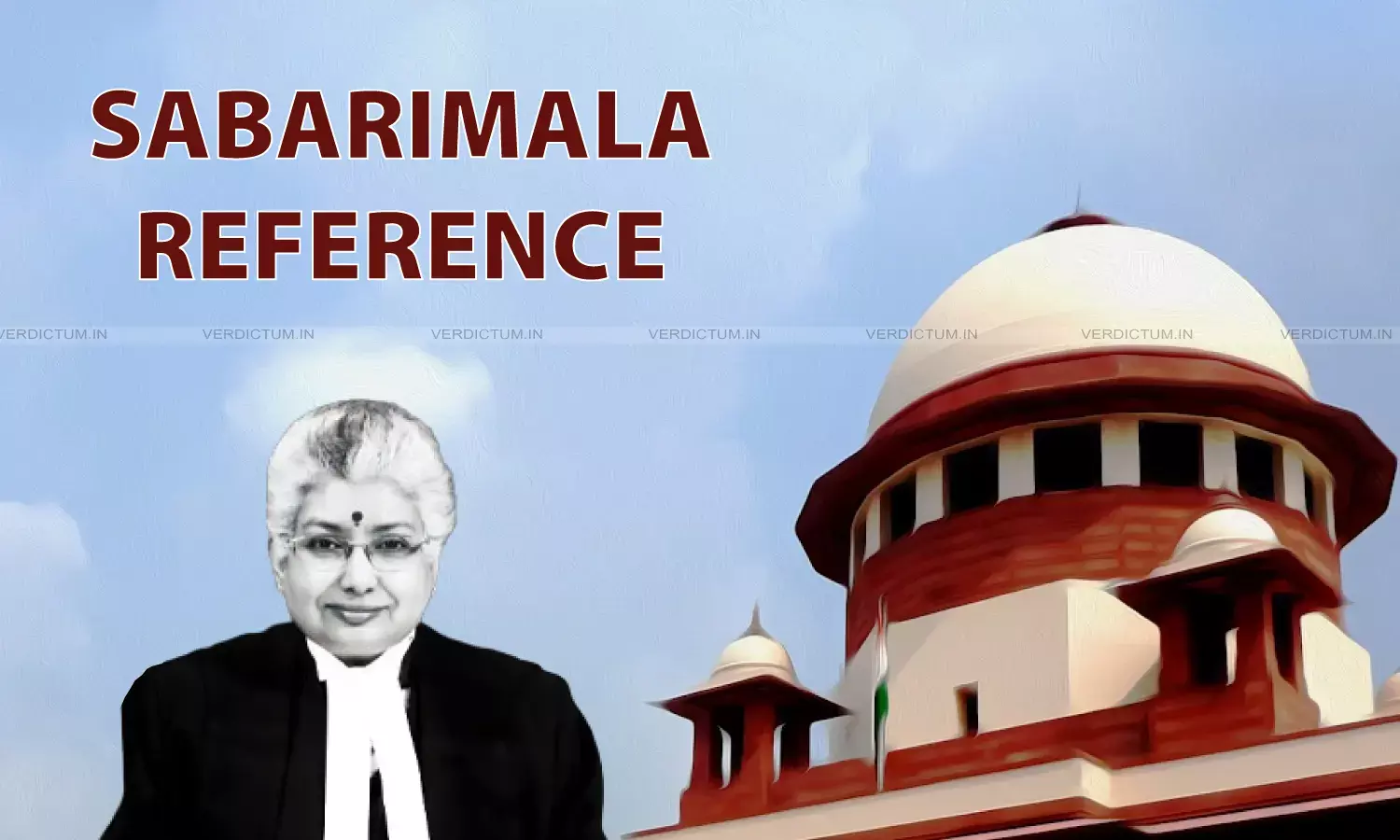
In the ongoing Sabarimala reference hearing, Justice B.V. Nagarathna pointed out that the challenge was not brought by devotees of Lord Ayyappa, but by the Indian Young Lawyers Association, a group with no direct association with the temple’s faith or practices.
Justice B.V. Nagarathna remarked, "They are not devotees. But… let us be clear. Can any devotee of Lord Ayyappa file a writ petition challenging this? It is not…If a non-devotee, a person who is not concerned with that temple, challenges it, can this Court entertain such a writ petition?...So, Mr. Solicitor, we have all been trained… we have all practised in trial courts...If a suit is filed by an association, the first question would be under Order VII Rule 11(a)...no cause of action, no causal connection ... the plaint would be rejected."
Concluding its submissions before the 9-judge Constitution Bench, Solicitor General Tushar Mehta, argued that secular courts lack the "scholarly competence" to sit in judgment over the validity or rationality of religious faith.
He also called for total abandonment of the "Constitutional Morality" doctrine as a basis for judicial review. He argued that the Courts should never test, either a legislative enactment or an administrative act, based on vague concepts that are capable of elastic interpretation, which is both subjective and individualistic.
Yesterday, April 7, 2026, the 9-judge Constitution Bench of the Supreme Court, led by Chief Justice Surya Kant, commenced the landmark hearing on the Sabarimala reference. Solicitor General (SG) Tushar Mehta, representing the Centre, led the arguments with a direct challenge to the 2018 verdict and the current judicial approach to religious practices.
Justice Nagarathna asked if the Court should entertain a writ petition challenging a religious practice when the petitioner is a "non-devotee" who is not personally affected by the custom? She questioned whether someone entirely unconcerned with a specific temple should have the legal standing to ask the Court to interfere with its internal traditions, especially under the banner of a "public interest" challenge.
Justice B.V. Nagarathna noted that in traditional litigation, a suit filed by an association without a direct "cause of action" or "causal connection" would be summarily rejected under Order VII Rule 11 of the CPC.
Mehta also raised fundamental questions regarding the use of Public Interest Litigation (PIL) to challenge religious traditions. He characterized the ongoing legal battle as a conflict between a "silent majority" and a "vocal minority," arguing that the original justification for PIL jurisdiction has significantly diminished.
Mehta pointed out that while PILs were initiated in the era of Bandhua Mukti Morcha to help those with no means to approach the Court, modern advancements like e-filing and the presence of National and District Legal Services Authorities (NALSA/DLSA) have made the judicial system far more accessible. He contended that since any citizen can now directly seek legal aid for fundamental rights violations, there is no longer a need for third-party representation of an "unrepresented class," especially when many current PILs are "motivated" by external agendas.
He said, "Your Lordships rarely sit in a Bench of nine. PIL jurisdiction was initiated in Bandhua Mukti Morcha v. Union of India, at a time when people had no means to approach the Court. I have pointed out in my written submissions that today the judicial system has become far more transparent and accessible. By e-filing, even a letter can reach the Court. Now, no one really needs representation through another for an unrepresented class. National Legal Services Authority is there. District Legal Services Authorities are there."
In response, the Chief Justice acknowledged the SG’s concerns but maintained that the Court has already evolved a rigorous internal vetting process. He noted that over the two decades between 2006 and 2026, the Supreme Court has become increasingly cautious and selective in entertaining PILs.
Chief Justice said, "If you sit in Court No. 1, you would have seen how many PILs we actually entertain. Notices are issued only when there is substance. Perhaps from 2006 to now, 2026… over these two decades, the situation has evolved, and the Court has become more cautious. The point is this: on a general principle of PIL, we may not even need to hear you. We agree with you that the Court has to be very cautious in entertaining PILs today, particularly when people come with different kinds of agendas."
The CJI emphasized that the Court now applies strict parameters to identify "substance" and filter out petitions driven by hidden agendas. While agreeing on the general principle that the judiciary must remain vigilant against the misuse of its jurisdiction, the Bench indicated that the threshold for entertaining a PIL today is far higher than in previous decades, specifically to prevent the court from becoming a tool for "vocal" interest groups.
Accordingly, the Union of India concluded its submissions, and the hearing was adjourned.
Cause Title: Kantaru Rejeevaru Vs Indian Young Lawyers Association; Sabarimala Custom Protection Forum Vs Indian Young Lawyers Association [R.P.(C) No. 3358/2018 in W.P. (C) No. 373/2006]