

Essential Religious Practice Test Must Be Replaced With Threshold Test; Constitutional Morality Will Homogenise Religious Practices: Senior Advocate Rajeev Dhavan Argues In Sabarimala Reference
He said that Article 26 should not be subordinated to individual rights under Article 25, as doing so would destroy the institutional autonomy required to manage religious affairs.

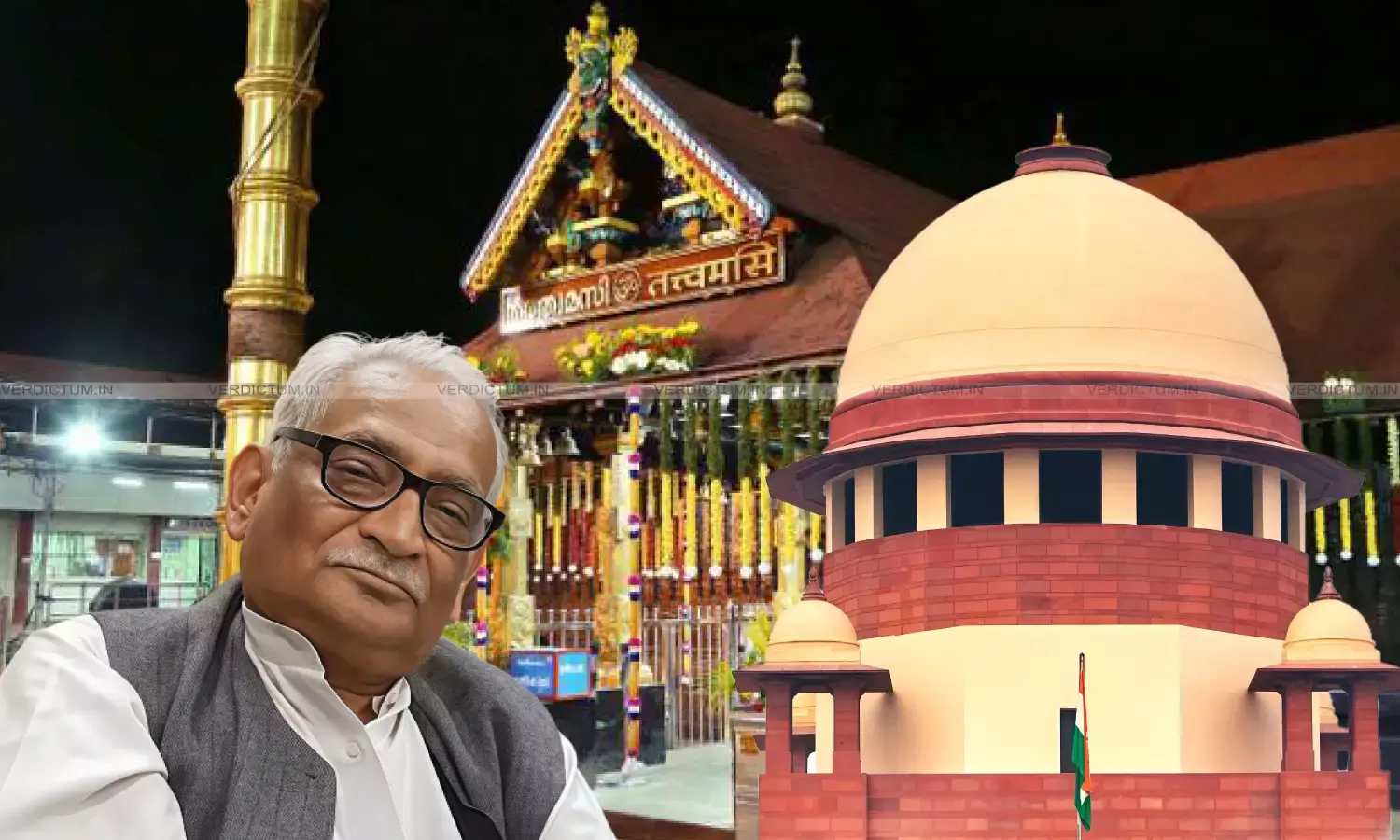
Senior Advocate Rajeev Dhavan, appearing for an intervenor, argued for a fundamental shift in how the Indian State interacts with faith. He contended that the Essential Religious Practices (ERP) doctrine has mutated from a simple inquiry into a "total collapse" test, forcing the judiciary to act as a theological body—a role he insisted judges are ill-equipped to perform.
Dhavan proposed replacing this intrusive audit with a "Threshold Test" that verifies only the bona fide sincerity and institutional roots of a religious claim, rather than its "essentiality" or scientific rationality.
The Bench comprising Chief Justice Surya Kant, with Justices B.V. Nagarathna, M.M. Sundresh, Ahsanuddin Amanullah, Aravind Kumar, A.G. Masih, Prasanna B. Varale, R. Mahadevan, and Joymalya Bagchi, was hearing review petitions and writ petitions arising out of the 2018 Sabarimala Judgment, which allowed women of all ages to enter into Lord Ayyappa's temple. The pleas were filed, inter alia, regarding the entry of Muslim women into mosques and dargahs, and the rights of Parsi women to enter Fire Temples if they have married outside their community and the legal validity of female genital mutilation within the Dawoodi Bohra community.
Arguments on behalf of Senior Advocate Rajeev Dhavan
Today, Senior Advocate Rajeev Dhavan, opened his submissions by addressing that the Court is not merely adjudicating a single Hindu practice but is defining the law for every belief and matter of conscience in India.
Dhavan argued that the Indian Constitution was uniquely designed for a civilization state, rather than a standard nation-state. He asserted that India possesses a diversity greater than Europe, sub-Saharan Africa, Russia, and the Americas combined.
Dhavan argued that the Court’s decision will profoundly impact tribal religions, where the application of social reform is often fraught with "pain." He questioned whether the State should intervene in external manifestations of belief that outsiders might deem "superstitious," asking where the line for judicial review must be drawn in these sensitive areas.
He then submitted, "After Partition, the Constitution was a solemn promise to heal a diverse nation. Healing is a part of the Constitution for everybody, this is captured by Justice Khanna...After the Emergency, it was used to fight tyranny. Today, we live under intimations of divisive forces where healing is crucial. It is a question that fell from Your Lordships, if this happens will we divide the society, if this litigation will divide society or harmonise the society?...The healing process is very much part of the interpretation of Articles 25 and 26."
Senior Advocate Rajeev Dhavan highlighted the profound judicial fragmentation in the original Sabarimala judgment, noting that the reference to a 9-judge Bench was effectively triggered by a shift in consensus. He pointed out that while the majority initially found the exclusion of women non-essential, subsequent shifts—including Justice Khanwilkar’s evolving position—led to Justice Indu Malhotra’s dissenting view on religious pluralism becoming the catalyst for the current constitutional review.
He noted that while Justices Misra, Khanwilkar, and Chandrachud championed "constitutional morality" rooted in egalitarianism, Justice Nariman viewed morality as a bar against only "abhorrent" practices. Conversely, Justice Malhotra used constitutional morality to safeguard pluralism and religious diversity, creating a "clear difference of opinion" that the current Bench must now reconcile.
Dhavan also addressed the contested status of the Ayyappa devotees as a "denomination." He warned that if the community fails this test, it loses the robust protections of Article 26, which he described as the "most important provision" in the interplay of religious rights. He further noted the divide over Article 17, where Justice Chandrachud likened the exclusion of women to "untouchability," a connection Justice Malhotra explicitly rejected.
Dhavan critiqued the emerging "narrow test" of essentiality, which asks whether the denial of a practice would fundamentally "alter the faith" of an adherent. He argued that requiring a believer to prove a total transformation of their faith just to merit protection is an overly restrictive standard that fails to account for the actual lived experience of religious devotion.
Dhavan focused on the expansive nature of "freedom of conscience" and the word "freely" in Article 25(1). He argued that conscience is a right that allows an individual to question anything—including the State and religion—provided it is done respectfully and bona fide. He interpreted "freely" as the right to follow, not follow, or even dissent from within one's own faith, citing figures like Ambedkar and Jyotiba Phule as examples of individuals whose assertion of conscience drove social transformation even before the law caught up.
Using the example of Saint Paul and the development of the Christian Church, he contended that institutions are responsible for the historical continuity of faith. He maintained that Article 26 is not merely a subset of Article 25, but a safeguard for the external expression of religious beliefs that requires its own autonomy.
Dhavan addressed the "congruence" between individual rights and institutional management. He resisted the idea that Article 26 should be subordinated to Article 25, arguing that such a move would destroy the autonomy of religious denominations. He cautioned that if the individual's right to "freely profess" is used to override the institution's right to "manage religious affairs," the specific protections and enabling powers (like social reform under Article 25(2)(b)) intended by the framers could be rendered nugatory.
'Denominations'
He then started his submissions regarding 'Denominations'. "There is a huge confusion regarding the denomination in Your Lordships' Court", he said.
Dhavan challenged the "entry simpliciter" argument, asserting that the right of an individual does not end at the temple gate. He argued that the right protected under Article 25 is not merely the physical act of crossing a perimeter, but the substantive right to worship. Dhavan emphasized that for a devotee, the "question of choice" (being told to visit another temple) is irrelevant if a specific shrine holds singular spiritual importance to them.
He contended that while certain areas like the Sanctum Sanctorum might be restricted due to denominational customs—a point he conceded to Senior Advocate Ranganathan—the right to worship generally extends to all parts of the temple. Dhavan's core submission was that the individual's right to pray and the denomination’s right to manage affairs under Article 26 must be adjusted and balanced rather than treated as a binary hand-off where one ends and the other begins.
Justice BV Nagarathna said, "Management of the institution is different from managing its own affairs in matters of religion."
He replied, "That is the important part, if you can't manage the institution and religious affairs unmashed in the institution...then where are we?"
Justice Nagarathna said, "That means no protection to non-denominational temples...But why are you saying that is so."
Dhavan replied, "What I am saying is, if Your Lordships move away from denomination and sect for a moment and look at religious institutions, then they will get broader protection."
Justice Nagarathna said, "We only want to know, is there any religion which exists without having denomination or denominational status, and still has protection?"
He warned that if the Court takes a restrictive view of what constitutes a denomination, many significant religious sites—including non-sectarian Hindu temples—would be left without the right to manage their own affairs or property.
He said that the "mistake" in the original Sabarimala ruling was the failure to recognize the Ayyappa temple as a protected entity under Article 26. He urged the 9-judge Bench to fix this by ensuring that the right to manage religious affairs is tied to the religious institution itself, preventing its autonomy from being decimated simply because it might not align with a rigid, Westernized concept of a "sect."
He then submitted, "There is an irony, you say you are not a religion but a religious denomination...now how all this occurred?"
He referred to the definition of 'denomination'. He said that they must go through five tests of 'denomination', i.e. especially the fifth element, which is absolute and exclusive distinctivness and if this fifth element is put to the test, many religious denominations will not be there.
Justice Amanullah asked, "At this juncture, we would like to know if 'religious denomination' would include 'religion' also?"
Justice Bagchi, "Mr Dhavan on your answer, the thing that you say overlaps is definitely correct that many sampradaya exercise its identity, it must be in the uniqueness of some religious practice that it manages, distinguishes it from other sampradayas or other sections of same common faith."
Dhavan said, "If it doesn't have that uniqueness, it will qualify...my quarrel with sabarimala is that they added a unique, exclusive and that was the problem because four judges went in different directions on trying to decide whether it was a denomination or not."
Doctrine of Essential Religious Practices
Dhavan then moved to the question i.e. where does the term 'Essential Practices' come from?
Dhavan said, "The problem with this essential practice is that this is a threshold so if you cant prove the threshold, you are out...Attorney general not the court invented essential practice, not the Court...this was not the argument by the court, this was the concept created by a very brilliant attorney generla..Justice mukherjee, in all three judgments rejected it...Where did it come from. The courts did not invent it. They were made to respond to it. They responded with many examples, but effectively rejected essential practices because they said it is very difficult to define and must be determined according to the tenets of the faith. And the Court is not going into the tenets of the faith."
Justice Nagarathan asked, "What happened in Sabarimala?"
Dhavan replied, "It is not an essential practice...so threshold you go out..."
The Court asked Dhavan, "Ladyship is asking if you a supportive of essential religious practice test."
Dhavan replied, "I am dead against it."
He argued that the doctrine has moved from a simple inquiry into a "total collapse" test, where a practice is only protected if its removal would cause the entire religion to perish. Dhavan contended that this standard is impossibly high and transforms the judiciary into a theological body—a role he insisted judges are ill-equipped to perform.
Dhavan further argued for the constitutional protection of beliefs that might be labeled as "superstitious," asserting that faith, by its nature, defies the scientific logic of verifiability. Invoking Karl Popper’s principles, he noted that since spiritual experiences cannot be empirically proven, subjecting them to scientific standards would cause all religions to disappear. However, he clarified that this protection must end where an external manifestation (such as witchcraft or prostitution) causes tangible secular harm or violates public order and health.
Dhavan proposed replacing the ERP test with a threshold test. This would allow the Court to verify the bona fide nature and institutional roots of a religious claim—filtering out "outlandish" or fake assertions—without the Court having to decide which specific rituals are "essential" to the creed. This approach, he suggested, would preserve the autonomy of religious institutions while ensuring they remain within the bounds of constitutional law.
Constitutinal Morality
Senior Advocate Rajeev Dhavan critiqued the elevation of "constitutional morality" from a guiding value to a formal legal limitation on religious freedom. He argued that while values like egalitarianism and pluralism are important to "imbibe," transforming them into a restrictive "ground of derogation" under Articles 25 and 26 creates a dangerous precedent that could homogenize diverse religious practices. He cited Manoj Narula, where the Court notably bypassed "constitutional morality" in favor of "constitutional trust"—the belief that high officials like the Prime Minister will act with integrity.
Dhavan asserted that the "real problem" with the 2018 Sabarimala judgment was that it introduced constitutional morality as a limitation on faith. He warned that if every religious belief is measured against a shifting, judge-led moral standard, the unique character of different religions will be erased.
Locus of the Court and PIL
Justice Nagarathna said, "The Court will add the word 'aggrieved person', then who raises this? Therefore, can, at the instance of a non-believer, the rationality of a religious practice be gone into?"
Dhavan replied, "The cause of action will lie with the believer. Suppose there is an Indian Lawyers Association which says it is a derivative body and puts forward that claim, then they may have locus. I am given to understand that someone is also appearing for a believer. That question will be decided separately."
Justice Nagarathna then said, "The cause of action of entry will always be the believer. A person cannot be on the principles of the Constitution. It has to be on the question of religious practice, because we have just said that the rationality of the practice cannot be gone into."
Accordingly, Dhavan concluded his submissions.
Arguments on behalf of Senior Advocate MR Venkatesh
Senior Advocate MR Venkatesh, representing the Aathmmarthan Trust, presented a critique of the current judicial trend of "secularizing" religious spaces. He argued that the term "denomination"—rooted in the Latin denominatio and influenced by the Irish Constitution—has been applied in a way that risks stripping non-denominational temples of their rights, potentially reducing sacred spaces to the status of a "bus stand" where any form of regulation or entry is permissible.
Venkatesh emphasized that Article 25(2)(a) and (b) are sui generis to India, with no international precedent, and must be interpreted with extreme caution. Venkatesh argued that the judiciary has "turned the whole argument upside down." While Article 25(2)(a) was intended to allow the State to regulate purely secular activities (like electoral laws or financial audits) where religion is peripheral, courts have instead begun using it to "corner" religious practices by defining what is "essential."
He invoked Dr. Ambedkar’s speeches to highlight a vital distinction missed in the 2018 Sabarimala judgment: the difference between caste-based untouchability (which is a permanent social slur) and temporary defilement (ritual purity associated with specific religious observances). He argued that conflating the two leads to a misapplication of Article 17. By merging Issues 1 and 2, Venkatesh proposed that if the Court recognizes the scope of religious freedom as "sky-high," State intervention must naturally become minimal. He asserted that any law using the "Essential Religious Practices" (ERP) test to abridge the core of a religion violates Article 13(2).
He maintained that if a law is religious in character and only incidentally secular, it should be considered absolutely non-invasive. He warned that the current practice of defining ERP has allowed the State to intrude into the religious core under the guise of regulating associated secular activities, effectively hollowing out the fundamental protections of Article 25(1).
Venkatesh turned his attention to Rule 6 of the Kerala Devaswom Rules, using it to illustrate that the restriction on entry is not an act of discrimination but a reflection of a widely observed cultural and religious discipline. He noted that Rule 6 prohibits several categories of persons from entering temple premises—including non-Hindus, those under birth/death pollution, intoxicated persons, and women during specific biological phases—to maintain the sanctity of the sacred space.
Venkatesh argued that these practices are not confined to Sabarimala or a single rule, but are part of an unwritten code of conduct followed across South India. He emphasized that even within their own homes, many women voluntarily abstain from entering puja rooms during their menstrual cycles as a matter of personal and collective faith.
On the last date of hearing, Senior Advocate Abhishek Manu Singhvi, representing Travancore Devaswom Board, contended before the 9-judge Bench that the exclusion of women aged 10–50 from the Sabarimala Temple is not an act of discrimination, but a valid classification rooted in the unique identity of the deity. He distinguished Sabarimala from approximately 999 other Ayyappa temples, noting that only this specific shrine depicts the Lord as a Naishtika Brahmachari (an eternal celibate student).
Previously, during the hearing of the Sabarimala Reference, when Justice Joymalya Bagchi highlighted the "Eclipsing" of Individual Rights of a non-believer by denominational rules, Senior Advocate CS Vaidyanathan, appearing for devotees' organisations in Kerala, submitted that individual freedom of conscience cannot defeat the freedom of community or the denomination.
On April 7, 2026, the 9-judge Constitution Bench of the Supreme Court, led by Chief Justice Surya Kant, commenced the landmark hearing on the Sabarimala reference. Solicitor General (SG) Tushar Mehta, representing the Centre, led the arguments with a direct challenge to the 2018 verdict and the current judicial approach to religious practices.
On April 8, 2026, concluding its submissions, Solicitor General Tushar Mehta argued that secular courts lack the "scholarly competence" to sit in judgment over the validity or rationality of religious faith. He also called for total abandonment of the "Constitutional Morality" doctrine as a basis for judicial review. He argued that the Courts should never test, either a legislative enactment or an administrative act, based on vague concepts that are capable of elastic interpretation, which is both subjective and individualistic.
Justice B.V. Nagarathna pointed out that the challenge was not brought by devotees of Lord Ayyappa, but by the Indian Young Lawyers Association, a group with no direct association with the temple’s faith or practices.
Cause Title: Kantaru Rejeevaru Vs Indian Young Lawyers Association; Sabarimala Custom Protection Forum Vs Indian Young Lawyers Association [R.P.(C) No. 3358/2018 in W.P. (C) No. 373/2006]