

Article 25 Is "Take It Or Leave It": Senior Advocate Gopal Sankaranarayanan Argues Dissenters Cannot Use Free Speech To Force Religious Reform
Contending that Article 26 occupies a "higher pedestal" than other rights, Sankaranarayanan, appearing for one review petitioner, urged the Bench to protect denominational autonomy from individual "horizontal" challenges.

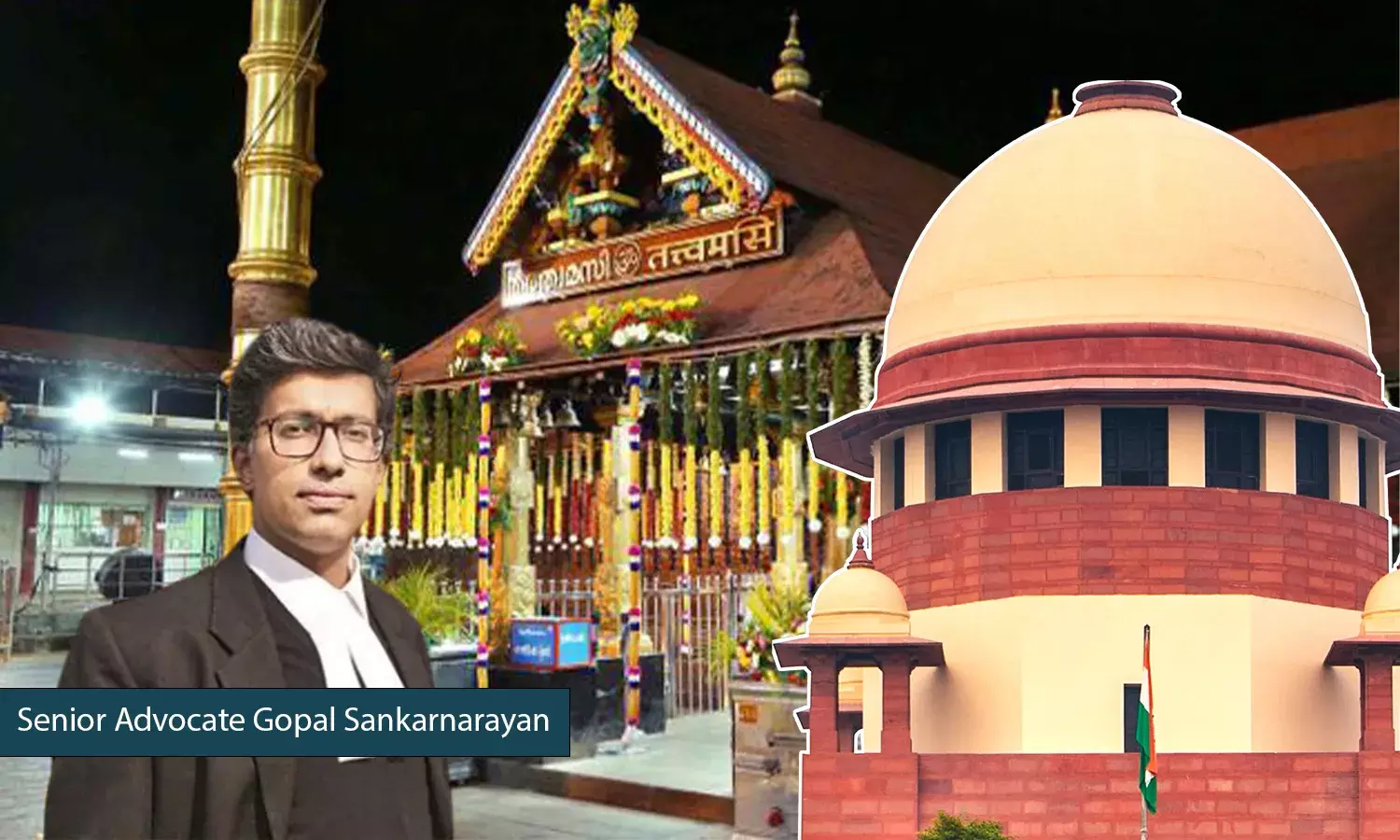
In Sabarimala Reference, today, Senior Advocate Gopal Sankaranarayanan argued that religious rights must be viewed through a "broad plane" of principle rather than the narrow facts of individual cases.
Sankaranarayanan’s central thesis was that Article 25(1) offers a "take it or leave it" protection for practicing a faith as it stands; it does not empower a believer to stay within a religion and use the courts to "correct" or reform practices they find abhorrent.
He posited that while a person has a right to dissent or debate under Article 19(1)(a) (Freedom of Speech), this right is not "horizontal"—meaning it cannot be enforced against a religious community to dismantle its established traditions.
The Bench comprising Chief Justice Surya Kant, with Justices B.V. Nagarathna, M.M. Sundresh, Ahsanuddin Amanullah, Aravind Kumar, A.G. Masih, Prasanna B. Varale, R. Mahadevan, and Joymalya Bagchi, was hearing review petitions and writ petitions arising out of the 2018 Sabarimala Judgment, which allowed women of all ages to enter into Lord Ayyappa's temple. The pleas were filed, inter alia, regarding the entry of Muslim women into mosques and dargahs, and the rights of Parsi women to enter Fire Temples if they have married outside their community and the legal validity of female genital mutilation within the Dawoodi Bohra community.
Arguments on behalf of Senior Advocate Gopal Sankarnarayan
Senior Advocate Gopal Sankarnarayan, appearing in RP(C)D.No. 38769/2018 titled "Usha Nandini v. Indian Young Lawyers Association" for the Petitioners noted that he was speaking on a point of principle. He explained that, as a matter of legal construction, he had difficulty with the majority view in the Sabarimala case on a point of law. He submitted that certain questions had to be answered in an abstract manner, without reference to the facts of any particular case. He suggested that these issues required deep reflection and rumination, as they dealt with profound areas of personal and collective faith across all religions in the country.
Sankaranarayanan agreed that the court should not look at the facts of individual cases. He stated that the matter had to be viewed on a broader plane rather than through the specific lens of the Sabarimala case. He noted that he appeared for the review petitioner in Sabarimala and other religious groups. He observed that because the nine-judge bench was reviewing these matters, they were effectively transporting themselves back to 1950, using past judgments as a template for the current legal struggle.
Sankaranarayanan adopted an approach that first examined the larger scheme of Part III of the Constitution against the backdrop of the nation’s diverse religions and denominations. Secondly, he considered specific religious practices and recurring issues. He pointed out that temple entry was a significant issue, but he also highlighted other conflicts, such as mutilation, the rights of Parsi women marrying outside their community, and the use of the hijab in schools. He argued that all these issues were encompassed by the rich cultural practices of the nation.
Within that framework, he explored the interaction between Articles 25 and 26. He noted that Justice Nagarathna had previously asked about the scope of "existing law." He pointed out that "existing law" was defined in Article 366(10) and mentioned the continuance of laws under Article 372, as well as the expression "laws in force" used in Article 13(3). He referenced a judgment from the 1950s which suggested that "laws in force" and "existing law" effectively meant the same thing.
He further explained that the definition of "law" included ordinances, orders, bylaws, rules, regulations, notifications, customs, or usages. He noted a mismatch in the language used for "laws in force" between different articles but drew attention to Article 372. He highlighted that, subject to the Constitution, all laws in force were to continue until altered or repealed. He noted that the President held the power to make adaptations and modifications to these laws to bring them into accord with the provisions of the Constitution.
Justice Nagarathna said, "If he doesn't believe in the existence of God. The agnostic believes in a higher strength or what you say a higher power, some kind of form of something... an agnostic does not believe in Gods, but he believes in a higher power. Ultimately, all are believers, either they believe in God or they belive higher God perhaps..."
Shanakarnarayan, "For the spritiual aspect of a believer not an anhilist, I would say that theh right would come from 25(1), but if I want to express myself in different fashions, whwether I want to express myself in public or if I want to be in a debate, or I want to write any newspaper, all of that comes from 19(1)(a). But to answer your Lordships' question if I am a person who has initially embraced the particular faith, and then I find that there is some practice which is abhorrent, and I want a correction of that field...that is not an expression of Article 25(1) because Article 25(1) is a take it or leave it provision...25(1) says for me is to propogate or practice religion, as it stands, you have that right under Article 25. But if there is dissent, if there is a course of correction that I want to agitate, I use my Article 19(1)(a), but I am not using it against the State...It is not a right available to me against my religion."
Justice Bagchi then said, "19(1)(a) is a horizontal right."
Shankarnarayan rebutted, "No, in my opinion, 19(1)(a) is not a horizontal right."
Justice Bagchi said, "Kaushal Kishore says that it is a horizontal right...We have to then look into Kaushal Kishore...If there is hate speech against an individual, can't he come to the Court and enforce his fundamental rights?"
Shanakrnarayan said, "In my view 19(2) gives an answer to that...it gives certain controls such as libel, defamation and slander, integrity, sovereignty of the country..."
Justice Bagchi said, "The very nature of defamation, it shows Article 19(1)(a) is not directed against the State, or not enforceable against the State, or by the State. The protection is definitely enforceable against anyone who suffers defamation, who suffers injury..."
Sankaranarayanan said, "I want to give you some examples. I am a school student. I stand up and keep interrupting the class saying I have an Article 19(1)(a) right. It is my horizontal right. I am expressing it. Is it wrong for the teacher to say I am throwing you out of class because you are disrupting it?...Can the student come back and say my Article 19(1)(a) right has been violated? My answer is no. I am clear about this. There is no horizontal right available for that person under the Constitution. There may be different disciplinary regimes, but those disciplinary regimes cannot be challenged by saying that my Article 19(1)(a) right has been violated...Because there are spaces within which discipline is required. Speech of this sort cannot, in fact, be utilized. Offices would not be able to function. Most places where you require some level of restraint would not be able to function...In fact, I know this as a personal tale, the Official Secrets Act provides that civil servants, if they speak out openly, honestly, and truthfully about what is happening in their offices, they are not protected by Article 19(1)(a), because the Official Secrets Act says that any action of this sort can..."
Justice Bagchi intervened and said, "That is because of the reasonable restriction."
Sankaranarayanan drew a parallel between religious denominations and minority educational institutions under Articles 29 and 30. He noted that while institutions run by the majority must provide reservations and accommodate 25% from the Economically Weaker Sections (EWS) under Article 21A, minority institutions are exempt from these requirements. He argued that minority institutions possess an additional right to admit students as they see fit, provided they maintain a "sprinkling" of non-minorities for balance.
He contended that religious denominations should be viewed on a similar constitutional footing. He asserted that if a denomination like the Aurobindo society required adherents to subscribe to specific principles for entry, that practice should be protected under Article 26. While he clarified that this did not permit the exclusion of "untouchables" or the use of child labor—practices explicitly abhorred by the Constitution—he argued that denominations occupy a higher pedestal because Article 26 is not specifically "subject to other parts" of the Constitution.
Sankaranarayanan further argued that Article 25(2)(b), which refers to "all classes and sections of Hindus," should not be interpreted to include gender-based exclusions or to automatically override the rights of a spiritually distinct denomination. To assist the court, he referenced the eleven-judge decision in R.C. Cooper, highlighting that the Constitution uses various methods—positive declarations, restrictions on State action, or general prohibitions—to protect fundamental rights. He emphasized that the phrase "establish and administer" appears in both Article 26 and Article 30, reinforcing the special status of these groups.
He posed several critical questions for the bench to consider:
1. What is the legal effect of the absence of a reference to Part III in Article 26?
2. Can non-Hindu religious institutions exclude specific classes or sections?
3. Can Scheduled Castes be excluded from Hindu institutions of a private character?
4. How can Article 25(2) apply to Article 26 when the text does not explicitly state it is subject to it?
Using a series of Venn diagrams, he illustrated three possible relationships between religion and denominations: as a total subset, as an overlapping entity with unique practices, or as a completely distinct entity.
Finally, he addressed the concept of "morality," arguing that it should be defined by the Court as "constitutional morality" rather than by majoritarian legislative determination. He concluded by rejecting the "Essential Religious Practices" test, asserting that it was unnecessary and that secular courts should not test ecclesiastical matters. Instead, he argued that if a practice has a connection to religion, the court should defer to the denomination's own stated beliefs.
Senior Advocate J. Sai Deepak, representing the Pandalam Royal Family and various devotee organizations such as Chetana Conscience of Women, All India Organizations of Ayappa Temples, the Shirur Mutt, the Tantri of Sree Padmanabhaswamy Temple and the Chilkoor Balaji Temple, contended that if a religious practice is inherently beyond the court's jurisdiction due to its sacred nature, the mere act of the State recognizing or "codifying" that practice through law does not suddenly grant the judiciary the power to review it.
Responding to this, Chief Justice Surya Kant remarked, "The moment you explain the wing of the state or the executive, the power of judicial review automatically comes. If the State, in the name of social welfare, prohibits a religious practice, who will examine it?...The power of judicial review...there is no need to attack on that power so much. We understand that limitations are there...but to say that there is no power at all may also be very difficult as a proposition".
Senior Advocate V. V. Giri submitted that the right to worship under Article 25(1) is not an absolute right of access, but one that must be "in sync" with the specific characteristics of the deity. He argued that since idol worship is an integral part, the unique identity of a deity—such as the Naishtika Brahmachari (eternal celibate) nature of Lord Ayyappa—forms the core of the worship conducted at the shrine.
On the last date of hearing, Senior Advocate Abhishek Manu Singhvi, representing Travancore Devaswom Board, contended before the 9-judge Bench that the exclusion of women aged 10–50 from the Sabarimala Temple is not an act of discrimination, but a valid classification rooted in the unique identity of the deity. He distinguished Sabarimala from approximately 999 other Ayyappa temples, noting that only this specific shrine depicts the Lord as a Naishtika Brahmachari (an eternal celibate student).
Previously, during the hearing of the Sabarimala Reference, when Justice Joymalya Bagchi highlighted the "Eclipsing" of Individual Rights of a non-believer by denominational rules, Senior Advocate CS Vaidyanathan, appearing for devotees' organisations in Kerala, submitted that individual freedom of conscience cannot defeat the freedom of community or the denomination.
On April 7, 2026, the 9-judge Constitution Bench of the Supreme Court, led by Chief Justice Surya Kant, commenced the landmark hearing on the Sabarimala reference. Solicitor General (SG) Tushar Mehta, representing the Centre, led the arguments with a direct challenge to the 2018 verdict and the current judicial approach to religious practices.
On April 8, 2026, concluding its submissions, Solicitor General Tushar Mehta argued that secular courts lack the "scholarly competence" to sit in judgment over the validity or rationality of religious faith. He also called for total abandonment of the "Constitutional Morality" doctrine as a basis for judicial review. He argued that the Courts should never test, either a legislative enactment or an administrative act, based on vague concepts that are capable of elastic interpretation, which is both subjective and individualistic.
Justice B.V. Nagarathna pointed out that the challenge was not brought by devotees of Lord Ayyappa, but by the Indian Young Lawyers Association, a group with no direct association with the temple’s faith or practices.
Cause Title: Kantaru Rejeevaru Vs Indian Young Lawyers Association; Sabarimala Custom Protection Forum Vs Indian Young Lawyers Association [R.P.(C) No. 3358/2018 in W.P. (C) No. 373/2006]