

Courts Not Precluded From Inquiring & Determining Basic Tenets Of Religion: Senior Advocate Gopal Subramanium In Sabarimala Reference
Gopal Subramanium was appearing in a case related to the Zoroastrian religion.

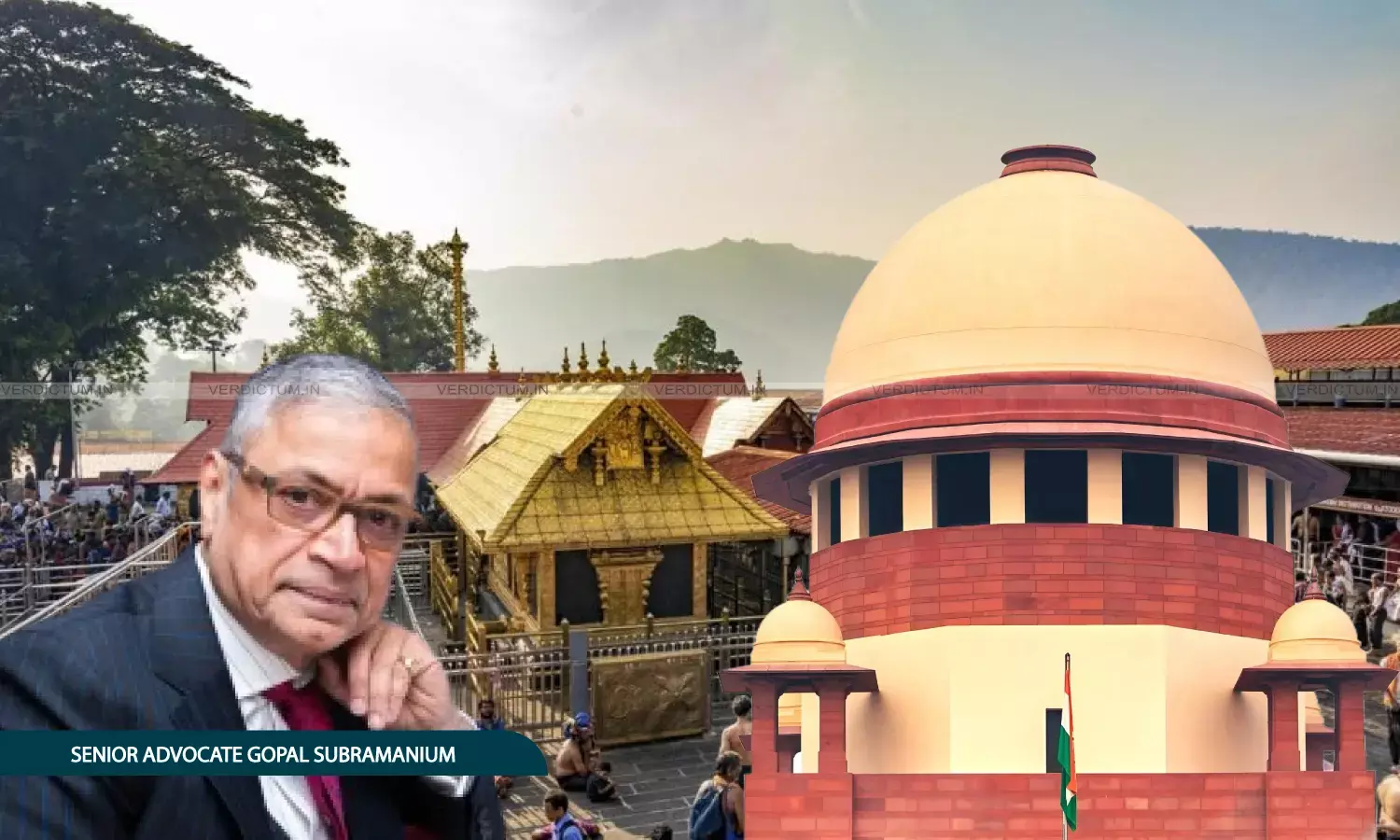
In his submissions before the 9-judge Constitution Bench, Senior Advocate Gopal Subramanium argued that the judiciary possesses the authority to inquire into and determine the fundamental tenets of a faith. He asserted that Article 26 is not merely a provision for administrative management but a robust guarantee that extends to the establishment and maintenance of institutions and the regulation of "matters of religion" under Article 26(b).
Subramanium urged the Court to reject the notion of total non-justiciability in religious matters, suggesting that the only truly "off-limits" area for a secular court is the subjective, internal faith of a devotee toward a philosophy or deity.
Beyond that personal threshold, he submitted that judges are not precluded from acquiring knowledge about a religion’s core beliefs to ensure that rights are treated with secular scrutiny and constitutional rigor.
The Bench comprising Chief Justice Surya Kant, with Justices B.V. Nagarathna, M.M. Sundresh, Ahsanuddin Amanullah, Aravind Kumar, A.G. Masih, Prasanna B. Varale, R. Mahadevan, and Joymalya Bagchi, was hearing review petitions and writ petitions arising out of the 2018 Sabarimala Judgment, which allowed women of all ages to enter into Lord Ayyappa's temple. The pleas were filed, inter alia, regarding the entry of Muslim women into mosques and dargahs, and the rights of Parsi women to enter Fire Temples if they have married outside their community and the legal validity of female genital mutilation within the Dawoodi Bohra community.
Arguments on behalf of Senior Advocate Gopal Subramanium
Senior Advocate Gopal Subramanium, appearing for Respondents in SLP, namely, Goolrokh M. Gupta v Burjor Pardiwala and Ors., which impugned the judgment passed by the Gujarat High Court holding that by marriage to a Hindu man, a Parsi woman ceased to be a Parsi, unless a competent court declares that she has continued to be a Zoroastrian after marriage.
He began his submissions by aligning himself with the Solicitor General on three foundational principles: the clear separation of State and Religion, the necessity for "narrowly tailored" and minimal State regulation, and the universal application of Articles 25 and 26 across all faiths. He argued that the term "religious denomination" in Article 26 must not be interpreted with a restricted or religion-specific meaning. Drawing on the Irish Constitution (specifically Article 44), which served as a bedrock for the Indian drafters, Subramanium noted that the term was intended to encompass entire churches, congregations, and sects alike, effectively granting equal institutional autonomy to every religious body, regardless of its size or faith.
Subramanium contended that the evolution of the law since the Shirur Mutt case requires a "course correction" to ensure that denominations are not erroneously confined only to private institutions. He defended the Ratilal decision, suggesting that Ratilal, Durgah Committee, and Shirur Mutt can be harmonized to show that a denomination is simply the institutional form—be it a trust, society, or endowment—that a religion takes to manage its affairs. By interpreting "every religious denomination" in Article 26 as a direct institutional counterpart to "religion" in Article 25, the Court would apply a uniform test across all faiths, moving away from subjective "faith" experiences toward a structured legal understanding of religious entities.
Crucially, Subramanium highlighted the dual nature of the Constitution as both a protector of religious freedom and a mandate for social reform. He noted that the framers placed "untouchability" in quotation marks in Article 17 to signify a specific historical evil they were determined to eradicate. Invoking the legacy of reformers like Raja Ram Mohan Roy and Dr. B.R. Ambedkar, he argued that Ambedkar was a proponent of a delicate balance: championing absolute equality and anti-exploitation (especially for children and the marginalized) while simultaneously seeking to safeguard the inherent human right to conscience and dignity.
He concluded that modern constitutional law requires reading Articles 14, 19, and 21 together to understand fundamental rights as a cohesive whole. In this framework, Article 25(1) declares the inherent right to religious freedom as part of human dignity, while Article 25(2) ensures that the path to social reform remains attainable. For Subramanium, the Constitution does not see reform and religion as enemies; rather, it provides a framework where institutional autonomy (Article 26) and the quest for equality (Article 17) can coexist through careful judicial harmony.
Subramanium argued that the words "profess, practice, and propagate" in Article 25 required an expansive and fundamental interpretation. He identified four distinct pillars that constituted the full scope of religious freedom under Article 25(1): the doctrinal philosophy of a faith, its associated practices, the right to worship, and the subjective extent of belief. He maintained that these rights protected individual autonomy and dignity, allowing two people to practice the same faith in entirely different ways while remaining equally shielded by the Constitution.
Subramanium emphasized that Article 25(1) operated as a foundational right of considerable breadth, though it remained subject to public order, morality, health, and other fundamental rights. He noted that the inclusion of the phrase "subject to the other provisions of this Part" ensured that one person's religious exercise did not infringe upon the equal rights of another. He further distinguished "conscience" from "religion," describing conscience as a detached faculty through which an individual absorbed philosophical truths.
Turning to Article 26, he described a "denomination" as the space where individuals collectively expressed their worship and faith. He rejected the idea that Article 26 was divorced from individual rights, asserting that members of a denomination continued to exercise their Article 25(1) freedoms even within an institutional setting. He also pointed out that denominations were not monolithic; they permitted internal deliberation, debate, and consensus-building among proponents and opponents, all of which fell under the protective umbrella of Article 26.
However, Subramanium clarified a critical boundary: while an individual possessed the liberty to choose their creed, once they became an adherent of a specific philosophy and operated within the framework of a denomination, they could not seek to alter its core doctrine from within. Finally, he proposed an organic relationship between Articles 25 and 26. He argued that the expression "all classes and sections of Hindus" in Article 25(2)(b) was intended to ensure that temple access remained open across all denominations, effectively bridging the gap between individual rights and institutional autonomy.
Subramanium said, "So My Lords, Article 26 actually has what is called a sui generis existence... without walking through the gate of 25... and an intention to form an organisation..."
He said, "A denomination is not necessarily a subset in a narrow sense. I said the entire faith can be comprehended... even sub-sects are comprehended... even those who are sections are also identifiable under Article 26(b). Cases such as Shirur Mutt and others involving particular sections would still fall within this framework and would be able to assert rights under Article 26...What is significant is that the framers were aware of the administration of religious endowments; they refer to it. It is also clear that they wanted Article 25 to be an article of the universe, giving an absolute maximum guarantee of freedom, subject to public order, morality, and the rights of others. No individual right can be exercised in violation of the rights of others, since all individuals have equal claims. At the same time, for the purposes of practice and propagation, there must be a collective form. A denomination must have the ability to acquire and hold property, and to establish and maintain institutions."
"Article 26 is not simply about management. It extends to establishing, maintaining institutions, and also regulating affairs in matters of religion, which can touch upon religious matter under 26(b). I am urging this court takes a view that nothing below this level is non-justiciable. The only area of non-justiciability is a devotee’s faith in a certain philosophy or towards a certain deity. That is completely different from a secular scrutiny of how rights are treated. If we stay within the constitutional boundaries of Articles 25 and 26, I submit that your lordships are not precluded in any way by any manner, to inquire and determine what is religion, what are the basic tenets and how is this religioius faith is being ascertain...in all these cases judges have been able to acquire a certain knowledge about the fundamental tenets of faith, and when I say faith, I mean religion...", he added.
Justice Joymalya Bagchi said, "I would understand you to mean that Article 25(2)(b) is a narrow window of legislative competence, in accordance with law, qualifying clauses (c) and (d) of Article 26, namely the management of property. That is, any general law can interfere with the right of a denomination to hold and manage property... But when it impacts matters of religion, the legislative competence is confined to Article 25(2)(b), i.e., social reform or social welfare alone. So, a general law cannot make an inroad. This is what you are trying to say...From there, the next clarification I seek from you is this... The words are 'social reform' and 'social welfare'... Will the State be within its limits if it says that it is enforcing constitutional duties while making a law under the ambit of social reform? Because the State has constitutional duties under the Directive Principles of State Policy, and a duty to enforce the fundamental duties of citizens. Will these qualify as social reform legislation?"
Subramanium replied, "Let us take the case of superstitions, or let us take a case of completely... practices which are abhorrent to morality... The legislature can intervene; it can intervene on the grounds of social welfare and reform. So, it is not that social welfare and reform are very limited... they can be actuated by a proper purpose. However, what I am submitting is the extent of invasion..."
Justice Bagchi intervened and asked, "The word is 'social', and Directive Principles are constitutional visions. So, whether the constitutional visions of the State can be a part of social reform legislation?"
Subramanium responded by describing the question as profound but cautioned against an over-expansive interpretation of the State's power to reform. He argued that because religious freedom and conscience were part of the basic structure of the Constitution, any legislation enacted under Article 25(2)(b) had to be read strictly. He maintained that there must be a clear and direct nexus between the identified need for reform and the legislative objective, warning that without such constraints, the provision could lead to the gradual erosion of religious liberty.
Subramanium further contended that even customs and usages that were not deemed "essential religious practices" deserved judicial respect if they formed part of a long-standing tradition or denominational practice. He suggested that when a law permitted entry into a temple in the name of social reform, the Court was required to apply strict scrutiny and examine the proportionality of the invasion. He emphasized that the State could not use Part III or the Directive Principles as an independent source of power to intervene beyond the specific framework provided within Article 25.
While acknowledging the importance of the Preamble's commitment to social and economic justice, Subramanium argued that the Essential Religious Practices (ERP) doctrine remained a useful tool for courts. He asserted that the doctrine allowed the judiciary to distinguish between genuine religious claims and extraneous or superstitious elements. He concluded that while the State had a valid role in reform, it must not allow "social welfare" to become an overarching provision that hallowed out the institutional autonomy of religious denominations.
Subramanium bridged the gap between ancient Indian philosophy and modern constitutionalism by citing Rabindranath Tagore. He noted that the principle of equality is not merely a secular import but is deeply rooted in the Upanishadic tradition, which emphasizes the unity of all beings through the consciousness of the eternal. By referencing the Durga Saptashati and the expression "Ya Devi Sarva Bhuteshu," he argued that the recognition of the divine in all beings demonstrates that universality and equality have always been central to Indian religious thought.
Subramanium further explored the constitutional meaning of "conscience" as protected under Article 25. He defined it as an inward knowledge and internal conviction—a faculty of the mind that allows for an inner sense of right and wrong. He maintained that while conscience and religion are related, they are not identical: religion is an organized system of beliefs with a doctrinal foundation, whereas conscience is a deeply personal, internal faculty that can exist even in agnostics or atheists.
Justice B. V. Nagarathna intervened to clarify the legal implications of this distinction, noting that conscience, in its internal form, is essentially non-justiciable. She observed that the Court cannot sit in judgment of the rationality or quality of a person’s inner thoughts. However, she emphasized that once conscience manifests as a physical action affecting the rights of others, it enters the realm of judicial review and must be justified by legal principles rather than subjective belief.
The discussion concluded with a focus on Constitutional Morality. Subramanium described it as the underlying thread that ensures the Constitution remains a "living instrument." He argued that this morality does not just apply to governance but flows from the very spirit of the Constitution, balancing the subjective experience of faith with the objective necessity of a harmonious, rights-respecting society.
Justice Ahsanuddin Amanullah said, "Thank you for clarifying that... If I understood you correctly, there is a connection between God and faith. However, when a temple is set up by a denomination, if you want to go to that particular temple, then the beliefs of that denomination have to be adhered to. It is not a restriction on your connection with that deity, but that will have to be respected... because that temple has been set up by that denomination with a particular belief and a set of principles that will come under protection under Article 26..."
Justice Amanullah observed that all human beings are bound by conscience, regardless of its quality. Subramanium agreed, linking this faculty to the Universal Declaration of Human Rights. He noted that the capacity for internal conviction and an inner sense of right and wrong is what fundamentally distinguishes a human being.
Subramanium’s submission suggested that while constitutional morality provides the "spirit" for interpreting laws, the actual judicial function must remain grounded in the literal provisions of the Constitution to avoid judicial overreach.
Subramanium concluded, "In these written submissions... Your Lordships will notice the word 'every denomination' occurs without fail, and it is in the context of religion that 'every denomination' must necessarily mean 'religious denomination.' So, the broader religious denomination subsumes all sections thereof. I, therefore, submit that the definition of religion as propounded by Justice Mukherjee—although he said, 'I can't give a right definition,' but later says, 'it is a system of beliefs connected in an organic whole'—should be accepted."
Justice Amanullah said, "Article 25 is the Right to Freedom of Religion, but then it uses the words 'freedom of conscience and free propagation of religion.' Is it not an indication that conscience itself cannot be equated with religion itself? Can your conscience, or any form of religious association with it, be equated standalone? Just above that is the Right to Freedom of Religion, but then the phrasing is 'conscience AND religion' with regard to the free profession, practice, and propagation of religion. Would it not be just a standalone matter of pure conscience? Can all of this be equated with that of a religion?"
Subramanium replied, "Religion is in the context of a set of beliefs enjoyed over a period of time, establishing a lot of doctrine that might be external to the person. So religion, in that sense, could be overlapping. As I said, in terms of the acts of conscience, but in terms of calling it 'religion'—well, if your Lordships were to use the word religion as an adjective, that is, as a word indicating it is as important as religion, I don't think I would have anything to say...Yes, it is as important as religion because there can be a host of people who are agnostic or atheistic, and they all may have the soundest and most robust conscience. It's perfectly possible. So, I would say that conscience does have a unique place in the setting of Article 25. Your Lordships can say it is perhaps as exalted as religion, but the meaning may not be identical."
Senior Advocate Gopal Sankaranarayanan argued that religious rights must be viewed through a "broad plane" of principle rather than the narrow facts of individual cases. Sankaranarayanan’s central thesis was that Article 25(1) offers a "take it or leave it" protection for practicing a faith as it stands; it does not empower a believer to stay within a religion and use the courts to "correct" or reform practices they find abhorrent.
Senior Advocate J. Sai Deepak, representing the Pandalam Royal Family and various devotee organizations such as Chetana Conscience of Women, All India Organizations of Ayappa Temples, the Shirur Mutt, the Tantri of Sree Padmanabhaswamy Temple and the Chilkoor Balaji Temple, contended that if a religious practice is inherently beyond the court's jurisdiction due to its sacred nature, the mere act of the State recognizing or "codifying" that practice through law does not suddenly grant the judiciary the power to review it.
Responding to this, Chief Justice Surya Kant remarked, "The moment you explain the wing of the state or the executive, the power of judicial review automatically comes. If the State, in the name of social welfare, prohibits a religious practice, who will examine it?...The power of judicial review...there is no need to attack on that power so much. We understand that limitations are there...but to say that there is no power at all may also be very difficult as a proposition".
Senior Advocate J. Sai Deepak, representing the Pandalam Royal Family and various devotee organizations such as Chetana Conscience of Women, All India Organizations of Ayappa Temples, the Shirur Mutt, the Tantri of Sree Padmanabhaswamy Temple and the Chilkoor Balaji Temple, contended that if a religious practice is inherently beyond the court's jurisdiction due to its sacred nature, the mere act of the State recognizing or "codifying" that practice through law does not suddenly grant the judiciary the power to review it.
Senior Advocate V. V. Giri submitted that the right to worship under Article 25(1) is not an absolute right of access, but one that must be "in sync" with the specific characteristics of the deity. He argued that since idol worship is an integral part, the unique identity of a deity—such as the Naishtika Brahmachari (eternal celibate) nature of Lord Ayyappa—forms the core of the worship conducted at the shrine.
On the last date of hearing, Senior Advocate Abhishek Manu Singhvi, representing Travancore Devaswom Board, contended before the 9-judge Bench that the exclusion of women aged 10–50 from the Sabarimala Temple is not an act of discrimination, but a valid classification rooted in the unique identity of the deity. He distinguished Sabarimala from approximately 999 other Ayyappa temples, noting that only this specific shrine depicts the Lord as a Naishtika Brahmachari (an eternal celibate student).
Previously, during the hearing of the Sabarimala Reference, when Justice Joymalya Bagchi highlighted the "Eclipsing" of Individual Rights of a non-believer by denominational rules, Senior Advocate CS Vaidyanathan, appearing for devotees' organisations in Kerala, submitted that individual freedom of conscience cannot defeat the freedom of community or the denomination.
On April 7, 2026, the 9-judge Constitution Bench of the Supreme Court, led by Chief Justice Surya Kant, commenced the landmark hearing on the Sabarimala reference. Solicitor General (SG) Tushar Mehta, representing the Centre, led the arguments with a direct challenge to the 2018 verdict and the current judicial approach to religious practices.
On April 8, 2026, concluding its submissions, Solicitor General Tushar Mehta argued that secular courts lack the "scholarly competence" to sit in judgment over the validity or rationality of religious faith. He also called for total abandonment of the "Constitutional Morality" doctrine as a basis for judicial review. He argued that the Courts should never test, either a legislative enactment or an administrative act, based on vague concepts that are capable of elastic interpretation, which is both subjective and individualistic.
Justice B.V. Nagarathna pointed out that the challenge was not brought by devotees of Lord Ayyappa, but by the Indian Young Lawyers Association, a group with no direct association with the temple’s faith or practices.
Cause Title: Kantaru Rejeevaru Vs Indian Young Lawyers Association; Sabarimala Custom Protection Forum Vs Indian Young Lawyers Association [R.P.(C) No. 3358/2018 in W.P. (C) No. 373/2006]