

Nothing Which Goes Against Grain Of Constitution Can Be Countenanced In Civilized Society: Raju Ramachandran On Limits Of Judicial Review In Sabarimala Reference
The Court remarked that India remains a resilient civilization due to the deeply intimate and constant relationship between its people and religion.

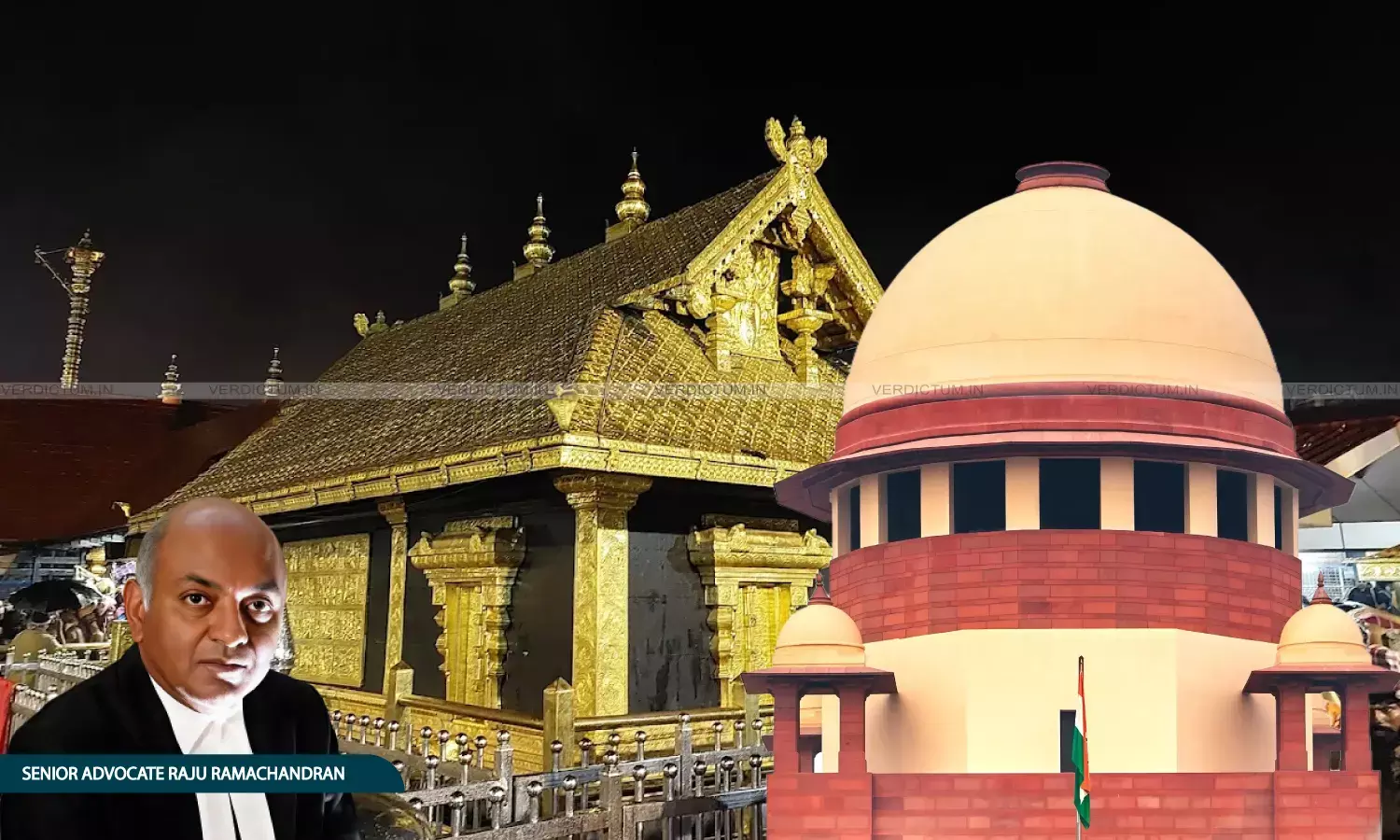
During the hearing of the Sabarimala reference, the Supreme Court reflected on the delicate balance between preserving India's ancient religious "constant" and upholding constitutional mandates.
Justice B.V. Nagarathna and Justice M.M. Sundresh questioned the long-term consequences of opening the judicial door to internal religious disputes, warning that it could lead to the collapse of pluralistic traditions if every practice were litigated.
In response, Senior Advocate Raju Ramachandran, representing in the matter concerning Excommunication in Dawoodi Bohras, contended that India is a "civilization under a Constitution" where no practice—including excommunication—could be countenanced if it violated human dignity or resulted in "civil death."
Justice Nagarathna said, "Everybody starts questioning certain religious practices or matters of religion before a constitutional court, then what happens to this civilization, where religion is so intimately connected with Indian society? There will be hundreds of petitions questioning this right, that right, opening of the temple, closure of the temple, right?...We are very, very conscious of this..."
Justice M M Sundresh intervened and said, "See what my sister is putting to you that if this happens, every religion will break and every constituional court will have be to closed because ultimately what you are seeking before us, it is, your belief, your practice or every injury that emanates out of it...vis-a-vis right of another person or in the form of religious denomination...everybody will question everything...it is more like an in-house setup...you may say that this is a civil wrong, so I will be coming to you. In other case, another member will say I don't agree with this...Now what extent we can go into these aspects?"
Justice B. V. Nagarathna said, "You can give your response...but I would like to add to my learned brother views. What is unique about India as compared to any other region? See, we are a civilization. Why are we a civilization despite having so many pluralities and diversities? I said diversity is our strength. We are still a civilization, despite, you may call us a sovereign democratic republic, but there is still a constant. One of the constants in our Indian society is the relationship of human beings, man, woman or child, with religion. It is so intimate to everybody. Now, when a religious practice or a matter of religion is questioned, where it is questioned, why it is questioned, whether it can be questioned, whether the questioning has to come from within the denomination itself for reform, or whether the State will have to do it, or whether the Court will have to adjudicate upon all these aspects, these are the things troubling us. See, what we lay down as a 9-judge Bench is for a civilization. That civilization is India. India has progressed despite all its developments, economy and eveything else. There is still a constant within us. We cannot break that constant. That is what is troubling us."
To this, Senior Advocate Raju Ramachandran answered, "We are a civilization under a Constitution, and therefore nothing which goes against the grain of our Constitution can be countenanced in a civilized society governed by the Constitution and it requires judicial statesmanship. That is where the task of the courts, the very difficult task of the courts, comes in. There the courts cannot throw up their hands and say that otherwise there will be too many petitions. No! It is then the duty and responsibility of the Court to determine whether there is a clear violation of fundamental rights warranting constitutional protection, or whether it is merely a difference between members of a religion which does not rise to that level...Ultimately, it is upon the Court's wisdom and statesmanship. But this does not mean that there can be a judicial hands off approach. In my humble and respectful submission, that position cannot be accepted."
Senior Advocate Raju Ramachandran submitted before the 9-judge Constitution Bench that the practice of excommunication directly impinged upon human dignity. He highlighted that in the Dawoodi Bohra sect, children upon attaining puberty took an oath of absolute allegiance to the Dai (religious head), surrendering their lives to his authority in both spiritual and temporal matters. He cited instances where individuals were excommunicated for secular actions, such as forming a cooperative society without the Dai's permission, which he argued resulted in a form of "civil death."
The counsel clarified that while various faiths imposed religious discipline to preserve communal cohesion—citing the example of the Akal Takht declaring leaders as Tankhaiya in the Sikh tradition—the issue at hand was the proportionality and impact of such punishments. He explained that excommunication among Dawoodi Bohras led to the breakdown of marriages, loss of employment, and total social ostracism. Most significantly, he noted that excommunicated individuals were barred from entering mosques and denied burial in community graveyards, effectively stripping them of their fundamental rights under Article 25(1).
During the exchange, Justice Nagarathna inquired if the practice of excommunication was still prevalent, to which the counsel replied in the affirmative. He argued that the Court could not decide the scope of Articles 25 and 26 in an academic vacuum without considering these factual realities. He maintained that just as the Parsi case involved the agency of women, the Bohra case involved the protection of human dignity against practices like social boycotts. Chief Justice Surya Kant noted that these facts were being placed before the Bench as illustrative context rather than for individual adjudication.
Justice Nagarathna pointed out that the original legal challenge regarding excommunication involved a conflict between the Syedna's denominational rights and state laws intended to protect community members. She observed that the affected community members were direct stakeholders who had not been properly impleaded in earlier rounds of litigation.
Ramachandran also emphasized the long-standing suffering of families who had faced humiliation and indignity for generations. He rejected the notion that the current proceedings were a mere procedural or "one-party" review, asserting that fundamental rights under Article 21 could never be waived.
Justice B.V. Nagarathna questioned how the Court should handle competing claims if another group within the same community approached the Bench to demand the restoration of excommunication as a protected religious right. She expressed concern over the Court's potential role in continually adjudicating internal denominational disputes.
Justice Amanullah probed the counsel’s use of "proportionality," noting the difficulty in reconciling it with Article 26’s guarantee of denominational autonomy. He suggested that if a practice had even a "slight tinge" of religion, it might fall entirely within the denomination's discretion. He cautioned that allowing the Court to test the proportionality of religious acts could dilute constitutional protections, challenging the counsel to justify judicial intervention in practices with a religious flavor.
Justice Amanullah said, "I will use an analogy, that what has been said is that under the garb of power under Article 26 a religion cannot be made hollow and by excommunication an individual can not be made hollow...to that extent the individual has to an individual in the sense of a living human being as it is required to be."
Then, Senior Advocate Raju Ramachandran argued that constitutional morality represents an evolving "constitutional ethos" that must inform the interpretation of religious rights. He contended that, much like the Basic Structure doctrine, this concept protects vulnerable citizens and cannot be frozen in its original 1948 context.
Justice Joymalya Bagchi cautioned against using such a broad term as a direct touchstone for constitutional validity. He suggested that religious practices should instead be tested against specific fundamental rights, such as Articles 15, 17, or 21, to avoid making the law ubiquitous or vague.
Ramachandran concluded by noting that a five-judge Bench had specifically referred the issue of excommunication to this 9-judge Bench because the constitutional question regarding the practice survived, regardless of existing statutes.
The Bench comprising Chief Justice Surya Kant, with Justices B.V. Nagarathna, M.M. Sundresh, Ahsanuddin Amanullah, Aravind Kumar, A.G. Masih, Prasanna B. Varale, R. Mahadevan, and Joymalya Bagchi, is hearing review petitions and writ petitions arising out of the 2018 Sabarimala Judgment, which allowed women of all ages to enter into Lord Ayyappa's temple. The pleas were filed, inter alia, regarding the entry of Muslim women into mosques and dargahs, and the rights of Parsi women to enter Fire Temples if they have married outside their community and the legal validity of female genital mutilation within the Dawoodi Bohra community.
Previously, the Supreme Court made scathing remarks against the Indian Young Lawyers Association (IYLA), the petitioner in the original Public Interest Litigation (PIL) on the Sabarimala issue.
The Court also remarked, while questioning the locus standi of the Indian Young Lawyers Association, which had filed the PIL in the Sabarimala matter in 2006, that its President, Advocate Naushad Ahmed Khan, should have attempted to put his house in order first before challenging the custom in the Temple.
Senior Advocate Indira Jaising concluded her arguments by arguing that the argument for non-intervention of the Court in the present religious matter is a "direct attack on the right of judicial review."
Justice B.V. Nagarathna questioned the "one-day" devotion of a petitioner visiting the shrine at age 40, leading Jaising to defend introspection as the heart of religion.
Cause Title: Kantaru Rejeevaru Vs Indian Young Lawyers Association; Sabarimala Custom Protection Forum Vs Indian Young Lawyers Association [R.P.(C) No. 3358/2018 in W.P. (C) No. 373/2006]