

We Respect Introspection, But It Does Not Happen Only On One Day: Justice Nagarathna Questions Sudden Decision Of Lady Petitioners To Visit Sabarimala
Justice Nagarathna remarked that restraints observed by women during periods should be viewed as respect for the deity.

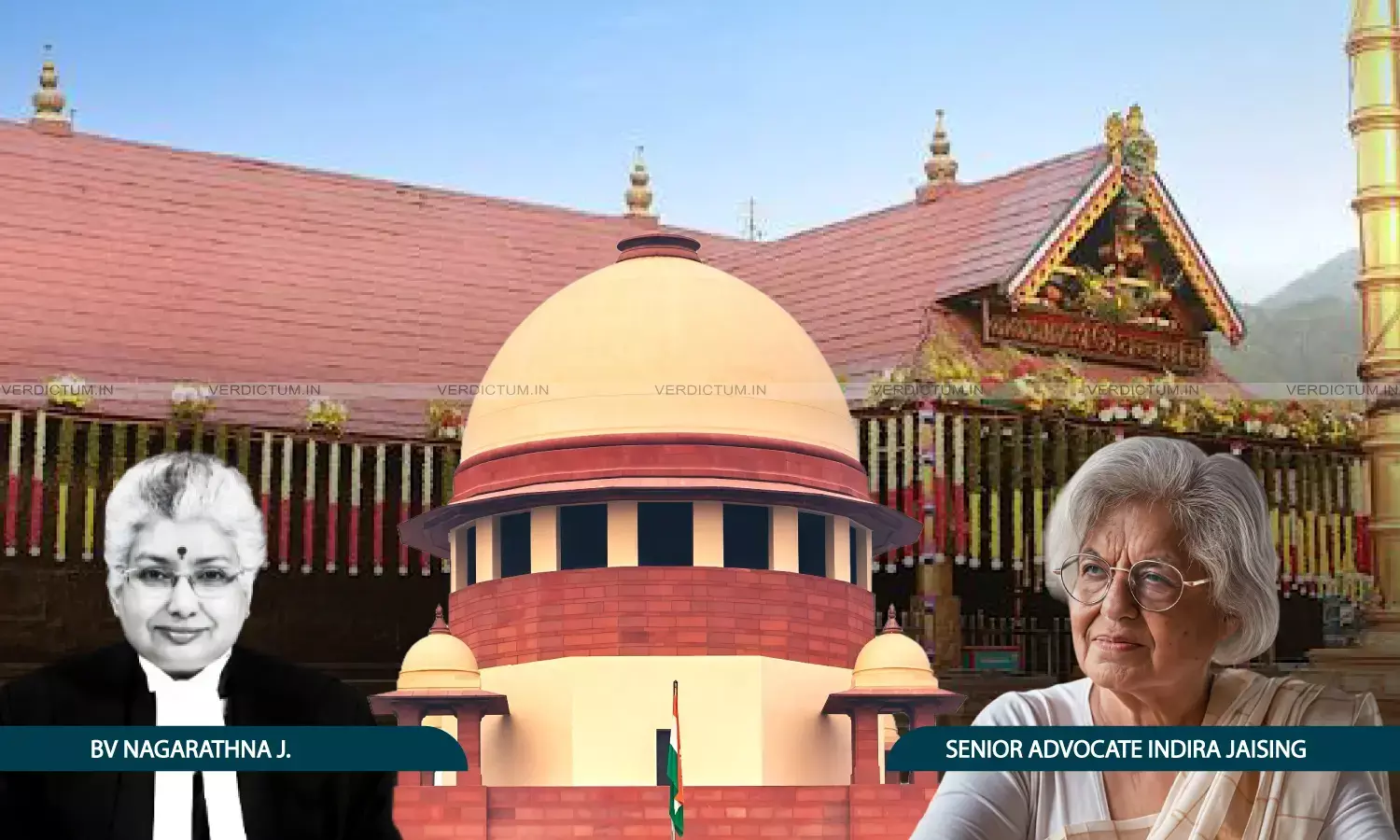
The nine-judge Constitution Bench continued its hearing on the Sabalimala reference, where Justice B.V. Nagarathna expressed scepticism regarding the devotional credentials of a lady petitioner who visited the shrine at age 40 after a nearly three-decade absence.
While Senior Advocate Indira Jaising defended the visit as an act of "introspection"—which she termed the heart of religion—Justice Nagarathna countered that true devotion typically involves consistent observance rather than a sudden realization, remarking, "We respect introspection, but it does not come only one day."
Justice Nagarathna also suggested that traditional restraints observed by women during certain periods should be viewed as respect for the deity, similar to the restraint practiced during times of birth or death in a family. However, Jaising challenged this view by sharing personal experiences of being barred from family rituals and funerals, arguing that the underlying basis for these restrictions is the harmful perception of being "polluted" or "defiling" a space. She concluded by questioning why the law should allow a woman’s biological nature to restrict her for the entire expanse of her creative life.
The Bench comprising Chief Justice Surya Kant, with Justices B.V. Nagarathna, M.M. Sundresh, Ahsanuddin Amanullah, Aravind Kumar, A.G. Masih, Prasanna B. Varale, R. Mahadevan, and Joymalya Bagchi, was hearing review petitions and writ petitions arising out of the 2018 Sabarimala Judgment, which allowed women of all ages to enter into Lord Ayyappa's temple. The pleas were filed, inter alia, regarding the entry of Muslim women into mosques and dargahs, and the rights of Parsi women to enter Fire Temples if they have married outside their community and the legal validity of female genital mutilation within the Dawoodi Bohra community.
Senior Advocate Indira Jaising, representing two women who had entered the Sabarimala Temple, commenced her submissions by highlighting that the 2018 judgment remained in full force and had not been stayed by the Court. She proposed a distinct approach to the case, arguing that a constitutional text must be read differently from a simple statute; while a statute might be interpreted semantically, a constitution requires a broader, transformative reading. She informed the Bench that she would confine her arguments specifically to the right of temple entry, asserting that this focus would effectively address the core legal questions.
Jaising contended that the Court could not recognize any custom or practice under Articles 25 or 26 if it violated the non-discrimination principles of Article 15. She specifically represented two Hindu women from Kerala, Bindu and Kanaka Durga, one of whom belongs to a Scheduled Caste. Jaising raised a fundamental question: whether the abolition of untouchability under Article 17 applied only to men or protected all persons. She argued that since men of all castes are permitted entry due to Article 17, denying entry to a Scheduled Caste woman based on her gender constituted a double deprivation.
Intersectional Discrimination: Gender, Caste, and the Right to Access
Senior Counsel submitted her arguments on temple entry. She said, "Lets take a case of female genital mutilation. There is an organization which is claiming that in exercise of power of religion, protected by Article 24, 25, 26, they have the power to perform female genital mutilation on girls about 7 years of age. This Court ia called to decide the constitutional validity? Is that something part of religion or not? Even if it, let me go to the extent of saying it is. Are you going to give constitutional sanctity to it? Or you will say, no, you cannot mutilate a child's body, in the name of religion."
Jaising expanded on her argument that religion is a matter of status, comparing it to the institution of marriage. She contended that identifying with a religion is a legal identity that the world must recognize. She introduced a significant dimension to this: that religion is largely inherited at birth. Since a child legally takes the religion of their parents through guardianship and custody, Jaising argued that individuals have no control over this identity until they reach the age of majority and choose to continue or exit that faith.
Jaising also drew a parallel between the current religious reference and the marital rape exemption case. She argued that just as religious practices must be scrutinized for equality, the institution of marriage should be defined as one of mutual respect and affection. She criticized the "deemed consent" theory—the idea that marriage implies permanent consent to sexual relations—as a violation of equality. She noted that while the Government of India is defending the exemption, the Delhi High Court's split verdict on its constitutionality highlights the deep legal tension between traditional exemptions and fundamental rights.
Jaising said that the Petitioner lady went to the temple when she was around 40 years of age and never went again. Justice Nagarathna asked, "Has she gone earlier?"
Jaising replied, "Yes, she has gone with her father at the age of 11."
Justice Aravind Kumar asked, "Then what was she doing between the age of 11 of 40?...why did she not go?"
Jaisingh replied, "She was studying. She became a lawyer. Then she was a teacher at a law school. She started teaching and after the judgment came, she went."
Justice Kumar replied, "So one day she woke up?"
Justice Nagarathan asked, "Is she a devotee?"
Jaising replied, "Can I answer it little later?...If I give you an answer saying she went to introspect, will you be satisfied?... Introspection is the heart of the religion."
Justice Nagarathna said, "We respect introspection, but it does not come only one day...See when there is a birth in a family and where there is a death in the family...Those days they don't go as their is restraint...only for the respect for God...True devotees who are women between 10 to 50, they also observe this restraint and stay away, after 50, they will go."
Jaising said, "It operates in my personal house. I was not allowed to touch my mother during these periods. As you know, they are not even allowed to go to the funeral pyre...they are not allowed to carry the funeral pyre. We know all these things, but the question is, is it right or wrong?...In my family, every single daughter of the family attended the funeral of our funeral, nobody stopped us, no tantri stopped us...We are talking about what the basis is. The basis is that polluted and polluted during these periods from 10 to 50. I am defiling if I go in. How can you take the whole expanse of my life?"
Justice Nagarathna remarked, "Why do you perceive it in the form of pollution or defilement...don't perceive it in that form."
Previously, Justice Ahsanuddin Amanullah highlighted the necessity of institutional norms, remarking that without a recognized body to regulate worship and sequences, religious spaces would descend into "anarchy." Advocate Nizam Pasha, representing the Peerzada of the Nizamuddin Dargah, argued that "entry" is the critical meeting point between an individual’s right to worship and a community’s right to manage its internal affairs.
Senior Advocate Neeraj Kishan Kaul concluded his submissions by referencing an article by Shashi Tharoor. While Chief Justice Surya Kant reminded the counsel that personal opinions of eminent persons remain subjective, Kaul argued that "knowledge and wisdom" from any source, university, or country should be embraced. Justice B.V. Nagarathna interjected with a sharp, witty remark, clarifying that such openness does not extend to the misinformation frequently associated with "WhatsApp University".
Senior Advocate Mukul Rohatgi contended that the "morality" was never meant to create a restriction, because the moment it is an additional restriction via 'constitutional morality,' it will dilute the content of Articles 25 and 26. Therefore, constitutional morality has no place as a restriction in our Constitution."
Cause Title: Kantaru Rejeevaru Vs Indian Young Lawyers Association; Sabarimala Custom Protection Forum Vs Indian Young Lawyers Association [R.P.(C) No. 3358/2018 in W.P. (C) No. 373/2006]