

"Is Religion Hands-Off For This Court?": Senior Advocate Indira Jaising Says That This Proposition Is Direct Attack On Judicial Review
Senior Advocate Indira Jaising represented the women petitioners who entered the Sabarimala temple on the strength of the Judgment of the Apex Court.

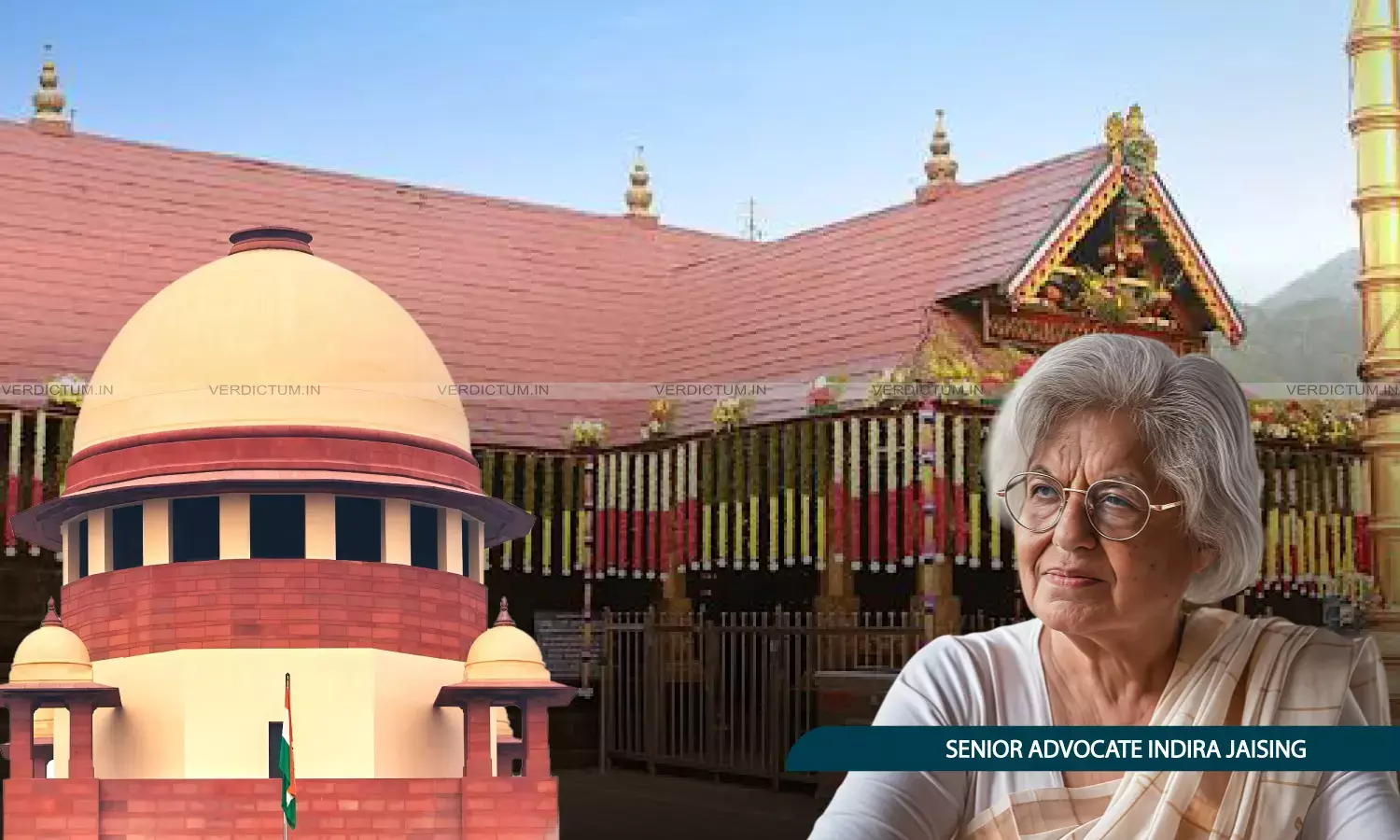
Senior Advocate Indira Jaising concluded her arguments by arguing that the argument for non-intervention of the Court in the present religious matter is a "direct attack on the right of judicial review."
She questioned whether the Court was being told that religious practices are effectively "hands-off" for the judiciary, even when they infringe upon fundamental rights.
Justice B.V. Nagarathna questioned the "one-day" devotion of a petitioner visiting the shrine at age 40, leading Jaising to defend introspection as the heart of religion.
While Jaising argued that the State's power under Article 25(2)(b)—which she labeled the "hero" of religious rights—must override exclusionary traditions like those involving perceived "pollution," the Bench cautioned against a radical individualism that could lead to the "annihilation of religion."
The Bench comprising Chief Justice Surya Kant, with Justices B.V. Nagarathna, M.M. Sundresh, Ahsanuddin Amanullah, Aravind Kumar, A.G. Masih, Prasanna B. Varale, R. Mahadevan, and Joymalya Bagchi, was hearing review petitions and writ petitions arising out of the 2018 Sabarimala Judgment, which allowed women of all ages to enter into Lord Ayyappa's temple. The pleas were filed, inter alia, regarding the entry of Muslim women into mosques and dargahs, and the rights of Parsi women to enter Fire Temples if they have married outside their community and the legal validity of female genital mutilation within the Dawoodi Bohra community.
Intersectional Exclusion and the Abolition of Untouchability
Senior Advocate Indira Jaising, representing two women who had entered the Sabarimala Temple, commenced her submissions by highlighting that the 2018 judgment remained in full force and had not been stayed by the Court. She proposed a distinct approach to the case, arguing that a constitutional text must be read differently from a simple statute; while a statute might be interpreted semantically, a constitution requires a broader, transformative reading. She informed the Bench that she would confine her arguments specifically to the right of temple entry, asserting that this focus would effectively address the core legal questions.
Jaising contended that the Court could not recognize any custom or practice under Articles 25 or 26 if it violated the non-discrimination principles of Article 15. She specifically represented two Hindu women from Kerala, Bindu and Kanaka Durga, one of whom belongs to a Scheduled Caste. Jaising raised a fundamental question: whether the abolition of untouchability under Article 17 applied only to men or protected all persons. She argued that since men of all castes are permitted entry due to Article 17, denying entry to a Scheduled Caste woman based on her gender constituted a double deprivation.
Substantial Deprivation and the ‘Shirur Mutt’ Test
Responding to the Bench’s observation that the exclusion was based on age (10 to 50 years) rather than caste, Jaising argued that this restriction covered the most "productive and fertile" period of a woman's life. She relied on the Shirur Mutt case to submit that such a long-term ban amounted to a substantial deprivation of a person's religious rights under Article 25(1). She maintained that any violation of equality and any denial of access to a place of worship for four decades of a woman's life caused "substantial injury" to her fundamental right to practice religion.
Justice Nagarathna, questioned whether the petitioners were genuine devotees and if they had visited the temple prior to the 2018 judgment. Jaising clarified that Bindu had visited the shrine as a child with her mother, and both women were driven by their conscience to perform darshan after the Court’s ruling. She placed on record the hardships faced by these women, noting that they were subjected to "shuddhi karan" (purification) ceremonies by certain groups and faced severe social backlash and physical attacks, which forced one of them to eventually leave the state.
The Scope of Judicial Review in Matters of Faith
Jaising cautioned the 9-judge Bench that their pronouncement would have far-reaching consequences on other pending matters, such as anti-conversion laws. She characterized the challenges against the Sabarimala judgment as "surrogate litigation" intended to achieve indirectly what could not be done directly.
Justice Bagchi remarked, "See Devaru makes a proportional impact that the fundamental religious identity or integral identity of a religion is not being eroded, and at the same time, there is an expression of either rights under Article 19, 21 or 14, in this situation, although we are not deciding Sabarimala, let us take an example of this nature, where Article 26 definitely trumps Article 25, it would still be required for the Court to examine whether Article 26 is of such an exclusionary nature that it completely dims out Articles 14, 19 or 21...Whether there is a harmonious blend...We need not go to a constitutional test to see how a denomination will manage its affairs, and in doing so, if the denomination...has a certain set of rules?"
Justice Varale said, "Isn't then this your submission that this intersectional exclusion itself is impermissible?"
Jaising said, "Yes it is my submission...I am supporting Shirur Mutt..."
On judicial intervention of the Courts in matters of religion, Jaising questioned, "Are we being told that the religion is handsoff from this Court?...I am not carried away by the words of the other side...I understand the question...so with respect I don't agree with the proposition...there is a direct attack on the right of judicial review, that is why they have framed a question there. That question has to be answered..."
Justice Nagarathna remarked, "So if the person or a group aggrieved comes, the Courts will definitely decide...non-aggrieved can't come and ask us to decide...See judicial review is a part of the basic structure, nobody is trying to curtail that neither we want to curtail our powers. The question is of entertainaibility and answering an merits, certain aspects of the judicial review."
To which Jaising replied, "Everyday I am sitting in this Court, Learned Chief Justice has been saying, why aren't you going there? For example in 32...although Ambedkar said that 32 is the heart and the soul of the Constitution, not because he wanted to everybody to come here but because judicial review is the heart of the Constitution. He didn't say it that all of you come running under 32. Thats is the reason, the Learned Chief Justice says why are you diminishing the powers of the High Courts, go there!...they are co-equal powers."
Distinguishing Conscience from Practice
Senior Advocate Indira Jaising asked, "What is the question that you are deciding first. I would like Your Lordships to decide what it is that you are going to decide in these proceedings and how you are going to decide it...I understand that discretion not to entertain a particular petition is different from lack of jurisdiction. What was said is that you cannot decide questions of religion because you are not theologians...If you are not theologians, you can call a theologian to advise you, because what constitutes religion is a question of fact maybe a mixed question of fact and law...How do you decide religion. It is written down. You have the Quran. Are you going to say that is not religion. You cannot. The Shastras tell you what is religion. That is what is relied upon...let me take one question, questions were asked how do you distinguish conscience from practice...I am not questioning conscience, I am only questioning a practice. There is still a difference between holding a point of view and practicing...you hold that view, I am not stopping you. But in exercise of that view, when you violate my right, I have a right to come to you (courts) and tell you(courts) that don't allow them to violate my right."
She added that what one thinks is not criminal, but when one executes what he thinks is criminal. She drew the analogy between 'Motive and intention' and 'conscience and practice'.
Article 25(2): The ‘Hero’ of Religious Rights
Senior Advocate Indira Jaising argued that the right to enter a public temple is a fundamental right granted directly by the Constitution under Article 25(1). She described Article 25(2) as the "hero" of the religious freedom provisions because it possesses the unique power to control and override both the individual’s right under Article 25(1) and a denomination’s right under Article 26(b). Jaising criticized the opposing side for making "harsh" statements without providing a logical explanation as to why they believe Article 25(2) does not override denominational autonomy in the context of temple entry.
She emphasized that the core of the issue lies in understanding the true content of the "right to religion." Jaising distinguished between conscience, which is an internal matter, and the physical act of going to a temple, which is a protected right under Article 25(1). She submitted that the right to enter a temple has always been a civil right and a right in rem—a right that determines a person's legal status. She compared this to marriage, noting that identifying as a Hindu or a Muslim establishes a specific status in the eyes of the law.
Jaising said by questioning how this "status right" could be violated by another person or group claiming their own religious rights. She argued that once a person's status as a believer is recognized, their individual right to worship cannot be blocked by the competing claims of a denomination, especially when the Constitution provides the State with the specific power to ensure public religious institutions are open to all.
Diversity, Denominations, and the ‘Clean Slate’ Theory
When Jaising was giving her submissions regarding 'denomiantion', Justice Nagarathna remarked, "What is unique in India is, Diversity. Diversity is our strength, and what Section 26(b) does is to recognize the diversity. We are strong because we are diverse, and to bring about a recognition of the diversity in denominations, Article 26(b) protects it. By giving such a protection, there is a unity also developed in the country, that is how we should look at it...Therefore, respect 'diversity'."
Jaising replied, "Yes, respect diversity! But show that you are diverse... don't show me that I am a temple and therefore I am diverse."
Senior Advocate Indira Jaising responded to the Bench by asserting that the Constitution did indeed provide a "clean slate" for rights, despite India's long civilizational history. This came after Justice B.V. Nagarathna observed that Articles 25 and 26 could not be interpreted in a vacuum, as the "past makes the present" and religion cannot be hollowed out under the guise of social reform. Jaising contended that the distinction between essential and non-essential practices was not a judicial creation but an internal feature of every religion. She noted that just as legal systems distinguish between mandatory and advisory provisions, faiths also have their own internal hierarchies of norms.
Jaising argued that it was a misconception to suggest that Courts unilaterally decided what was essential to a faith. She explained that the Essential Religious Practices (ERP) test was merely a tool for harmonization, where the Court looked at the religion's own dictates to determine if a practice was fundamental. She cited the Sabarimala case as an example where a practice was scrutinized based on whether the religion itself treated it as essential. She maintained that the Court's role was to identify these internal distinctions rather than to invent them.
The senior counsel further submitted that theology was a matter of fact rather than mere opinion, as it was rooted in written texts such as the Vedas, Puranas, Agamas, Quran, and Hadith. She stated that what constituted a religion was a factual inquiry that a Court could legitimately undertake. Jaising emphasized that the right to religion was a civil right that existed even before the Constitution was enacted. She concluded that while the Constitution recognized this inherent human right, it also placed necessary limitations on it to ensure social welfare and justice.
The State’s Endowment of Power and the Question of Intent
Justice B.V. Nagarathna posed a hypothetical regarding the Kashi temples, questioning if a law could override a denominational rule that barred Hindus from a specific region (like South India) from entering. She sought to understand if the State could legally set aside such restrictive customs through legislation.
Jaising clarified that Article 25(2)(b) does not directly grant an individual the right to enter a temple. Instead, she described it as an "endowment of power" that provides legal immunity to State laws aimed at social reform. According to Jaising, this provision ensures that when the State mandates the "throwing open" of public religious institutions, such laws cannot be challenged for violating religious freedoms.
Justice Ahsanuddin Amanullah questioned the intent of those seeking entry. He asked whether the Court should "lift the veil" to distinguish between a "true believer" and someone whose conduct might intentionally violate the predominant sentiments of a faith. He pondered if a genuine adherent would insist on acting in their own way, or if the underlying motive behind such actions should be judicially examined.
Preserving Religion vs. Mandating Social Reform
Chief Justice Surya Kant questioned whether Article 25(1) acts as the source of a new fundamental right to enter a temple or if it merely recognizes a right that existed prior to the Constitution's commencement on January 26, 1950. He noted that if it is a recognition of an existing right, the "saving" of previous laws might carry different weight than if it were an entirely new liberty.
Senior Advocate Indira Jaising maintained that her freedom is derived directly from Article 25(1), subject only to the limitations explicitly written in the text. She argued that a Hindu, as defined by law, possesses an inherent right to enter a Hindu temple. However, she clarified that a sharp line must be drawn at the entrance: while entry is a protected right, the ritualistic performance inside remains beyond the court's mandate. She conceded that individuals cannot interfere with how a puja or namaz is conducted, as those rituals are protected by the Agamas and various precedents like Shirur Mutt and Devaru.
Justice Joymalya Bagchi observed that the definition of a "denomination" has evolved from a macro-philosophical level to a more granular, micro level. He noted that while broad systems like Jainism and Buddhism were historically clubbed with Hinduism as reformist expressions, modern jurisprudence—starting from Seshammal—looks at the micro level of management. This includes how prayers are offered and whether specific groups are permitted to participate, suggesting that denominational identity is now interpreted through these specific, practical functionalities.
Justice Amanullah said, "Are we in agreement with the proposition that this right can be enforced only by a devotee who wants to visit a temple? Is that fundamental or not? Or can a casual visitor also claim this right? Let us be clear first."
Indira Jaising replied, "No, I am not in agreement."
Justice Amanullah asked, "Then do you say it should be open to everybody?"
Indira Jaising responded, "As I said, the limitation most of these laws impose is that I must be a Hindu. That is not merely a law; it is a matter of belief. But if you ask me my belief, I would say everyone is welcome in the house of God. Who can be excluded from the house of God?"
Justice Amanullah remarked, "We are not concerned with your belief. We are concerned with a person approaching the Court. Is this right available only to a believer? If a person does not call himself by a particular name but believes in the place he is going to, is that sufficient? That is the basic question."
To which Indira Jaising said, "No, I am not in agreement. As I said, the limitation imposed is that I must be a Hindu. That is a matter of belief."
Justice Amanullah commented, "But when you enter, why are you entering? Because you are entering a specific place. You are a believer... because you believe that you will derive solace there, that the deity there has a certain power...Then the question is: if you go there as a believer, how do you get the knowledge of what you believe? You are told certain things as part of a package. Can you then say that you accept some parts but not others? Can you bifurcate that belief? If you accept the belief in the deity, can you reject the practices associated with it? That is the question."
Senior Advocate Indira Jaising disagreed with the notion that only traditional devotees hold this right. While she acknowledged that existing laws often require an entrant to be a "Hindu," she argued that anyone approaching with shraddha (reverence) or a desire for self-realization should be protected under Article 25. Addressing the concern of "hurting" others, Jaising contended that "hurt" is not a legal barrier unless it constitutes a legal injury. She maintained that a contest between an individual's right to worship and a community's traditional norms must be resolved through a constitutional examination of the consequences.
Justice M.M. Sundresh remarked, "What my brother is saying is true. Sometimes it leads to consequences, and I will tell you why. Suppose there is a common belief. People practice, profess, and propagate in a particular way. If each individual goes there and says, 'I do not want this, I want it in a particular way,' and another says, 'I do not want this practice,' then what remains?...If you really look at it, this kind of interpretation will be a disaster for the entire concept of religion itself. It will be repeated again under Article 25(1)."
Justice B.V. Nagarathna said, "If you look at it that way, we are then faced with something like the annihilation of religion, which we do not want to be a part of. What are 'matters of religion' must be given a broad meaning. We then come to Article 25(2). However, matters of religion are generally not something that the Court should intervene in."
However, Justice Nagarathna clarified that the Constitution-makers were conscious of the need for social reform, which is why they specifically empowered the State under Article 25(2)(b) to ensure that Hindu religious institutions are open to all classes and sections. She noted that these specific reform provisions are unique to Hindu law within the constitutional scheme, precisely to prevent the exclusion of any section of the community from public worship.
Jaising also emphasized the supreme authority of the Constitution in her submissions, describing it as the "Grundnorm"—a concept from jurist Hans Kelsen's theory of legal hierarchy. She argued that the Constitution represents the absolute highest norm in India, and consequently, all other systems—including culture, tradition, and religion—must yield to it.
Accordingly, Senior Advocate Indira Jaising concluded her arguments, and the bench posted the matter next Tuesday.
Previously, Justice Ahsanuddin Amanullah highlighted the necessity of institutional norms, remarking that without a recognized body to regulate worship and sequences, religious spaces would descend into "anarchy." Advocate Nizam Pasha, representing the Peerzada of the Nizamuddin Dargah, argued that "entry" is the critical meeting point between an individual’s right to worship and a community’s right to manage its internal affairs.
Senior Advocate Neeraj Kishan Kaul concluded his submissions by referencing an article by Shashi Tharoor. While Chief Justice Surya Kant reminded the counsel that personal opinions of eminent persons remain subjective, Kaul argued that "knowledge and wisdom" from any source, university, or country should be embraced. Justice B.V. Nagarathna interjected with a sharp, witty remark, clarifying that such openness does not extend to the misinformation frequently associated with "WhatsApp University".
Senior Advocate Mukul Rohatgi contended that the "morality" was never meant to create a restriction, because the moment it is an additional restriction via 'constitutional morality,' it will dilute the content of Articles 25 and 26. Therefore, constitutional morality has no place as a restriction in our Constitution."
Cause Title: Kantaru Rejeevaru Vs Indian Young Lawyers Association; Sabarimala Custom Protection Forum Vs Indian Young Lawyers Association [R.P.(C) No. 3358/2018 in W.P. (C) No. 373/2006]