

No Site Can Be Occupied For All Times, Everyone Has Right To Protest: Supreme Court Issues Notice In Traders' Plea Against Ramlila Maidan As Protest Site
While hearing pleas related to Delhi Protests, the Court said that orders granting or refusing permission to protest must disclose reasons and that a designated time must be fixed for a designated period.

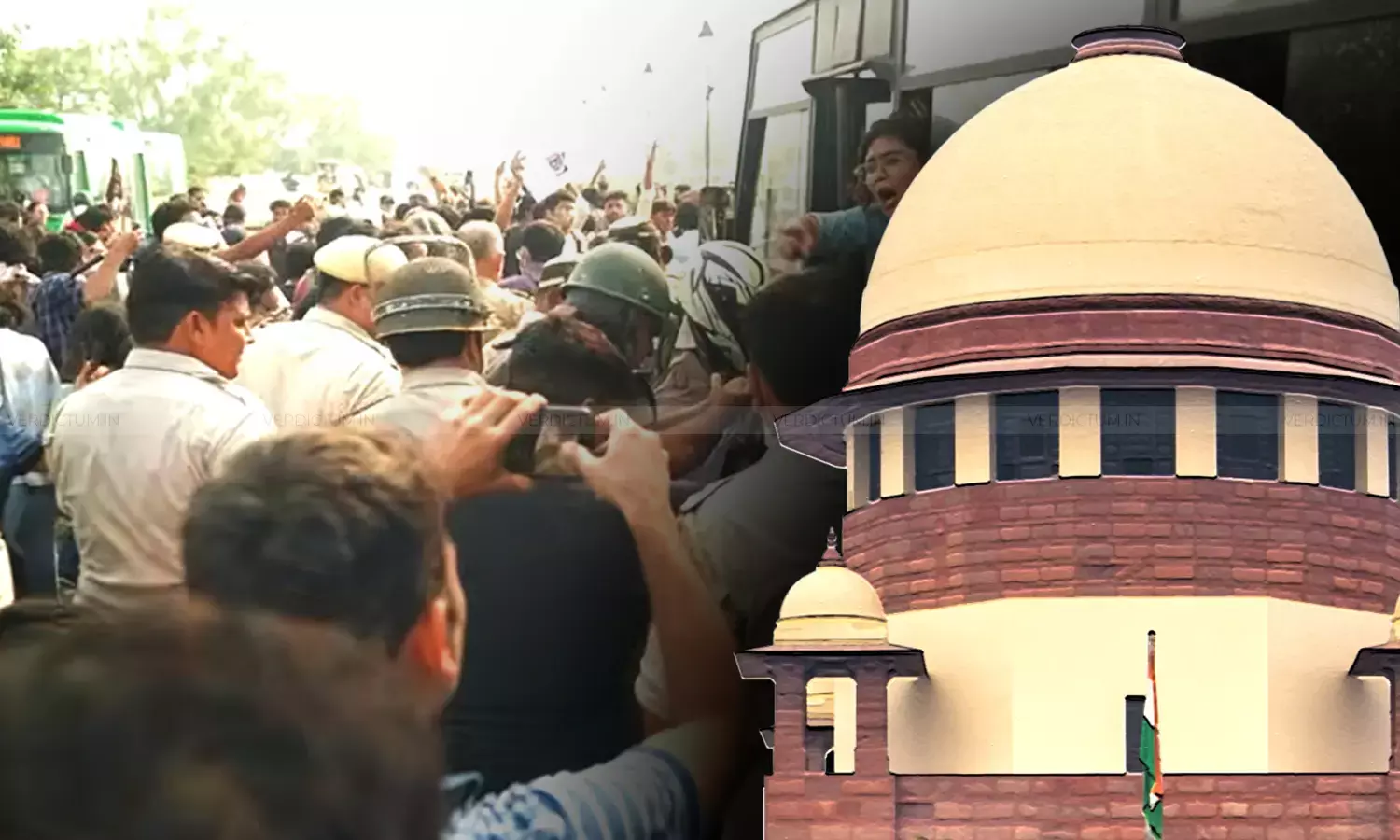
The Supreme Court observed that no protest site could be occupied for all times, but that every person had the right to protest, while hearing the petitions relating to the crackdown on the Delhi protests against Chief Election Commissioner Gyanesh Kumar.
The Court was hearing the matters, which raised issues of mass detentions, alleged police brutality, arbitrary closure of metro stations and internet shutdown.
The Chief Justice observed that an order granting or refusing permission to protest must disclose reasons, and that a designated time must be fixed for a designated period.
Previously, the Court had issued notices in all related matters.
The Bench of Chief Justice Surya Kant, Justice Joymalya Bagchi and Justice V Mohana issued notice in a few matters and listed them for a further date.
Chief Justice Kant said, "You can't occupy a site for all time. Where will farmers, journalists, etc. go? Everyone has the right to protest. Designated time must be given for a designated period...The order granting permission must define why you are or are not granting permission. You can't prevent other people, that I am doing a protest now; so you can't."
Senior Advocate Mukul Rohatgi, appearing for the trading associations of Delhi, submitted that nearly eighty years after Independence, the question of designated protest sites such as Jantar Mantar and Ramlila Maidan required fresh consideration. He submitted that Ramlila Maidan was situated about one mile from Connaught Place, with a hospital on one side, and that nearly fifty lakh persons resided in the vicinity.
Rohatgi submitted, "I belong to Delhi, and I can tell you, Ramleela is one mile from Connaught Place. You just come down Minto Bridge, and you reach Ramleela. One side is, hospital. So now, when you come down Minto Bridge, in one mile you come to Ramleela Ground. Ramleela Ground is fenced by millions of people who live there, and you have all kinds of wholesale markets. The most famous is Asaf Ali Road, Daryaganj, Delhi Gate, Kamala Market, and millions of people living, go back to that famous or infamous Turkman Gate, which was in those days, and then it joins Jama Masjid. 50 lakh people live there. I represent all the trading associations in Delhi. Apart from the fact that we've lost thousands of crores, all shops remain closed."
He added, "This is a festive season. If you don't sell in the festive season, we have millions of workers. Their workers are ancillary workers, tempo people, labor, loaders, all that has gone for a six. I had a long chat with all of them, from Sadar Bazaar, from here, there, our sales are down. This is a festive season."
He stated that all shops remained closed and that Connaught Place was deserted, causing a steep fall in festive season sales. He urged the Court to consider an “out of the box” solution and further submitted that protests had turned violent in certain parts of the world. He also prayed that no protest or dharna be permitted for the next two months.
The Solicitor General Tushar Mehta submitted that whoever gave a call for bandh must bear responsibility for its consequences. He also submitted that the Union’s replies were ready in respect of five categories, namely habeas corpus, journalists, advocates and the denotification of Jantar Mantar. He stated that the reply on the last issue had not yet been filed.
Senior Advocate Hariharan submitted that Jantar Mantar was a notified site and that an objection was now being raised even to that. Senior Advocate P.V. Dinesh submitted that every site would affect some trader and that protest was part of the democratic process.
Senior Advocate Arundhati Katju questioned whether the loss of sales could be attributed solely to the protests. Senior Advocate Menaka Guruswamy submitted that Jantar Mantar was a designated site and that the violence was committed by the Delhi Police. She further submitted that about 7,000 detentions had taken place and asked whether democracy itself was not suffering.
The Court said that every person had the right to protest and that a designated time must be fixed for a designated period. It was further observed that an order granting or refusing permission must disclose reasons, and that one group could not be prevented from protesting merely because another was already doing so.
The Solicitor General submitted that Jantar Mantar was a public road and not a protest site, that permission had been granted for only one day whereas the site was occupied for seventeen days, and that the protesters marched towards Parliament without permission. He submitted that they could not have been permitted to march to Parliament or the Supreme Court without permission. He stated that the persons concerned had not been detained but only removed.
The Chief Justice suggested that all organisations which conducted the protest be impleaded, observing that no court could adjudicate the matter without hearing them.
Senior Advocate Indira Jaising submitted that the Court had indicated that it would constitute a special Special Investigation Team (SIT) and requested that the order be passed constituting an SIT to deal exclusively with sexual violence against women journalists. She stated that she had furnished names in a sealed cover and that the petitioners would raise their grievances before the SIT, which could not be a common committee. When the Solicitor General interrupted, she requested that the petitioners not be interrupted during their submissions.
The Chief Justice observed that no order had been passed on the earlier date as the Court wished to afford the respondents an opportunity. The Solicitor General stated that he had filed his affidavit.
The Court ordered that the Union had filed its counter affidavit, directed that a copy be furnished to the nodal counsel for the petitioners and listed the matter separately on 23rd November.
The protests were held on October 10 after it was reported by The Indian Express that Election Commissioners Dr Sukhbir Singh Sandhu and Dr Vivek Joshi registered written dissents on record on at least 14 separate occasions over a 10-month period. The objections pertained to administrative decisions and official orders issued without the knowledge, consent, or participation of the full Commission, four of which occurred on a single day.
The Court had also directed that no coercive action shall be taken against the woman journalist whose complaint regarding alleged molestation and harassment, along with related proceedings involving an ACP, was under consideration, noting that she would cooperate with ongoing processes while remaining protected from adverse coercive measures.
The Bench had also indicated that certain categories of journalists might require an additional level of protection, and agreed in principle that allegations of sexual violence and harassment against women journalists during the Delhi protests warranted consideration by a committee predominantly or exclusively comprising women.
In a special hearing held on Sunday, the Court had issued notice in a contempt plea against Union and Delhi officials for alleged non-compliance with its orders. Previously, it directed the concerned authorities to reconsider the complete prohibition on Metro services and train movements in New Delhi ahead of the October 10 protests.
The Supreme Court had also remarked that Courts are agnostic to the individual, be it a police officer, a lawyer or an ordinary citizen, who claims to be a victim of violence during the recent protests in Delhi. Senior Advocate Kirti Uppal opposed lawyers taking to the streets to protest, while appearing in an impleadment application seeking to safeguard the institution and preserve the decorum of the legal profession.
Chief Justice of India Surya Kant had turned down a request by Congress leaders Mallikarjun Kharge and Rahul Gandhi for an administrative meeting to submit a memorandum on issues including the Election Commission, student arrests, and transit disruptions, stating that doing so would violate the constitutional principle of separation of powers.
A petition was also filed by Congress leader Rahul Gandhi and others over alleged large-scale voter deletions and irregularities in the SIR of electoral rolls. The Court issued notice in the petition filed by him.
Cause Title: MA Baby v. Union of India and other connected matters [ W.P.(C) No. 1333/2026; Diary No. 63560/2026]