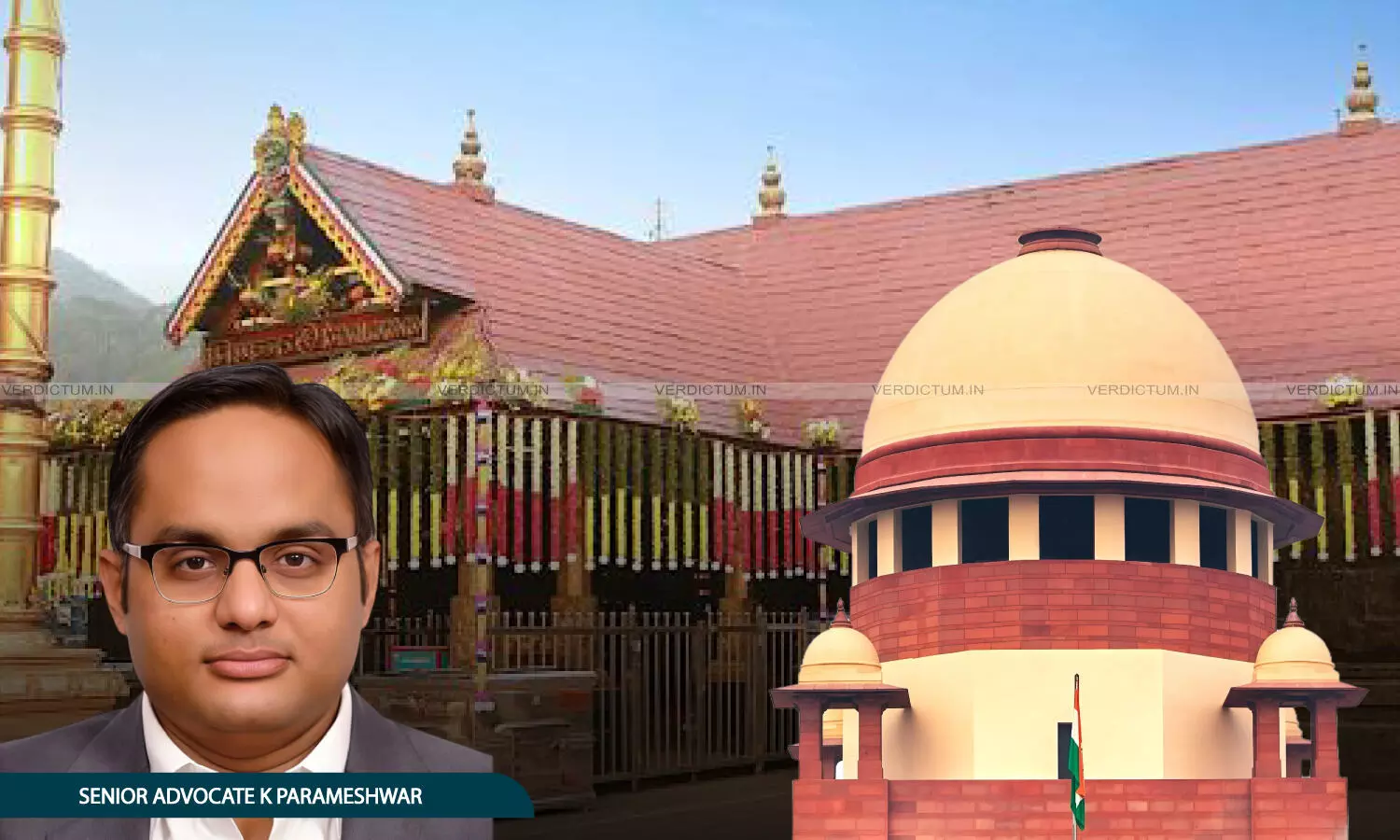
Sabarimala Reference|Supreme Court Reserves Verdict After Amicus Curiae Frames Religious Freedom As ‘Swaraj’ And Challenges ‘Elitist’ Doctrine Of Essentiality
 |
|The nine-judge Constitution Bench concluded its historic marathon hearing after Senior Advocate K. Parameshwar submitted that spiritual autonomy must protect both collective denominational identity and individual conscience.
The nine-judge Constitution Bench of the Supreme Court has reserved its judgment in the landmark Sabarimala reference case following the conclusion of rejoinder and Amicus submissions.
Concluding his arguments, Amicus Curiae Senior Advocate K. Parameshwar framed religious freedom through the concept of 'Swaraj', describing Article 26 as a restatement of collective spiritual autonomy essential for the meaningful exercise of individual faith.
Critiquing the Essential Religious Practices (ERP) doctrine as a "deeply elitist" and textually unsupported tool, he proposed a tripartite framework—comprising the Believer, the Belief, and the Object of Belief—to harmonize Articles 25 and 26.
While the Bench, led by Chief Justice Surya Kant, reaffirmed that the Court’s authority to examine religious matters is a "constitutional duty" that cannot be surrendered, the Amicus cautioned against restrictive dictionary-based definitions of "denomination," arguing that rigid tests fail to account for India's diverse syncretic traditions and the historical struggle for temple entry.
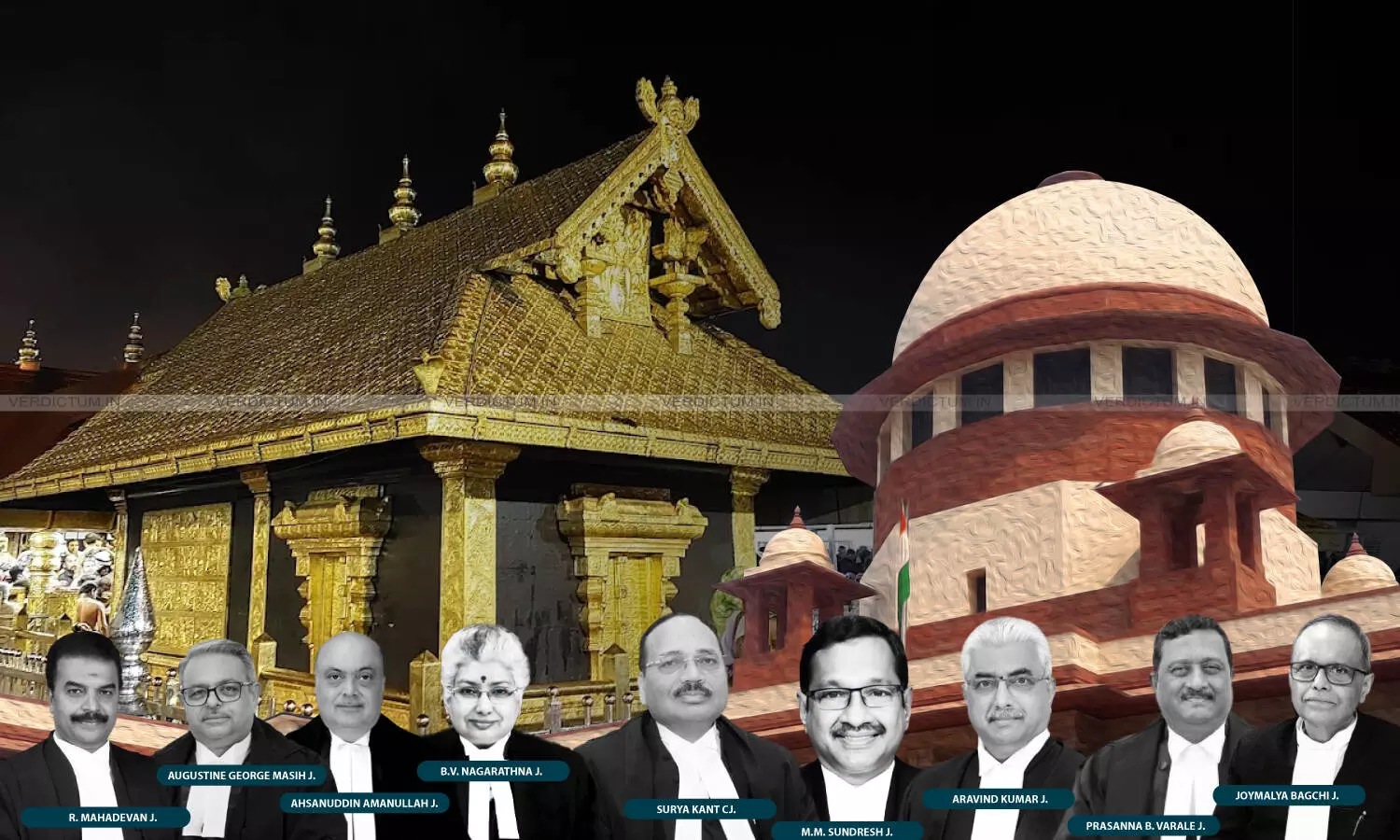
The Bench comprising Chief Justice Surya Kant, with Justices B.V. Nagarathna, M.M. Sundresh, Ahsanuddin Amanullah, Aravind Kumar, A.G. Masih, Prasanna B. Varale, R. Mahadevan, and Joymalya Bagchi, heard the review petitions and writ petitions arising out of the 2018 Sabarimala Judgment, which allowed women of all ages to enter into Lord Ayyappa's temple. The pleas were filed, inter alia, regarding the entry of Muslim women into mosques and dargahs, and the rights of Parsi women to enter Fire Temples if they have married outside their community and the legal validity of female genital mutilation within the Dawoodi Bohra community.
Senior Advocate K. Parameshwar, Amicus Curiae, argued that the Supreme Court should not exclude the application of other fundamental rights when interpreting Articles 25 and 26. He maintained that it is in the interest of constitutional interpretation that Part III receives its "full play," urging the Bench to maintain all legal "arrows in its quiver" to address unforeseen judicial circumstances. However, he emphasized that this must be a careful balancing exercise, where the Court "tailors" the application of rights like Article 14, 19, and 21 based on the specific nature of the dispute.
To protect religious autonomy, the Amicus proposed building specific safeguards into the judicial framework. He suggested that for "pure denominational conflicts"—such as disputes over specific rituals, control over institutions by competing sets of believers, or succession to religious offices—the Court should potentially avoid the judicial review route, leaving such matters to civil suits. This approach aligned with a query from Justice Nagarathna, who noted that the balancing act could depend on whether the issue at hand has a direct "nexus to religion."
Parameshwar further cautioned against the "constitutionally imprudent" task of attempting to define "religion" with absolute precision. He pointed out that any such definition would inevitably be either overbroad or unduly restrictive, noting that even the United States Supreme Court has struggled unsuccessfully to define the term since the 19th century. Instead, he argued that the meaning of "religion" must fluidly inform related concepts like "religious practice" and "denominational affairs," recognizing that the Constitution treats matters of faith and conscience with a unique sensitivity distinct from how it manages material resources.
Parameshwar launched a sharp critique of the Essential Religious Practices (ERP) doctrine, describing it as "deeply elitist" and textually unsupported by the Constitution. He argued that the doctrine creates an arbitrary hierarchy by privileging certain practices while discarding others that may be central to an individual's faith. By linking Article 21 (Right to Life and Liberty) with Article 25, Parameshwar contended that a person's spiritual pursuit is an integral part of their personal identity; therefore, when a court removes or invalidates a religious practice, it effectively damages the individual's constitutional identity.
He argued that Articles 25 and 26 become balanced when the Court recognizes that access to a religious site is not "unregulated," but is instead tethered to the specific nature of the belief and the deity. Under this approach, the collective rights of believers to maintain the sanctity of their "object of belief" under Article 26 must align with the individual's right to worship under Article 25(1).
Temple Entry
Addressing the landmark Devaru judgment, the Amicus critiqued how the Court historically balanced denominational autonomy against temple-entry laws. He noted that while Article 25(2)(b) is textually an "enabling provision" (allowing the State to make laws for social reform), Devaru elevated it to a substantive right. Parameshwar contended that any "right of entry" must ultimately be traced back to the individual freedom of religion in Article 25(1), rather than being viewed as a standalone power that automatically overrides denominational rights.
He submitted, "My respectful submission is that right to temple entry for a Believer, is a right guaranteed under 25...therefore when Devaru attempts to balance 25 and 26 bit seeks to balance the right of temple entry under 25(1) and the right of denomination under 26...I must straightaway say that the right to entry under 25(1) into an Hindu temple is not an absolute one."
"Temple entry is a matter of struggle; it is after a long battle that people were given access to temples. If your lordships are only to situate it in 25(2)(b), which is merely an enabling power, it does a disservice to the entire struggle of temple entry that we have seen over the last one century,", he added.
Parameshwar suggested that a religious denomination is formed by the alignment of three essential elements: 1. The Believer; 2. The Belief and 3. The Object of Belief.
"All three are important. The Believer doesn't exist in isolation from the object of the belief. His belief is paramount because it is the belief that connects the believer to the object of belief...if you remove any of these three things, temple entry fails", he said.
To which Justice Nagarathna said, "But in the case of Sabarimala, the case is contrary, the believer cannot enter the temple between the age of 10-50 years. It is a temporary situation there. Keep that in mind. It is different when there is denial of entry, here it is denial of entry between age of 10-50. In so far as a believer is concerned there is no problem, but who is questioning becomes the point."
Amicus Curiae K. Parameshwar urged the Court to adopt a broad, "non-restrictive" understanding of religious denominations and the unique nature of Article 25.
The "Affirmative Right" Paradox
Parameshwar highlighted a unique constitutional anomaly: religion is the only category that transitions from a prohibited ground of discrimination (under Articles 15 and 16) to an affirmative constitutional right (under Article 25). He argued that while the State is forbidden from discriminating based on religion, the Constitution simultaneously mandates the protection of religious practice. Because of this dual status, he insisted that the "subject to" clause in Article 25 must be read as a tool to ensure that one person's exercise of faith does not extinguish the fundamental rights (including Article 21) of others.
Critiquing the "Dictionary Definition" of Denominations
The Amicus challenged the long-standing reliance on the Oxford Dictionary definition established in the Shirur Mutt case. He argued that requiring a "distinct name" or a "rigid institutional structure" is culturally insensitive to India’s diverse religious landscape.
The Sabarimala Example: He noted that the devotees were unfairly burdened with proving a "novel" or "unique" identity simply because they didn't fit a standard organizational model.
Syncretic Traditions: He cited temples dedicated to Sai Baba and Ramana Maharishi, where the presence of worshippers from multiple faiths (Hindu, Muslim, etc.) has led to conflicting judicial rulings on whether they qualify as "Hindu temples" or "charitable institutions."
He maintained that the "determinative factor" for a denomination cannot merely be "who comes there," but must account for the shared belief system.
The Court’s Non-Delegable Duty
During these submissions, Chief Justice Surya Kant issued a significant clarification regarding judicial review. He stated that the Court’s authority to examine religious matters is not a "question of power" but a "constitutional duty" that cannot be surrendered or signed away.
He said, "Any Constitutional Court cannot give up its responsibility. You cannot surrender that. It is not merely a question of power. It is a constitutional duty of the constitutional court. We cannot surrender that."
Distinction Between Sanyasi and Mathadipati
The hearing also touched upon the hierarchy within religious orders. Justice Aravind Kumar and Justice Nagarathna clarified that a Sanyasi (an ascetic) and a Mathadipati (the head of a monastery) occupy different legal and spiritual roles. Justice Nagarathna emphasized that the position of a Mathadipati carries specific institutional responsibilities and status that should not be conflated with general asceticism.
'Swaraj' As A Concept
Concluding his submissions, he submitted ‘Swaraj’ as a conception of spritual autonomy and religious freedom. In his submissions, he said, "Article 26 embodies the spiritual identity and autonomy of the collective. The spiritual identity of the denomination is different from that of the individual: it is not the sum of all parts or individuals. It is the accumulation of historical practice, doctrines and the Swaraj: Spiritual Autonomy & Religious Freedom refinement of the doctrines through discussion and debate through time. Article 26 in this sense is an emphatic restatement of the collective pursuit of religion in Article 25(1). A meaningful exercise of individual religious freedom is contingent on the continued existence and protection of the institutional and collective structures within which such freedom is realized. At the same time, collective and individual pursuits are not hierarchical; the individual conscience and collective conscience inform and infuse each other. The conception of Swaraj as inner freedom must be seen as cognizant of the spiritual identity and autonomy, not just of the individual but equally also the collective."
Accordingly, the hearing was concluded.
Cause Title: Kantaru Rejeevaru Vs Indian Young Lawyers Association; Sabarimala Custom Protection Forum Vs Indian Young Lawyers Association [R.P.(C) No. 3358/2018 in W.P. (C) No. 373/2006]