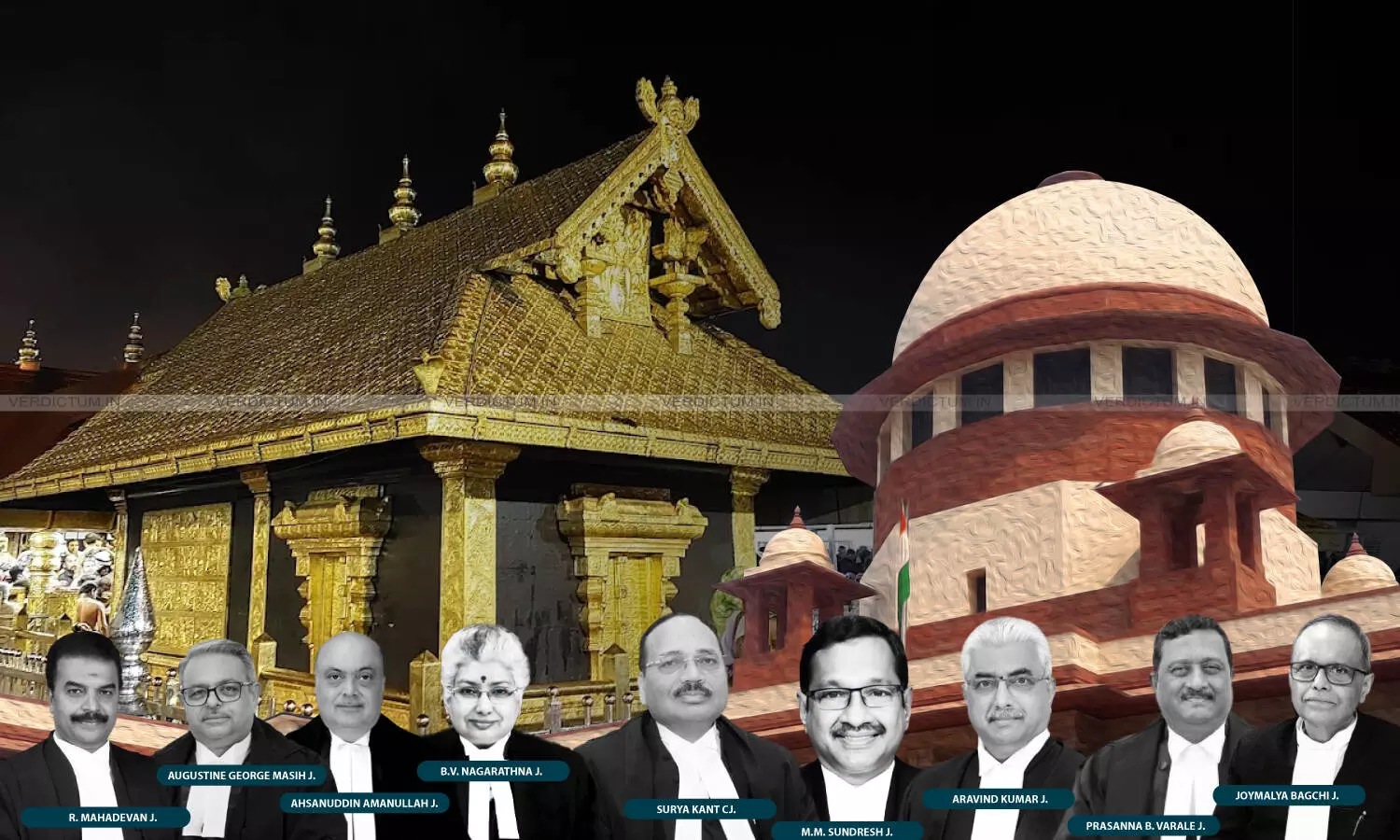
Sabarimala Reference| Rejoinder Submissions By Petitioners Call For Minimalist Judicial Approach To Traditions; Court To Now Hear Amicus
 |
|The final day saw a battery of Senior Counsels, including Mukul Rohatgi, Gopal Subramanium, and Rajeev Dhavan, argue that the judiciary must respect the "plane of religion" and avoid acting as a "theological arbiter."
The nine-judge Constitution Bench of the Supreme Court has concluded hearing parties before it after a 16-day hearing in the Sabarimala reference case and will now hear the Amicus Curiae appointed by the Court.
The final two days of the proceedings saw a series of rebuttals from Solicitor General Tushar Mehta, Senior Counsels, including CS Vaidyanathan, Abhishek Manu Singhvi, Neeraj Kishan Kaul, Gopal Sankarnarayanan, Mukul Rohatgi, Gopal Subramanium, Rajeev Dhavan and others, who urged the Court to respect the "plane of religion" and move away from the controversial "essentiality test."
The hearing is continuing as Senior Advocate K Parameshwar, who is Amicus curiae in the matter, will begin his submissions.
Rejoinder Submissions
The "Silo" Argument: Why Articles 25 and 26 Must Coexist
Solicitor General Tushar Mehta challenged the "essentiality test," arguing that it is textually absent from the Constitution and leads to an impermissible narrowing of religious freedom. He contended that Articles 25 and 26 should not be treated as "isolated islands." By analyzing the internal organization of Part III, Mehta demonstrated that the framers grouped these articles under a single subchapter: "Right to Freedom of Religion." He warned that if Article 26 (religious denominations) were treated as a standalone "silo" immune to the rest of Part III, it would destabilize the entire constitutional scheme, potentially turning other rights—like Article 29 (cultural rights)—into insulated pockets of law where general fundamental rights do not apply.
The "Plane of Religion" and Article 25(1)
Justice B.V. Nagarathna prompted the Solicitor General to expand on whether the phrase "subject to the other provisions of Part III" in Article 25(1) should be interpreted narrowly. She noted that the word "religion" is largely absent from Articles 13 to 24, appearing only in specific contexts like anti-discrimination (Articles 15 and 16).
She said, "You are right in one sense, because the word 'religion' between Articles 14 and 24 is found only in Article 15(1), which is against the State...so you know Article 15(2), which you may describe as a horizontal right, and Article 16(5), where religious denominations are specifically mentioned, except for these three provisions, the word “religion” is absent in Articles 13 to 24. Therefore, when Article 25 says “subject to the other provisions of Part III,” perhaps it must operate only on the plane of religion and nothing beyond that."
She added, "If another article does not deal with religion at all, then how can the fundamental right to religion be made subject to an entirely different article which is otherwise foreign to religion?...That is what we are trying to understand. Please develop your argument on that."
She said that if an article (like Article 14's general equality mandate) does not deal with religion at all, making the fundamental right to religion subject to it could lead to an indiscriminate mixing of legal standards that might eventually "hollow out" religious freedom entirely.
Justice Nagarathna noted that while the State can certainly use Article 17 as a basis for social reform legislation under Article 25(2), it may be legally inaccurate to say that the individual right under Article 25(1) is directly subject to Article 17, since the latter does not explicitly define itself through a religious lens.
Solicitor General Mehta agreed, noting that while no one can violate Article 17 even in private, the mechanism for reform is distinct from the core definition of the religious right itself.
Then Justice Nagarathna remarked, "If we begin mixing everything into it indiscriminately, then there will be no religion left in this country."
Chief Justice Surya Kant then added, "We are unnecessarily debating this. The question of Religious practice has nothing to do with the majority principle or minority principle. Minorities can have their own religious practices. Majorities may have their own. All are protected under the Constitution. It is not a question of majority religion versus minority religion. We are only examining the extent of that."
Then Justice Joymalya Bagchi added, "Mr Solicitor, please see Article 25, it says three words, ALL EQUALLY FREELY, if you read this in line everyone has equal rights, irrespective of the number of persons."
Solicitor General Tushar Mehta concluded his submissions by proposing a restrictive framework for judicial review in matters of faith, emphasizing that the "essentiality" test should be abandoned in favor of a more evidence-based and minimalist approach.
Mehta illustrated the distinction between religious acts and secular transactions using the example of a diva (lamp). While lighting the lamp is a religious practice, the purchase of ghee is a secular activity. He argued that even if the State restricts the purchase of ghee, such a restriction should be viewed through the lens of how it benefits or impacts the religious practice as a whole, rather than treating the commercial act in isolation.
Mehta urged the Court to stop acting as a "court of first instance" in religious disputes based merely on affidavits. He proposed a four-step judicial policy: 1. Identification; 2. Avoidance of the Essentiality Test; 3. The Civil Suit Remedy and 4. Perspective of the Believer.
Previously, Mehta submitted that the 2018 Sabarimala judgment was "wrongly decided" and "deserves to be declared a wrong law." He also called for total abandonment of the "Constitutional Morality" doctrine as a basis for judicial review. Lastly, he submitted that secular courts lack the "scholarly competence" to sit in judgment over the validity or rationality of religious faith.
Senior Advocate CS Vaidyanathan, appearing for devotees' organisations in Kerala, argued that Articles 25 and 26 recognize pre-existing natural rights rather than conferring new ones, emphasizing that Article 26 provides denominations with complete autonomy independent of individual rights under Article 25. He contended that the "Essential Religious Practices" (ERP) doctrine has been misinterpreted by courts to allow judges to decide what is essential, whereas the Shirur Mutt precedent intended for the denomination itself to define its religious practices.
Vaidyanathan further asserted that the landmark Devaru judgment should be overruled as per incuriam because its conclusion—that Article 25(2)(b) overrides Article 26—discriminates against Hindu denominations and ignores their distinct field of operation. He concluded by maintaining that an individual's right to worship cannot override a denomination's right to prescribe the manner of worship, noting that a non-adherent has no standing to challenge internal customs and that the deliberate omission of "sex" or "gender" as grounds for state intervention under Article 25(2)(b) confirms that the framers intended to protect certain gender-specific religious spaces.
He previously submitted that individual freedom of conscience cannot defeat the freedom of the community or the denomination.
Senior Advocate Abhishek Manusinghvi, appearing for Travancore Devaswom Board, made his rejoinder submission and submitted that there is a growing consensus that "essentiality" is an unsustainable and impermissible test because it effectively adds a non-textual restriction to the list of limitations already present in Article 25.
He maintained that the Court's role should be confined to the factual determination of whether a religious belief is genuinely held by the community, rather than acting as a theological arbiter of what is integral to the faith.
He concluded, " Subject to the caveats, this Court is entitled to recognize Article 25(1) as a natural or pre-existing right, inherent in the very existence of human beings since time immemorial, to conceive of human beings who are cohabiting in the society, which is completely bereft of religion, would be to create an imaginary world, overwhelmingly barring individual exceptions, religion severally and collectively is likely to play a dispositive, important, even dispositive role in the society. Hence, Article 25(1) can rightly be treated as recognition of equality in exercising freedom of conscience and the righ the right to freely profess, practice and propagate. In that sense, it is an inherent, inalienable aspiration of every member of that site."
Singhvi further introduced a critical distinction between the right of entry and the right of management. He contended that while Article 25(2)(b) facilitates social reform by ensuring access to public religious institutions, it does not empower the state or individuals to alter the fundamental character of a religious denomination.
Previously, Singhvi argued that the exclusion of women aged 10–50 from the Sabarimala Temple is not an act of discrimination, but a valid classification rooted in the unique identity of the deity.
Senior Advocate Neeraj Kishan Kaul, appearing for the Dawoodi Bohra community, argued that excommunication, when used to preserve core faith tenets, is a protected religious practice rather than a subject for social reform. He emphasized that the Dai represents the Imam and requires absolute allegiance, noting that the Dawoodi Bohra community has not exercised excommunication in sixty years. Kaul maintained that while the State may pursue social reform, it cannot abolish internal religious discipline or rewrite legislation to strip the "head of the flock" of the authority to maintain communal integrity.
Previously, Kaul concluded his submissions by referencing an article by Shashi Tharoor. While Chief Justice Surya Kant reminded the counsel that personal opinions of eminent persons remain subjective, Kaul argued that "knowledge and wisdom" from any source, university, or country should be embraced.
Senior Advocate Gopal Sankarnarayanan focused on the textual hierarchy of the Constitution, arguing that the reasoning in the Devaru judgment contains a fundamental error by treating Article 25 and Article 26 as provisions of exactly "equal authority" without accounting for the explicit limitations in the text. He pointed out that Article 25 is explicitly "subject to the other provisions of Part III," a phrase that does not appear in Article 26.
Sankarnarayanan contended that this distinction is crucial: if the right of entry into a place of worship does not fall under the specific protections of Article 26 (management of religious affairs), then the perceived conflict between the two articles disappears.
Sankaranarayanan had argued that religious rights must be viewed through a "broad plane" of principle rather than the narrow facts of individual cases.
Similarly, Senior Advocate J Sai Deepak, representing the Pandalam Royal Family and various devotee organizations such as Chetana Conscience of Women, All India Organizations of Ayappa Temples, the Shirur Mutt, the Tantri of Sree Padmanabhaswamy Temple and the Chilkoor Balaji Temple, also made his brief rejoinder submissions. Previously, he submitted that if a religious practice is inherently beyond the court's jurisdiction due to its sacred nature, the mere act of the State recognizing or "codifying" that practice through law does not suddenly grant the judiciary the power to review it.
Senior Advocate Mukul Rohatgi, appearing for the Dawoodi Bohra community, argued that the 1986 writ petition challenging the Syedna judgment has effectively abated due to the passing of the original petitioners and the lack of a registered body to prosecute it. He maintained that a writ petition cannot lie against a prior court judgment, especially one as exhaustively debated by Constituent Assembly members and a "galaxy of counsel" as the Syedna case was. Furthermore, Rohatgi clarified that there has been no instance of excommunication in seventy-five years, dismissing the idea of an arbitrary authority and asserting that the rarely used power is a legitimate disciplinary tool protected under denominational autonomy.
In his rejoinder submissions, Senior Advocate Gopal Subramanium, appearing in an SLP concerning a Parsi Woman, argued that Articles 25 and 26 operate in distinct constitutional spheres, suggesting that if they are understood as independent rather than overlapping, the perceived tension between individual and denominational rights disappears, rendering the need for "harmonisation" unnecessary. He drew a sharp distinction between "religion" as a broad established doctrine and a "denomination" as a structured body of believers adhering to specific tenets, noting that while individual faith under Article 25 is fluid and personal, Article 26 protects the collective right to maintain both physical institutions and the spiritual expositions carried on within them.
"If the words of the Constitution are clear, then there is no scope for applying the theory of implied limitations when the intention to express limitation is manifest in the text of the article", he added.
He also said, "If these provisions are read together, one gets a constitutional picture quite different from the ordinary vertical rights framework. In fact, I would respectfully say that the expressions 'vertical' and 'horizontal' perhaps oversimplify the matter...This is not merely a situation where rights are enforced against the State in the conventional sense, or where the State guarantees ordinary fundamental freedoms. These are a distinct category of rights where one simultaneously enjoys freedom of religion and also, in some situations, the constitutional status of a minority institution."
Senior Advocate Rajeev Dhavan, representing an intervenor, argued that the Constitution balances individual conscience with group rights, viewing India as a society of diverse institutions rather than just individuals. He rejected the "silo" approach, advocating for an assimilated interpretation where Articles 25 and 26 are read alongside the "Golden Triangle" (Articles 14, 19, and 21) to extract principles of reasonableness and just law.
Dhavan cautioned that while social reform is essential to prevent communalism, it must be achieved through harmonisation rather than subordination. He specifically warned that the current essentiality test risks hollowing out religious freedom; if courts set the threshold for "essential practices" too high, the substantive protections of both Article 25(1) and Article 26 will effectively disappear.
Accordingly, all the parties concluded their arguments.
Cause Title: Kantaru Rejeevaru Vs Indian Young Lawyers Association; Sabarimala Custom Protection Forum Vs Indian Young Lawyers Association [R.P.(C) No. 3358/2018 in W.P. (C) No. 373/2006]