

Breaking: Supreme Court Told Thiruparankundram Lamp Not Lit Despite Its Order; Petitioners To File Contempt Plea
The Collector informed the Court that the lamp could not be lit and that the compliance report had been filed.

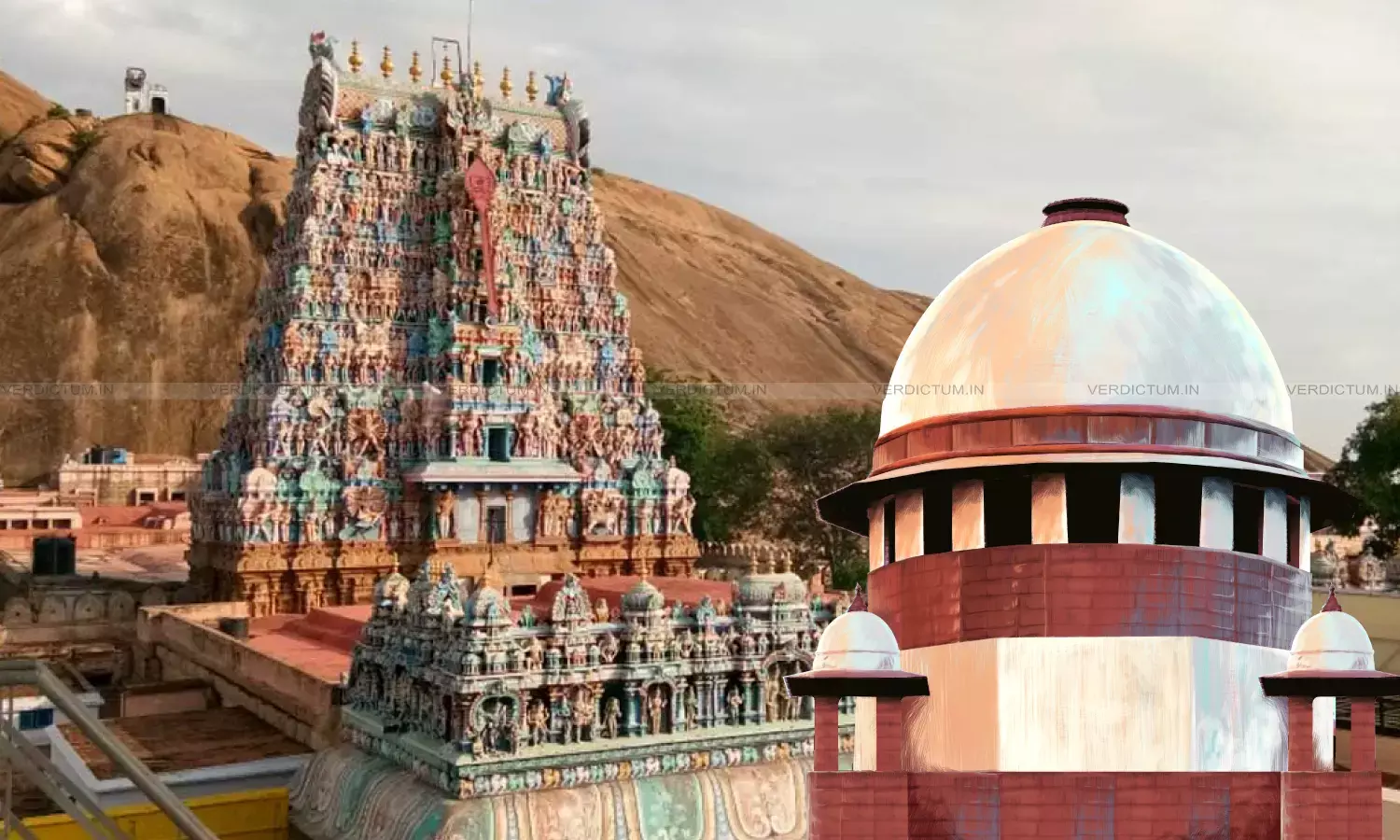
The matter relating to the lighting of the Karthigai Deepam at the Deepathoon, the stone pillar atop the Thiruparankundram hill in Madurai, was mentioned before the Supreme Court on Wednesday, a day after the lamp could not be lit at the Deepathoon despite the Apex Court's order.
Yesterday, the Madras High Court passed an injunction in the nature of a John Doe order restraining members of the general public from calling for the violation of the Supreme Court's order dated November 20, 2026, which permitted the lighting of the Karthigai Deepam at the stone pillar identified as Deepathoon atop the Thiruparankundram hill.
The State of Tamil Nadu had also approached the Supreme Court seeking review of the interim order dated November 20, 2026,
The matter was first mentioned on behalf of the District Collector, Madurai, who informed the Court that the lamp had not been lit in the end and that his status report on the steps taken in compliance had already been filed. The petitioners countered that the State had evaded compliance through "stratagem and devices", including by citing prohibitory orders and claims of custom attributed to the temple's Board of Trustees and the sthanikars, which the sthanikars later denied having made.
The matter was mentioned before the bench of Justice Aravind Kumar and Justice Vipul M Pancholi. The petitioners informed the Bench that they would file a contempt petition, and urged the Court to initiate suo motu contempt proceedings and to direct that the flame lit at the customary spot be carried to the Deepathoon.
Senior Advocate Gopal Sankaranarayanan, for the authorities, submitted, "As the Collector, I was supposed to file a status report on what took place. We have just had that filed. We have a number. I think Your Lordships may take it up because unfortunately the lamp didn't get lit. So I, as a Collector, I have traced out all the steps that I was supposed to comply with."
Senior Advocate Guru Krishna Kumar submitted, "This is like anticipatory breach, anticipatory mentioning. Most unfortunate, My Lords. State tells the High Court some prohibitory orders were...they use the Board of Trustees—and I say this—to say the custom does not permit it, and the sthanikars have said it cannot be done. In the evening, later sthanikars say that 'no, we didn't make any such statement, no opinion was sought from us'. Deliberate attempt at not complying with the order, and they've succeeded by stratagem and devices. Most unfortunate...There is a complete infraction of the rule of law. This is majesty of the law that we are looking at..."
The Court said, "File your application, we'll pass necessary orders."
Another counsel urged the Court to initiate suo motu contempt proceedings, and pointed out that the State had instead filed a review application. Senior Advocate Guru then informed the Bench that the petitioners would file a contempt petition. Justice Kumar told counsel to file the petition first, and said the Court would consider the matter thereafter.
The Supreme Court had permitted a limited team from the Arulmigu Subramaniya Swamy Temple to light the Karthigai Deepam at the Deepathoon on November 24, 2026. The Court made it clear that the permission was for this year alone, and stayed the findings of the Madras High Court under challenge until further orders.
The Supreme Court appointed the District Collector, Madurai, as the nodal officer to coordinate and supervise the arrangements, and directed him to submit a brief compliance report within three days of the event. The State of Tamil Nadu thereafter filed a petition seeking review of the order.
On November 23, 2026, the District Collector, Madurai, issued a prohibitory order under Section 163 of the Bharatiya Nagarik Suraksha Sanhita, 2023 (BNSS). A batch of writ petitions was filed before the Madurai Bench of the Madras High Court challenging the order. The petitioners apprehended that the Supreme Court's order would not be implemented for political reasons, and recalled that the High Court's own order on the issue had been defied the previous year.
The Division Bench comprising Justice G.R. Swaminathan and Justice M.D. Sumathi took up the matter on November 24, 2026 and summoned the District Collector and the Commissioner of Police, Madurai, to appear in person. The Collector, Shri Nishanth Krishna, IAS, appeared before the Bench and submitted that the prohibitory order had been issued only to prevent unauthorised persons from climbing the hill.
He drew the Court's attention to a specific recital in the order exempting anything done in pursuance of the Supreme Court's order, and assured the Bench that he had acted, and would act, in strict compliance with it.
Senior Advocate Gopal Sankaranarayanan, appearing for the State authorities, initially informed the Bench that the officials were facing certain difficulties in implementing the Supreme Court's directions. He later submitted that devotees were moving freely to the temple and that the prohibitory order did not restrict religious processions or customary practices. He informed the Court that about 258 persons, all allegedly linked to various organisations, had been detained on apprehension of disorder, and that two FIRs had been registered against persons protesting against the Supreme Court's order.
The High Court observed that although it could neither overreach nor interpret the Supreme Court's order, it was entitled to direct the authorities to comply with it. Invoking Article 144 of the Constitution, the Bench reminded the District Collector that he was answerable only to the Supreme Court in the matter and was to ignore any contrary advice from any other authority.
Relying on Israr Ahmad Khan v. Amarnath Prasad, the Bench held that the mere pendency of a review petition was no ground for non-compliance, and declared that none of the officials concerned could later plead that they were unable to comply because a review petition had been filed.
The Bench further passed an injunction in the nature of a John Doe order, restraining members of the public from calling for the violation of the Supreme Court's order, and observed that while a judicial order could be criticised, no one could with impunity demand that it not be implemented. The Court also expected persons unlawfully detained by the police to be released without delay, and disposed of the writ petitions accordingly.
Despite these proceedings and assurances, the lamp was not lit at the Deepathoon on 24.11.2026, leading to the matter being mentioned before the Supreme Court the following day.
Accordingly, the Bench asked the petitioners to take necessary steps and file an application, stating that it would pass necessary orders.
Cause Title: Hindu Dharma Parishad v. The Union of India and Ors. [W.P. (C) 1280/2025], The Commissioner v. Rama Ravikumar and Ors. [Diary No. 36337/2026] and Rama Ravikumar v. The Executive Officer Arulmigu Subramanian Swamy Temple Thiruparankundram Madurai and Ors. [ Diary No. 4500/2026]