

Breaking: Madras High Court Passes John Doe Order Against Calls To Defy Supreme Court In Thiruparankundram Deepam Case
The Madurai Bench held that officials could not cite the pending review petition as a ground to avoid complying with the Supreme Court's order.

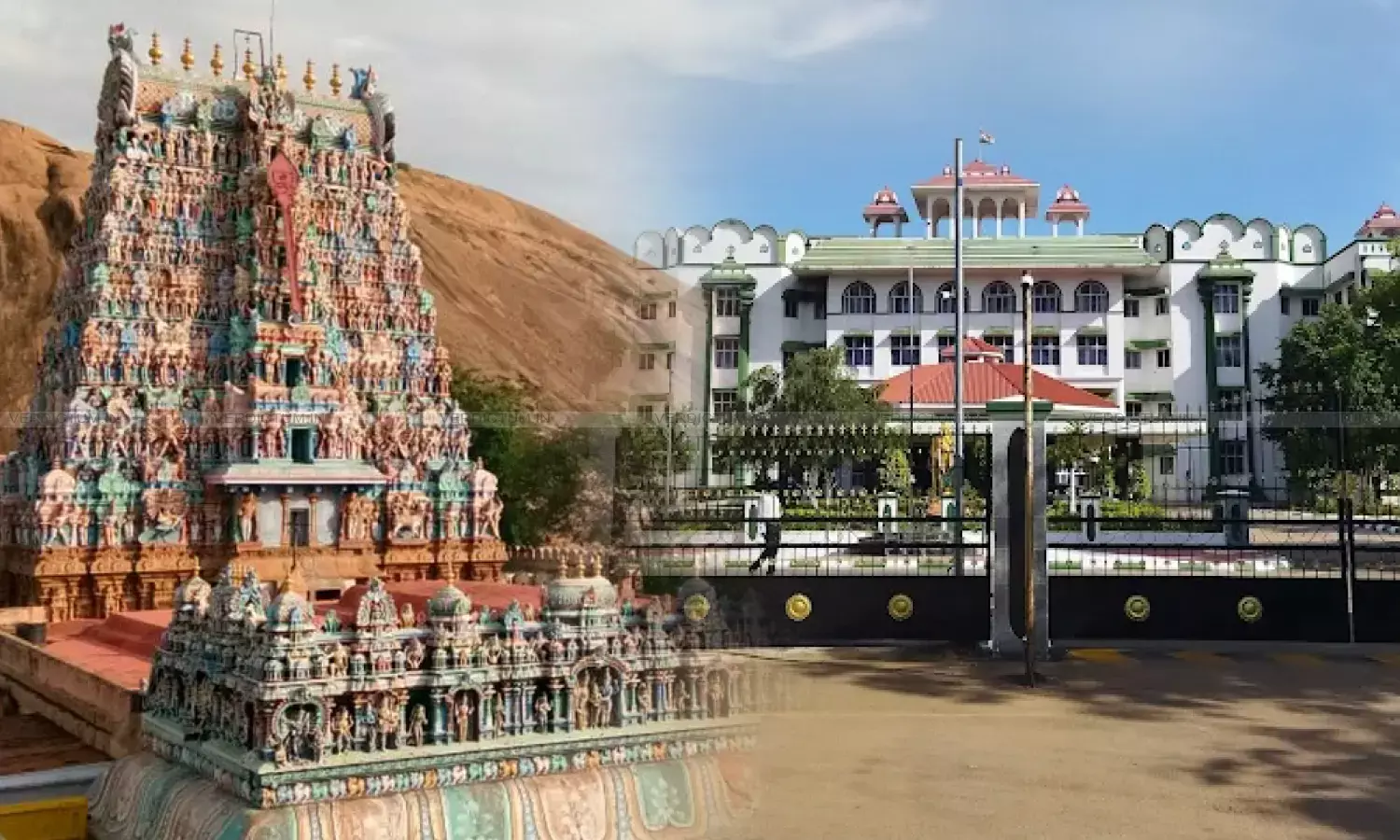
The Madras High Court passed an injunction in the nature of a John Doe order restraining members of the general public from calling for the violation of the Supreme Court's order dated November 20, 2026, which permitted the lighting of the Karthigai Deepam at the stone pillar identified as Deepathoon atop the Thiruparankundram hill.
It was held that the mere pendency of a review petition before the Supreme Court was no ground for non-compliance.
It reminded the District Collector, Madurai, that under Article 144 of the Constitution, he was answerable only to the Supreme Court in the matter, and disposed of the batch of petitions challenging the prohibitory order issued under Section 163 of the Bharatiya Nagarik Suraksha Sanhita, 2023 (BNSS).
Today, in the previous session, the Court observed that although it could neither overreach nor interpret the orders of the Supreme Court on the lighting of the Karthigai Deepam at the Deepathoon in Thiruparankundram, it was entitled to direct the District Collector, the police officials and the temple authorities to comply with the directions issued by the Apex Court.
The Division Bench comprising Justice G.R. Swaminathan and Justice M.D. Sumathi ordered, "Some of the counsel pointed out that this court should come down heavily on those who openly call for defying and flouting the order of the Honourable Supreme Court. We find force in the said submission. Even a judicial order can be criticised. The criticism can even be strident, but no one can with impunity demand that the Supreme Court's order should not be implemented. We pass an injunction order which will be in the nature of a John Doe order restraining members of the general public from calling for violating the aforesaid order dated 20.11.2026 passed by the Honourable Supreme Court. Lastly, we again quote this Deve Gowda case, that the State cannot be permitted to play ducks and drakes with the solemn decision of the court. The officials concerned—again, we name those persons—have a duty to comply with the Supreme Court's order. We have the power to issue a writ of mandamus calling for the discharge of the said duty. We already clarified—we expect persons who have been unlawfully detained by the police, such as Advocate Kutralanathan of Tirunelveli, to be set at liberty without any delay. Writ petitions stand disposed of accordingly."
Senior Advocate Gopal Sankaranarayanan appeared for the State.
The Court ordered, "The Honourable Supreme Court, by order dated 20.11.2026, directed that a lamp shall be lit today, that is, 24.11.2026, at the Deepathoon atop the Thiruparankundram hill. The writ petitioners apprehend that for political reasons and to appease a section of the public, the apex court's order would not be implemented. They cite the promulgation of a prohibitory order dated 23.11.2026 under Section 163 of the BNSS, 2023, issued by the District Collector, Madurai. They recall that this court's order was defied last year and that the present trend is disturbingly reminiscent of the said past."
The Court added, "Pursuant to our request, Shri Nishanth Krishna, IAS, the District Magistrate and District Collector, Madurai, appeared before us. The Honourable Supreme Court had appointed him as the nodal officer to coordinate and supervise the arrangements, and had also directed him to submit a brief report regarding compliance with its directions within three days after the event. Shri Nishant Krishna, IAS, pointed out to us that the prohibitory order has been issued only to prevent unauthorised persons from climbing up the Thiruparankundram hill. He drew our attention to the specific recital in his order which clarifies that it shall not apply to anything done in pursuance of or for giving effect to the order of the Honourable Supreme Court dated 20.11.2026. The District Collector made it clear that he has acted and that he will act in strict compliance with the Supreme Court's orders."
The Madurai Bench was hearing a batch of petitions challenging the prohibitory orders issued under Section 163 of the Bharatiya Nagarik Suraksha Sanhita, 2023 (BNSS), and indicated that it intended to rely upon a Supreme Court judgment holding that a writ petition would lie to enforce a judicial order.
The authorities issued the orders in view of the lighting of the Karthigai Deepam at the Deepathoon, the stone pillar on the hill, which was scheduled for the same day pursuant to the directions of the Supreme Court.
It was ordered, "Article 144 of the Constitution of India mandates that all authorities, civil and judicial, in the territory of India shall act in aid of the Supreme Court. The District Collector is a civil authority and Article 144 will squarely apply to him. Since officials brazenly defied judicial orders last year in connection with the Karthigai Deepam event, we deem it necessary to remind the District Collector that he is a public servant who is answerable only to the Honourable Supreme Court of India in this case. He shall ignore any contra advice given by any other authority. We are sure that no law officer worth his salt will counsel him to act in contravention of the order dated 20.11.2026. No doubt, a review petition has been filed before the Honourable Supreme Court in respect of the order dated 20.11.2026, but no order has been passed in the said review petition."
The Bench listed the matters for hearing at 12:30 PM. The Bench also summoned the District Collector, Madurai, and the Commissioner of Police, Madurai, and directed them to appear in person before the Court at the time of the hearing.
When the matter was taken up at 12:30 PM, Senior Advocate Gopal Sankaranarayanan, appearing for the authorities, informed the Bench that he had been instructed that the officials were facing certain difficulties in implementing the directions of the Supreme Court. He submitted that the Collector had been informed of the hearing only recently and was presently occupied, and requested the Court to take up the matter at around 3:00 PM.
At or around 4:30 p.m., the Collector also joined the proceedings through video conferencing.
Senior Advocate Gopal Sankaranarayanan apprised the Bench of the situation on the ground and submitted that there was no restriction on the movement of devotees to the temple. He stated, "The first is that as of now, there is complete free movement as far as the temple is concerned. Between 24,000 and 30,000 people have entered the temple. Over 6,000 people have got the ₹100 tickets... the numbers are swelling as one can imagine." He added that a live YouTube link was available through which the Court could view the movement of devotees in real time.
Addressing the concern raised by the Bench in the afternoon regarding restraint on devotees, the Senior Counsel said, "There is no restraint as far as religious movement is concerned, concerning any of the traditional aspects of the temple or individuals expressing their Article 25 rights. That is, in fact, taken note of in the 163 notice as well." He pointed out that the prohibitory order contained two sub-clauses which made it clear that religious processions and customary practices would remain undisturbed.
He submitted, "So there is no question of the magistrate or the commissioner or anybody using that notice against people who are moving peacefully for the religious procession."
On the issue of detentions, the Senior Counsel informed the Court, "As of now, there are about 258 individuals who have been detained. Every single one of them are linked to some organization or other." He explained that the detentions were made on the apprehension that these persons might create disorder, based on their past conduct and intelligence inputs.
In response to the Court's query regarding persons protesting against the Supreme Court's order, the Senior Counsel stated that two FIRs had been registered. He submitted that FIR No. 134 of 2026 had been registered that day against one Siraj at the Tirunelveli City Police Station, and FIR No. 296 of 2026 had been registered the previous day against a group of persons, again for protesting against the Supreme Court's orders, for offences including nuisance, negligence and public obstruction. He remarked, "So it appears at least that they have been somewhat even-handed as far as this is concerned."
The Senior Counsel also disagreed with the Bench's view that the Supreme Court's order was confined only to the top of the hill. He submitted, "My take on this is that it's not limited only to the top of the hill. The lamp lighting definitely is to the top of the hill, but everything else that falls on the shoulders of the district administration is clearly with reference to access as well, up to and beyond the temple and the hill. So it would be our remit, and it's in pursuance of that that our 163 notice has gone out."
On the question of law, the Senior Counsel handed over a note on the case law relating to Article 144 of the Constitution, and observed that the Court's earlier remarks on whether High Courts could execute the Supreme Court's orders had given him "food for thought."
He relied upon the decision of the Allahabad High Court in Chakkan Lal v. State of Uttar Pradesh, and read out paragraph 27, which stated that "such action in aid of Supreme Court does not include the responsibility of execution of the order of Supreme Court, particularly when the Supreme Court itself is capable of executing its own orders. There is no law permitting the High Court to undertake the exercise of executing the order of the Supreme Court."
While reading the judgment, the Senior Counsel clarified, "I don't agree with this sentence, I don't agree that the High Court is a creature of statute, but there being no statutory obligation, the High Court is not supposed to invoke its writ jurisdiction to execute order of the apex court." He added that execution did not fall within the ambit of the writs that could be issued under Article 226, and that although the decision was of the Allahabad High Court, "it would have persuasive value because the logic otherwise would be right."
He further relied upon the decision in Union of India v. Jaiswal Co., in which the Supreme Court had taken a dim view of a Single Judge passing orders while the matter was pending before the Apex Court. He described the situation as being "very close for comfort."
Concluding his submissions, the Senior Counsel urged that the petitioners should seek clarity from the Supreme Court itself. He submitted, "Rather than going by my interpretation or not, whether it's limited to the top of the hill or not, if we have any doubt about that, the petitioners should possibly approach the Supreme Court to get clarity on this, rather than proceed on an interpretive notion which is what they are seeking to adopt, and inviting you to indulge them."
On the pendency of the review petition, the Bench relied upon the decision of the Supreme Court in Israr Ahmad Khan v. Amarnath Prasad, and recorded that the law laid down was that "pendency of a review petition is not a ground for non-compliance." It also referred to an order to similar effect in Reliance Industries v. Vijayan.
The Bench declared that none of the officials concerned, namely the District Collector, the Commissioner of Police, the Deputy Commissioner, the Chairman of the Board of Trustees and the Executive Officer of the temple, "can tomorrow plead that they could not comply with the order citing the filing of the review petition."
The Bench further recorded that the prohibitory order would not be applied in a manner affecting the fundamental rights of devotees under Article 25, and referred to the decision in Gulam Abbas.
After the dictation, the Senior Counsel requested that his submission be recorded that, since the Supreme Court's order was comprehensive, the High Court ought not to exercise jurisdiction in these petitions.
Justice Swaminathan responded, "We haven't done anything at all. See, ours is more, you know, in the nature of, you know, reminding—educating the officials about what the law says. That's all." He added that the purpose was to ensure that the officials did not later contend that they could not comply due to the pendency of the review, and clarified, "We have not passed any order that will work at cross-purposes."
The Bench then posed a direct question as to the steps taken to comply with the Supreme Court's order, and sought that the Executive Officer and the trustee of the temple appear through video conferencing.
The Senior Counsel, stating that he had instructions from the Collector as the nodal officer, read out a note of the steps taken. He submitted that a meeting with the revenue authorities was held on November 20 immediately after the Supreme Court's order, even before it was uploaded, followed by a coordination meeting on November 21 with the Commissioner of Police and the Deputy Commissioner, HR&CE, in which detailed instructions were issued to all departments. He stated that a further review meeting was held on November 22, and that on the night of November 23, the prohibitory order was issued and the materials for lighting, namely clay, firepot, ghee, cloth and ID cards, were received in the manner accepted by the Archaeological Survey of India.
The Senior Counsel further submitted that the Collector and the Commissioner of Police had personally visited the temple and inspected the arrangements, and that the Deputy Commissioner, HR&CE, had informed that a meeting was scheduled that day for authorising the team that would light the lamp. He stated that observers, a health team, fire officials and police personnel were present at the site, and that all arrangements were in place.
The Supreme Court allowed a limited team from the Arulmigu Subramaniya Swamy Temple to light the Karthigai Deepam atop the Deepathoon on Thiruparankundram Hill on November 24, making clear that the permission is for this year alone. Until further orders, the Madras High Court’s findings under challenge will remain stayed.
The State of Tamil Nadu also approached the Supreme Court seeking review of the order.
The Thenparankundram Umaiyandar Temple, a cave temple, has been excavated on the southern slope of Thirupparankundram Hill, facing south, and this cave temple can be reached by taking the dirt road leading from the Girivala path to the foot of the hill. The archaeologists have built long steps to reach the cave temple. It was originally a Jain cave temple. Historians believe that this cave temple was excavated during the 8th-9th centuries AD, when Jainism flourished in Madurai.
Accordingly, the petition was disposed of.
Cause Title: J. Jaaswant v. The District Collector and Ors. and other connected matters [WP(MD) Nos.33993, 33994, 34002, 34010 & 34012 of 2026]
Click here to read/download the Order
[This is a hearing story; the order was uploaded later]