

Supreme Court Permits One-Time Lighting Of Karthigai Deepam At Thiruparankundram’s Deepathoon On Nov 24
The Court stayed the High Court’s findings until further orders, barred public gatherings at the site, and clarified that the permission creates no right of custom, access or ownership.

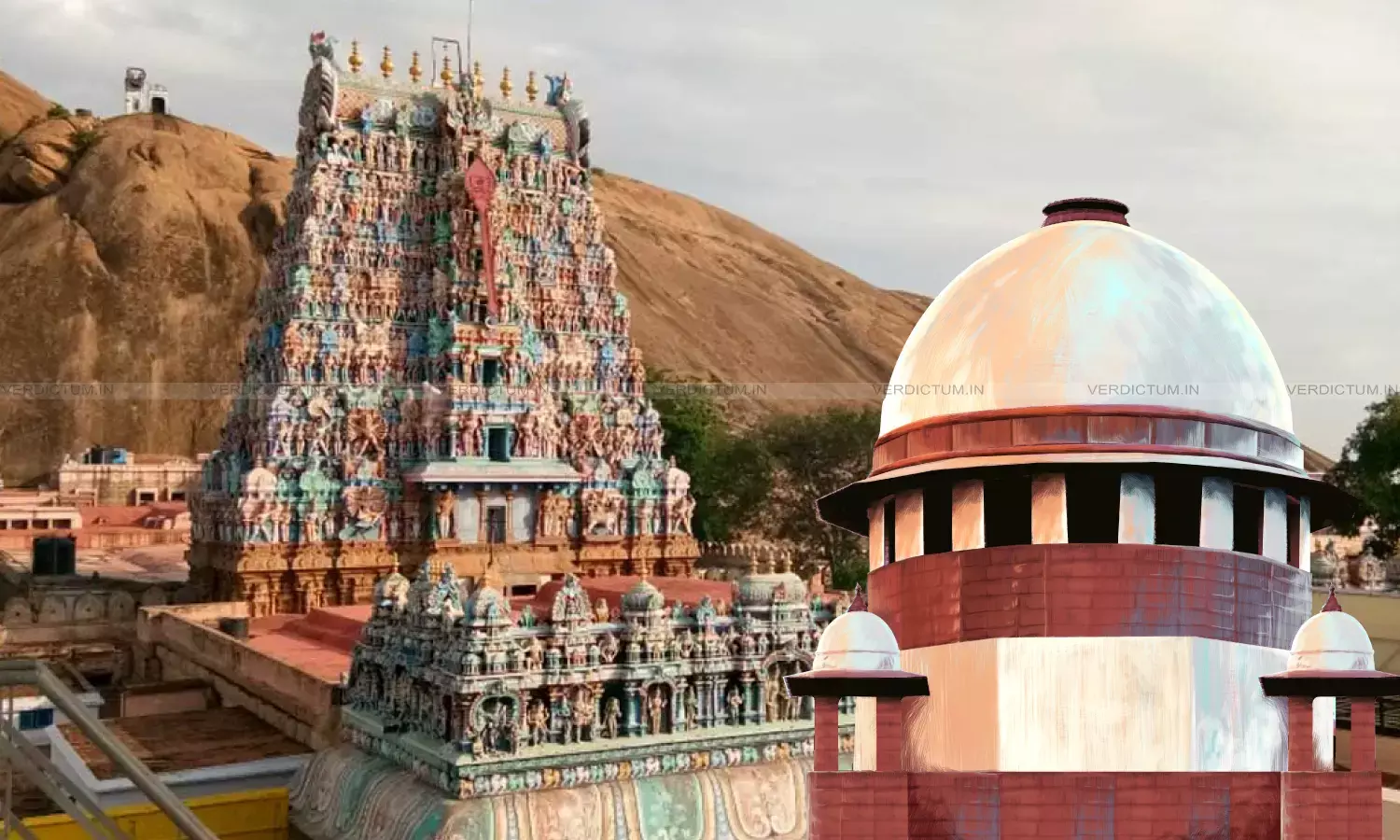
The Supreme Court allowed a limited team from the Arulmigu Subramaniya Swamy Temple to light the Karthigai Deepam atop the Deepathoon on Thiruparankundram Hill on November 24, making clear that the permission is for this year alone.
Until further orders, the Madras High Court’s findings under challenge will remain stayed.
A plea was filed seeking to take over the entire Thirupparankundram Temple by the Archaeological Survey of India and to light a lamp on the top of the Deepathoon located on the top of Thiruparankundram Hill Pillar permanently for 24 hours daily.
In January 2026, the Court had issued notice in the plea. A petition under Article 32 of the Constitution of India was filed before the Supreme Court seeking the issue of a writ of mandamus or any other appropriate direction to the ASI.
The Court had also issued notice in a plea assailing the order passed by the Madras High Court confirming the order permitting the lighting of the Karthigai Deepam on a stone pillar located on the lower peak of the hillock. By upholding the single judge’s previous order, the High Court had cleared the way for the traditional lamp-lighting ceremony to proceed at that specific location.
The Bench of Justice Aravind Kumar and Justice Vipul M Pancholi directed that the Madurai District Collector decide the size and composition of the team in consultation with the temple’s Executive Officer, the ASI and the Commissioner of Police. The Collector will supervise the arrangements. The police will provide security, with support from the CRPF if required and feasible.
Senior Advocate Jaideep Gupta appeared for the State of Tamil Nadu, Senior Advocate Gopal Sankaranarayanan for the District Collector, Senior Advocate Shekhar Naphade for the HR&CE Commissioner, Senior Advocate Huzefa Ahmadi for the Dargah parties, Senior Advocate Narender Hooda for a priest supporting the State, and Senior Advocate Guru Krishnakumar for the writ petitioner.
The Court ordered that access to the site will be limited to the authorised team and to officials needed for supervision and security. The Bench prohibited any public gathering, procession, demonstration or sloganeering there. It left it to the district administration to decide when the ceremony will be held, which route the team will take and how long it will last.
The Bench made it clear that the ceremony must not disturb worship at the places where it is customarily offered, or lawful access to the Dargah and the mosque. The order, it said, gives no one a fresh right to enter, occupy or control the hill, and does not settle any question of custom or ownership.
The team must leave as soon as the ceremony ends and carry back everything it brought. The ASI will lay down safeguards to protect the site, and no excavation, construction or structural change will be allowed.
The Court added that this one-time permission stands apart from the High Court’s directions. It cannot be cited later as evidence of custom or of a right of access, or as a ground for seeking permission in future years, and complying with it will not be held against any party. The Collector must report any legal, physical or security hurdle the safeguards cannot address, and file a compliance report within three days of the festival.
In the morning session, Senior Advocate S. Guru Krishnakumar, appearing for the writ petitioner, supporting the High Court’s order, relied on the 1923 civil decree and called the dargah’s challenge to the temple’s title “a red herring.” He pointed out that the trial court had held the plaintiff Devasthanam entitled to a declaration and injunction over the property found to belong to it. No decree for possession was needed because the Devasthanam was already in possession.
The Muslim defendants had claimed the entire hillock, but the trial court rejected that claim and confined their ownership to the peak on which the dargah stands. Counsel submitted that the Single Judge and the Division Bench had done nothing more than follow this decree.
He submitted, "Therefore, I respectfully submit that this is really a red herring which is sought to be raised. What the High Court today has done—both the Single Judge and the Division Bench—is go by this. That's all they have done...This is point one. Then please come to point B: "The topography and physical features of the Thiruparankundram hill are clearly discernible from the record. The Arulmigu Subramanya Swamy Temple lies at the foot of the hill. The said hill consists of two peaks and a few summits. The Sikandar Dargah stands on the highest peak, and the Deepathoon stands on a peak separate from it." There is a wedge—and this is important—there is a wedge between the Deepathoon and the Sikandar Dargah."
The Thenparankundram Umaiyandar Temple, a cave temple, has been excavated on the southern slope of Thirupparankundram Hill, facing south, and this cave temple can be reached by taking the dirt road leading from the Girivala path to the foot of the hill. The archaeologists have built long steps to reach the cave temple. It was originally a Jain cave temple. Historians believe that this cave temple was excavated during the 8th-9th centuries AD, when Jainism flourished in Madurai, as the Petition submitted.
It was prayed by the Petitioner that directions maybe issued to the ASI to i) take over and control of the entire Thirupparankundram Lord Murugan Subramaniya Swamy Temple, Madurai, Tamil Nadu by the ASI; ii) to lit a lamp on the top of the The Deepathoon (ancient stone lamp post) located on the top of Thiruparankundram Hill Dheepa Pillar permanently for 24 hours daily and iii) to Every year, on the day of Karthigai in the month of Karthigai, the entire Thiruparankundram hill be lit with lamps and Muruga devotees be allowed to worship.
Accordingly, the Court disposed of the interim applications subject to further orders and listed the appeals for hearing in the second week of January 2027.
Background
In March 2026, the Madras High Court had also asked the trustees of the Arulmigu Subramania Swamy Temple, Thirupparankundram, Madurai, to decide within two weeks on the Court’s suggestion to allow a limited group of persons to visit the lower peak of the hillock where the Deepathoon is located and offer symbolic prayers.
The High Court, on December 18, 2025, had reserved its verdict on a series of appeals against a single judge’s order. The Single Judge's order permitted the lighting of the Karthigai Deepam (lamp). Rama Ravikumar, who claimed to be a devout follower of Lord Muruga, sought such a direction via Writ Petition before the Madurai Bench, and then,a few other Writ Petitions were also filed for the very same relief.
On December 4, 2025, despite an order of the Madras High Court passed in a contempt of court case allowing lighting of the Karthigai Deepam atop Thiruparankundram Hill, Madurai, by the Petitioner under protective escort by the CISF, Tamil Nadu Police prevented the ritual, triggering protests. A Bench of Justice G. R. Swaminathan, in a contempt petition, passed directions allowing the petitioners to light the deepam under CISF protection after the temple management and the state had failed to comply with its previous order.
Justice Swaminathan, while rejecting their objections, referencing a 1923 civil decree affirming the temple’s title over the hill, upheld, later by the Privy Council, that the Deepathoon stood on unoccupied temple property and outside the dargah precinct. The Court quashed the Executive Officer’s decision to confine lighting to the mandapam and directed that the Deepam be lit at Deepathoon this year, ordering police protection to ensure enforcement.
The Single Bench had also reprimanded the Government Officials while considering the contempt proceedings alleging non-compliance with the earlier orders related to the Karthigai Thiruparankundram Deepam issue. The High Court further stated that law and order cannot be a ground for flouting a court's order.
Cause Title: Hindu Dharma Parishad v. The Union of India and Ors. [W.P. (C) 1280/2025], The Commissioner v. Rama Ravikumar and Ors. [Diary No. 36337/2026] and Rama Ravikumar v. The Executive Officer Arulmigu Subramanian Swamy Temple Thiruparankundram Madurai and Ors. [ Diary No. 4500/2026]