

Rights Of Muslims Won’t Be Affected: Madras High Court Directs Temple Management To Light Karthigai Deepam At Thirupparankundram Hill
The Madras High Court said that lighting a lamp is a sacred act and hence, it cannot offend anybody’s sensibilities.
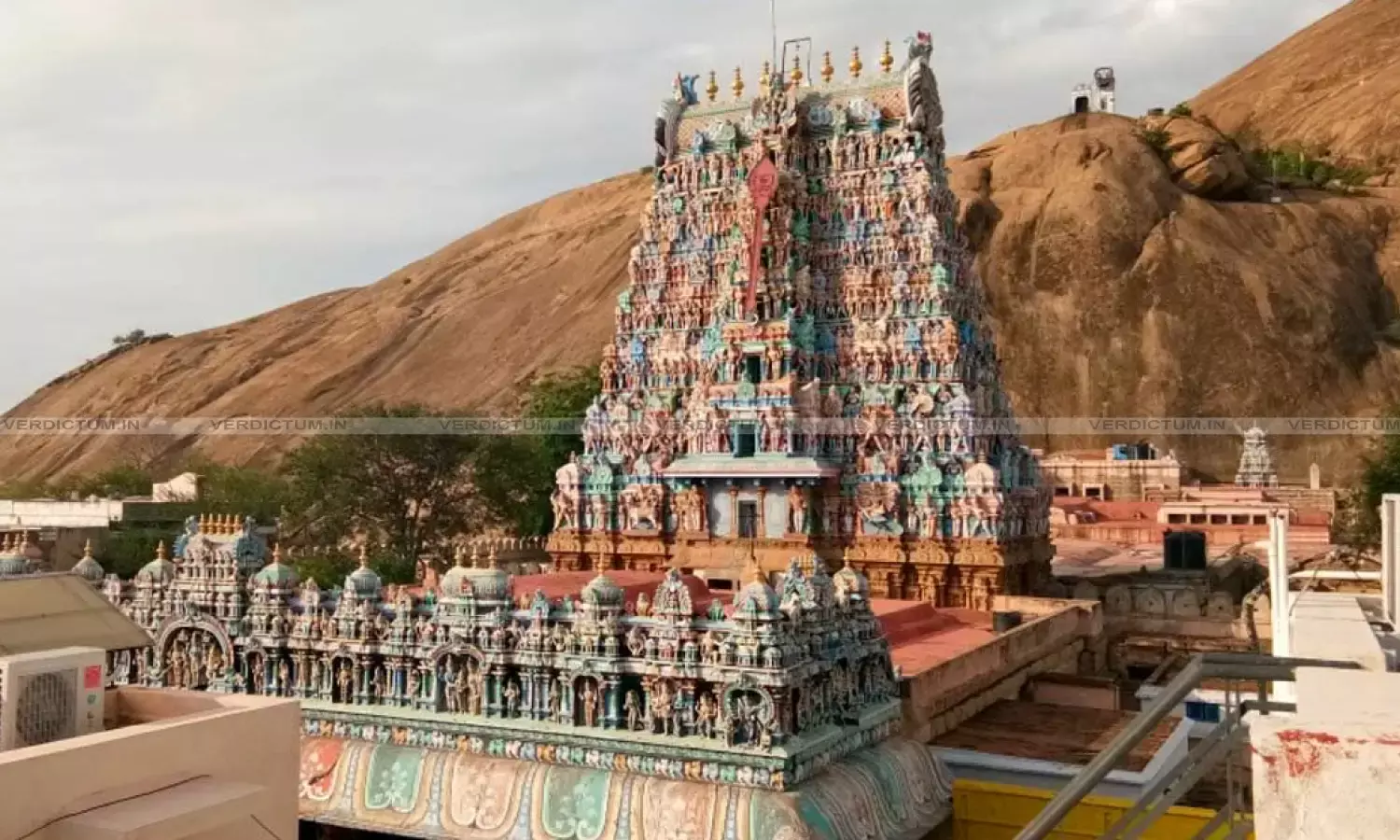
Thiruparankundram Temple
The Madras High Court has directed the Temple Management to light the Karthigai Deepam at Dheepathoon (Ancient Stone Lamp Pillar), situated on the Thirupparankundram Hill Top.
Rama Ravikumar, who claimed to be a devout follower of Lord Muruga sought such a direction via Writ Petition before the Madurai Bench and then, few other Writ Petitions were also filed for the very same relief.
A Single Bench of Justice G.R. Swaminathan observed, “By lighting the lamp at Deepathoon, the rights of the Dargha or the Muslims will not in any way be affected. The Dargah management has not demonstrated as to how they will be affected if the lamp is lit at the Deepathoon. It is not their case that Deepathoon is within the Dargha campus. On the other hand, if the lamp is not lit at Deepathoon, there is always a possibility that the rights of the temple may be jeopardised.”
The Bench remarked that the temple management appears to have forgotten the lessons of history and now is on the same page as that of the Dargha.
“In the Madras High Court, there is a practice of closing the four outer gates for 24 hours once a year. The public are informed that no one will be allowed to enter. This is to prevent easement claims by the public. The case on hand is something similar”, it noted.
The Court said that if traditions have been abandoned, the temple management has to restore them so long as Constitutional morality is not breached. It added that lighting a lamp is a sacred act and hence, it cannot offend anybody’s sensibilities.
Advocate M.R. Venkatesh represented the Petitioner, while Additional Advocate General (AAG) J. Ravindran, Special Government Pleader (SGP) M. Lingadurai, Senior Advocates Shanmugasundaram, and T. Mohan represented the Respondents.
Factual Background
The Petitioner, namely Rama.Ravikumar, who claimed to be a devout follower of Lord Muruga, had applied to the Executive Officer of Arulmigu Subramania Swamy Temple, Thirupparankundram, seeking permission to light the Karthigai Deepam for this year. In response thereto, the Executive Officer of the Temple informed the Petitioner that as per the established custom of the temple, Karthigai Deepam would be lit in the Deepa Mandapam near the Uchi Pillaiyar Temple that is located halfway up the hill.
Challenging the said communication, a Writ Petition was filed by him before the High Court. He sought direction to the temple management to light the Karthigai Deepam on the Deepathoon (Stone Lamp Pillar), which is located on one of the peaks of Thirupparankundram hill. After filing of this Petition, few other Petitions were also filed for the very same relief. Impleading Petitions were filed, some supporting the claim that the festival lamp must be lit at the Deepathoon and some contending that the lamp should be lit only near Uchi Pillaiyar Temple.
Court’s Observations
The High Court, after hearing the contentions of the counsel, noted, “The temple management went to the highest court ie., the Privy Council which set aside the High Court's judgment and restored the decision of the trial judge. The Privy council observed that the construction of the mosque was an infliction which the Hindus might well have been forced to put up with. But this was no evidence that the remainder of the hill was expropriated from the Hindus.”
The Court added that the unoccupied portion of the hill has been in the possession of the temple from time immemorial and has been treated by the temple authorities as their property and that the conclusion of the Trial Judge was right and that there was no ground to disturb his decree.
“A settled issue cannot be reopened. But the petitioners before me do not insist that on the hilltop, the lamp should be lit. They only want the lighting of the lamp at the Deepathoon. Deepathoon is not at the hilltop. There are two peaks. The mosque is at the highest peak. The Deepathoon is at the lower peak. The trial Judge in O.S No.4 of 1920 himself recognised that while the mosque is at the highest peak, the Hindu God Subramaniya is at the base of the lower of the two peaks”, it said.
The Court took note of the fact that Deepathoon is not an occupied portion of the Muslims. It held that the Deepathoon which is in the unoccupied portion belongs exclusively to the temple.
“Deepathoon or stone lamp pillar can be defined as a circular oil lamp made in stone held by a stem standing on a circular base. The structure that is found on the lower of the two peaks perfectly answers this description. On the other hand, a flagstaff is a post usually covered with metal plate put up permanently on a pedestal within the temple and in front of the deity for hoisting the temple flag at the commencement of the temple festival. Dargha worship is an anathema to conservative Muslims. Some of the Hindu practices of worship have been absorbed by the followers of Sufi Cult. Dargha is a concrete manifestation of this. They also have annual festivals known as Kandhuri”, it further observed.
The Court said that the flag is hoisted on the flagstaff and obviously, it would be within the Dargha campus and will not be outside.
“There is a flagstaff within the Dargha campus. But efforts are made to tie the flag to a tree branch far away from the Dargha. … In any event, a Deepathoon is what it is. It is not a flagstaff. The very purpose of Deepathoon is to light lamp thereon. Res Ipsa Loquitor. The thing speaks for itself. A Deepathoon at this spot would not have been put up for aesthetic value. Obviously, it is not an ornament. It has an instrumental value and that is to facilitate lighting lamps on occasions such as this”, it also remarked.
The Court was of the view that the Deepathoon is a temple property which is proved by the recent happenings and apprehending that some overenthusiastic Hindu may attempt to light the lamp, the temple management had hurriedly put up a covering.
“I posed a specific question to the counsel for the contesting respondents ; Who put up the covering around the Deepathoon ? It was admitted that the temple management had done so. If the Deepathoon and the adjoining area belonged to the Dargha, the Dargha would not have kept quiet or permitted the temple authorities to put up the covering. This single instance is sufficient to falsify the case projected by the Dargha management”, it asked.
Moreover, the Court noted that one has to climb on the rocks to reach the Deepathoon and spiritually all paths may lead to one truth; but this spiritual truth is not in sync with geographical reality.
“The paths that lead to the Dargha will not take one to the Deepathoon. They diverge and the divergence is too obvious. Just like the Sub–Judge, I too personally visited the spot. In fact, it was not a secret visit. I made an announcement in the open Court. It was a standing invitation to the counsel to join. Only after making such an announcement, in the evening, I visited the spot. I climbed the steps that led to Nellithope and further climbed the steps from Nellithope. I noted that on one side lies the Dargha and on the other the stone lamp pillar. I am however not anchoring my conclusion on any personal observation. I visited the spot more to satisfy my judicial conscience”, it added.
The Court said that lighting lamp atop the hill is a Tamil tradition and there is a popular saying “Kundrin Mel Itta Vilakkai Pola” (Like a lamp lit atop the hill).
“The reference to Karthigai Deepam in the above stanza indicates that the Tamil people have the tradition of lighting lamps atop the hill during the Tamil month of Karthigai. Thiruvannamalai is a well known pilgrim centre. Just like Thirupparankundram hillock, the hill of Arunachala itself is worshiped as Lord Shiva”, it observed.
Conclusion and Directions
The Court held that the Petitioners are justified in demanding that the temple management resumes or restores the tradition and even if it is not a matter of custom, asserting the title of the temple over the lower peak by lighting at the Deepathoon is imperative.
“It is therefore necessary that the temple management remains vigilant throughout to foil any attempt to encroach on its property. This can be done only by regular and periodical assertion of title. It is not a matter of religious tradition alone. At least, for the sake of protecting its property, the temple management is obliged to light the festival lamp at the Deepathoon”, it emphasised.
The Court said that while amity is to be celebrated, rights of both the parties have to be respected and rights of one party cannot be sacrificed. It added that the activists and devotees alone are in the forefront and the temple trustees are keeping quiet.
“… the rights of the temple cannot be left to legislative vagaries. Assuming that Section 109 is not there in the statute book or it is deleted, the temples and religious institutions cannot recover properties that have been extinguished due to limitation. This underscores the need to keep asserting one's right and ensuring that it is not taken away”, it also remarked.
The Court was of the opinion that the temple management has a legal duty in the matter and that duty has not been discharged. It noted that since the Devasthanam is going to be tasked with lighting the Deepam, there is no question of obtaining permission from the HR&CE authorities.
“Even otherwise, I fail to see as to why the HR&CE authorities have to be involved in the matter. Only if a temple property is to be alienated, Commissioner's permission has to be taken. This is a case of protecting the temple property. … Deepathoon is located 50 meters away from the Dargha. It does not fall within the prohibited distance from the flight of steps or the Nellithope area. As already mentioned, apart from these three, no other place belongs to the Muslims”, it further observed.
The Court, therefore, directed the temple management/Devasthanam to light the Karthigai Deepam at Deepathoon also apart from the usual places.
“Karthigai is also a festival of light. Lamps are lit all over the house and not in the pooja room alone. The Karthigai Deepam shall be lit from this year onwards at Deepathoon also. It is the duty of the jurisdictional police to ensure that the direction of this Court is complied with. The Commissioner of Police, Madurai City shall see to it that no one comes in the way of enforcement of this order”, it concluded.
Accordingly, the High Court allowed the Writ Petition and quashed the impugned decision.
Cause Title- Rama.Ravikumar v. The District Collector, Madurai & Ors. (Case Number: W.P(MD)Nos.32317, 33112, 33197, 33724 and 34051 of 2025)
Appearance:
Petitioner: Advocates M.R. Venkatesh and R.M. Arun Swaminathan.
Respondents: AAG J. Ravindran, SGP M. Lingadurai, Senior Advocates Shanmugasundaram, T. Mohan, Government Advocate A. Albert James, AGP G. Suriya Anandh, DSGI K. Govindarajan, Advocates V. Chandrasekhar, A. Syed Abdul Kather, G. Prabhu Rajadurai, D.S. Haroon Rasheed, Niranjan S. Kumar, and S. Vanchinathan.
