

Crime Scene Re-Enactment Not Per Se Testimonial Compulsion; Expert Analysis Based On It Admissible As Corroborative Evidence: Supreme Court
The Bench noted that staged video walkthroughs to capture a suspect's physical attributes serve as non-testimonial identification data rather than forced confessions.

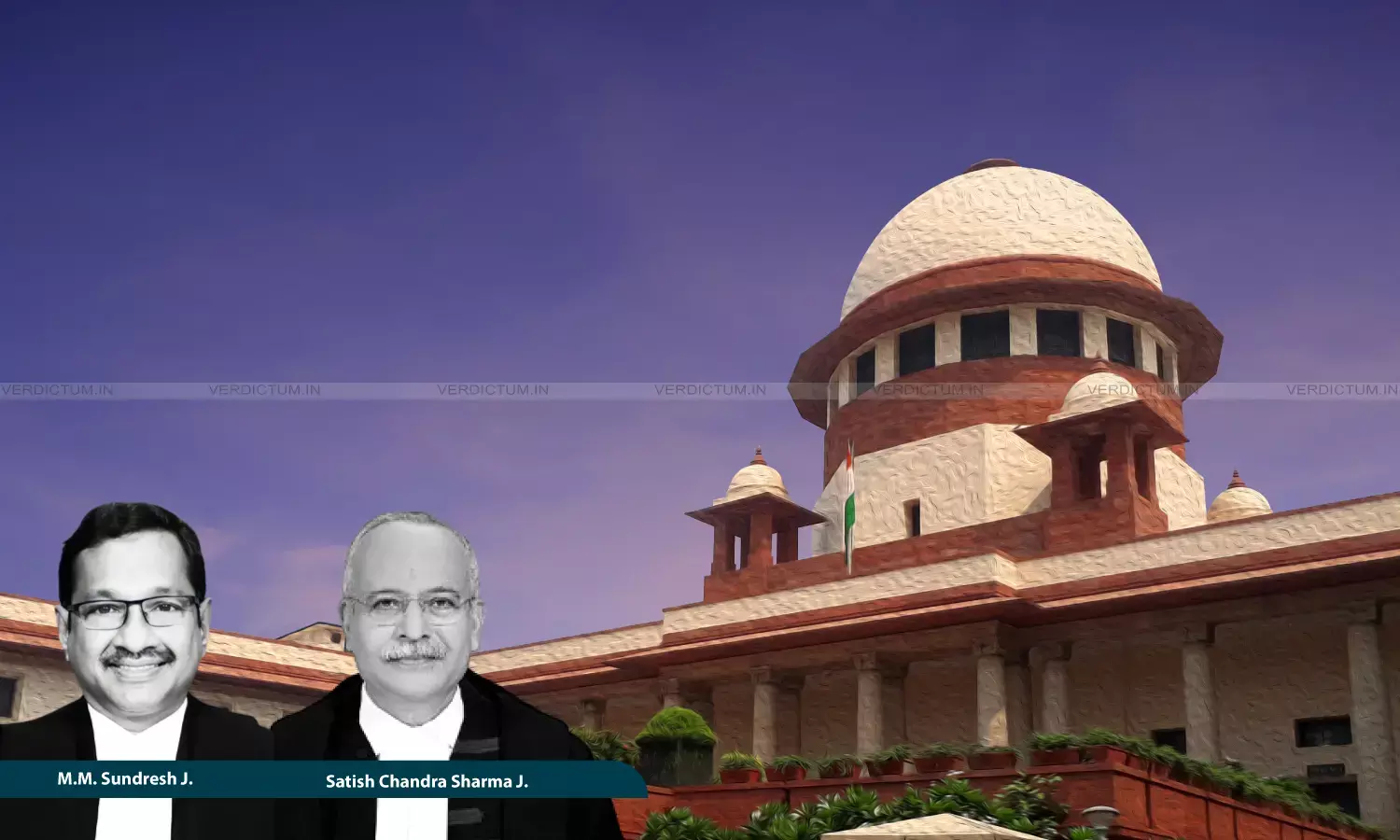
Justice M.M. Sundresh, Justice Satish Chandra Sharma, Supreme Court
The Supreme Court has held that while a directed crime scene re-enactment or walkthrough is legally admissible, it remains a corroborative piece of evidence that cannot independently form the sole basis of a criminal conviction. The Bench ruled that if a re-enactment merely requires an accused to walk, act in a certain manner, or imitate a visual sequence to capture physical attributes for forensic comparison, it functions purely as secondary, corroborative proof rather than a forced personal testimony under Article 20(3) of the Constitution of India.
In the judgment, while upholding the conviction in Dr. Subbiah’s murder case, the Bench observed that an expert report generated from a simulated walkthrough, such as a forensic gait analysis, is inherently a created document representing the investigating officer's directions rather than the suspect's personal statement. The Bench cautioned that laying down sweeping rules to routinely bar re-enactments would eliminate a potent scientific investigative technique, provided courts maintain a strict line of distinction between a directed physical demonstration and an exercise that forces an accused to unearth hidden personal knowledge of a crime.
Justice M. M. Sundresh and Justice Satish Chandra Sharma observed, “…it needs to be noted that evidence based on a re-enactment or demonstration is not a substantive piece of evidence of the actual commission of the offence. It is merely corroborative evidence which may be useful to corroborate the identities and physical attributes of the suspects, sequence of the alleged occurrence, physical attributes of the place of occurrence etc. On its own, re-enacted evidence cannot be made the basis to arrive at a finding of conviction…the High Court has committed an error in holding that reenactment by the accused persons amounted to their personal testimonies within Article 20(3) of the Constitution. In fact, the accused persons have themselves questioned the gait analysis report on the ground that re-enactment carried out by them was artificial and was made to align with the movements shown in the CCTV footage and therefore, similarities were bound to emerge”.
“…Per se, a re-enactment of an occurrence is merely ‘created’ document/evidence and on its own, it hardly proves anything…”, it further noted.
Senior Advocate Siddarth Luthra appeared for the appellant and Senior Advocates R. Basant, Jayanth Muth Raj, M Sathyanarayanan appeared for the respondents.
The constitutional question arose during the trial of multiple individuals accused in the broad daylight murder of Dr. Subbiah, a prominent Chennai-based physician who was brutally hacked with a sickle on September 14, 2013, due to a bitter land dispute.
Reversing the acquittal, the Supreme Court held that the High Court erred by treating the artificially staged demonstration as an inadmissible confession. The Bench extracted the clear ratio that while a crime scene re-enactment functions as corroborative identification data akin to voice samples or fingerprints to establish identity or physical attributes during trial, it lacks the legal character of substantive proof of the actual commission of the offence.
“The re-enactment or demonstration of an occurrence by an accused is often based on eye-witness accounts of the offence or on the basis of CCTV footage extracted from nearby cameras installed in public spaces. Nevertheless, it cannot be held as a general proposition that every re-enactment or demonstration of a crime scene per se amounts to personal testimony of the accused. If the re-enactment is merely based on a direction to walk or to act a certain way or to imitate a visual sequence, it does not necessarily involve any physical manifestation or disclosure of the personal knowledge of the accused. In that sense, it does not amount to any personal testimony. However, if the accused is somehow led into demonstrating the incriminating acts committed by him from his own knowledge, the same would amount to testimonial compulsion and would be squarely hit by Section 25 and 26 of Evidence Act…”, the Bench observed.
“…Therefore, it would be dangerous to lay down a general rule against the admissibility of evidence based on re-enactment or demonstration of the occurrence, as it would effectively kill a potent and scientific investigative technique. The right approach is to tread a proportionate path and see whether the re-enactment is merely a directed demonstration to analyse physical attributes of the suspects or a manifestation of the personal knowledge of the accused. Although, we must be mindful of the fact that inherently, by its very nature, an exercise of re-enactment of occurrence is carried out as per the directions given by the investigating officer and the re-enacted version does not amount to a personal version of the accused. Rather, it remains an enactment or demonstration of the version of the investigating officer...On the basis of such re-enactment, expert analysis such as gait analysis is carried out, which gives rise to a distinct piece of evidence, with distinct implications. Such expert evidence is not based on the personal testimony of the accused and is merely an analysis of the physical attributes of the accused, which could be used for the purpose of identification during trial. Thus, the thin line between ‘re-enactment’ and ‘evidence based on reenactment’ needs to be acknowledged”, the Bench further observed.
While allowing the criminal appeals, except Accused Nos. 1 and 2, all respondents were directed to surrender before the Trial Court within two weeks to undergo their sentences. Considering the limited role and advanced age of Accused Nos. 1 and 2, the Court suspended their sentences for eight weeks to enable them to seek pardon from the Governor of Tamil Nadu under Article 161 of the Constitution of India.
Cause Title: The State of Tamil Nadu v. Ponnusamy & Ors. (Neutral Citation: 2026 INSC 507)
Appearances:
Appellant: Kartik Seth, Shilpa Saini, Ratakshi Sarvaria,. K.m. Abish,. Shaesta Irshad, Ragib, Adv. M/s Chambers Of Kartik Seth, AOR, Siddarth Luthra, Sr. Adv., M.F.Philip, Purnima Krishna, AOR, Kartikeya Dang, Aadarsh Joshi, Karamveer Singh Yadav, Togin M. Babichen, Muskan Anand, Advocates.
Respondent: M.F. Philip, Purnima Krishna, AOR, Karamveer Singh Yadav, Togin M. Babichen, Dr. Yug Mohit Chaudhary, Siddhartha, S. Prabu Ramasubramanian, Bharathimohan M., V. Swetha, Vairawan A.s, AOR, Navneet Dugar, AOR, Prashant Padmanabhan, AOR, R. Basant, Sr. Adv., N. Sai Vinod, AOR, Kanu Garg, Raunak Arora, Kavinesh Rn, Shubham Chopra, M Sathyanarayanan, Sr. Adv., Anindita Mitra, AOR, Vishal Sinha, Lakshman Raja T, Payoshi Roy, Kaushal Kishore, Amit Pratap Shaunak, Achintya Tiwari, Priyanshu Maheshwari, Shivangi Chaturvedi, M. Srinivasan, D. Narayana Kumar, C. Solomon, AOR, Shri Singh, Arshiya Ghose, Rudrali Patil, Arunima M, Varuni Aggarwal, S. Parthasarathi, AOR, Jayanth Muth Raj, Sr. Adv., Shivani Vij, AOR, Shrutanjaya Bhardwaj, Siddhi Nagwekar, Yash Tayal, Nizam Pasha, Lzafeer Ahmad B. F., AOR, Anshika Das, Arif Ali, Sidharth Kaushik, Advocates.