

Job Of A Criminal Court Is Not To Order Loose Acquittals: Supreme Court Upholds Conviction In Dr Subbiah Murder Case
The Bench noted that the High Court applied artificial proof standards and fictional probabilities to dismiss direct evidence of conspiracy.

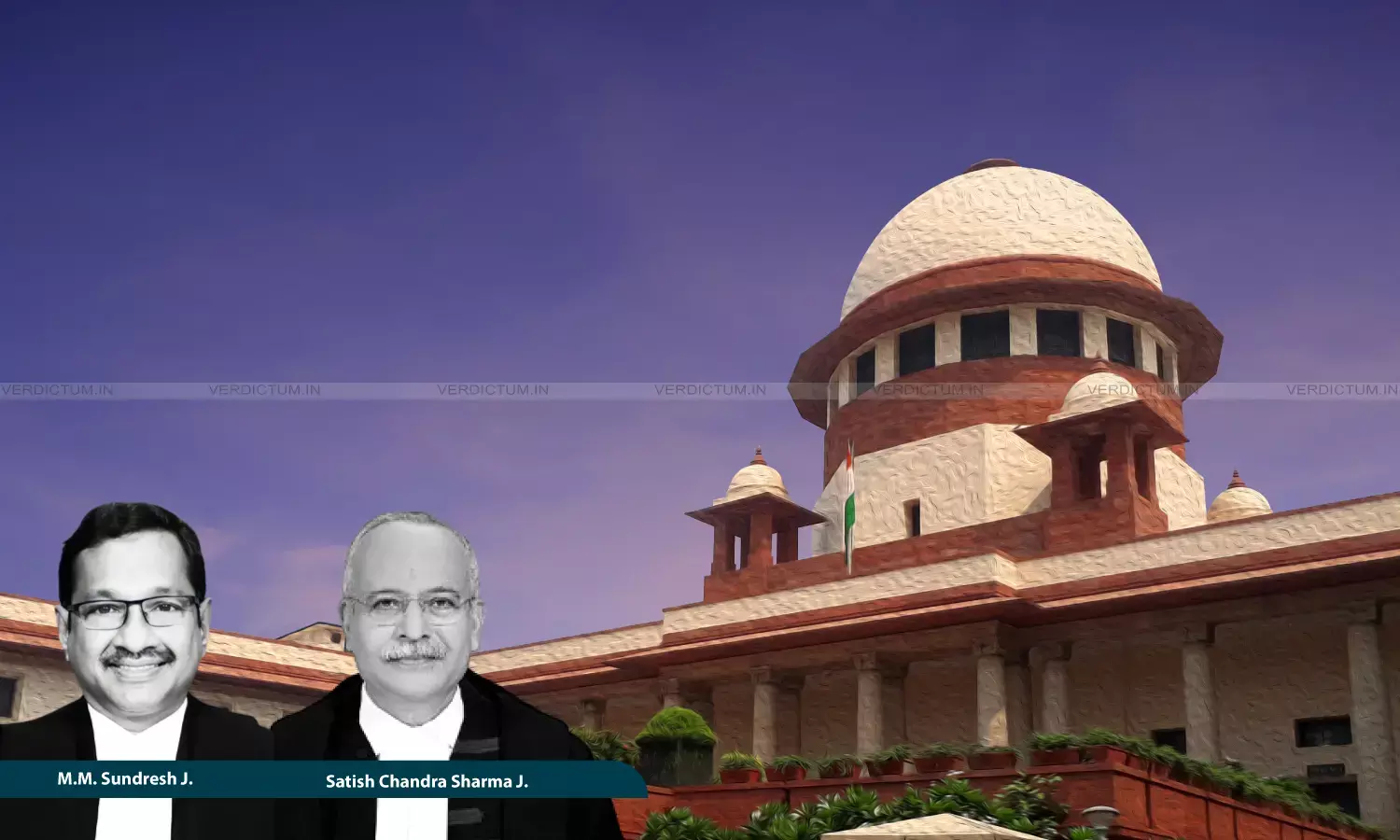
Justice M.M. Sundresh, Justice Satish Chandra Sharma, Supreme Court
The Supreme Court has set aside the Madras High Court's acquittal, and restored the convictions in Dr. Subbiah’s murder case. Opening the judgment with a quote from Rabindranath Tagore, “The greed of gain has no time or limit to its capaciousness... It is ruthlessly ready without a moment's hesitation to crush beauty and life”, the Court said that the judiciary must resist ordering routine acquittals based on speculative hypotheses when a trial court's evaluation of concurrent evidence remains unassailable.
It observed that while advanced techniques like gait analysis are valuable for criminal identification, an expert forensic report cannot be relied upon unless it is built upon primary source materials that are independently proved as admissible and reliable. The Court observed that a High Court sitting in appeal must not reflexively enter into a wholesale re-appreciation of evidence or disturb conviction findings by force of habit, unless the trial court’s conclusions are demonstrably perverse, illegal, or completely impossible.
A Division Bench comprising Justice M. M. Sundresh and Justice Satish Chandra Sharma noting the meaning of ‘beyond reasonable doubt’, observed, “…we feel constrained to note that the High Court has appreciated the entire evidence on an artificial standard. We are afraid, the High Court has introduced numerous fictional probabilities in the sequence of events, without being supported by the record and cross-examination of the concerned witnesses. …On conspiracy, for instance, the High Court has proceeded to lay down general statements of law to the effect that a conspiracy is always hatched in secrecy and cannot be heard by third persons. It went to the extent of calling it an ‘insult to the criminal justice system’ if it is believed that the conspiracy was discussed in the presence of eye witnesses. We are a little taken back with the sweeping nature of remarks made in the impugned judgment. Effectively, to say so would mean that there could possibly never be any direct evidence of conspiracy. We often find ourselves reiterating that conspiracies are generally hatched in secrecy, however, it does not mean that direct evidence of conspiracy is an impossibility, or that such evidence would get rejected on this notion alone”.
“…Unsurprisingly, ordinary doubts are bound to emerge in a case of this nature where the transaction and witnesses are scattered across a wide spectrum. The job of a criminal court is not to order lose acquittals by entertaining such vague and ordinary doubts, convoluted theories and suppositions…”. the Bench remarked.
Senior Advocate Siddarth Luthra appeared for the appellant and Senior Advocates R. Basant, Jayanth Muth Raj, M Sathyanarayanan appeared for the respondents.
The matter originated from the murder of Dr. Subbiah, a prominent physician at Chennai’s Billroth Hospital, who was brutally hacked with a sickle in broad daylight on September 14, 2013, later succumbing to his wounds.
Investigations revealed a bitter, long-standing title dispute over a valuable two-acre land parcel in Kanyakumari District as the prime motive. This dispute culminated in a multi-layered criminal conspiracy involving land brokers, henchmen, and hired contract killers organized to eliminate the doctor so the accused could enjoy the property unhindered.
The Trial Court convicted the accused persons, awarding the death penalty to seven individuals for offences including murder and criminal conspiracy. On appeal, the High Court of Judicature at Madras reversed the conviction and recorded a wholesale acquittal after discarding the eye-witness accounts, the testimony of the accomplice-turned-approver, the money trail, and the forensic gait analysis evidence.
Reversing the acquittal, the Supreme Court reasoned that the High Court had adopted artificial standards of proof to dismiss a consistent prosecution narrative backed by eye-witnesses and an approver. Striking a balance on scientific evidence, the Court clarified that non-testimonial physical demonstrations, such as a re-enacted crime scene walkthrough, do not violate the right against self-incrimination under Article 20(3) of the Constitution of India.
. …the Court is not expected to import its own doubts, without being supported by the manner in which the case has been defended by the accused persons. The dangers associated with the lose application of the principle of ‘beyond reasonable doubt’ have been discussed on various occasions by this Court. We would not like to prolong our judgment by reiterating once again, and suffice to note that a lose acquittal of a guilty person is as dangerous as the conviction of an innocent”, it observed.
However, the Bench extracted the clear ratio that a gait analysis report cannot be relied upon if the baseline CCTV footage on which it is based suffers from serious apprehensions of mishandling and an inconsistent chain of custody, as a comparison of two unproved or unreliable pieces of electronic evidence cannot produce a reliable conclusion.
“…A reasonable doubt, therefore, emerges in view of the distorted chain of custody and destruction/corruption of the original hard disk and DVR. In such circumstances, merely because the copied footage was played in the Trial Court, it cannot be held that the footage was proved in accordance with the law. Therefore, we find it dangerous to place reliance on the CCTV footage or the gait analysis report prepared on that basis. The High Court has rightly rejected this piece of evidence”, it noted.
“However, as noted in case of CDRs, rejection of gait analysis report shall not affect the outcome of the case. For, the report has been relied upon for purely corroborative purposes to prove the identities of A8 and A9, and in view of ample direct and circumstantial evidence on record, both oral and documentary, we feel no need for corroboration on the basis of gait analysis. The identities of the accused persons have been established to the satisfaction of the Court by credible eye witness accounts…”, further noted.
While allowing the criminal appeals, except Accused Nos. 1 and 2, all respondents were directed to surrender before the Trial Court within two weeks to undergo their sentences. Considering the limited role and advanced age of Accused Nos. 1 and 2, the Court suspended their sentences for eight weeks to enable them to seek pardon from the Governor of Tamil Nadu under Article 161 of the Constitution of India.
Cause Title: The State of Tamil Nadu v. Ponnusamy & Ors. (Neutral Citation: 2026 INSC 507)
Appearances:
Appellant: Kartik Seth, Shilpa Saini, Ratakshi Sarvaria,. K.m. Abish,. Shaesta Irshad, Ragib, Adv. M/s Chambers Of Kartik Seth, AOR, Siddarth Luthra, Sr. Adv., M.F.Philip, Purnima Krishna, AOR, Kartikeya Dang, Aadarsh Joshi, Karamveer Singh Yadav, Togin M. Babichen, Muskan Anand, Advocates.
Respondent: M.F. Philip, Purnima Krishna, AOR, Karamveer Singh Yadav, Togin M. Babichen, Dr. Yug Mohit Chaudhary, Siddhartha, S. Prabu Ramasubramanian, Bharathimohan M., V. Swetha, Vairawan A.s, AOR, Navneet Dugar, AOR, Prashant Padmanabhan, AOR, R. Basant, Sr. Adv., N. Sai Vinod, AOR, Kanu Garg, Raunak Arora, Kavinesh Rn, Shubham Chopra, M Sathyanarayanan, Sr. Adv., Anindita Mitra, AOR, Vishal Sinha, Lakshman Raja T, Payoshi Roy, Kaushal Kishore, Amit Pratap Shaunak, Achintya Tiwari, Priyanshu Maheshwari, Shivangi Chaturvedi, M. Srinivasan, D. Narayana Kumar, C. Solomon, AOR, Shri Singh, Arshiya Ghose, Rudrali Patil, Arunima M, Varuni Aggarwal, S. Parthasarathi, AOR, Jayanth Muth Raj, Sr. Adv., Shivani Vij, AOR, Shrutanjaya Bhardwaj, Siddhi Nagwekar, Yash Tayal, Nizam Pasha, Lzafeer Ahmad B. F., AOR, Anshika Das, Arif Ali, Sidharth Kaushik, Advocates.
Click here to read/download the Judgment