

Breaking: Supreme Court Mandates Extreme Legal Measures Against Sand Mining Mafia In National Chambal Sanctuary; Warns Of CRPF Deployment & Directs Total Mining Ban
The Court issued a series of mandatory directions, and the creation of armed joint patrol teams, while warning states that failure to curb the mining mafia would result in a total sand mining ban and the deployment of central forces.

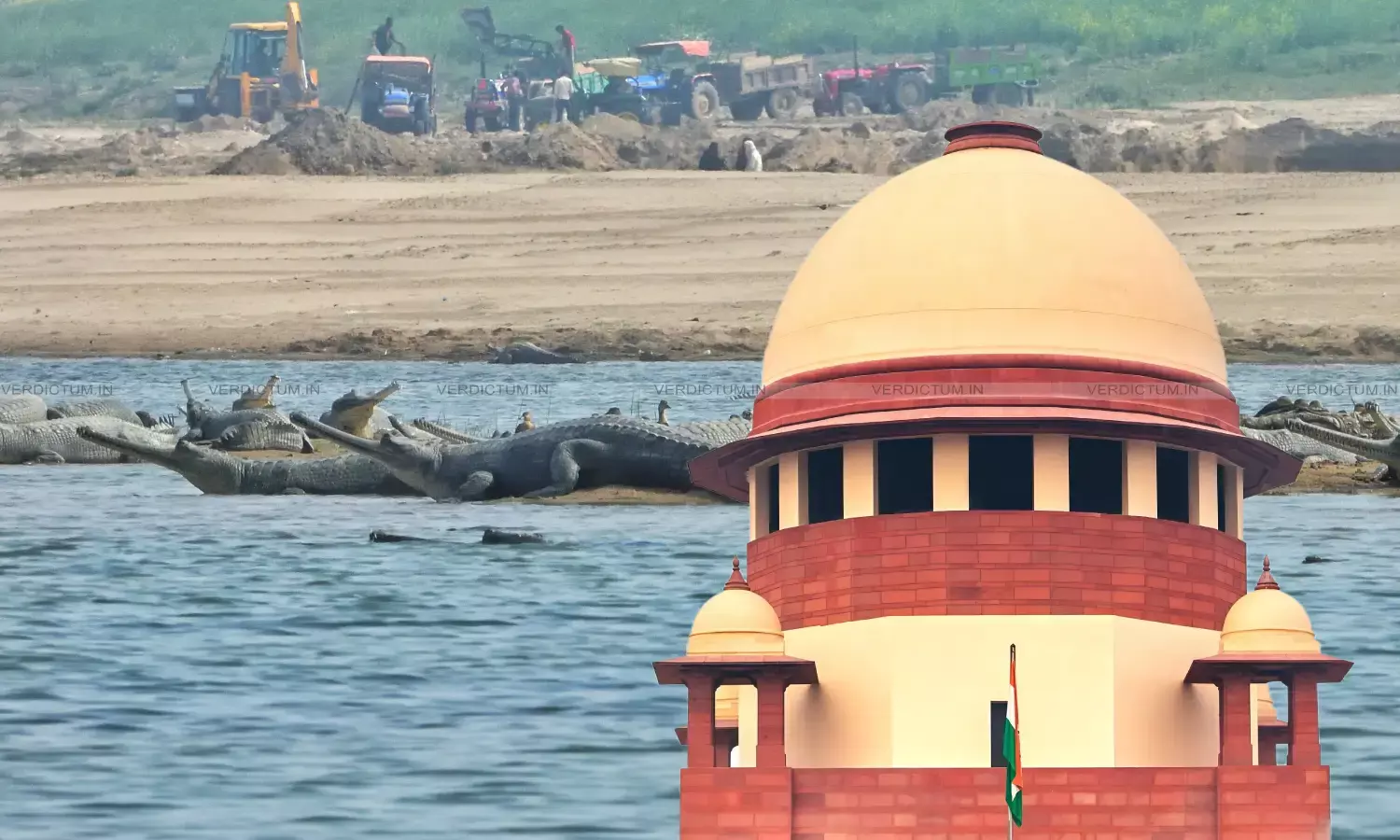
Addressing the catastrophic failure of state machinery to protect the National Chambal Gharial Sanctuary, the Supreme Court has laid down a rigorous legal and operational framework to tackle organized illegal mining in National Chambal Sanctuary.
The Court directed State Pollution Control Boards to recover environmental compensation from violators for ecological restoration.
To ensure enforcement, the bench ordered the immediate implementation of real-time monitoring through Wi-Fi-enabled CCTV and mandatory GPS tracking for all mining equipment in high-risk districts like Morena and Dhaulpur.
Furthermore, the Court established a standard of personal accountability for officials, warning that any negligence would be met with contempt proceedings, while reserving the right to deploy the Central Reserve Police Force (CRPF) should the administrative authorities continue to "drag their feet" against the mining mafia.
Previously, the Court reserved its orders in the present matter. The Court, on April 2, 2026, granted an interim stay on a December 2025 notification by the State of Rajasthan that sought to denotify 732 hectares of sanctuary land for boundary rationalization.
The bench of Justice Vikram Natha and Justice Sandeep Mehta ordered, "The statutory framework is well-armed to deal with the mining mafias, but apparently, the administrative authorities are dragging their feet for reasons which are not difficult to discern. We feel that under such grave circumstances, the state governments concerned would be well-advised to invoke the provisions relating to preventive detention, seizure, and confiscation of immovable properties and machinery, and to undertake effective and stringent prosecutions so as to bring the offenders to book and ensure the protection of the environment. We, therefore, expect the states of Madhya Pradesh, Rajasthan, and Uttar Pradesh to come out with concrete and effective measures for tackling illegal mining activities, failing which this court will be constrained to invoke its extraordinary jurisdiction for issuing appropriate directions, including the deployment of paramilitary forces or the Central Reserve Police Force, directing a complete ban on sand mining in the states of Madhya Pradesh and Rajasthan, and imposing heavy penalties on the said states for failing to safeguard the critical habitats and the river ecosystem vital for sustaining all forms of life."
ASG SV Raju appeared for the State of MP, while Senior Advocate Nikhil Goel and AOR Rupali Samuel appeared as Amicus Curiae.
The instant suo motu Writ Petition (WP) came to be registered based on certain news reports pertaining to rampant illegal mining on the sand banks of the Chambal River, thereby destroying the habitats of the protected species of Gharial. The news reports give a vivid description of the destruction of the habitat of various aquatic animals in addition to that of Gharials. Further, the news reports also refer to the de-notification of 732 hectares from the National Chambal Sanctuary by the State of Rajasthan as part of a boundary rationalization exercise.
The Court ordered, "In view of the foregoing discussion and having regard to the exigencies of the situation, the following directions are hereby issued for immediate compliance. The states of Madhya Pradesh, Rajasthan, and Uttar Pradesh shall ensure the installation of high-resolution, Wi-Fi-enabled CCTV cameras mounted on appropriately elevated poles or masts at all routes frequently used for illegal sand mining, as well as along the vulnerable stretches of the river where such activities are prevalent. The concerned authorities shall undertake a detailed assessment with regard to the positioning and placement of such CCTV cameras in consultation with the Central Empowered Committee so as to ensure that the installation is carried out in a manner that minimizes ecological disturbance and complies with all applicable environmental regulations, particularly those relating to the non-disturbance of the riverbed and surrounding forest areas to the greatest extent possible."
The Court said that live feed of such surveillance cameras installed in terms of Direction A shall be placed under the direct control, supervision, and operational oversight of the Superintendent of Police or the Senior Superintendent of Police of the concerned district and the Divisional Forest Officer, who shall ensure continuous and effective monitoring by designating appropriate officers not below the rank of Sub-Inspector or Station House Officer and an appropriately ranked Forest Official for the set purpose. In the event of the detection of any instance of illegal mining or allied unlawful activity through such surveillance, the concerned officers shall be under a mandatory obligation to initiate prompt and appropriate action in accordance with law, including the mobilization of enforcement teams and the initiation of necessary legal proceedings so as to ensure effective deterrence and the prevention of such activities.
It also added that the concerned authorities or departments of the states of Madhya Pradesh and Rajasthan shall, on a pilot basis, ensure that GPS tracking devices are mandatorily installed in all vehicles and machinery—including dredgers, loaders, excavators, tractors, and any other equipment or machinery used in mining activities—registered or operating within District Morena, Madhya Pradesh, and District Dhaulpur, Rajasthan, so as to enable real-time monitoring and effective surveillance as well as complete traceability of their movement.
It was directed, "The states of Madhya Pradesh, Rajasthan, and Uttar Pradesh shall, by the next date of hearing, place on record a detailed report indicating the feasibility of establishing dedicated control rooms in each district falling within or adjoining the National Chambal Gharial Sanctuary, wherein the live CCTV feeds and the data collected through surveillance mechanisms, including GPS tracking systems, may be centrally received, monitored, and analyzed. The report shall also indicate the proposed framework for coordination between the concerned departments and the enforcement agencies so as to ensure that timely and effective action is taken in accordance with law on the basis of such real-time inputs. The concerned authorities and departments of the states of Madhya Pradesh, Rajasthan, and Uttar Pradesh shall ensure that any vehicle or machinery found involved in illegal sand mining is immediately seized and the driver, owner, and all persons involved are prosecuted in accordance with applicable laws, including the relevant environmental protection, conservation, and mining regulation statutes."
It said that the implementation shall be carried out through the respective Departments of Transport of the States, and the data generated shall be made accessible to the District Magistrate and the Police Authorities for enforcement purposes. Based on the outcome and effectiveness of the set pilot implementation, appropriate steps shall be taken for its phased extension to other districts falling within or adjoining the National Chambal Gharial Sanctuary. Appropriate publicity shall be given to the above direction, stipulating that any non-compliance shall result in the immediate seizure of the vehicle or the machinery concerned, with no possibility of release except with the express permission of the court.
"Appropriate proceedings for the confiscation of such vehicles and machinery shall also be initiated and diligently pursued in accordance with law so as to ensure effective deterrence against such illegal activities. The concerned authorities, including the State Pollution Control Boards of the states of Madhya Pradesh, Rajasthan, and Uttar Pradesh, shall initiate appropriate time-bound proceedings for the assessment, imposition, and recovery of environmental compensation from all violators strictly in accordance with the "Polluter Pays Principle," so as to ensure restitution as well as the remediation of the ecological damage caused by the illegal sand mining activities. Such exercise shall be undertaken in a scientific, transparent, and objective manner, having due regard to the extent of the environmental degradation, and shall be enforced to serve both compensatory and deterrent purposes", it ordered.
The Court directed the states of Madhya Pradesh, Rajasthan, and Uttar Pradesh shall constitute dedicated, fully operational, and well-equipped joint patrol teams in each district falling within or adjoining the National Chambal Gharial Sanctuary, comprising officials from the police and forest departments. It said that the state shall ensure that an adequate and well-trained strength of support security personnel is deployed for such patrols on a continuous and round-the-clock basis, particularly in vulnerable and high-risk areas. It shall further be ensured that such teams are equipped with modern surveillance and communication equipment, protective gear, and appropriate arms so as to enable them to effectively prevent illegal mining activities, respond swiftly to emergent situations, and safely handle instances involving resistance and violence by organized groups engaged in such activities.
It observed, "It cannot be gainsaid that the issues involved are of grave concern, inasmuch as the rampant illegal mining activities in the riverbed have created an environmental crisis and havoc in the Chambal Gharial Sanctuary, causing a grave risk to the very project of Gharial preservation of which the state governments themselves were proponents and were under an obligation to foster and promote. The utter failure of the state governments in discharging this duty is writ large on the face of the record. The lackadaisical response of the states in the proceedings before the National Green Tribunal gives rise to a genuine apprehension in our mind regarding the intent of the state governments to act as the protectors of the environment."
The court expresses profound dissatisfaction with the states' historical "lackadaisical" response, noting that their failure to act has endangered the Gharial preservation project. It warns that officials will be held personally accountable for any negligence or dereliction of duty, including potential contempt of court proceedings. If significant progress is not evidenced by the next hearing on May 11th, the court has threatened to exercise its extraordinary jurisdiction to deploy paramilitary forces, impose a total ban on sand mining, and levy heavy penalties on the defaulting state governments.
To strengthen ground-level enforcement, the states are ordered to form joint patrol teams consisting of police and forest personnel, equipped with modern surveillance gear, protective equipment, and arms to counter organized resistance. The court emphasizes the need for a uniform Standard Operating Procedure (SOP) to facilitate interstate coordination and seamless operations across state boundaries. Furthermore, any vehicle or machinery caught in illegal activities must be seized immediately and cannot be released without express court permission, while violators face prosecution and financial liabilities under the "Polluter Pays Principle" for ecological restoration.
On the last date of hearing, the Court had also slammed the State of Madhya Pradesh for inaction in the death of a forest guard. The Court had suggested putting high-resolution cameras and a GPS monitor tracking system on all the vehicles, including loaders, tippers, excavators, etc.
The state governments submitted multiple affidavits admitting their inability to curb the mining mafia. The states claimed that illegal miners possessed superior weaponry compared to local authorities. Justice Mehta rejected these justifications, pointing out that the state had failed to utilize legal tools such as preventive detention, which had proven effective in similar cases of organized crime in other regions.
On March 20, the Court remarked that the officials of departments of Forest, Mining, and Water Resources, as well as the police authorities of the states of Rajasthan, Madhya Pradesh, and Uttar Pradesh, by their lethargy and inaction, would be liable to be held vicariously liable for aiding and abetting the destruction of these precious habitats by allowing illegal sand mining to continue at the National Chambal Sanctuary.
According to reports, Madhya Pradesh Chief Minister Mohan Yadav released 10 gharials into the Chambal River at the sanctuary in Morena in February last year.
The National Chambal Sanctuary, also called the National Chambal Gharial Wildlife Sanctuary, is a 5,400 sq km tri-state protected area. Besides the endangered gharial, it is home to the red-crowned roof turtle and the endangered Ganges river dolphin.
Located on the Chambal river near the tripoint of Rajasthan, Madhya Pradesh and Uttar Pradesh, the sanctuary was first declared a protected area in Madhya Pradesh in 1978 and now constitutes a long, narrow eco-reserve co-administered by the three states.
Accordingly, the matter is now on 11th May for further consideration.
Cause Title: In Re: Illegal Sand Mining In The National Chambal Sanctuary And Threat To Endangered Aquatic Wildlife [SMW(C) No. 2/2026 Diary No. 15656/2026]
Click here to read/download the Judgment
(This is a hearing story; the judgment was uploaded later.)