

Gharials & Aquatic Life On Verge Of Extinction: Supreme Court Stays Rajasthan’s Denotification Of Chambal Sanctuary Land
The Court halted the state's move to de-reserve 732 hectares of protected habitat, slamming authorities for failing to curb a "terrifying" mining mafia that threatens the endangered gharial.

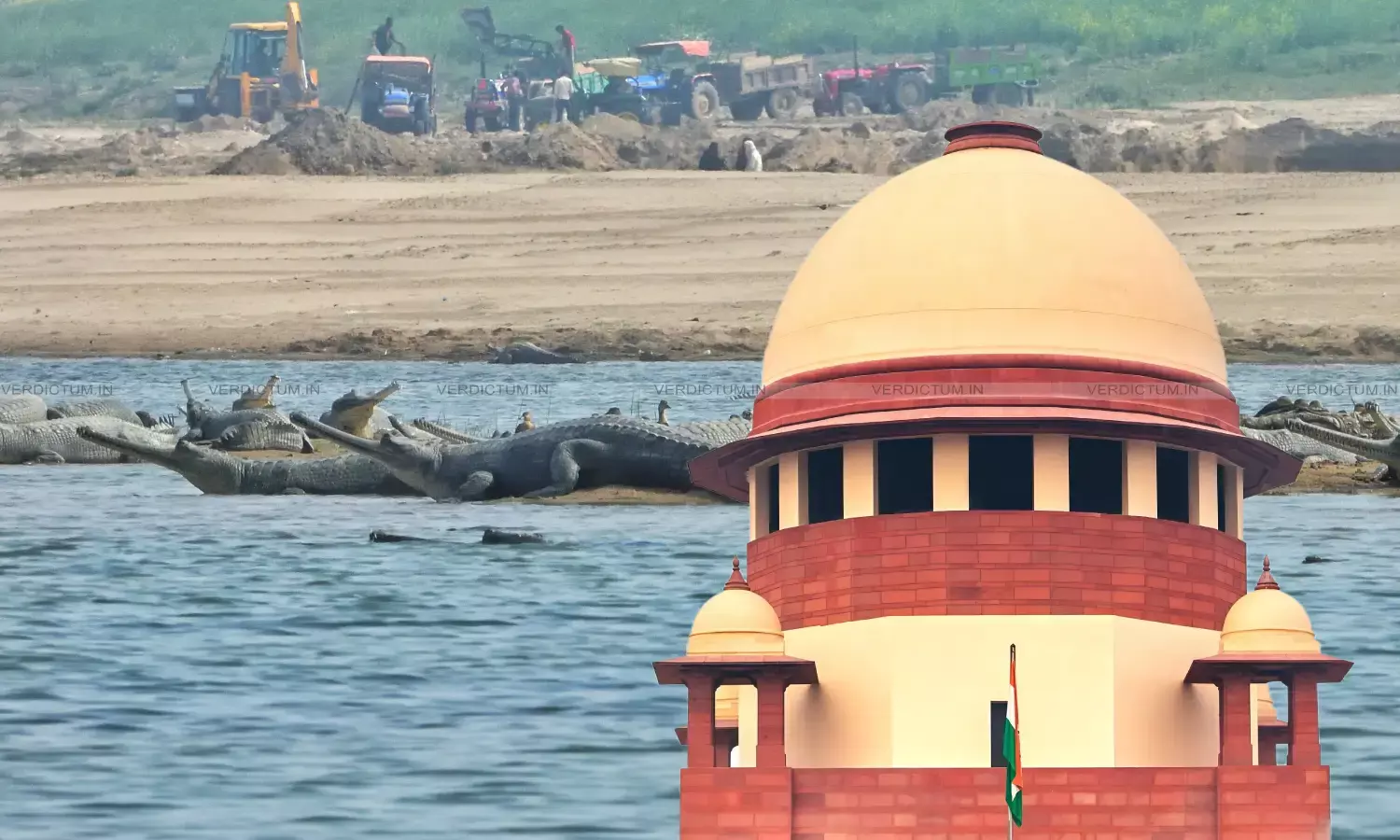
The Supreme Court issued an interim stay on a December 2025 notification by the State of Rajasthan that sought to denotify 732 hectares of sanctuary land for boundary rationalization in a suo motu matter concerning the survival of the National Chambal Sanctuary.
The Court criticized the State's admission that it could not tackle the mining mafia due to inferior weaponry, noting that authorities had "completely forgotten" the power of preventive detention while allowing over a thousand trucks of illegal sand to pass by police outposts daily.
Consequently, the Court impleaded the National Wildlife Board of India, transferred related proceedings from the NGT to itself, and demanded a response from the Ministry of Environment, Forest and Climate Change (MoEF) within four weeks.
The Bench of Justice Vikram Nath and Justice Sandeep Mehta ordered, "The Amicus has submitted the first report dated 2nd April 2026. A copy of the same has been served on the counsel representing the State of Rajasthan, the State of Madhya Pradesh, and the State of Uttar Pradesh. Counsel for the three states are granted four weeks, as is the Central Empowered Committee (CEC). The States of UP and Rajasthan have already filed affidavits. The State of MP is granted time. The Ld. ASG is to take instructions from the MoEF and file an appropriate affidavit. The National Wildlife Board of India is to be impleaded as a respondent, and notice is to be issued making it returnable on May 11. In the meantime, the notification dated 23.12.2025 issued by the State of Rajasthan under Section 18 of the Wildlife Protection Act, 1972, shall remain stayed. Further, OA No. 248/2022 pending before the NGT, initiated suo motu, is called to this court."
Senior Advocate Nikhil Goel and AOR Rupali Samuel appeared as Amicus Curiae.
The instant suo motu Writ Petition (WP) came to be registered based on certain news reports pertaining to rampant illegal mining on the sand banks of the Chambal River, thereby destroying the habitats of the protected species of Gharial. The news reports give a vivid description of the destruction of the habitat of various aquatic animals in addition to that of Gharials. Further, the news reports also refer to the de-notification of 732 hectares from the National Chambal Sanctuary by the State of Rajasthan as part of a boundary rationalization exercise.
Justice Mehta said, "CEC has filed a report. Have you filed a report, Mr. Goyal? What is the status? And that denotification is also a serious issue. So, what is your finding on that? They should have come to the court for denotifying… They could not have done it on their own. There is no question; that is illegal. Mr. Sharma, your state is in hot water—the hot waters of Chambal. Irrespective thereof, we are not allowing the denotification of any reserved land for protected species. There is no question. Have you seen that location? Have you been to that location? Go and see how fragile it is. It is with great difficulty that they could be reconserved. The gharials are now virtually on the verge of extinction. Not only gharials, but so many animals—aquatic animals. For whose facilitation? For illegal mining? What is the purpose of repair? Don't tell us, please, Mr. Sharma. Don't tell us. Please, you are mistaken. The sort of illegal mining which takes place in Dholpur… You are facilitating illegal mining."
Justice Sandeep Mehta expressed grave concern regarding the fragile state of the Chambal Sanctuary, noting that species such as the gharial were on the verge of extinction. The Court observed that illegal mining was being facilitated by the state's inaction, despite the area’s ecological sensitivity. Justice Mehta criticized the state authorities for allowing mining activities to persist near police and mining outposts, describing the situation as "terrifying."
The Amicus Curiae informed the Court that while Madhya Pradesh withdrew its attempt to denotify sanctuary land, the State of Rajasthan issued a notification on December 23, 2025, to denotify 732 hectares. It was further noted that Rajasthan failed to define eco-sensitive zones, unlike neighboring states. The Amicus argued that once land was denotified, it became revenue land, stripping it of the protections afforded by the Wildlife Protection Act.
He said, "Now, the state of Rajasthan has issued a notification which was published in the official gazette a little later, on 23rd December 2025. It is annexed with the CEC report, My Lord. A 732-hectare area is denotified in these four areas. I have given the bifurcation. The CEC report, My Lord, has a pictorial depiction of this. Simultaneously, take the CEC report, My Lord. There is a pictorial depiction on page 19. This is the original map which also corresponds to the map in my notes. And then, My Lord, at page 20, you will find a yellow-marked portion in the colored map. This is the area denotified. One map at the top. And the bifurcation of districts and areas I have given in my note. Therefore, I requested Your Lordship to take both together. 208, My Lord, in Kishorepura—I am telling the majority 320 in Shivpura, and 186 in Saktapur. They are all adjoining or part of Kota."
Justice Mehta said, "Those videos, Mr. Goyal, they are literally terrifying. There are animals moving around and those earth-movers are taking out sand from the river—one thousand trucks a day. And passing through the police stations, passing by the mining outposts...A number of SDMs have been killed in Rajasthan by this mining mafia. Police officers, forest officials."
Amicus replied, "For a state government to come and tell a judicial authority, "Yes, we are unable to deal with it; we don't have guns," and "those who are doing mafia work have better guns than us"—this is the only problem, you know. Five affidavits, all repeating that they have better weapons than we have."
Justice Mehta remarked, "Well, the problem is that the state government has completely forgotten that there is a law called preventive detention. Completely forgotten. A similar thing took place in Jaisalmer, where all the windmills were destroyed by these mafias. The complete system was on the verge of collapse. We directed in one case that you consider invoking preventive detention. They started doing it and it immediately reduced. But they don't...There must be an absolute halt. There has to be an absolute halt. Absolute halt. You can't do that...Dacoity is a thing of the past; please don't tell us that. Now, these are the dacoits—these mining mafias. The traditional mode of dacoity has now been replaced by this, unfortunately."
The state governments submitted multiple affidavits admitting their inability to curb the mining mafia. The states claimed that illegal miners possessed superior weaponry compared to local authorities. Justice Mehta rejected these justifications, pointing out that the state had failed to utilize legal tools such as preventive detention, which had proven effective in similar cases of organized crime in other regions.
Accordingly, the Court issued an interim stay on the Rajasthan government’s denotification order and impleaded the National Wildlife Board of India as a respondent.
The Court also ordered the transfer of related proceedings from the National Green Tribunal (NGT) to the Supreme Court to avoid duplicate litigation. The states and the Ministry of Environment, Forest and Climate Change (MoEF) were directed to file responsive affidavits within four weeks.
On the previous date of hearing, the Court remarked that the officials of departments of Forest, Mining, and Water Resources, as well as the police authorities of the states of Rajasthan, Madhya Pradesh, and Uttar Pradesh, by their lethargy and inaction, would be liable to be held vicariously liable for aiding and abetting the destruction of these precious habitats by allowing illegal sand mining to continue at the National Chambal Sanctuary.
According to reports, Madhya Pradesh Chief Minister Mohan Yadav released 10 gharials into the Chambal River at the sanctuary in Morena in February last year.
The National Chambal Sanctuary, also called the National Chambal Gharial Wildlife Sanctuary, is a 5,400 sq km tri-state protected area. Besides the endangered gharial, it is home to the red-crowned roof turtle and the endangered Ganges river dolphin.
Located on the Chambal river near the tripoint of Rajasthan, Madhya Pradesh and Uttar Pradesh, the sanctuary was first declared a protected area in Madhya Pradesh in 1978 and now constitutes a long, narrow eco-reserve co-administered by the three states.
Cause Title: In Re: Illegal Sand Mining In The National Chambal Sanctuary And Threat To Endangered Aquatic Wildlife [SMW(C) No. 2/2026 Diary No. 15656/2026]