

Breaking: Supreme Court Directs Lighting Of Lamp At Deepathoon Tomorrow, Appoints Two Former Judges As Receivers Of Temple, Hands Security To CRPF
Finding prima facie wilful disobedience of its November 20 order, the Court issued contempt notice to 15 persons, including the Chief Secretary, DGP and Madurai Collector.

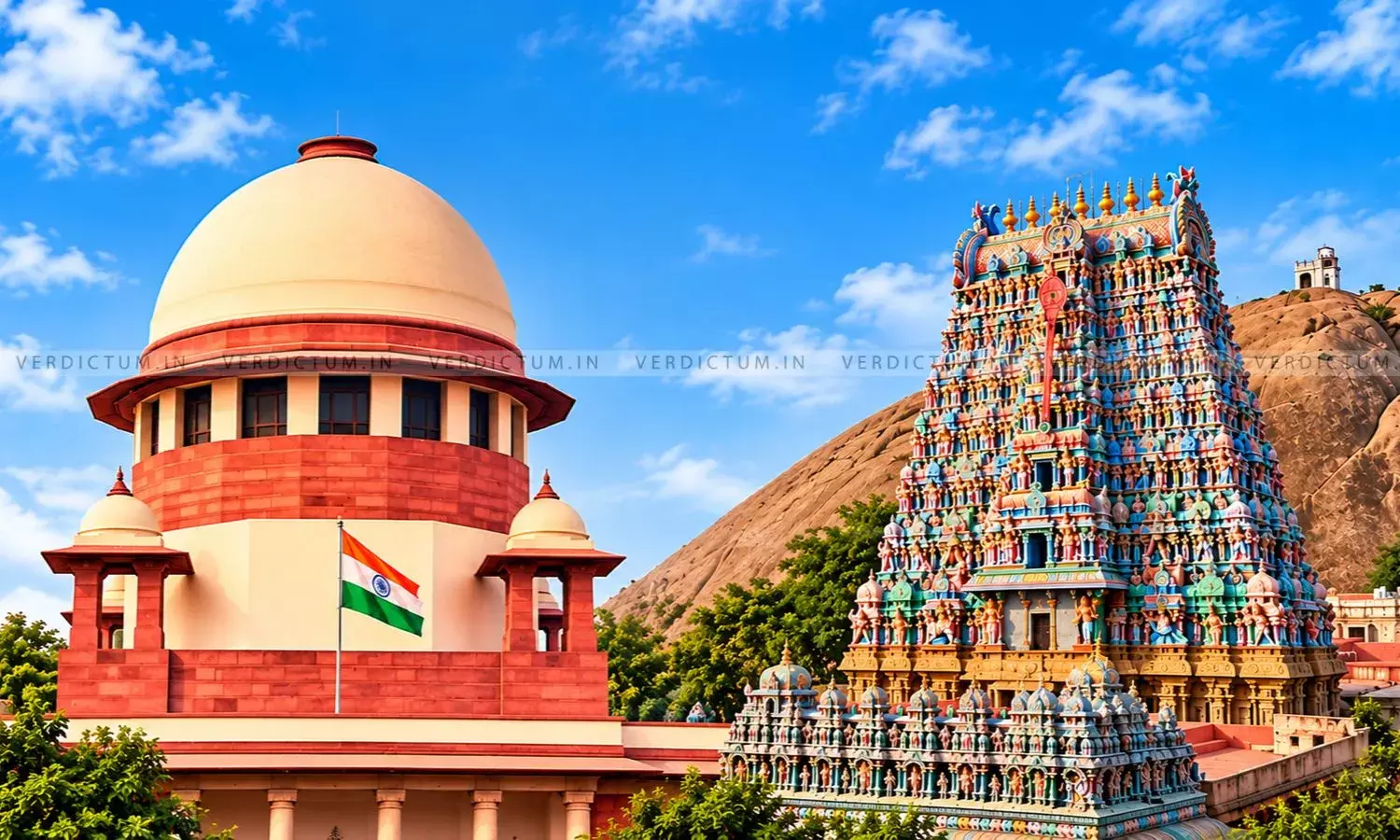
The Supreme Court directed that the Karthigai Deepam be lit at the Deepathoon atop Thiruparankundram Hill on November 28, 2026, using the flame lit at the Uchi Pillaiyar Mandapam on November 24, 2026.
The Court held that the authorities had not even attempted to purge the contempt.
The Court also vacated its interim stay of November 20, 2026, permitting devotees to light the lamp on the hill at the Deepathoon and at other places at least 50 metres away from the dargah.
The Bench suspended and superseded the Board of Trustees of the Arulmigu Subramaniya Swamy Temple, Thiruparankundram, and appointed Justice S. Vaidyanathan, former Chief Justice of the Meghalaya High Court, and Justice V. Parthiban, former Judge of the Madras High Court, as receivers to take immediate charge of the temple and ensure the lighting of the Deepam.
It directed the CRPF to forthwith take over security of the temple and the entire hill. The Court also issued contempt notice to the Chief Secretary, the DGP, the Madurai Collector, the temple's Executive Officer and the five Trustees, among others, for wilful disobedience of its order.
The Bench of Justice Aravind Kumar and Justice Vipul M Pancholi ordered, "The failure of the executive authorities to implement the orders of this Court resulted in the Deepam remaining unlit at Deepathoon on 24.11.2026, the auspicious day of the Tamil month of Karthigai when Krittika (Karthigai) nakshatra coincided with Pournami (the full moon). That occasion has passed." Finding "some force" in the applicants' submission that the Deepam should nevertheless be lit during the month of Karthigai, the Court directed "the receivers to ensure lighting of Karthigai Deepam at Deepathoon tomorrow, that is, 28.11.2026, at such time as may be fixed in consultation with the sthanikars, using the flame lit at Uchi Pillaiyar Mandapam on 24th November 2026"
The Court further held, "In view of the non-implementation of the order and the authorities not even attempting to purge the contempt, we deem it proper to vacate the interim order of stay of the judgment granted by us on 20.11.2026, and we direct the receivers to permit every devotee to light the lamp on the Thiruparankundram hill on such terms and conditions keeping in mind the security aspects." Having regard to the other religious institution on top of the hill, the Court directed that "the lamp which should be lit by the devotee or the temple administration should be at Deepathoon and other place at least at a distance of 50 meters away from the dargah from all sides."
The Court made it clear that "The CRPF is at liberty to take all necessary steps as permissible in order to protect the dargah, and they shall also ensure that the persons or devotees visiting the dargah are in no way hindered, stopped, prevented from offering their prayers at dargah/mosque."
The Court observed, "After having heard the learned Senior Advocates, the first thing which comes to our mind is to express Alas!. It would be a relevant and appropriate expression to be used in the present scenario...Time has come to deal with such a situation with an iron hand, as otherwise it may lead to constitutional chaos...The concept of rule of law is supreme in a democratic society...Article 144 of the Constitution mandates that all authorities, civil and judicial, shall act in aid of the Supreme Court. Any attempt, direct or indirect, to undermine this constitutional mandate would be firmly dealt with without any misplaced sympathy. Any attempt to pollute the stream of justice by any person, however high he is, will not be tolerated. This is the message which we intend to convey in this order...It binds the State, its officers and every statute or religious institution functioning under the State's law until this Court itself modifies it. Therefore, when an order of this Court is quoted, we cannot sit in silos."
The Court observed that "Despite the express direction of the Court and the solemn undertaking given before the High Court, the State and its instrumentalities are alleged to have acted pursuant to an alleged clandestine understanding and in collusion with the administrators of the Devasthanam to ensure that the Deepam at the Deepathoon atop the hill was not lit as directed," and that the lamp continued to be lit at the Uchi Pillaiyar Mandapam temple at the mountain top.
The Court held that the alleged conduct, as borne out by the record, prima facie disclosed "a brazen and willful disobedience of this Court's order, a flagrant disregard of undertaking given before the High Court, and a calculated affront to the authority of both constitutional courts." The Court observed that "the conduct of the officers entrusted with the administration prima facie reveals a state of administrative chaos in the State of Tamil Nadu, or at least in Madurai district."
The Court further observed that "the Devasthanam Board has purported to have overreached the orders of this Court by placing a strained construction on this Court's order and has been willfully obstructing its implementation."
It noted that the Board was said to have passed a resolution barely a few hours before the Deepam was to be lit, declining to authorize a team to light the Deepam at the Deepathoon, and that "the Collector is attempting to take umbrage under this resolution." Invoking historical antiquity, Agamic rules, religious documents and the purported opinions of sthanikars, "which is seriously disputed", the Board was said to have resolved that the Karthigai Deepam would be lit only at its customary location, the Deepa Mandapam near the Uchi Pillaiyar Mandapamtemple, and that "these traditions should be brought to the court's notice." The Court observed that "In other words, the trustees have categorically taken a stand they would not implement the orders of this Court. This is a serious infraction on their part, which is also aided by other officials."
The Court held that the resolution, on its face, "firstly discloses willful and flagrant disobedience of the interim order of this Court. Secondly, it evinces a deliberate attempt to undermine the authority of this Court and a brazen disregard of the undertaking given before the High Court. Thirdly, what shocks the conscience of this Court is the Board's statement, 'that these traditions should be brought to the court's notice'." The Court noted that it had heard both sides at length on the temple traditions before passing the interim order, and that the statement "carries the unwarranted insinuation that this Court had failed to appreciate the very traditions canvassed before it."
The Court further noted that "the Board has never appeared before this Court or contested the matter by impugning the order dated 6.1.2026," and that, read with the Board's refusal to give effect to the interim order, "the statement prima facie compounds the affront to the authority of this Court."
The Court observed, "When this Court speaks through an order, it speaks with the authority of the Constitution. Its orders command obedience, and Article 144 expressly enjoins all authorities, civil and judicial, in the territory of India to act in aid of this Court. An executive authority that presumes to decide whether an order of this Court deserves to be obeyed arrogates to itself a power the Constitution has never conferred upon it. Willful defiance by the officers charged with carrying the orders of this Court into effect is itself a flagrant breach of constitutional duty. It obstructs the administration of justice and strikes at the very root of the rule of law. The affront is all the graver when it comes from the very authorities whom the Constitution commands to act in aid of this Court. The willful non-compliance of orders of the court, especially by the executive authorities, cannot go unnoticed and it has to be dealt with an iron hand."
The Court held that the failure to light the lamp at the Deepathoon, viewed with the adoption of a resolution contrary to the express direction of this Court and the invocation of temple tradition to justify that stand, prima facie disclosed willful and flagrant disobedience.
The Court was "satisfied that a prima facie case is made out against the District Collector, Madurai, the Deputy Commissioner of Hindu Religious and Charitable Endowments Department, who also serves as the Executive Officer of the temple and signed the resolution, the Board of Trustees, and other authorities whose role in the disobedience and in aid of it is borne out by the records."
Accordingly, the Court directed the Chief Secretary, State of Tamil Nadu, to file an affidavit "specifying the details, including emails, telephone calls, messages, if any, made, forwarded, exchanged between the officials, with all detailed records" and to appear in person before the Court.
As regards the preliminary report of the District Collector, Madurai, the Court noted that the Collector had stated that the order could not be complied with because the temple administrators did not appoint anyone to light the lamp, had tendered a formal apology, and had "attempted to shift the blame for non-compliance entirely to the temple administration."
The Court observed, "We are surprised that the Collector, who is the District Magistrate, can take such a stand. His powers are wide enough. His hands are quite long, which can be used for implementation of the orders of this Court."
Being "prima facie satisfied that the order of this Court dated 20.11.2026 has been willfully disobeyed despite the undertaking given before the High Court that the order would be complied with in letter and spirit," the Court directed notice to be issued by all permissible modes to the alleged contemnors, calling upon them to show cause why contempt proceedings should not be initiated against them for willful disobedience of the order dated November 20, 2026.
The Court appointed Justice S. Vaidyanathan, former Chief Justice, High Court of Meghalaya, and Justice V. Parthiban, former Judge, High Court of Madras, "as receivers to take immediate charge of the administration of the temple from the Board of Trustees. The receivers shall administer the temple in keeping with its traditions and rituals, preserve its sanctity, and comply with the applicable Act, Rules, and Regulations." The receivers were given liberty to approach the Court for clarification or further directions, and the State Government was directed to "extend all logistic support to the court receivers."
Senior Advocates Guru Krishna Kumar and J Sai Deepak appeared for the Petitioners/Applicants, while Senior Advocate Abhishek Manu Singhvi appeared for the HR&CE, Senior Advocate Gopal Sankaranarayanan appeared for the Collector, and Senior Advocate Sidharth Luthra appeared for the Commissioner of Police.
The Court recorded submissions of all the parties while dictating the order.
The Court noted that the District Magistrate had issued prohibitory orders under Section 163 of the BNSS, 2023, and that certain devotees had filed writ petitions before the Madurai Bench of the Madras High Court challenging those orders and seeking to witness the lighting of the Deepam at the Deepathoon. In those proceedings, Senior Counsel for the District Collector, Madurai, on instructions, submitted that the order of the Court dated November 20, 2026 would be complied with.
When Senior Advocate Huzefa Ahmadi was appearing on behalf of the Dargah, the Court said, "You don't have anything to do in this." To which he submitted that "The court specifically said one-time measure", and raised two concerns. First, he submitted that when this activity took place, the activities of the Dargah were affected, and that the Court should not dilute its earlier order. The Court responded, "We will not dilute it in any manner." Second, he submitted that he was "only concerned about someone creating a public mischief."
On a query from the Court as to how many people visited, he submitted that there was a Dargah as well as a mosque, visited by about 100 to 200 people. The Court noted a maximum of around 500 and asked whether any Urs was being held, to which he replied that it would be held on December 10, 2026. The Court observed, "If anybody is attempting to create constitutional chaos, we will set it right."
Submissions of the Applicants & ASI
Senior Advocate Guru Krishna Kumar, for the Applicant, submitted, "The onus which has been placed squarely on the authorities has unfortunately been completely let et down. The preliminary report which was filed by the District Collector is virtually like a confessional statement...they show that they have done everything except ensuring that the lamp was lit..."
The only reason given was that the Board of Trustees had purportedly passed a resolution on November 24, 2026, with no time stated, that "it is customary practice in the temple to light it only at the earlier place where it was being lit in the last few years and therefore it cannot be lit at any other place."
He submitted that "This Board of Trustees has never... contested the matter" and was "fully bound by the orders passed... by the single judge, the division bench."
He submitted that "the Collector would want to believe that he did everything literally under the sun except... speaking to the Board of Trustees and asking them... to... make arrangements." It was only in the afternoon and evening that the Collector wrote an email to the Board of Trustees asking them to authorize persons, which he described as "Completely... incredible." He submitted that when the Board of Trustees "comes from nowhere and says that this cannot be permitted", the Collector and the named authorities "had no duty to look at it, they had to ignore it, they didn't."
He further submitted that the Board of Trustees were "newly constituted... political appointees of the political executive constituted only on 13/11, hardly 10 days before the event."
He submitted that there was nothing on record to show when the resolution was passed, whether "on 20th, 21st, 22nd, or 24th in the morning or in the afternoon."
He submitted that the HR&CE department had "contested the matter at every stage before single judge, division bench, and before this Hon'ble Court, and they claim locus on the ground that under the HR&CE Act, the Commissioner has administrative control over the Board of Trustees." He asked "how is it that... the authorities who were invested with the responsibility of implementing the order could simply then fold their hands and say, 'I did not get the authorized persons from the Board of Trustees, therefore I could not light the lamp.'"
He submitted that the authorities first passed prohibitory orders, "stopped everybody from coming anywhere near the place", and claimed to have deployed 5,000 police personnel and several companies of forces, but did "everything except calling upon" the Board of Trustees, even though "the Board of Trustees... are sitting in the temple itself. The Executive Officer is sitting in the temple. The camp... is at the foot of... the hill where the light has to be lit."
He submitted that "the state had decided at the outset that they will not comply with the order. The paperwork which has been produced before My Lords today or the report which is produced today before My Lords is only an attempt at covering up."
He submitted that "the Board of Trustees who are appointed by the state is chosen... as the vehicle and the refuge to hide behind, to say that we are not able to comply with the order. Perhaps the weakest link... in the administrative chain and in the political chain, they are chosen... to justify inaction, because it's a decision taken earlier."
Summing up, he submitted that the Collector did "everything under the sun except doing the needful of ensuring that persons were deputed". On a query from the Court as to who countersigned, he submitted that it was "the Executive Officer, who is an officer of the state." When this was sought to be disputed from the other side, he submitted that "they should hold their peace together for what they have done today. They should just wait for My Lords to call upon them to answer. Such a gross case of contempt."
He concluded, "The political executive, even the concerned ministers, are culpable."
Solicitor General Tushar Mehta, appearing on behalf of the ASI, submitted, that "Something very very disturbing has taken place. There has been request by one set of litigants to light the lamp, another set opposed it. The aggrieved party came here, court did pass an order. The court also assigned duties." He submitted that "The persons whom the court trusted were government appointees. They are not believers."
Relying on a report from the ASI's local official, who was present throughout and signed by the Superintending Archaeologist, he submitted that "The collector's meeting was ultimately a cloak." He submitted that the ASI team was halted by the local police at a certain point at 3:00 pm and was not permitted to go near the lamp, and that the ASI was informed by the Temple Trustees that no instruction had been received from higher officials.
He submitted, "This is a case of not only contempt but an aggravated contempt and administrative arrogance and why I say this is that the Government had been opposing the prayer from the beginning that, come what may, we will not permit lighting of the lamp. The Court permitted the lighting of the lamp with certain safeguards, which are mentioned by Your Lordships in the Order, which are not complied with."
Distinguishing civil and criminal contempt, the Solicitor General submitted that he was pressing criminal contempt. He submitted that "Conventionally understood, criminal contempt happens in the presence of the judges. If one set of litigants in a pre-determined way do not comply, that is criminal contempt."
He accordingly requested on behalf of the ASI that, "in view of the admitted position that the order is not complied with," the contemnors, "before the contemnors are heard, they should purge themselves of contempt by ensuring the lamp is lit."
Solicitor General further submitted that "The way in which police had functioned, leaves nothing to be said. There are videos available which shows the entire premises was packed by police." He requested the Court to "please ensure any other agency monitors this," submitting that "Let a neutral report come. It [can] be done only if the court appoints someone to monitor the situation. Agencies not under the State control should monitor this."
Senior Advocate J Sai Deepak submitted that "The court did not leave anything to the discretion of the temple management. It's a direction. Knowing fully well that this is a contested matter, the merits of the case could not be cited to defeat the direction of the court. There is no portion in the court order which allows any discretion."
He questioned whether "The district administration and temple administration waiting for trustees to give a go-ahead is itself not a contempt." He submitted that the Trustees did not file a review against the Order, and that "Trustees are employees of the state statutorily. They are appointed under the TN HR&CE Act if the revenue of the temple is over 10 lakhs a year." He further submitted that "They were appointed only on November 13, 2026. A week before the court's order. These are state appointees whose shoulders are used by the State [to] fire the bullet from."
Taking the Court through the timeline of events, he submitted that "The district collector was logged into Madras High Court till 4:45 PM. Even at 4:45 pm on November 24, 2026, he did not inform the Madras HC that he was yet to receive a list of approved persons to comply with the directions of the order. The rest of the preparations are meaningless and useless. How does this show intent to comply? This is criminal contempt conduct."
Senior Advocate Valliappan, appearing for the original petitioner, Rama Ravikumar, submitted that the present contempt ought to be viewed against the backdrop of the Respondents' earlier conduct.
He submitted that they had violated the orders of the learned Single Judge, the Division Bench and this Court, and not merely the Order dated November 20, 2026. He further submitted that, even before November 24, 2026, Ministers had publicly stated that the lamp would be lit at the Uchi Pillaiyar Mandapam Temple and that a court order need not be complied with, which made their intention to defy the Order apparent. Pointing out that the month of Karthigai was still continuing and that it was customary to light the lamp every day, he prayed that the Respondents be directed to light the lamp on one of the subsequent days.
Written submissions were also filed by Senior Advocate J Sai Deepak, who submitted that "the conduct of the non-Applicants/Respondents in relation to the direction passed by this Hon'ble Court on 20.11.2026 ("the Order") is a manifest case of premeditated and, therefore, willful disobedience. The attempt of the Respondents to pass the buck on to the Trustees of the Thiruparakundram Murugan Temple ("the Temple") for disobedience of the order of 20.11.2026 is not only baseless but also makes a mockery of the clear and express directions passed by this Hon'ble Court for conduct of the Deepam ceremony at the Deepathoon."
Relying on Paragraph 14(i) of the Order, he submitted that the direction that the "lighting of the lamp shall be undertaken exclusively by a team of persons authorized by the Devasthanam" made it "abundantly clear that this Hon'ble Court had passed a positive direction for the performance of the ceremony with no room for exercise of discretion by any party with regard to the very conduct of the ceremony."
He submitted that Paragraphs 14, 18, 19 and 20 of the Order made the State authorities, "in particular the District administration of Madurai led by the Collector," responsible "for the overall conduct, coordination and supervision of the arrangements to ensure the compliance of the Order in letter and spirit." Paragraph 20 also placed the duty to file the compliance report on the District Collector. Hence, "there was no room whatsoever available to the State administration, including the District Collector, to cede any discretion to the Trustees of the Temple. Despite this, the Order of this Hon'ble Court has been brazenly disobeyed, ostensibly citing the need for approval from the Trustees of the Temple for the conduct of the ceremony. Clearly, this is an extra-judicial consideration which has no basis in the Order."
On the site, he submitted that "The Uchi Pillaiyar Temple is a moksha sthanam for the departed and is not the traditional place for the lighting of the Karthigai Deepam. The Deepathoon on the Thiruparakundram Hill has been the traditional place of the lighting of the Deepam, as has been attested by the Sthalapuranams that relate to the Temple."
Submissions by the Collector and the Commissioner
Senior Advocate Gopal Sankaranarayanan, appearing for the District Collector, submitted that a status report in compliance with the Order was in the process of being filed.
Reading through the Order, he submitted that "The remit as far as the government officials stops after ensuring everything is carried out. When I read these directions, I look at each of our individual duties." He submitted that there had been clear consultation with the ASI, that multiple meetings were held with it, and that the ASI official who signed the letter relied upon by the learned Solicitor General had "stood at the top and took photos." He submitted that he would show, step by step, what had taken place.
He then reiterated the events of November 24, 2026 and submitted that multiple meetings were held with all the relevant parties, i.e. ASI, revenue officials and commissioner of police.
Justice Aravind Kumar observed, "Normally in such circumstances, the collector will convene a meeting. How many such meetings?", to which the Counsel replied that there were "Multiple such meetings," and that the ASI had attended the meeting on November 21, 2026.
He further submitted that there were photographs of ASI officials at the site. Responding to the allegation of countersignature by the Executive Officer, he submitted that "the press release was not signed by EO. It was only signed by trustees. First thing the resolution is passed by trustees, it becomes a press release. Five trustees sign it. The press release does not name any of the Stanikars."
Sankaranarayanan added, "My view is that let our comprehensive status report come, the court will know what were the circumstances, the position is and how everything took place. Much of it is not placed in the bar, without us having the advantage of any of those events."
Senior Advocate Sidharth Luthra, appearing for the Commissioner of Police, submitted that the police had been asked to deploy personnel and had accordingly deployed 1,200 Armed Reserve Police personnel and 24 companies of the Tamil Nadu Special Police, with a total of 5,717 police personnel on the spot to prevent any breach of law and order.
Taking the Court through the preparations made, he submitted that the prohibitory orders had been passed at the request of the Commissioner of Police.
Justice Kumar remarked, "We will see at a later stage whether it is real tears or crocodile tears. We will have to take your affidavit and hear you."
Senior Advocate Manu Singhvi, appearing for HR&CE/Respondent No. 1, submitted, "I am not a direct contemnor. I want to give a different perspective. Well it is true that there is, and perhaps justifiably, a lot of righteous indignation in Mr Guru Krishna Kumar's presentation. It is also true that he has carried it right up the ladder to various percentages...The second aspect is that maybe there was an error. But the feeling was because the court was deferring the decision on merit."
Justice Kumar said, "We did not give any liberty to trustees. We are making it clear. He said he also did not know till 4:30. That is why Gopal made a statement that lamp will be lit."
Sankaranarayanan intervened and submitted, "I never said I will light the lamp. I said I will ensure the order is complied. I was very clear with my statement."
Singhvi further submitted that, if at all there was any element of wilful disobedience, "The level of the pitch is put at higher level," and that "The court has been very very careful on no pre-judging anything."
Singhvi added, "All I am saying is that there might clearly be an error, a gross error. Almost a pre-planned conspiracy of the nature, the trustees have either wrongly exercised their discretion to permit, they may have violated your order, but I would earnestly urge the Court to see in the spirit of carefully calibrated order dictated by the Court and within the spirit, there could still be an error."
Accordingly, the Court directed the alleged contemnors to file their replies within 10 days of service of notice and to appear in person on December 15, 2026, the next date of hearing.
Cause Title: Hindu Dharma Parishad v. The Union of India and Ors. [W.P. (C) 1280/2025], The Commissioner v. Rama Ravikumar and Ors. [Diary No. 36337/2026] and Rama Ravikumar v. The Executive Officer, Arulmigu Subramanian Swamy Temple, Thiruparankundram, Madurai and Ors. [ Diary No. 4500/2026]