

Law Declared In Bijoe Emmanuel's Case Will Apply To Vande Mataram: Supreme Court Agrees To Consider Challenge To Penal Consequences
The Supreme Court was considering a PIL filed by musician TM Krishna.

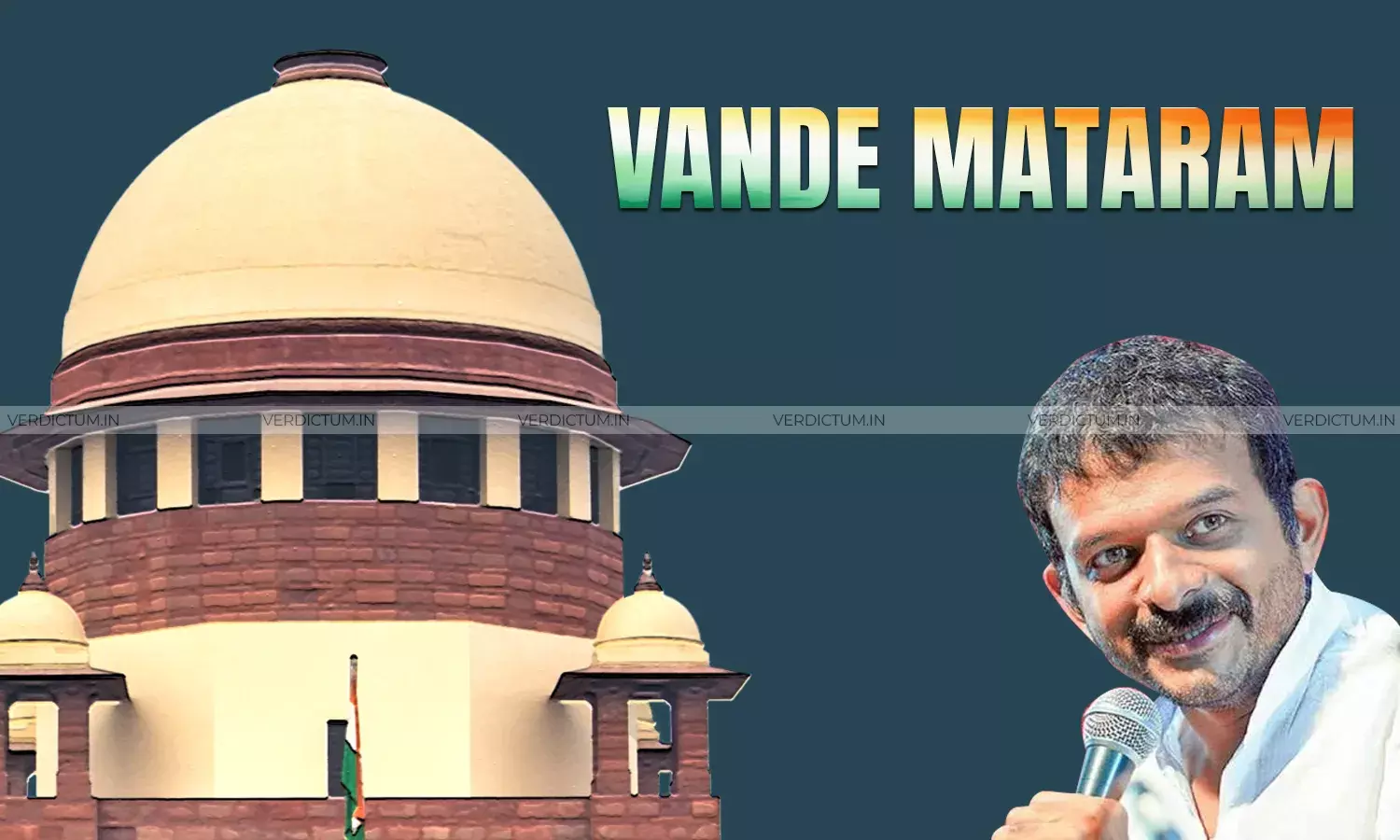
The Supreme Court has asked the Union Government to file a response in a writ petition filed by Carnatic musician T.M. Krishna challenging the constitutional validity of the 2026 amendment to the Prevention of Insults to National Honour Act, 1971, which criminalises insults to the National Song, Vande Mataram.
During the hearing, the Court observed that it expects the law laid down by it in the 1986 judgment in Bijoe Emmanuel's case to be applied to the State's actions pertaining to Vande Mataram.
It also assailed the Ministry of Home Affairs' directions mandating the recitation of the complete six stanzas of the song at official functions.
The hearing turned contentious when Solicitor General Tushar Mehta remarked that constitutional decision-making rests with Parliament rather than conforming to "what the Naxalites want". Senior Advocate S. Muralidhar, appearing for the Petitioner, strongly objected, calling for a retraction and urging the Bench to disallow such remarks on a live broadcast.
Today, the Karnataka High Court has also deferred the petition challenging the Government Order by which the State of Karnataka has directed that at all State Government programmes, except those attended by the President, the Vice-President, the Prime Minister or the Governor, only the first two stanzas of the National Song "Vande Mataram" shall be sung.
The Bench of Chief Justice Surya Kant, Justice Joymalya Bagchi and Justice V Mohana, while refusing to issue notice at the current stage, listed the matter after two weeks and asked the Union of India to file their response in the matter.
Senior Advocate S Muralidhar appeared for the Petitioner, while Solicitor General Tushar Mehta appeared for the Union
Muralidhar submitted, "See, what they have done is, as far as the amendment to the Act is concerned, they introduce the expression "National Song", but the Act does not define what a National Song is. It's a serious lacuna in the Act, and it can be misused because, My Lords, they introduce this office memorandum which is not even gazetted. I do not know the provision. They don't cite any provision; they simply issue an office memorandum."
Justice Bagchi, "Dr Muralidhar, whether a religious icon or a religious flavor would impact secularism of a Constitution, or a state, of a constitutional democracy? Nothing can be more strong in positive secularism than the American Constitution. But the American National Anthem uses the word "God"...Any national song, or national anthem expressing a sense of homage to a particular form of God, would not perhaps, impact secularism. But your point about whether someone who is a conscientious objector is subjected to penal consequences."
To which Senior Advocate Muralidhar replied, "A penal statute can't be in the realm of vagueness. You don't even define what a National Song is in the statute, and you make it a punishable offence?"
The Court said that, by custom and usage, the National Song has always been meant and understood as Vande Mataram.
Muralidhar added, "With the two stanzas. So, for the first time after almost 80 years, they are trying to tell us it's not two stanzas. This is why when you use the adjective "National", there has to be some building of a public opinion; it has to be by some consensus. You can't thrust it, and you can't have penal consequences. That is what is most worrying to us."
To which Justice Bagchi responded, "Extent of penal consequences requires examination. But the declaration of the song as a national is clarified. Perhaps the State is the best answer to articulate national aspirations."
Chief Justice Kant added, "If this kind of thing is also permitted, then it will be most unfortunate for the nation."
Muralidhar urged the Court to seek clarification from the Government that penal consequences would not be attached based merely on an executive office memorandum. The Bench clarified that while the State may declare what constitutes the national song, the constitutional protection accorded to conscientious objectors under Articles 25 and 26, as laid down in Bijoe Emmanuel, remains undisturbed law.
Solicitor General Mehta, who was present in the court at that moment, submitted that the issuing notice in the matter will create "sensation".
Justice Bagchi said, "We are not inclined to issue any notice or to create any sensation, but we would expect that the law of the land, as declared by this court in Bijoe Emmanuel, would govern the act of the State. National Song is not in dispute as to what is the National Song. The declaration of law in Bijoe Emmanuel has, till now, not been questioned. So, the boundaries are very clear. It's for the democratically elected State to decide and give aspirations to the nation as to what is the National Song—four stanzas, or two stanzas."
The hearing was escalated when the Solicitor General used the term 'Naxalite' and said that the law-making should not be as per 'Naxalite's idea'.
To which Muralidhar responded, "Withdraw the expression he used just now! My Lords, this is going live. I don't want this expression from a Solicitor General of India going online...I strongly object! Please withdraw your expression."
The Bench asked both the sides not to bring in unnecessary tension and emotion.
Solicitor General clarified that his remarks were directed at competing ideologies rather than any individual.
Muralidhar said, "I just request this; the learned Solicitor used an expression which does not behove a law officer. Even they should not play to the gallery like this. This is playing to the gallery."
Solicitor General replied, "I will again say, he said, 'I am objecting to the way in which decision-making is..." Decision-making is under the Parliament. I said that is the constitutional way, not what the Naxalites want. And I'm not sorry about it."
Ultimately, the Bench reiterated that Bijoe Emmanuel governs the field, and granted two weeks for the parties to file their respective responses.
The Plea prayed, "Issue a Writ in the nature of mandamus declaring that Section 3 of the Prevention of Insults to National Honour Act, 1971, as amended by the Prevention of Insults to National Honour (Amendment) Act, 2026, ultra vires the Constitution of India as the Impugned Act violates Fundamental Rights of the Petitioner guaranteed under Articles 14, 15(1), 19(1)(a), 21 and 25(1) of the Constitution of India to the extent that the expression National Song therein means the entire six stanza song as specified in the Order/Circular bearing File No. 14/2/2025-Public dated 28.01.2026, together with the subsequent communication of the Ministry of Home Affairs dated 09.07.2026."
It was further prayed that the Impugned Order/Circular must be declared ultra vires the Constitution, as the impugned orders violate the Fundamental Rights of the Petitioner guaranteed under Articles 14, 15(1), 19(1) (a), 21 and 25(1) of the Constitution.
Previously, the Union Home Ministry issued a set of guidelines on the occasions on which the National Song Vande Mataram is to be played or sung, and its proper observance. The Ministry clarified that the full version of the song is to be played, and whenever the official version is sung or played, the audience shall stand to attention. However, it is not expected of the audience to stand when the Song is played as a part of the film in the course of a newsreel or documentary.
The Court had refused to entertain a plea against a Home Ministry circular on singing the national song Vande Mataram at official events, saying that a directive was not mandatory.
Cause Title: TM Krishna v. Union of India [W.P. (C) No.1183/2026]