

Karnataka High Court Defers Challenge To State Order Restricting 'Vande Mataram' To Two Stanzas Pending Supreme Court Hearing
The Court listed the matter after three weeks as a similar plea is pending adjudication before the Supreme Court.

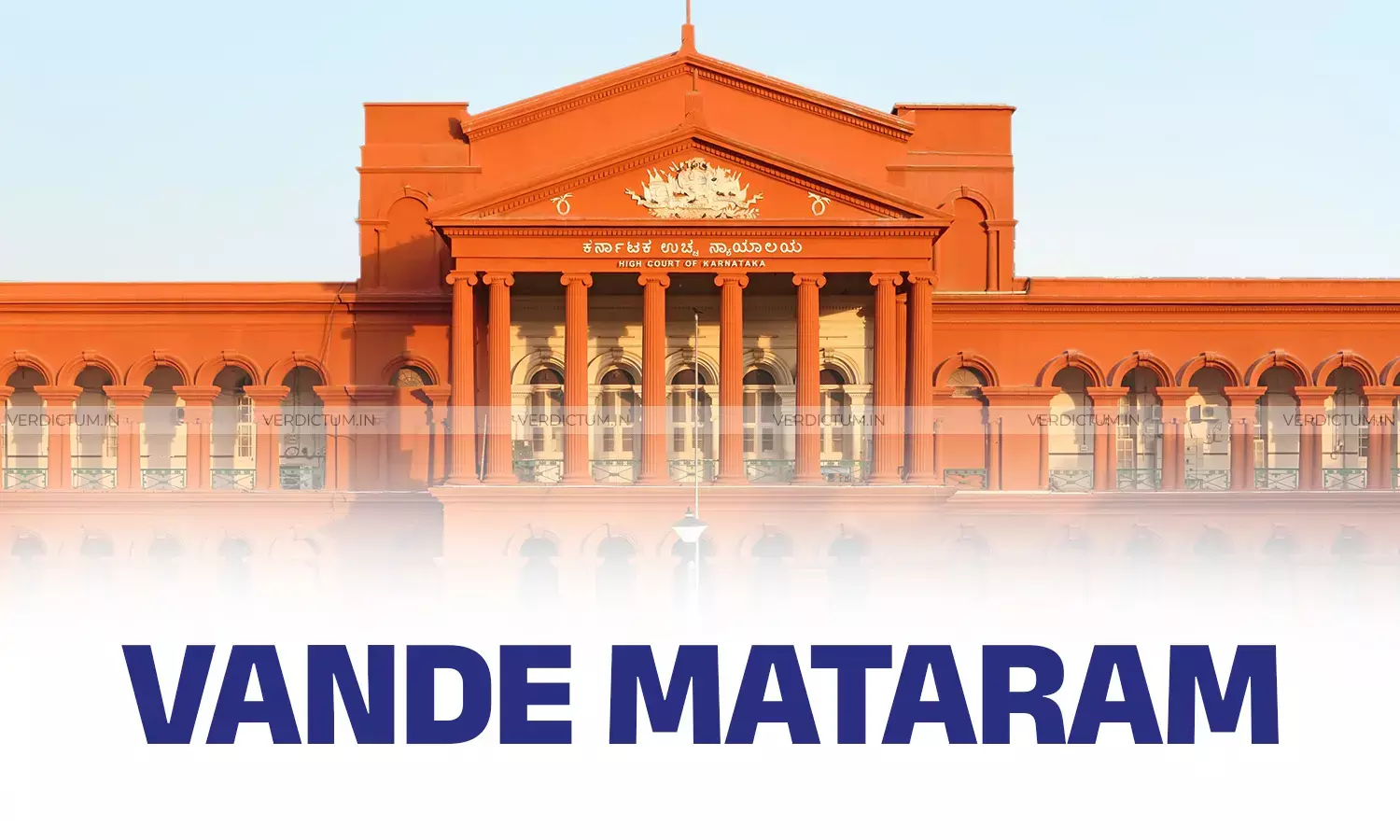
The Karnataka High Court deferred the petition challenging the Government Order by which the State of Karnataka has directed that at all State Government programmes, except those attended by the President, the Vice-President, the Prime Minister or the Governor, only the first two stanzas of the National Song "Vande Mataram" shall be sung.
The Bench directed that further steps in the matter shall await the orders of the Apex Court, adjourning the hearing for three weeks.
The Supreme Court, today, has issued notice to the Union Government on a writ petition filed by Carnatic musician T.M. Krishna. The petition assailed the constitutional validity of the 2026 amendment to the Prevention of Insults to National Honour Act, 1971, which criminalizes insults to the National Song, Vande Mataram.
The Division Bench of Justice Anu Sivaraman and Justice TP Vivekananda ordered, "Heard the learned Advocate General, as well as the learned Additional Solicitor General of India. It is submitted by the learned Advocate General that there is a direct challenge raised as against the provisions of Annexure D, which is WP Number 11838 of 2026, which will have a direct bearing on the prayers made in this writ petition. In the above view of the matter, we are of the opinion that the further steps in this writ petition should await the further orders of the Apex Court in the matter. List this after three weeks."
Advocate Girish Bharadwaj and Advocate Angad Kamath appeared for the Petitioners
Counsel for the Petitioner submitted, "While the Union Government has prescribed the official version to be six stanzas, the State Government, vide the impugned order at page 28, has directed that only two stanzas will be sung in its functions and therefore, this is an attempt by the State to override and appropriate the national symbol to itself."
He added, "There is absolutely no reason that is set out in the order. There is absolutely no justification that is offered as a circumstance to depart from an executive instruction. In any case, this is a national symbol which can only be legislated upon by the Centre. Neither the preamble nor any reason is given to show power to legislate or pass executive instructions, for which they would have to show an entry in List II. There is no entry in List II or List III which concerns a national symbol, which is the national song. All national symbols—whether it's the emblem, the flag, the song, the anthem—have always been within the competence of the Union."
It was further highlighted that an amendment had been carried out to Section 3 of the Prevention of Insults to National Honour Act, placing the national song on the same footing as the national anthem.
Counsel contrasted this with the national anthem, for which the Union had officially prescribed both a full version and a shortened 20-second version. In the case of the national song, however, only one official version was prescribed.
He also added, "Tagore's poem had five stanzas. What the Union has prescribed to be the official version which is sung as the national anthem is only the first stanza...So, where the Union wanted to prescribe the content to be a part of the whole, it has specifically done so in the context of the anthem."
Counsel also assailed the procedure adopted by the State Cabinet in arriving at the decision. It was pointed out that the matter was taken up as Item No. 37 during the Cabinet meeting held on September 3, 2026, under the head of an "informal discussion," without prior inclusion in the agenda or sponsorship by any specific department.
He pointed out that the Cabinet’s decision was plagued by serious procedural flaws under the Transaction of Business Rules. He emphasized that for a matter carrying such significant constitutional weight, the Ministers were asked to decide without the benefit of a formal Cabinet note, a legal opinion, or even the relevant MHA guidelines before them.
Per Contra, the Counsel for the State raised a preliminary objection regarding the maintainability and premature timing of the petition. He highlighted that the petitioner had submitted his representation on September 14, 2026—a public holiday—and rushed to file the writ petition the very next day, September 15, 2026, without giving the authorities any meaningful time to look into the matter.
On the merits, the State argued that unlike the National Anthem, reciting the National Song is not mandatory. He submitted that the directives in question are purely directory and advisory in nature, making the petitioner’s legal challenge premature and unfounded.
He added, "The stand of the Centre is: it is not mandatory, it is optional, it's not a law."
It was submitted that the performance of the national song was not mandatory, unlike the national anthem.
He also informed the Court that a similar matter challenging the validity of the notification dated July 9 had been taken up for hearing by the Supreme Court today, wherein the Apex Court has sought a response.
He emphasized that the Supreme Court treated the circular merely as an advisory that carried no penal consequences for citizens, meaning no apprehension of legal compulsion arose. He further submitted that in 2022, the Apex Court similarly refused to interfere with a Government Order dated 25th September 2022, which had prescribed the tune and duration for the Karnataka State anthem, Jaya Bharata Jananiya Tanujate. On these grounds, counsel urged that since the Supreme Court had already dismissed the very same contentions in earlier proceedings, the present writ petition was devoid of merit.
He also submitted that there exists no legal mandate compelling individuals to sing the National Song in its entirety. Referring to paragraph 22, he highlighted the petitioner’s own admission that executive instructions regarding ceremonial functions fall well within the State’s ordinary administrative control under Article 162 of the Constitution. He pointed out that ever since 1932, it had been the continuous practice to sing only the first two stanzas of the composition.
Counsel submitted that the State was adhering strictly to the official version comprising the first two stanzas. Referring to Roman III on page 62 of the Union's guidelines, he argued that the word "desirable"—rather than "shall"—was deliberately used regarding mass singing on non-ceremonial occasions.
He submitted that the guidelines were purely advisory, allowing the State ample latitude under Article 162 to prescribe the recitation of the first two stanzas. Additionally, he raised a preliminary objection regarding the petitioner's bona fides, submitting that the petitioner had suppressed his active political affiliation in his affidavit while claiming to litigate purely in the public interest.
The Ministry of Home Affairs on July 09, 2026, circulated to every State "for strict compliance" the Orders relating to the National Song of India, which prescribe the official version of the National Song as the complete composition in six stanzas and provide that "on all occasions, when the National Song is sung, the official version only shall be recited in mass singing."
The Parliament thereafter enacted the Prevention of Insults to National Honour (Amendment) Act, 2026, extending to the National Song the statutory protection given since 1971 to the National Anthem. The Petitioner says that the National Song is not a matter enumerated in List II or List III of the Seventh Schedule; it is within the exclusive competence of Parliament under Entry 97 of List I read with Article 248, and the executive power of the State under Article 162 does not reach it.
It was averred that the impugned Order is further in breach of Articles 256 and 257(1), which require the State to exercise its executive power to ensure compliance with the laws made by Parliament and so as not to impede the executive power of the Union; it is contrary to the policy of a Parliamentary enactment in an occupied field; and it is an unreasoned order taken without application of mind.
The Plea also argued that the impugned order is contrary to the policy of a Parliamentary enactment in an occupied field. It says that a standing executive direction of the State that the National Song shall be sung in part only, at every State function, is executive action pulling against the policy of a Parliamentary enactment on a subject within Parliament's exclusive domain.
Previously, the Union Home Ministry issued a set of guidelines on the occasions on which the National Song Vande Mataram is to be played or sung, and its proper observance. The Ministry clarified that the full version of the song is to be played, and whenever the official version is sung or played, the audience shall stand to attention. However, it is not expected of the audience to stand when the Song is played as a part of the film in the course of a newsreel or documentary.
The Supreme Court had refused to entertain a plea against a Home Ministry circular on singing the national song Vande Mataram at official events, saying that a directive was not mandatory.
Accordingly, the matter will be heard after three weeks.
Cause Title: Sri Girish Bharadwaj v. The State of Karnataka and others [W.P. No. 29423/2026]