

Madhya Pradesh High Court: Merely Inheriting Property Jointly Does Not Infer Joint Hindu Family For All Times
The Bench noted that unpartitioned property as co-owners is legally distinct from the existence of a coparcenary.

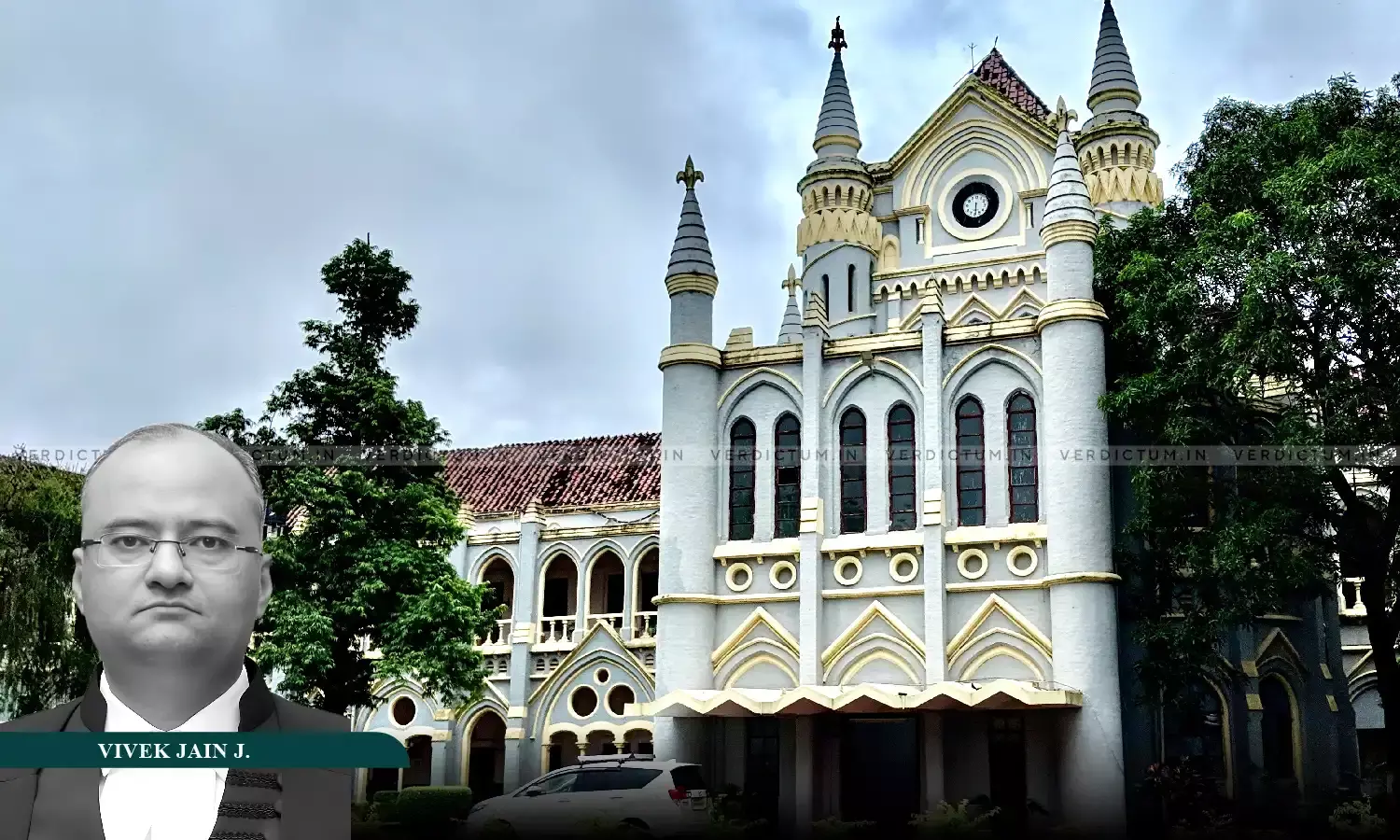
Justice Vivek Jain, Madhya Pradesh High Court
The Madhya Pradesh High Court has held that joint inheritance of property by siblings following the death of their father does not automatically establish a Joint Hindu Family or coparcenary, nor does it convert individually acquired properties of family members into joint family property. Addressing the Trial Court's approach, the Court remarked that assuming an ongoing Joint Hindu Family exists indefinitely simply because siblings succeeded some ancestral land jointly, and deeming any subsequent acquisitions as joint property, is a proposition far too drastic to be accepted.
The Bench while modifying a 2003 decree passed by the 4th Additional District Judge, Satna, noted that unpartitioned property as co-owners is legally distinct from the existence of a coparcenary.
A Single Judge Bench of Justice Vivek Jain observed, “To infer existence of joint Hindu family, no evidence has been placed on record by the plaintiffs and there is no pleading as such. Upon death of their father, the property would have devolved jointly upon the sons because the father died prior to 1956. The property would, therefore, remain to be jointly owned property and merely because the three sons have succeeded some property from their father jointly, it would not infer that for all times to come, there would be joint family of these three sons and whatever property would be acquired by any of the three sons would be deemed to be joint property of all the sons. Such a proposition is too drastic to be accepted”.
Senior Advocate Sanjay Agrawal appeared for the appellant and Advocate Aditya Singh Rajput appeared for the respondent.
The underlying dispute involved three brothers, Baladatt, Moolchand, and Rameshwar Prasad, and their sister, Krishni Devi. Their father, Vrindavan, passed away leaving behind 5 survey numbers.
Subsequently, another 5 survey numbers were acquired exclusively in the name of Rameshwar Prasad, who died issueless in March 1998. Following his demise, Krishni Devi claimed ownership of the entire property through an unregistered, notarized Will allegedly executed by Rameshwar Prasad five days before his death.
The surviving brothers filed a civil suit to declare the Will null and void, asserting that the family operated as an HUF and that the lands registered in Rameshwar Prasad's name were bought using joint earnings remitted by them while working in Rishikesh. The Trial Court decreed the suit in favor of the brothers, holding that all properties belonged to an HUF nucleus and excluding the sister entirely, which led to the appeal before the High Court.
Upon examining the evidence, the Court observed that the plaintiffs failed to submit any documentary proof, such as bank transfer records or earnings statements, to substantiate their claim of sending money to purchase the disputed lands in Rameshwar Prasad's name.
The Bench also upheld the invalidation of the alleged Will executed in favor of the sister and her husband. Applying the Supreme Court judgment in Kavita Kanwar v. Mrs. Pamela Mehta and others, (2021) 11 SCC 209, Justice Jain pointed out suspicious circumstances surrounding the document, including the active involvement of an attesting witness who was the son-in-law of the propounder and attempted to conceal his close family relationship, as well as another witness who claimed to have met the 75-year-old testator purely by chance in court premises.
Concluding that Rameshwar Prasad died intestate without Class-I legal heirs, the High Court held that his estate must devolve equally upon his surviving brothers and his sister as Class-II legal heirs under Schedule II of the Hindu Succession Act, 1956.
The Court directed that both the 5 self-acquired survey numbers and Rameshwar Prasad's 1/3rd share in the inherited ancestral lands be divided equally into 1/3rd shares among the three siblings, with the parties liberty to seek consequential partition through competent authorities under Section 54 of the CPC.
Cause Title: Krishni Devi And Others v. Baladatt (Dead) Through Lrs. Uma And Others First Appeal No.280 of 2003
Appearances:
Appellant: Sanjay Agrawal, Senior Advocate, Aishwarya Nandani Tiwari, Advocate.
Respondent: Aditya Singh Rajput, Vijay Kumar Shukla, Advocates.