Dowry Demand Made After Marriage Is Punishable Even Without Prior Agreement Or Fixed Amount: Madhya Pradesh High Court
The Court held that the Sessions Court had wrongly treated the absence of a pre-marriage dowry bargain and discrepancies concerning the earlier ₹17 lakh as reasons to discard evidence of a repeated demand for another ₹8 lakh.
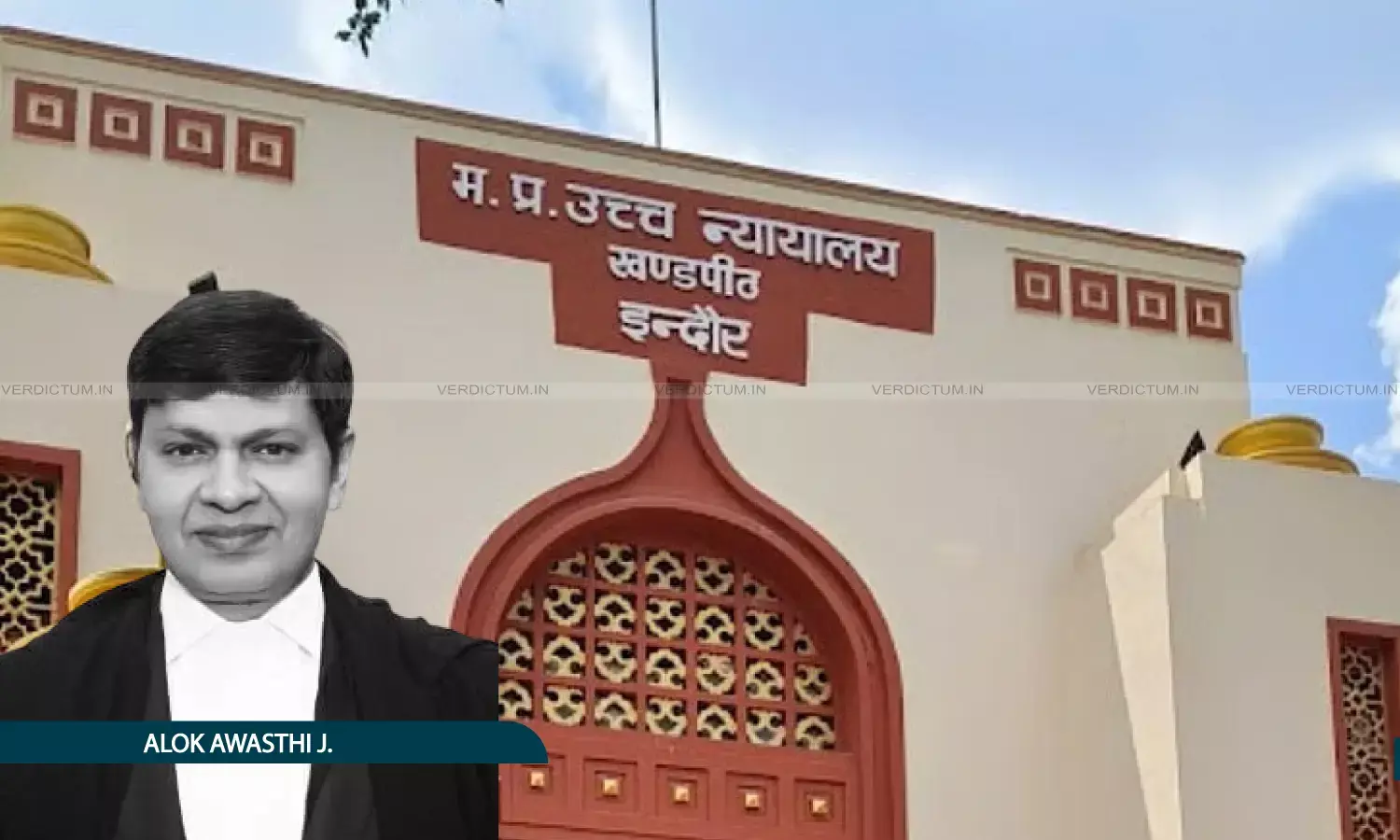
The Madhya Pradesh High Court has held that a dowry demand made after marriage can attract Section 4 of the Dowry Prohibition Act, 1961, without proof that a particular amount was fixed as dowry before the marriage.
The Court set aside the husband’s acquittal and restored his conviction under Section 498A IPC and Section 4 of the Dowry Act.
The Court was hearing the complainant-wife’s appeal against a Sessions Court judgment which had reversed the trial court’s conviction of her husband and father-in-law for dowry demand and matrimonial cruelty.
A Bench of Justice Alok Awasthi observed: “The expression ‘demand’ is itself the material act contemplated by Section 4 of the Dowry Act. The prosecution was not required to establish that a particular amount had formally fixed as dowry before the marriage. A subsequent demand connected with the marriage can attract the provision.”
Senior Advocate Vivek Singh appeared for the appellant, Senior Advocate Avinash Sirpurkar appeared for the respondents, and Government Advocate Ambuj Patel appeared for the State.
Background
The prosecution alleged that the appellant’s family gave jewellery, household articles and ₹17 lakh at the time of her marriage in 2007. According to her, the accused subsequently stated that they had expected ₹25 lakh and repeatedly demanded the remaining ₹8 lakh.
The appellant testified that she was harassed over the demand and sent to her parental home to bring the balance amount. She further alleged that her husband and father-in-law travelled to Indore and demanded ₹8 lakh from her family.
The trial court convicted both accused under Section 498A IPC and Section 4 of the Dowry Act, sentencing each to one year’s rigorous imprisonment and a fine of ₹1,000 under each provision. It acquitted them of offences under Sections 406 and 506 Part II IPC.
The Sessions Court subsequently acquitted them of the remaining charges. Before the High Court, the appellant argued that the Sessions Court had erroneously treated the absence of a fixed pre-marriage agreement as fatal to the prosecution.
The accused supported the acquittal, contending that there was no prior dowry agreement and that the prosecution evidence contained discrepancies concerning the ₹17 lakh and the alleged later demand.
Court’s Observations
Prior Dowry Bargain Is Not Required
The Court examined Sections 2 and 4 of the Dowry Prohibition Act. It noted that the statutory definition includes property or valuable security given or agreed to be given before, at, or any time after marriage, provided it is connected with the marriage.
The Bench held that a demand made after solemnisation of the marriage could therefore constitute a dowry demand. The absence of a pre-existing agreement about the exact amount, jewellery or other articles did not preclude prosecution under Section 4.
The Court stated: “It is clear from the aforesaid provisions of law that the demand made after the solemnization of marriage would be dowry. ‘Dowry’ means any property or valuable security given or agreed to be given either directly or indirectly by one party to the other side in marriage at or before or any time after the marriage in connection with the marriage of the said parties.”
The Court further held that the alleged demand did not require documentary proof and could be established through oral testimony.
The Court added: “There is no rule that the demand of money as dowry can be proved only by producing the documentary evidence.”
Referring to State of Andhra Pradesh v. Raj Gopal (2004), the Court reiterated that a prior dowry contract was not necessary for prosecuting a subsequent marriage-linked demand.
Evidence Established Repeated ₹8 Lakh Demand
The Court noted that the appellant testified about being told that the accused had expected ₹25 lakh but had received only ₹17 lakh. Her mother, brother and father supported the allegation of a demand for the remaining ₹8 lakh.
The Bench also referred to the testimony of her father’s friend, who stated that he was present when the accused demanded ₹8 lakh at Indore. The Court noted that this part of his evidence remained unrebutted.
The Court observed that minor differences in wording, dates and the witnesses’ sources of knowledge did not destroy the consistent allegation of demand and harassment. Referring to Jayaseelan v. State of Tamil Nadu (2009) and Rajesh Yadav v. State of Uttar Pradesh (2022), it stated that discrepancies which did not affect the prosecution’s core case should not be magnified into fatal contradictions.
The Court held: “The evidence establishes a consistent post-marriage demand, reiterated and supported by the testimonies of the appellant and corroborated in material particulars by her mother, brother, father and her father's friend. The demand was linked to the alleged expectation of a higher amount at marriage and to the appellant's treatment in the matrimonial relationship.”
Sessions Court Applied Wrong Cruelty Test
The Court observed that the two clauses defining “cruelty” under the Explanation to Section 498A IPC operate separately. A prosecution under Explanation (b), concerning harassment to coerce an unlawful demand, did not additionally require proof of the ingredients under Explanation (a).
The Bench found that the Sessions Court had placed undue emphasis on whether the cruelty was grave and persistent enough to drive the appellant to suicide and on the absence of medical evidence for every alleged assault.
The Court stated: “The prosecution case was not merely that the appellant suffered ordinary matrimonial wear and tear, it was that she was repeatedly harassed for an unlawful monetary demand which was made to her and to her parents and in failure to fulfill the demand. Hence, the question, was whether the prosecution had proved harassment connected with the unlawful demand. It was not to prove that the appellant had reached the point of attempting suicide or sustaining grave luxury injury.”
The Court also observed that matrimonial cruelty law did not require a woman to lodge a separate police complaint after every incident of harassment. It found the explanation that the family initially attempted reconciliation before approaching the police to be plausible.
Conclusion
The Court partly allowed the appeal and set aside the Sessions Court’s judgment insofar as it acquitted the surviving accused. It restored his conviction under Section 498A IPC and Section 4 of the Dowry Act, along with the sentence of one year’s rigorous imprisonment and a ₹1,000 fine under each provision.
The sentence remained subject to adjustment for any period of incarceration already undergone and any order passed by a competent court during the proceedings. The Court directed the accused, who was on bail, to surrender before the trial court within seven days.
The acquittal under Sections 406 and 506 Part II IPC remained undisturbed. The appeal had abated against the father-in-law following his death. The Court also revived the trial court’s direction for releasing the seized jewellery to the appellant.
Cause Title: D.B. v. State of Madhya Pradesh and Others (Neutral Citation: 2026:MPHC-IND:28859)
Appearances
Appellant: Senior Advocate Vivek Singh with Advocate Piyush Parashar
Respondents: Government Advocate Ambuj Patel; Senior Advocate Avinash Sirpurkar with Advocate Yogesh Kumar Gupta