

Indian Courts Not Bound To Mechanically Enforce Foreign Interest Order, If Enforcement Contrary To Child’s Welfare: Madhya Pradesh High Court
The Court affirmed that judicial comity must yield to the paramount interest of the child and maternal care during formative years.

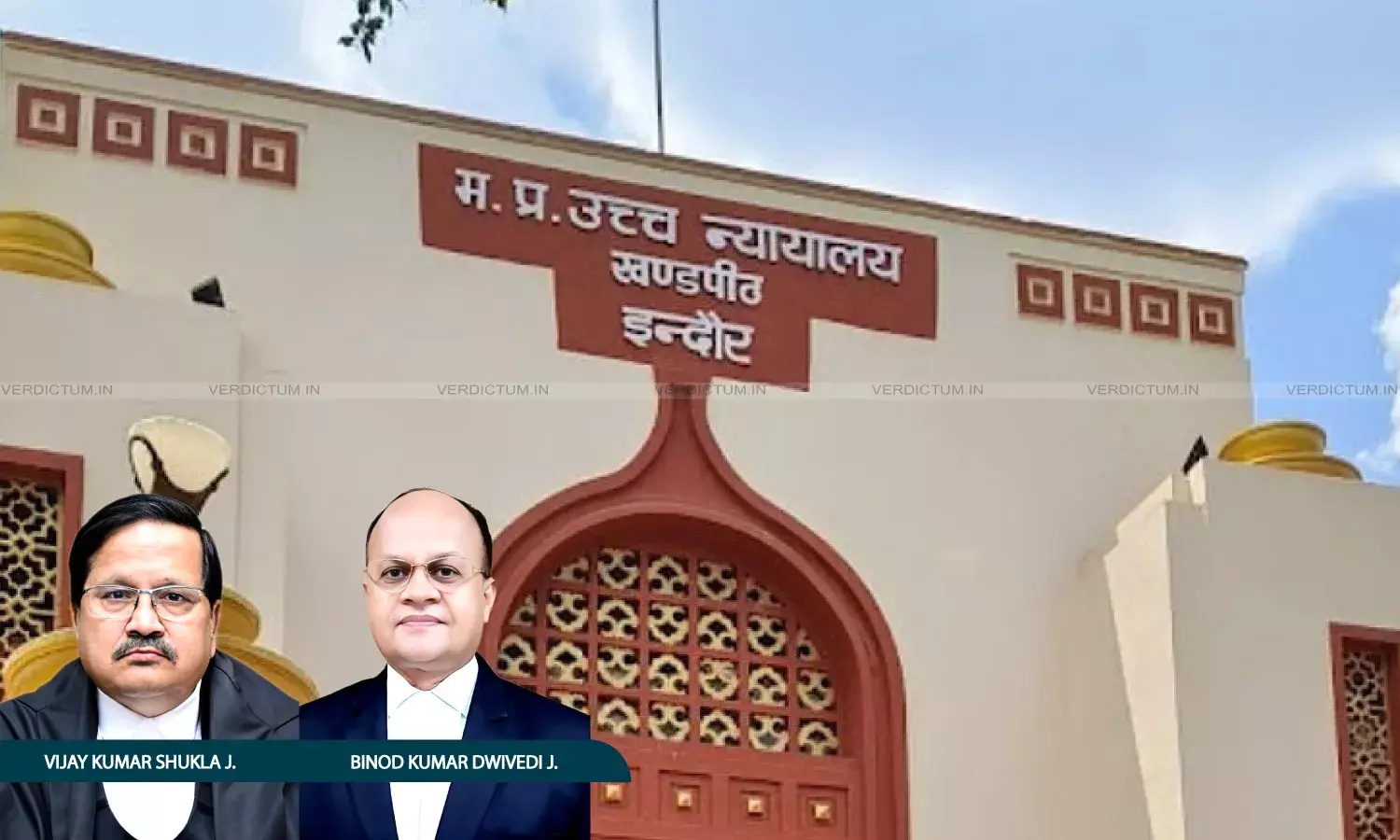
Justice Vijay Kumar Shukla and Justice Binod Kumar Dwivedi, Madhya Pradesh High Court
The Madhya Pradesh High Court, Indore Bench has clarified that while a writ of habeas corpus is maintainable for the custody of a minor, Indian courts are not bound to mechanically enforce foreign court orders. It noted that the "best interest of the child" is the overriding determinant, allowing courts to decline the summary return of minors to a foreign jurisdiction if they have developed roots in India or if such a move would be detrimental to their emotional and educational stability.
Consequently, the Bench on the principle of parens patriae jurisdiction, found that maternal care at a child's formative stage is a "civilizational norm" that resonates with both ancient Indian philosophy and modern statutory law.
Justice Vijay Kumar Shukla and Justice Binod Kumar Dwivedi “…In relation to the impact of an order of a Foreign Court relating to interest, it is well settled that the same is a relevant factor, however, the same is not conclusive. The doctrine of Comity of Courts cannot overwrite the paramount consideration of the welfare of the children. The Indian Court is not bound to mechanically enforce a foreign interest order, if such enforcement would be contrary to the child’s welfare.
Senior Advocate Shadan Farasat appeared for the petitioner and Rahul Sethi, Additional Advocate General appeared for the respondent.
The petitioner, a father residing in Texas, USA, sought a writ of habeas corpus for the return of his two minor children, Arjun and Shaunak. The parties had lived in the United States since 2017, but in August 2024, the mother traveled to India with the children for a temporary visit. She subsequently refused to return, prompting the petitioner to obtain an ex-parte order from a Texas District Court appointing him as the sole managing conservator.
The petitioner alleged that the children were being held in unlawful custody in India contrary to their habitual residence.
The respondents initially challenged the maintainability of the writ, citing a Gwalior Bench decision. However, the court declared that previous ruling per incuriam, noting that various Supreme Court precedents have settled that habeas corpus is an appropriate, albeit extraordinary, remedy in child custody cases.
The Division Bench then conducted an interaction with the minors in chambers to assess their comfort and integration into their current Indian environment.
The Court held that the children, having resided in India for eight months and being enrolled in school, appeared well-settled. It noted the petitioner lived alone in the USA without immediate family support, whereas the children required maternal care at their tender ages. Drawing on the "Tender Years Principle" and historical maternal roles, the Court determined that the children’s welfare would be better served by remaining with their mother.
“We have taken note of the facts that the petitioner is living alone in the USA. The mother of the petitioner has already died and the father of the petitioner is residing in India. There is no allegation by the petitioner that the children are not being taken care properly. We have also taken into consideration the age of the children, the need of maternal care at their formatting stage, the emotional and educational stability of the children and the overall circumstances placed on record, we are of the considered view that the custody of the children cannot be directed to be handed over to the petitioner solely on the basis of a foreign decree, which would not subserve the welfare of the minor as it has been found that it is not in the interest of both the child to return to the foreign country and the custody to the petitioner”, the Bench, thus, observed.
The Court dismissed the writ petition, clarifying that it had not adjudicated the merits of permanent custody but focused solely on the immediate welfare of the minors.
Cause Title: Ankur Joshi v. State of Madhya Pradesh and Others (Neutral Citation: 2026:MPHC-IND:10638).
Appearances:
Petitioner: Shadan Farasat, Senior Advocate, Harshit Anand, Priyal Jain & Piyush Parashar, Advocates.
Respondents: Sunil Ramchandani, Praveen Yogi, Advocates, and Rahul Sethi, Additional Advocate General.