

Breaking| Roles Are Different Than Others, Parity Can't Be Sought: Delhi High Court Rejects Bail To Umar Khalid, Sharjeel Imam In 2020 Delhi Riots Case
The Court held that it is bound by judicial discipline to strictly abide by the conditions laid down by the Supreme Court in Gulfisha Fatima v. State

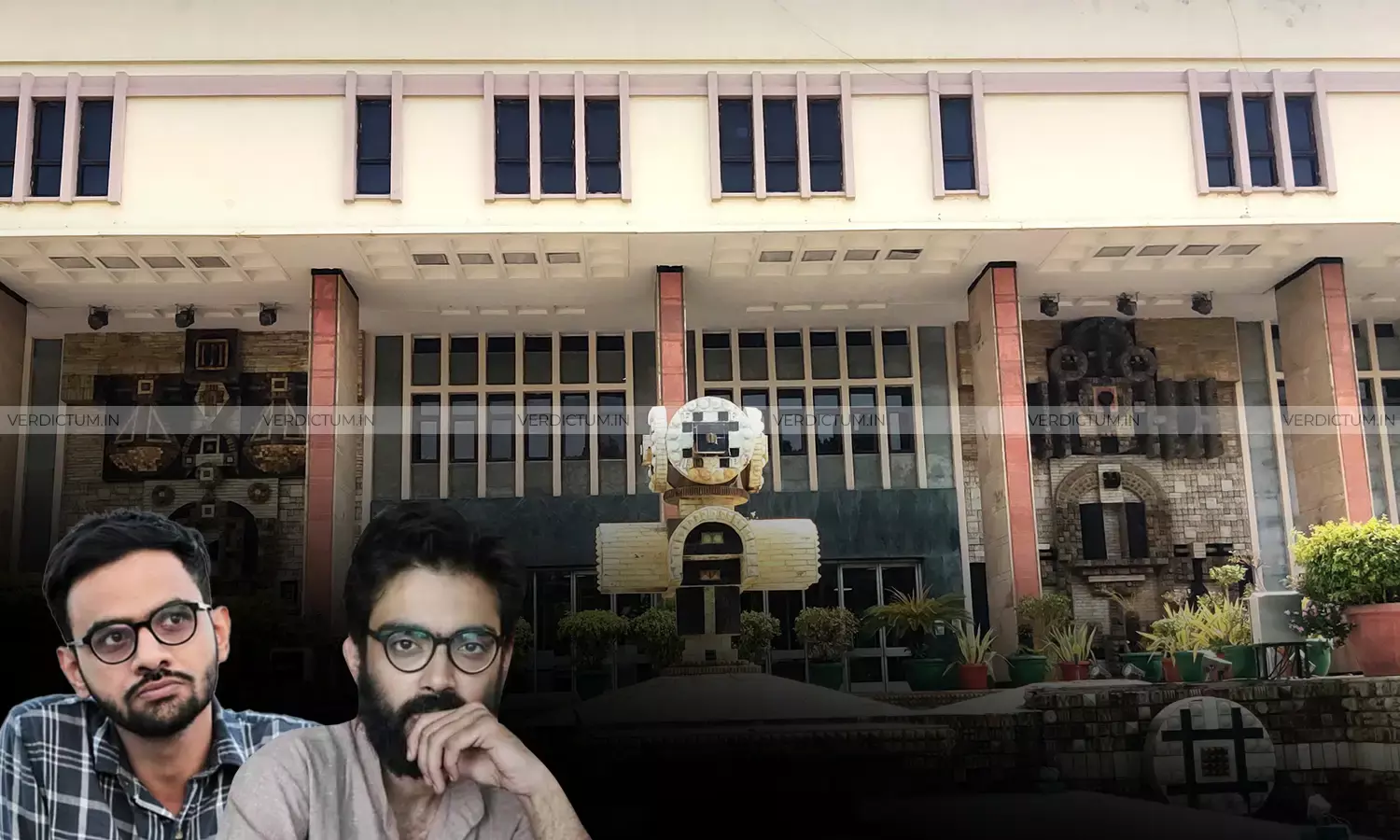
The Delhi High Court has rejected the bail appeals filed by Sharjeel Imam and Umar Khalid in connection with the 2020 Delhi riots larger conspiracy case under the Unlawful Activities (Prevention) Act (UAPA).
The Court upheld the Sessions Court's order, observing that the role of both appellants as core conspirators remains distinct from co-accused who were granted relief, and held that parity cannot be claimed.
In July, 2026, the Court had sought the stand of the city police and issued notice in the pleas. On July 4, the trial court rejected Khalid’s bail application, saying it had "no option but to follow" the Supreme Court's January 5 order and, therefore, could neither entertain the plea nor grant him the relief.
The Division Bench of Justice Prathiba M Singh and Justice Dinesh Bhatt ordered, "The role of Tasleem Ahmed and Khalid Saifi is different from that of Umar Khalid and Sharjeel Imam, and therefore parity cannot be sought...In so far as the Northeast Delhi riots are concerned, this Court in another case arising out of the same FIR in Athar Khan versus State of Delhi had examined the role of Athar Khan and had rejected the bail on the ground that the role of Athar Khan... on the following terms: para 62 and 63 and 64 of this judgment. In view of the above discussion and the overall facts of these two cases, specifically the conditions imposed in paragraph 432 qua the same very two appellants in Gulfisha Fatima, in the decision in Gulfisha Fatima, this Court cannot find fault with the decision—order passed by the trial court in the present case. Accordingly, the present appeals are rejected."
Senior Advocate Trideep Pais appeared for the Appellants, while ASG SV Raju appeared for the State
The Court observed, "As can be seen from the above extracted paragraph, the present two appellants were given liberty—while rejecting the bail of the present two appellants, they were given liberty to renew their prayer for grant of bail before the jurisdictional court, upon either of the following circumstances taking place: A) Completion of examination of the protected witnesses relied upon by the prosecution; or B) Expiry of a period of one year from the date of this order, i.e., till 5th January 2026, whichever is earlier. Despite this specific observation, the present two appellants have moved applications for grant of bail."
The Court also observed that the Court in another case arising out of the same FIR in Athar Khan versus State of Delhi had examined the role of Athar Khan and had rejected the bail on the ground of Athar Khan's role. The said judgment in Athar Khan is also stated to be pending before the Supreme Court in SLP Criminal 14920 of 2026, titled Athar Khan versus State, where vide order dated 19th August 2026, notice has been issued by the Supreme Court, it added.
"The Court has, in fact, put a query to the counsels for the appellant as to whether they would be willing to wait till the first week of January 2027 to press the present appeals. The response of counsels for the appellants clearly is that they would like to—they would like orders to be passed by this Court and would not wish to wait till January of 2027", the Court said.
Appeals were filed challenging the appeal filed by Sharjeel Imam and Umar Khalid under Section 21(4) of the National Investigation Agency Act, 2008, read with Section 483 of the Bharatiya Nagarik Suraksha Sanhita, 2023, challenging the impugned order passed by the Sessions Court. Vide the impugned order, the application filed by the Appellants seeking regular bail has been rejected by the Trial Court.
The primary allegations in the said FIR are relating to a criminal conspiracy, which is stated to be—alleged to be hatched by various persons, for commission of large-scale riots, in the light of the enactment of the Citizenship Amendment Act and the NRC, CAA and NRC.
The Appellants have submitted that the appellants are entitled to bail on the above three grounds, in as much as the trial is not likely to conclude anytime soon, and in view of the opinion expressed both in Sayed Andrabi and Tasleem Ahmed, merely on the ground of delay of trial itself, the appellants are entitled to bail.
The Appellants submitted that the Supreme Court has granted liberty to approach the Court for bail in paragraph 432 of Gulfisha Fatima v. State (Govt. of NCT of Delhi), 2026 INSC 2. Thereafter, the Supreme Court has also granted bail to two other co-accused persons, i.e., Tasleem Ahmed and Abdul Khalid Saifi@ Khalid Saifi, vide order dated 22nd May, 2026 in ‘Tasleem Ahmed v. State of Govt. of NCT of Delhi’.
Further, it was submitted that the stagnation of the trial entitles the Appellants to be released on bail.
Raju submitted that the accused persons did not pose a systemic risk and that the logic of detention could not be applied homogeneously where their risk profiles were dissimilar. He also highlighted that the basic ground on which bail is being sought by the appellants is on the ground of parity with Tasleem and Khalid Saifi.
Referring to the Supreme Court order in Athar Khan, it was noted that no interim bail or final bail was granted. The Bench observed that Athar Khan's role was previously analyzed and compared with co-accused Umar Khalid and Sharjeel Imam while rejecting bail.
Raju submitted, "The law is, if you file a successive application, there has to be change in material circumstances after the order has been passed. Therefore all this, his conduct was good, was already there before the Supreme Court...Agency has not delayed. Agency has not asked for time. Only thing is this: there is a finding of this Honorable Court by a coordinate bench which has said that the delay is attributable to a co-accused. And we argued before the Supreme Court that even if an accused delays it, it can be used against you."
The Bench also questioned how delay could be attributed solely to the prosecution when multiple applications filed by the accused persons slowed down trial proceedings.
Raju argued that the investigating agency did not cause any delay and relied on a High Court finding attributing the delay to the co-accused. It was also submitted that if delay is caused by one accused, co-accused cannot claim benefit of such delay, further emphasizing that under paragraphs 430 and 431, the threshold of Section 43D(5) of UAPA was duly attracted.
The applications are premised on the following three changes in circumstances:
1. That the judgment in Gulfisha Fatima has been reconsidered by the Supreme Court in Sayed Iftikhar Andrabi, and doubt has been expressed in respect of the ratio in Gulfisha.
2. In the case of two other co-accused, namely Tasleem Ahmed and Khalid Saifi, despite the decision in Gulfisha, the said two co-accused have been granted bail on the mere ground of delay in trial... [granted interim bail of six months on the ground of delay in trial].
3. That subsequent to the judgment of the Supreme Court in Gulfisha, further six months have lapsed when the application was filed, i.e., 5th of June 2026.
The Court had also sought the response of jail authorities on a plea by student activist Sharjeel Imam, seeking access to research material stored on a pen drive to complete his PhD.
On January 5, 2025, the Supreme Court had denied bail to Umar Khalid and Sharjeel Imam but allowed the bail pleas of Gulfisha Fatima, Meeran Haider, Shifa Ur Rehman, Mohd. Saleem Khan and Shadab Ahmad.
On September 2, 2025, a High Court division bench denied bail to Umar Khalid, Sharjeel Imam and other accused persons. The Bench remarked that the role of the Appellants, Sharjeel Imam and Umar Khalid, is prima facie grave in the entire conspiracy, having delivered inflammatory speeches on communal lines to instigate a mass mobilization of members of the Muslim Community.
Khalid was accused of committing large-scale riots in the National Capital Territory (NCT) of Delhi, in protest against the enactment of the Citizenship Amendment Act, 2019 (CAA) and the National Register of Citizens (NRC). These riots were allegedly carried out by inciting widespread communal violence in February 2020 which resulted in the loss of 54 lives including the death of a Senior Police Officer and an Intelligence Bureau Official, grievous injuries to several Police officers and members of the public, damage to more than 1,500 public and private properties, etc, apart from the other intangible harm caused to the Nation as a consequence.
As per the prosecution's case, several accused persons and individuals, including the Appellants, allegedly committed large-scale riots in the National Capital Territory (NCT) of Delhi, in protest against the enactment of the Citizenship Amendment Act, 2019 (CAA) and the National Register of Citizens (NRC). These riots were allegedly carried out by inciting widespread communal violence in February 2020 which resulted in the loss of 54 lives including the death of a Senior Police Officer and an Intelligence Bureau Official, grievous injuries to several Police officers and members of the public, damage to more than 1,500 public and private properties, etc, apart from the other intangible harm caused to the Nation as a consequence.
Cause Title: Sharjeel Imam v. State of NCT Of Delhi & Ors. [CRL.A.-647/2026] and Umar Khalid v. State of NCT Of Delhi & Ors. [CRL.A.-720/2026]