

Supreme Court Reserves Verdict On Definition Of 'Industry' Under Industrial Disputes Act
The Bench remarked that the Preamble of the ID Act focuses on the "settlement of disputes" for industrial peace, suggesting that a narrower definition might exclude various human activities from a law designed to prevent social unrest.

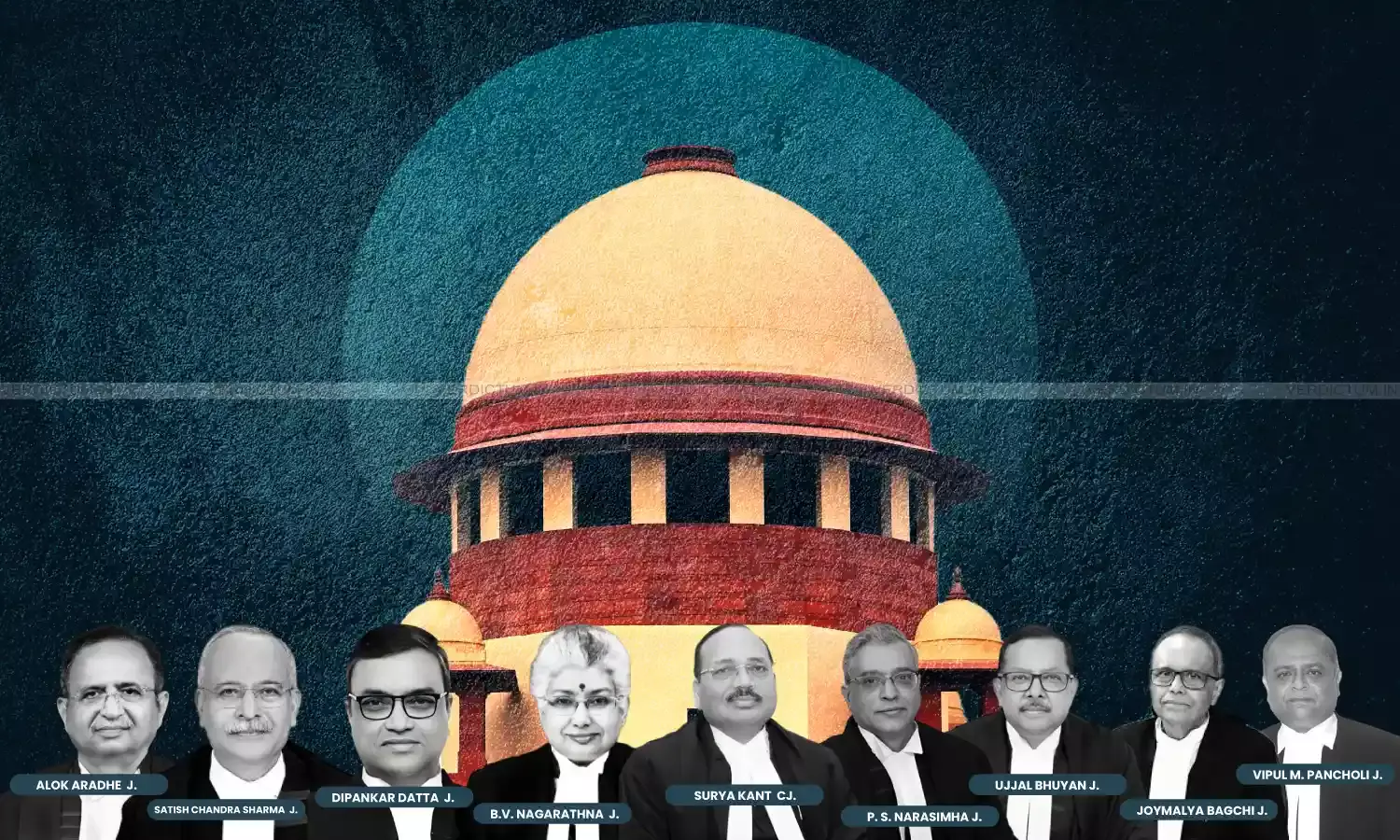
The Supreme Court of India has reserved its verdict after three days of intense arguments regarding the reconsideration of the 1978 Bangalore Water Supply judgment.
The nine-judge Constitution Bench concluded the hearing by weighing the expansive "triple test" against modern administrative concerns and the fundamental rights of workers.
The bench comprising Chief Justice Surya Kant, Justices B V Nagarathna, P S Narasimha, Dipankar Datta, Ujjal Bhuyan, Satish Chandra Sharma, Joymalya Bagchi, Alok Aradhe and Vipul M Pancholi, said it would examine the legal correctness of the 1978 judgment of a seven-judge bench giving an expansive interpretation of the term "industry" to govern labour relations.
It heard the submissions of various lawyers including Attorney General R Venkataramani, Additional Solicitor General K M Nataraj and others, such as senior advocates Shekhar Naphade, Indira Jaising, C U Singh and Sanjay Hegde during the three-day-long hearing.
On the first day of the hearing, Attorney General R. Venkataramani and Additional Solicitor General KM Nataraj argued that while the triple test is logically sound, its "indiscriminate application" has blurred the lines between industrial undertakings and the essential functions of a modern welfare state. The AG contended that the 1978 ruling relies on a "colonial understanding" of sovereign functions, failing to recognize that contemporary government activities—such as implementing socio-economic policies and welfare schemes—should not be treated as industrial just because they possess "incidental operational aspects" like hiring staff. The Union maintains that charitable organizations and departments performing constitutionally mandated functions deserve exemption.
Justice Joymalya Bagchi warned that using a 2025 law to re-interpret a 1978 judgment would be "passing off a wolf in sheep’s clothing," effectively giving retrospective power to a prospective law. Furthermore, Justice PS Narasimha criticized the legislature for failing to provide a clear, scheduled list of excluded industries, noting that leaving the definition "open-ended" has forced the courts into decades of unabated litigation.
Justice Dipankar Datta questioned the "pressing demands" cited by previous benches as the reason for this review, pointing out that a seven-judge bench's decision is binding regardless of whether it was a split verdict (5:2).
Senior Advocate Indira Jaising argued that there is no genuine conflict between past judgments and that the reference was based on "incorrect information." She emphasized that excluding workers from the Industrial Disputes Act (IDA) without providing an alternative forum for justice would leave them "going nowhere."
Counsel for various stakeholders debated the "commercial sense" test established in the Safdarjung Hospital case, which the Bangalore Water Supply ruling had largely discarded. Proponents of a narrower definition argued that activities without a commercial character or profit motive—even if secondary—should be exempt. Conversely, labor representatives like Senior Advocate C.U. Singh argued that the current framework is functional and that the issues framed for this reference do not arise naturally from the 1947 Act. The Court clarified that its focus remains strictly on who is entitled to protection under the original IDA, unaffected by subsequent unnotified amendments or new codes.
On the final day, Senior Advocate C.U. Singh and other counsel for labour unions argued that the current broad definition of "industry" serves as a vital "safety valve" for industrial peace. They contended that the Industrial Disputes (ID) Act already contains provisions (such as Sections 36A and 36B) that allow the government to exempt specific industries in the public interest.
Singh argued that the states are essentially asking the Supreme Court to "shoot from its shoulder" by judicial decree rather than exercising their own legislative power to notify exemptions. He further criticized the Safdarjung Hospital case for having "fatal flaws," including a misinterpretation of Australian law that wrongly suggested hospitals should only be considered industries if they were in the private sector.
Senior Advocates Gopal Shankarnarayan and Jayna Kothari emphasized that the "triple test" is inextricably tied to the identity of a "workman." They warned that if the Court narrows the definition of industry to exclude sectors like forest departments, social welfare schemes, or military clubs, thousands of employees would be left "remedyless."
Kothari argued for a purposive interpretation of the Act, stating that its core objective is to protect workers who lack bargaining power. She pointed out that under Directive Principles of State Policy (Articles 38, 39, and 43A), the law must favor the protection of labor rights over a restrictive, technical reading of "sovereign functions," which are increasingly being privatized anyway.
Amicus Curiae J. Cama presented a more restrictive view, arguing that "pure charity"—such as the government providing free milk or education—is fundamentally antithetical to the concept of an industry. He contended that for an activity to be an "industry," there must be an element of business or trade, which traditionally implies a profit motive. Cama critiqued Justice Krishna Iyer’s 1978 ruling for being "far too wide," suggesting that the mere existence of an employer-employee relationship should not automatically qualify an entity as an industry.
Justice Nagarathna and Justice Bagchi engaged deeply with this, questioning whether the structural nature of the work remains the same regardless of whether a fee is charged.
Shankarnarayan noted that over 27 Supreme Court cases and 66 High Court judgments have followed the Bangalore Water Supply precedent. He argued that for a nine-judge bench to reverse such a foundational view, there must be a "fair degree of unanimity" that the original decision was an error that has caused significant public harm.
Justice Bagchi noted that the Preamble of the ID Act focuses on the "settlement of disputes" for industrial peace, suggesting that a narrower definition might exclude various human activities from a law designed to prevent social unrest.
On February 21, 1978, a seven-judge bench delivered a verdict on the definition of the term "industry" while deciding the plea of Bangalore Water Supply and Sewerage Board and expanded the definition which brought millions of employees in hospitals, educational institutions, clubs and government welfare departments under the protection of the Industrial Disputes (ID) Act, 1947.
On February 16, the top court had formulated the broad issues to be adjudicated by the nine-judge bench. The Apex Court asked parties to update their written submissions or submit additional fresh written submissions on or before February 28, 2026. It clarified that matter will be heard on March 17 and 18.
First, the matter had reached the five-judge bench after a three-judge bench had found an "apparent conflict" between the two decisions passed by the apex court in 1996 and 2001 on the issue.
Earlier, a three-judge bench, in its 1996 judgement, had relied on a 1978 seven-judge bench verdict and had held that social forestry department was covered by the definition of 'industry'.
Later, in 2001, a two-judge bench took a different view on the issue, after which the matter was referred to a five-judge bench.
Cause Title: State of U.P. v. Jai Bir Singh [C.A. No. 897/2002]