

Compromise Or Settlement Between Deceased's Family & Accused Not A Ground To Quash Death By Negligence Case: Meghalaya High Court
Criminal justice system is not a “purchasable commodity” that serious public wrongs affecting society at large can be nullified with settlements

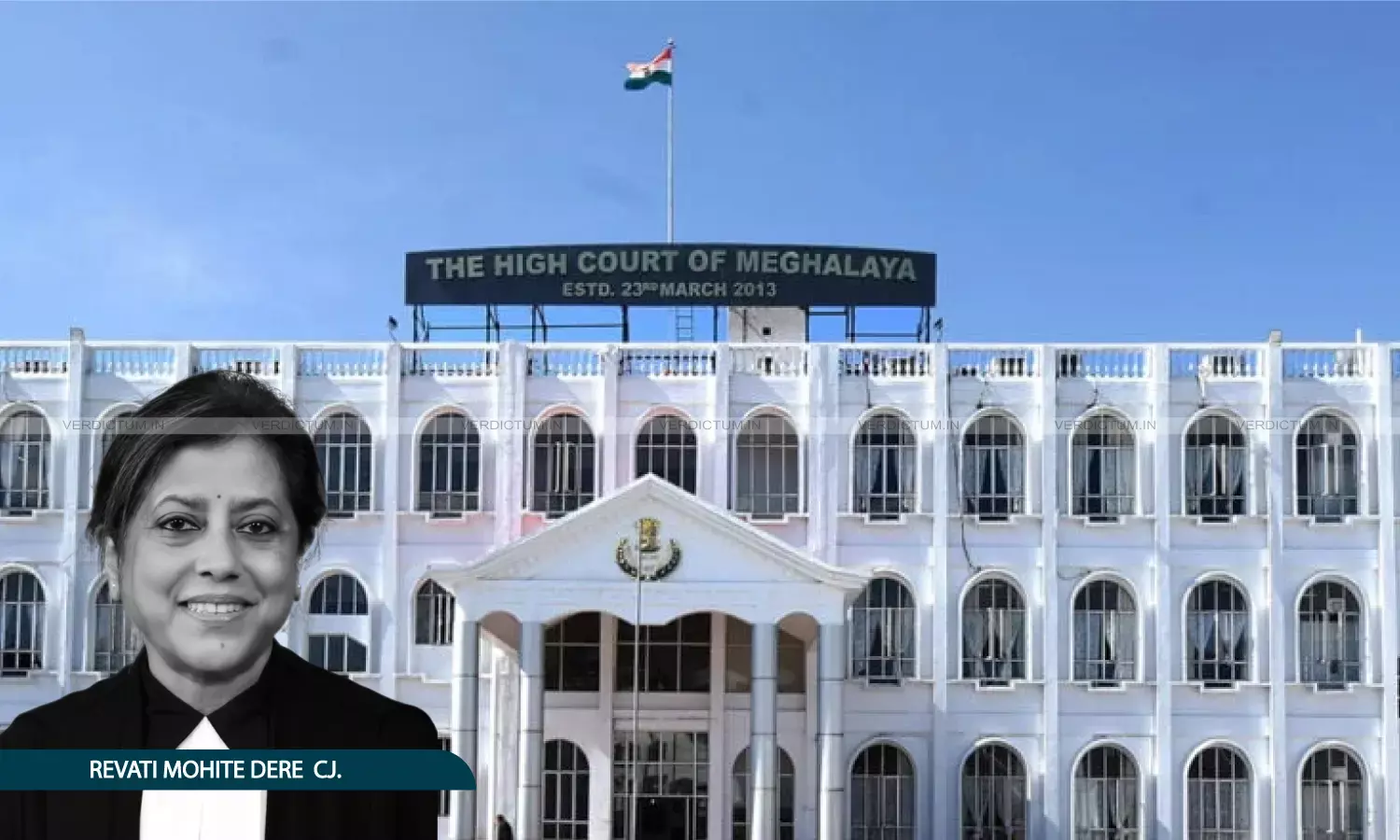
The Meghalaya High Court has refused to quash criminal proceedings in a case involving death by rash and negligent driving, holding that offences under Section 106(1) of the Bharatiya Nyaya Sanhita, 2023 (BNS) is a public wrong, and cannot be treated as private disputes merely because the accused and the victim’s family have arrived at a settlement.
The Court further observed that criminal justice is not a “purchasable commodity”, and that grave public wrongs such as motor accidents resulting in death, having wider societal ramifications, cannot be diluted merely on the basis of private settlements. Further, the Bench noted that the victim’s consent is a sine qua non for arriving at a lawful settlement, and since the victim had succumbed to the injuries sustained in the accident, obtaining such consent was rendered impossible.
Chief Justice Revati Mohite Dere observed, “…proceedings under Section 106(1) of BNS (earlier, Section 304A of IPC) where the deceased is no more, cannot be quashed on the basis of a compromise/settlement having arrived at between the accused and the legal heirs/representatives of the deceased. This practice of entering into a settlement/compromise more often than not, involves monetary consideration to the victim’s family. Criminal justice system is not a purchasable commodity. Where there are serious public wrongs and where the society as a whole, has a stake, the justice delivery system cannot be put at naught by the accused, only because of his/her financial capacity/position in society. If the same is permitted, the same will be antithetical to the rule of law. If faith in the public justice delivery system is to be maintained, any compromise between the accused and the legal heirs/representatives of the deceased under Section 106(1) of BNS cannot be sustained. There cannot be misplaced sympathy, based on settlement between the legal heirs of the deceased and the accused”.
“Thus, where the deceased who is the real victim is no more and is incapable of giving his consent, the question of a settlement between the accused and the legal heirs of the deceased would not arise. In fact, if such a compromise is permitted on the ground of mutual accord, the same would not only undermine the public confidence in the justice delivery system but would also ultimately shatter the faith of the public in the judicial system”, the Bench further observed.
Advocate N.M. Mansuri appeared for the petitioner and K.P. Bhattacharjee, GA appeared for the respondent.
The Court was hearing a petition filed under Section 528 of the Bharatiya Nagarik Suraksha Sanhita (BNSS), 2023, seeking quashing of an FIR registered at Rynjah Police Station, Shillong. The petitioner was charged under Sections 106(1), 125(b), and 281 of the BNS in connection with a road accident that resulted in the death of one Kennystar Lyndem.
According to the prosecution, the petitioner lost control of his vehicle, veered onto the wrong side of the road, and collided with a scooty driven by the deceased, who later succumbed to his injuries. A charge sheet had already been filed and the matter was pending before the Judicial Magistrate First Class, Shillong.
During the pendency of the proceedings, the accused and the legal heirs of the deceased, his wife and mother entered into an amicable settlement. Both legal heirs filed affidavits expressing no objection to the quashing of the FIR and the criminal case.
The petitioner argued that the High Court could exercise its inherent powers to quash non-compoundable offences in appropriate cases where parties have settled the dispute.
However, the Bench held that while the High Court’s inherent powers under Section 528 BNSS are distinct from compounding powers under Section 359 BNSS, such powers must be exercised with utmost caution and only to secure the ends of justice or prevent abuse of process. The Court noted that offences under Section 106(1) BNS (corresponding to Section 304A IPC) involve death caused by rash or negligent acts and cannot be viewed as purely private in nature.
Accordingly, the Court dismissed the petition and declined to quash the FIR or the pending proceedings, reiterating that cases involving death by negligence must ordinarily proceed to trial notwithstanding any settlement between the accused and the victim’s family.
Cause Title: Flamingstar Sohkhlet v. State of Meghalaya & Ors. [Neutral Citation: 2026:MLHC:69]
Appearances:
Petitioner: N.M. Mansuri, Advocate.
Respondent: K.P. Bhattacharjee, GA, A.P. Kharsahnoh, Advocates.