

Stamp Duty Is To Be Determined With Reference To Date of Execution Of Document & Not On Date When It Is Impounded: Madhya Pradesh High Court
The Madhya Pradesh High Court was considering a petition filed against the order of the Collector, whereby the petitioner was directed to pay the deficit stamp duty along with a penalty.

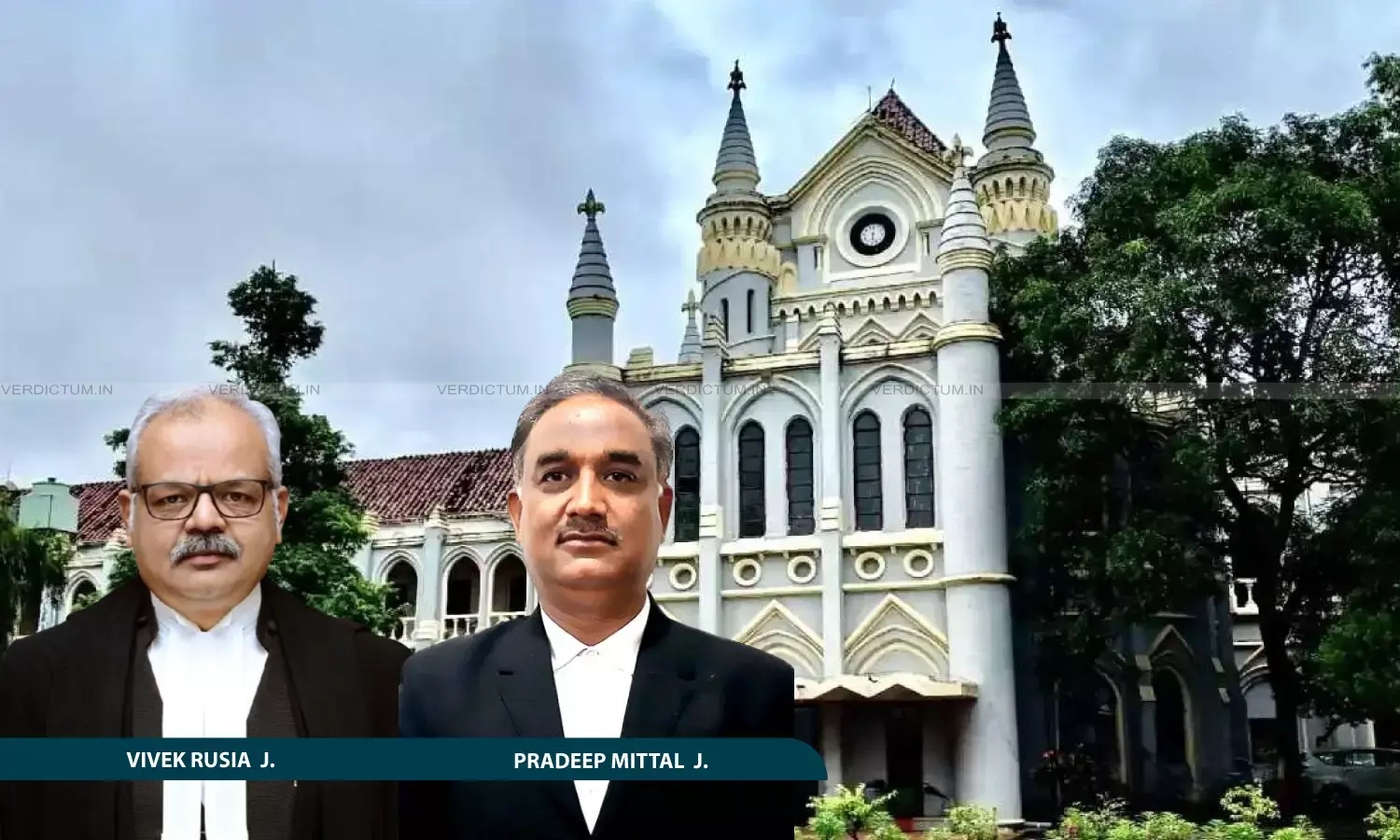
While directing the Collector to register a lease deed on payment of stamp duty without imposing any penalty or Upkar, the Madhya Pradesh High Court has held that stamp duty is to be determined with reference to the date of execution of the document, and not on the date when the document is impounded or when an order is subsequently passed by the Registrar of Stamps.
The High Court was considering a Petition challenging the order of the Collector, whereby the petitioner was directed to pay the deficit stamp duty along with a penalty amounting to Rs 2,44,57,462 (Rs 1,94,58,462 towards deficit stamp duty and Rs 50,00,000 as penalty).
The Division Bench of Justice Vivek Rusia and Justice Pradeep Mittal held, “Under Section 23 of the Registration Act, 1908, a document must be presented for registration within four months from the date of its execution. Failure to submit within prescribe period, late payment of stamp duty attracts a penalty, if a document is submitted for registration significantly later than its execution, the Sub-Registrar might assess the duty based on the market value of the property at the time of submission. Therefore, it is clear from the relevant law and rules that stamp duty is to be determined with reference to the date of execution of the document, and not on the date when the document is impounded or when an order is subsequently passed by the Registrar of Stamps.”
Senior Advocate R.S. Jaiswal represented the Petitioner, while Government Advocate Ritwik Parashar represented the Respondents.
Factual Background
The petitioner Company was granted a mining lease for the extraction of limestone over an area of 150.028 hectares situated at Village Karmau for a period of 30 years by the State Government. A Mining Lease Agreement was executed in 2014, and due to urgent necessity, the agreement was executed on a stamp paper of Rs. 1,000. The petitioner submitted the document before the Sub-Registrar for proper determination and payment of stamp duty and for registration. As per Article 38(vi) of the Stamp Act, as amended by the Madhya Pradesh Stamp Duty Amendment Ordinance, 2014, stamp duty was payable at 5% of the average annual rent reserved. In 2015, proceedings were registered by the Collector of Stamps, Satna, under Section 40 read with Article 38(vi) of the Stamp Act.
The Collector issued a letter to the Mining Officer, Satna, seeking information regarding the average annual royalty for the lease area of 150.028 hectares. Based on the Mining Officer’s report, the stamp duty at 5% of the average annual royalty of Rs. 1,25,35,110 amounted to Rs. 6,26,755. The Collector added the dead rent and calculated the stamp duty at Rs. 1,94,58,462, which also included dead rent and cess (Upkar). The petitioner filed objections before the Collector of Stamps stating that, as per the mining plan, total production for five years would be 5,96,910 metric tons, and the average annual production would be 1,19,382. Aggrieved by the order, the petitioner preferred a Revision under Section 56(4) of the Stamp Act before the Board of Revenue; however, the same was dismissed.
Reasoning
The Bench explained that stamp duty is primarily imposed on the execution of the document (on the date it is signed), rather than solely on the date it is submitted for registration. However, it is required to be paid before or at the time of registration. “Stamp duty must be paid before the document is executed, on the date of execution, or on the next working day. Execution means the date on which the parties sign”, it added.
Coming to the facts of the case, the Bench noted that when the document was presented, the law governing payment of stamp duty on lease deeds was the M.P. Stamp Duty (Amendment) Ordinance, 2014, published in the M.P. Gazette on September 16, 2014. The amendment prescribing stamp duty at 5% came into force on September 16, 2014, and the subsequent amendment introducing stamp duty at 0.75% came into force only on January 14, 2016. Thus, as per the Bench, the later amendment could not be applied retrospectively to a lease deed executed before that date, and the Collector committed an error in applying the amendment that came into force on January 14, 2016.
“While calculating the annual rent, the Collector also added the dead rent to the royalty, which is contrary to law. It is well settled that either royalty or dead rent, whichever is higher, is to be levied. This means that both cannot be levied simultaneously on the same lease. Therefore, in calculating the annual rent, the Collector committed an error by taking the dead rent into consideration along with the royalty”, the order read.
The Bench was of the view that the imposition of Upkar was contrary to law, as Upkar is leviable on instruments such as sale deeds, gift deeds, and leases exceeding 30 years, and a lease deed does not fall within the definition of a sale deed or a gift deed. Moreover, the period of the disputed lease did not exceed 30 years. Considering that, as per the M.P. Stamp Duty (Amendment) Ordinance, 2014, published in the M.P. Gazette, the amendment prescribing 5% stamp duty applied to the annual rent and not to thirty times the annual rent, the Bench held that the Collector wrongly calculated the stamp duty, and consequently, the penalty imposed by the Collector was also erroneous.
Thus, finding the order imposing stamp duty along with penalty to be erroneous, the Bench allowed the petition, and directed the Collector/Registrar of Stamps to register the lease deed on payment of stamp duty at Rs. 6,26,775 only, without imposing any penalty or Upkar.
Cause Title: M/S Jai Prakash Associated Pvt. Ltd. v. The State of Madhya Pradesh (Neutral Citation: 2026:MPHC-JBP:15508)
Appearance
Petitioner: Senior Advocate R.S. Jaiswal, Advocate Anjali Upadhyay
Respondent: Government Advocate Ritwik Parashar