

Grounds of Arrest Must Be Disclosed in Writing; Erring Police Officials Must Be Suspended: Allahabad High Court
Reiterating safeguards, orders immediate release

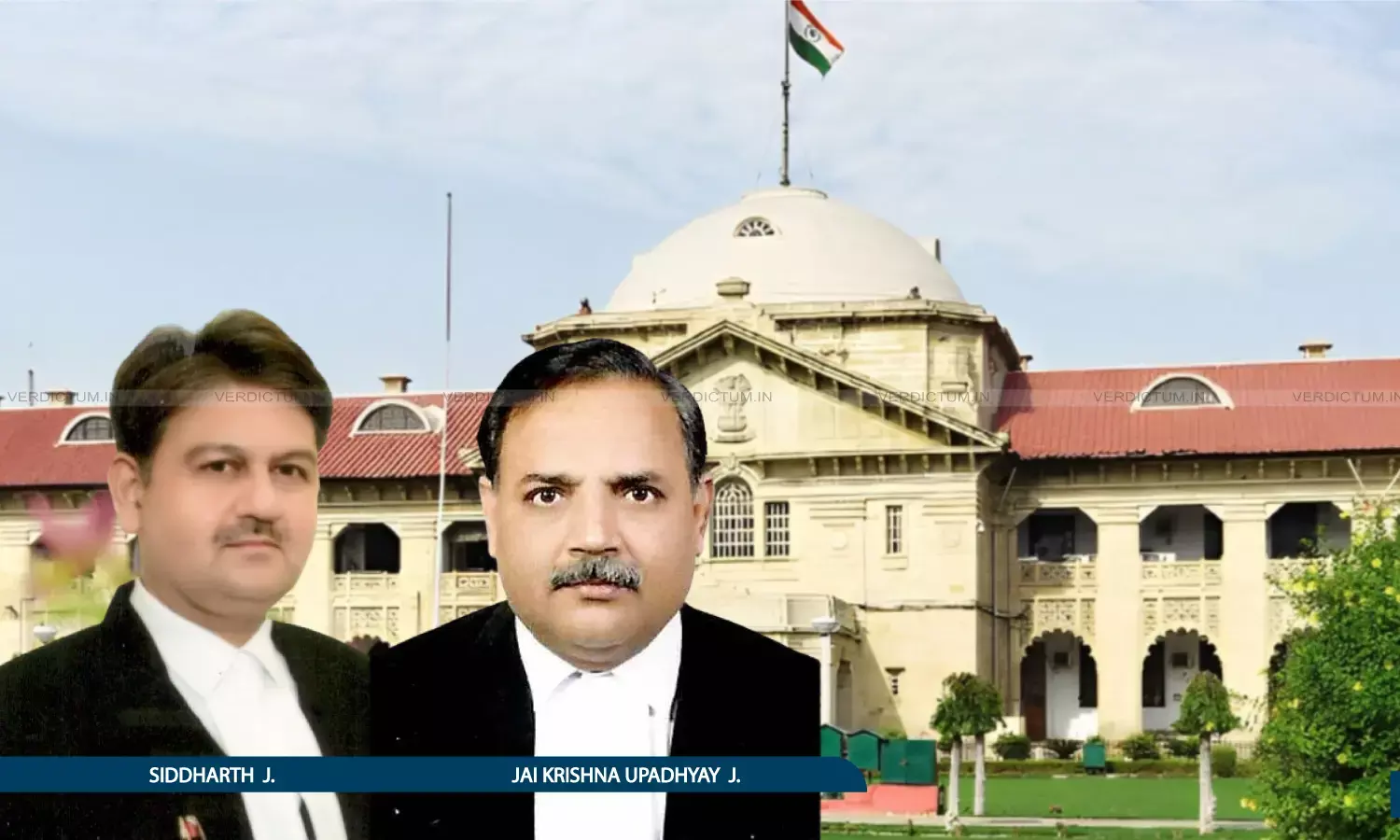
The Allahabad High Court has observed that a police officer who fails to disclose the grounds of arrest required as per clause 13 of the arrest memo, commits misconduct and dereliction of duty, and is liable to suspension and departmental proceedings. The Court further reprimanded the Magistrate for failure to ensure compliance with statutory safeguards at the remand stage, observing that the remand was granted mechanically without verifying whether constitutional requirements had been met.
Ordering immediate release, the bench quashed the arrest and judicial remand of the petitioner since it was in clear violation of Article 22(1) of the Constitution of India, 1950 and the mandatory safeguards under the Bharatiya Nagarik Suraksha Sanhita, 2023 (BNSS).
A division bench of Justice Siddharth and Justice Jai Krishna Upadhyay sternly observed, “It is high time that the police officials, who are not complying the requirements of the arrest memo and violating the constitutional mandate provided under Article 22(1) of the constitution of India and further violating Section 50 and 50A Cr.P.C / 47, 48 and B.N.S.S should be sternly dealt with. The violation of the constitutional mandate, provision of Cr.P.C/ B.N.S.S and the direction of the Director General of Police of the State of U.P dated 25.07.2025 clearly amounts to dereliction of duty on the part of the police personnel investigating this case. The empty compliance of law and justification of the same before the court, as in this case by the respondents, deserves to be discouraged”.
“It is hereby directed that the violation of the aforesaid legal provisions by any police officer, while affecting arrest an accused, by not disclosing the grounds of arrest as per clause 13 of the memo of arrest, would amount to the misconduct of dereliction of duty by police official concerned and he shall be liable for being proceeded departmentally, after being placed under suspension, so that he may not perpetrate this illegality any more”, the bench further observed.
Advocate Raghav Dev Garg appeared for the petitioner, and Additional Advocate General Kartikey Saran appeared for the respondent.
In the matter, the habeas corpus petition arose from the alleged illegal detention of the petitioner’s father by the police, followed by the arrest of the petitioner himself. According to the pleadings, the petitioner was taken into custody without being informed of the grounds of arrest, and without being supplied a valid arrest memo, despite his signature being obtained on the document.
The petitioner challenged the legality of his arrest and subsequent remand, contending that the police acted in a high-handed manner and that the Magistrate failed to apply judicial mind while authorising custody.
The Court observed that arrest memos in Uttar Pradesh were earlier prepared in an unregulated manner, leading to “anarchy,” after which, pursuant to judicial directions, the DGP issued a standard arrest memo format and circulated it statewide through a 25-07-2025 circular.
Clause 13 of the prescribed arrest memo format, requires detailed disclosure of:
-material indicating the accused’s involvement;
-reasons necessitating arrest;
-evidence collected till the time of arrest; and
-justification for custodial detention.
Observing that arrest memos in Uttar Pradesh were earlier prepared in an unregulated manner, leading to “anarchy,” after which, pursuant to judicial directions, the DGP issued a standard arrest memo format and circulated it statewide through a 25-07-2025 circular, the court said, “…no such effort had been made by the learned Magistrate to ensure adequate legal aid to the accused petitioner and appropriate opportunity of hearing at the time judicial remand. Even the arrest memo does not contain any column regarding grounds of arrest of the petitioner. This very issue is primarily the bone of contention between the parties in the instant matter. Accordingly, this, being a clear non-compliance of the mandate under Section 50 of the Code which has been introduced to give effect to Article 22(1) of the Constitution of India, 1950…”.
The bench also directed the Director General of Police, Uttar Pradesh to circulate and ensure strict compliance with Sections 47 and 48 BNSS.
Cause Title: Umang Rastogi and another v. State of U.P. and 3 Others [Neutral Citation: 2026:AHC:16946-DB]
Appearances:
Petitioner: Anand Kumar, Aditya Giri, Raghav Dev Garg, Advocates
Respondent: Kartikey Saran, Additional Advocate General assisted by Manju Thakur, A.G.A.-Ist for the State.
Click here to read/download the Order