"Triple Test" For "Industry" Laid Down In 1978 Bangalore Water Supply Case Will Govern All Pending Disputes Under Repealed Industrial Disputes Act: Supreme Court's 9-Judges Bench Clarifies
 |
|The Court held that the new Industrial Relations Code's definition of "industry" must be interpreted independently, unburdened by Bangalore Water Supply or any fresh formulation attempted in this judgment.
A nine-Judge Bench of the Supreme Court in its judgment pronounced on August 20, 2026 has held that the test laid down by the seven-Judge Bench in Bangalore Water Supply & Sewerage Board v. A. Rajappa (1978) for determining what constitutes an "industry" under Section 2(j) of the now-repealed Industrial Disputes Act, 1947, will continue to govern all disputes pending under that Act, notwithstanding decades of doubt cast on its correctness by intervening references. The Court held that this outcome applies regardless of whether individual judges on the Bench found the 1978 formulation itself flawless or in need of recalibration.
The Bench was equally emphatic on the converse proposition: the definition of "industry" under Section 2(p) of the Industrial Relations Code, 2020, which came into force on November 21, 2025, replacing the 1947 Act, must be construed entirely on its own text and scheme, without being anchored to, or coloured by, either the original Bangalore Water Supply ratio or any of the reformulations debated in this judgment. Every opinion on the Bench, despite significant internal disagreement over the correctness of Bangalore Water Supply, converged on this firewall between the old law and the new.
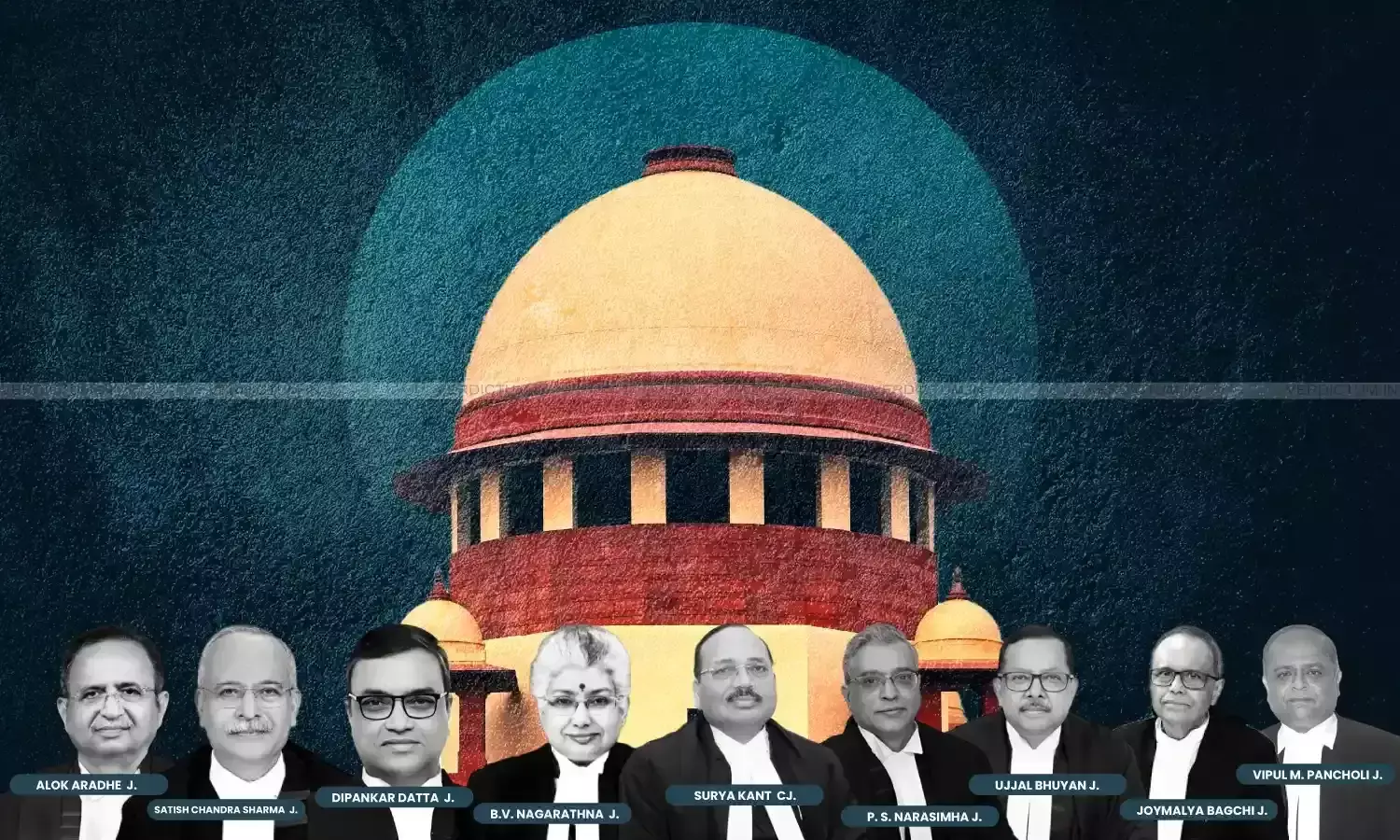
A Bench of nine judges comprising Chief Justice Surya Kant, Justices B V Nagarathna, P S Narasimha, Dipankar Datta, Ujjal Bhuyan, Satish Chandra Sharma, Joymalya Bagchi, Alok Aradhe and Vipul M Pancholi. Separate opinions were by Justice B.V. Nagarathna, Justice Pamidighantam Sri Narasimha, Justice Dipankar Datta and Justice Ujjal Bhuyan (jointly), and Justice Joymalya Bagchi, in a batch of appeals led by State of Uttar Pradesh v. Jai Bir Singh, arising out of a reference that had travelled from a three-Judge Bench in 2002 through a five-Judge Bench in 2005 and a seven-Judge Bench in 2017 before reaching this nine-Judge Bench.
R. Venkataramani, Attorney General for India, K.M. Nataraj, Additional Solicitor General of India, Additional Advocates General Shadan Farasat, Sridhar Potaraju appeared for the appellant while Senior Advocates Indira Jaising, Bharat Sangal, C.U. Singh appeared for the respondent and Senior Advocates Jamshed P. Cama, Parthasarathi Sengupta appeared as amicus.
Chief Justice Surya Kant (also for Justice Satish Chandra Sharma, Justice Alok Aradhe and Justice Vipul M. Pancholi), observed, “It is pertinent to clarify at this juncture that the foregoing is only a hypothesis, and we do not propose, at this stage, to disturb the application of the Triple Test to proceedings that remain pending. To do so would risk creating new and unnecessary distinctions between similarly situated parties, and consequently generate entirely new classes of ‘haves’ and ‘have-nots’. Our decision is informed not only by the possibility of creating such an artificial and narrowly defined class by retrospectively altering the manner in which the Triple Test is to be applied, but also by the fact that Section 2(j) of the ID Act is no longer in operation and has since been succeeded by the legislative framework contained in the Industrial Relations Code”.
“It goes without saying that we are not in complete agreement with the ratio laid down in Bangalore Water Supply (supra). Had we been in complete agreement, there would have been little reason for us to undertake the detailed examination of its reasoning, formulations, and constituent elements that has occupied the preceding pages. Our endeavour has instead been to identify, with the benefit of hindsight and experience, those aspects which may merit refinement, without unsettling the legal position governing matters that have already entered the judicial stream”, it was further noted.
The reference asked whether the "triple test" articulated by Justice Krishna Iyer in Bangalore Water Supply, systematic activity, organised through employer-employee cooperation, for production or distribution of goods and services satisfying human wants, correctly states the law; whether government welfare schemes could constitute "industrial activities"; and what falls within "sovereign functions" excluded from the definition. The reference itself was triggered by a perceived, and on closer scrutiny largely illusory, conflict between rulings on whether a State Forest Department's social forestry scheme was an "industry."
The opinions diverged sharply on how to get there. Chief Justice Surya Kant's opinion, while professing broad respect for Bangalore Water Supply, proposed a "hypothetical" recalibration of the triple test to give greater weight to the commercial character of an activity, while expressly clarifying this reformulation would not disturb pending cases.
Justice Nagarathna held the reference itself unnecessary and the earlier references misconceived, finding the 1978 majority ratio good law requiring no reconsideration at all. Justice Narasimha held the reference validly made but concluded that, with the 1947 Act repealed, any pronouncement on Bangalore Water Supply had become largely academic and should not cast a shadow on the new Code.
Justices Datta and Bhuyan, after a granular critique of the 2005 reference order, concluded it did not meet the threshold for disturbing a settled precedent and required no answer. Justice Bagchi affirmed the triple test as correctly decided on its own merits, including its treatment of sovereign functions, charitable institutions, clubs and liberal professions.
Justice Bagchi's opinion went further than the others by separately affirming, on the merits, several category-specific applications of the triple test: that "sovereign functions" must be confined to the narrow, non-justiciable core of Statehood rather than extended to welfare schemes; that charitable institutions, temples and educational bodies fall within "industry" so long as an organised employer-employee relationship exists, irrespective of the charitable or spiritual character of the enterprise; and that large, systematically run clubs and professional establishments (as opposed to solitary practitioners) likewise qualify. This category-wise affirmation was not necessary to, and does not alter, the Bench's core and unanimous holding on the treatment of pending cases and the Industrial Relations Code.
“The repercussions of a contrary view are far from academic and they strike most heavily at those on the lowest rungs of public employment. Many of these workers endure severe occupational hazards and social vulnerability, yet a blanket exclusion of Government departments would mean that the very people who most require the protection of the law are the first to be denied it. It would be a profound irony if a doctrine intended to safeguard the State is used to unprotect labour. This also offends the equality principle enshrined in Article 14, for a gardener, driver, or maintenance employee does not perform a different species of labour simply because their wage slip bears the seal of the State”, Justice Bagchi noted.
Despite this, the Court unanimously directed that all pending references arising under the Industrial Disputes Act be carried to their logical conclusion applying the law on "industry" as it stood prior to the Industrial Relations Code taking effect, and that nothing in the judgment shall have any bearing on the independent interpretation, or any future constitutional challenge, to Section 2(p) of the 2020 Code.
Cause Title: State of Uttar Pradesh v. Jai Bir Singh (Neutral Citation: 2026 INSC 897)
Appearances:
Appellant: R. Venkataramani, Attorney General for India, K.M. Nataraj, Additional Solicitor General of India, Shadan Farasat, Additional Advocate General, Sridhar Potaraju, Additional Advocate General, Shekhar Naphade, Senior Advocate, Sanjay Hegde, Senior Advocate, Alok Sangwan, Senior Additional Advocate General, Jaideep Gupta, Senior Advocate, Saket Sikri, Anand Verma, and Krishna Kumar, Advocates
Respondents: Indira Jaising, Senior Advocate, Bharat Sangal, Senior Advocate, C.U. Singh, Senior Advocate, Vijay Hansaria, Senior Advocate, Gopal Sankaranarayanan, Senior Advocate, P.V. Surendranath, Senior Advocate, Jayana Kothari, Senior Advocate, K.S. Chauhan, Senior Advocate, Ashok Kumar, Shivam Singh, Sangeeta Bharti, and Nidhi, Advocates