Breaking: Supreme Court Modifies “Triple Test” Laid Down In 1978 Bangalore Water Supply Case; But Will Apply Prospectively
 |
|The majority opinion held that the reference made was validly entertained, overruling maintainability objections. Conversely, Justices B.V. Nagarathna, Dipankar Datta, and Ujjal Bhuyan held that the reference was not maintainable.
The 9-Judge Bench of the Supreme Court has resolved the long-standing reference regarding the 1978 Bangalore Water Supply precedent, holding the reference to be validly made while ruling that the reformulated "triple test" for defining an "industry" under Section 2(j) of the Industrial Disputes Act, 1947, will operate strictly prospectively.
On March 19, 2026, the Supreme Court reserved its verdict after three days of intense arguments regarding the reconsideration of the 1978 Bangalore Water Supply judgment. The nine-judge Constitution Bench concluded the hearing by weighing the expansive "triple test" against modern administrative concerns and the fundamental rights of workers.
Chief Justice of India pronounced the judgment on behalf of himself, Justice Satish Chandra Sharma, Justice Alok Aradhe, and Justice Vipul M Pancholi, along with a substantially concurring opinion penned by Justice P.S. Narasimha.
Justice B.V. Nagarathna has expressed an independent opinion holding that the reference to the nine-judge Bench is not maintainable.
Similarly, Justice Dipankar Datta, for himself and Justice Ujjal Bhuyan, has also declined to entertain the reference on grounds of maintainability. Whereas Justice Joymalya Bagchi has rendered an independent opinion holding the reference to be valid while affirming the ratio and principles laid down in Bangalore Water Supply.
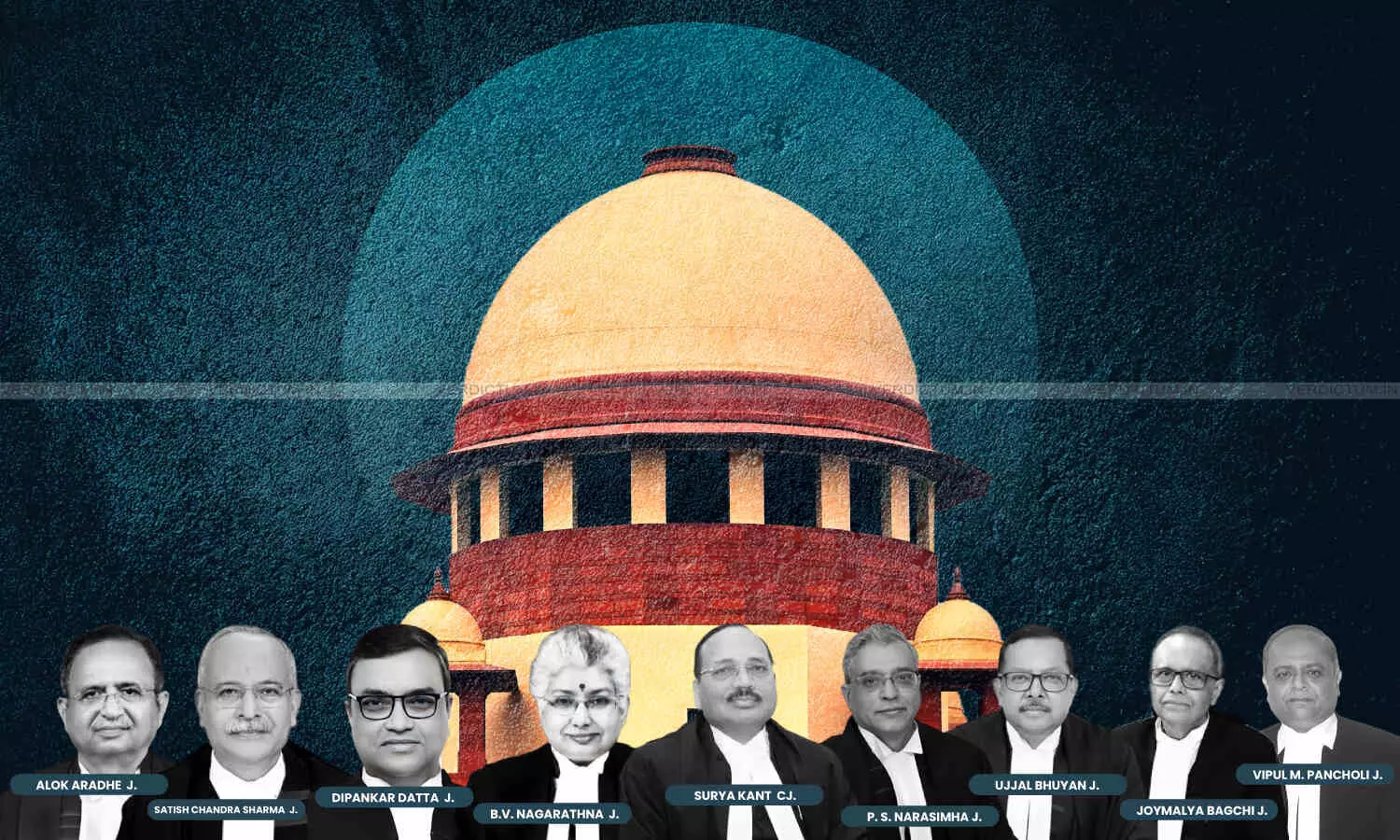
The Bench comprising Chief Justice Surya Kant, Justices B V Nagarathna, P S Narasimha, Dipankar Datta, Ujjal Bhuyan, Satish Chandra Sharma, Joymalya Bagchi, Alok Aradhe and Vipul M Pancholi delivered the verdict.
The Bench held, "The majority opinion has thus held that the reference was validly made, and that no objection can legitimately be sustained as to its maintainability...However, it has been expressed with abundant caution that the majority opinion on the reformulation of the test will only operate prospectively, and is not intended to displace the governing legal position in respect of pending proceedings. Consequently, all matters presently pending before courts, tribunals, labor authorities, or other fora under the Industrial Disputes Act, 1947, shall be adjudicated in accordance with the triple test laid down in Bangalore Water Supply..."
The Bench at the end of pronouncement concluded, "The majority opinion has refrained from entering into an examination of the definition of 'industry' as it exists under the Industrial Relations Code, 2020, or the Industrial Disputes (Amendment) Act, 1982. Accordingly, and pursuant to the conclusions set out in our judgment, the principles set out in the majority opinion... the principles laid down in Bangalore Water Supply, supra, shall not be regarded as a sheet anchor for the interpretation of the Industrial Relations Code, 2020, or any of its provisions, should such a question arise in the future. And such questions shall be interpreted on its own text and context...The references are accordingly disposed of."
Chief Justice Surya Kant, along with Justice Satish Chandra Sharma, Justice Alok Aradhe, and Justice Vipul Pancholi formulated four questions:
1. Whether the triple test laid down in Bangalore Water Supply is correct in law?
2. Whether the Industrial Disputes (Amendment) Act, 1982 and the Industrial Relations Code, 2020 have any legal impact upon the interpretation of "industry" as contained in the principal Act of 1947?
3. Whether the social welfare activities and schemes of government departments or their instrumentalities can be construed as industrial activities for the purpose of Section 2(j) of the 1947 Act?
4. What are the sovereign functions of the State that fall outside the purview of Section 2(j)?
Majority View
Chief Justice Kant, along with Justices P S Narasimha, Satish Chandra Sharma, Joymalya Bagchi, Alok Aradhe and Vipul M Pancholi held, "The present reference has been validly made and rightly entertained; no legitimate doubt can be cast upon its maintainability, and the reference is accordingly answered on merits...In our considered view, certain aspects of the triple test and the accompanying guidelines formulated in Bangalore Water Supply are susceptible to further refinement."
It was added that while the essential framework laid down therein has stood the test of time, we are of the opinion that some of its constituent elements could have been articulated differently to better reflect the scope and contours of Section 2(j).
The Court added, "In view of the foregoing, the reformulated triple test articulated in this judgment is to be understood as no more than our considered opinion on the proper interpretation of Section 2(j) of the Industrial Disputes Act, 1947. It is not intended to displace the governing legal position in respect of pending proceedings. Consequently, all matters presently pending before Courts, Tribunals, Labour Authorities, or other fora under the Industrial Disputes Act, 1947, may be adjudicated in accordance with the triple test as laid down in Bangalore Water Supply."
The Bench held that it has not disturbed that, as doing so would create artificial discrimination. It was held that the present clarifications shall operate prospectively; they shall not reopen, disturb, or otherwise affect proceedings that have attained finality.
The Majority held, "Judgments, awards, settlements, and determinations no longer subject to challenge shall remain undisturbed. The same principle applies to proceedings, appeals, and other hearings currently in the process of adjudication. Finally, we refrain from entering into any examination of the definition of "industry" as it presently exists under the Industrial Relations Code, 2020, or the Industrial Disputes (Amendment) Act, 1982."
Justice BV Nagarathna's View
Justice Nagarathna authored a separate concurring opinion outlining the reasons why the reconsideration of the ruling of the Supreme Court in Bangalore Water Supply was not warranted.
Justice B.V. Nagarathna delivered a separate opinion holding that the reconsideration of Bangalore Water Supply was unwarranted and that the reference made by the five-judge Bench in State of Uttar Pradesh v. Jai Bir Singh was unnecessary.
It was concluded that the ruling called for no interference and answered the reference accordingly, noting that the five-judge Bench could have reconciled the issue using existing three-judge Bench precedents like Jagannath Maruti Kondhare.
Examining the "triple test" and the historic overruling of Safdarjung Hospital, the Solicitors' case, and Gymkhana Club, Justice Nagarathna emphasized the necessity of maintaining an expansive definition of "industry" under Section 2(j) of the Industrial Disputes Act, 1947.
It was observed that post-independence socio-economic transformations, along with India's shift toward privatization and liberalization, rendered the protection of workmen increasingly vital. As state-managed undertakings transitioned to private hands, public sector workers effectively became private sector employees.
Justice Nagarathna concluded that the definition of "industry" must remain broad-based, as held by the majority in Bangalore Water Supply, rather than narrowly tailored.
Justice B.V. Nagarathna provided ten key reasons for upholding Bangalore Water Supply and answered the reference accordingly.
Justice Nagarathna held, "I have also answered the questions referred to us...On the first question, I have said that the test laid down in paragraphs 140 to 144 of the opinion of Justice Krishna Iyer in Bangalore Water Supply is the correct law...I have also said that the 1982 Amendment and the Industrial Relations Code do not have any legal impact on the interpretation of the expression "industry" as contained in Section 2(j) of the Act."
Justice Nagarathna observed, "On the second question, social welfare activities and schemes or other enterprises undertaken by government departments or their instrumentalities can be construed to be industrial activities for the purposes of Section 2(j) of the Act, depending upon the nature of the activities...Merely because the government is undertaking these activities, they cannot, per se, be excluded from the definition of "industry".
Justice PS Narasimha's Opinion
Justice Narasimha indicated how the problem arose not because of the methodology of interpretation, but because of the way in which the definition is formulated.
He observed, "The procedure by which the ratio in Bangalore Water Supply has been referred for reconsideration to a Bench of nine Judges is valid...The endeavour of various decisions of the Court after Bangalore Water Supply, leading to reference by Jai Bir Singh to bring about certainty about the way industry—what industry entails—is justified. The reference can be answered on merits."
It was added that while an authoritative interpretation of the definition of 'industry' was compelling at the time of reference, such a determination has now become unnecessary with the repeal of the said provision with effect from 21.11.2025. With the advent of the Industrial Relations Code, 2020, with effect from 21.11.2025, the ratio in Bangalore Water Supply (supra) is now confined to cases arising under the repealed Act.
"It is prudent to dispose of the pending cases on the basis of the ratio laid down in Bangalore Water Supply without attempting to create a third set of principles applicable only to the pending cases...Here, I have completely agreed with the Chief Justice's perspective of the hypothetical perspective of how in future, we may have to reinterpret the new Code provisions. I have agreed with him on that", Justice Narasimha said.
It was also indicated that it is important to ensure that the future interpretation of the definition of 'industry' under Section 2(p) of the Industrial Relations Code, 2020, is not burdened by the existing interpretations on the repeal of Section 2(j) of the Industrial Disputes Act, 1947. The Industrial Relations Code, 2020, should be interpreted on its own text and in its own context alone.
Further, Justice Narasimha said if the nine-judge Bench modifies and restricts the ratio laid down in Bangalore Water Supply, it will have a serious effect of excluding certain entities from the fold of industries as defined under Section 2(j) of the repealed Act.
It was concluded, "This will have the consequence of excluding long-pending disputes from the regulatory regime of the Industrial Disputes Act, 1947, and the parties will be relegated to remedies before the civil court. It is therefore necessary to dispose of the disputes arising under the repealed Act on the basis of the ratio laid down in Bangalore Water Supply."
Justice Dipankar Datta and Justice Ujjal Bhuyan's Opinion
Justice Dipankar Datta delivered an opinion on behalf of himself and Justice Ujjal Bhuyan, holding that the definition of "industry" under Section 2(j) of the Industrial Disputes Act, 1947, was perhaps the most litigated word in Indian labour jurisprudence.
It was emphasized that institutional credibility demanded an authoritative determination to bestow certainty, preserve finality, and lay to rest the lingering uncertainty surrounding Bangalore Water Supply.
Upholding the preliminary objection raised by Senior Advocate Indira Jaising, it was observed that Parmar had distinguished Maruti on affidavit evidence, leaving no conflict or occasion for a reference. Evaluating the reference made in State of Uttar Pradesh v. Jai Bir Singh, the Court held that it failed the tests laid down by Chief Justice P.B. Gajendragadkar in Kesoram Industries (1965), as well as the principles in Shah Faesal and Balasaheb Patil. Applying the "substance test" rather than the "form test" under Dawoodi Bohra, it was concluded that the reference served no practical, jurisprudential, or doctrinal purpose.
Assuming arguendo that the reference was proper, it was affirmed that Bangalore Water Supply correctly laid down the "triple test." Respecting legal finality over perpetuating doubt, the Court rejected the reference and held that Bangalore Water Supply required no reconsideration. It was said that all pending matters under the repealed Act be concluded in accordance with the law subsisting prior to the operationalization of the Industrial Relations Code, 2020, without affecting any potential challenges to the new Code.
Justice Bagchi's Opinion
Justice Joymalya Bagchi concurred with Chief Justice Surya Kant and Justice P.S. Narasimha regarding the procedural validity of the reference, holding that the manner in which the ratio in Bangalore Water Supply was referred for reconsideration strictly conformed to the law declared in Dawoodi Bohra. He noted that whether the reference satisfied the "substance test" remained a matter of judicial opinion.
On the merits, however, he expressed inability to agree with the reformulation of the "triple test" propounded by the Chief Justice regarding the definition of "industry."
Instead, Justice Bagchi respectfully concurred with the opinions of Justice B.V. Nagarathna and Justice Dipankar Datta, holding that the original "triple test" laid down in Bangalore Water Supply correctly determined the scope and ambit of "industry" under Section 2(j) of the Industrial Disputes Act, 1947.
The Court examined the legal correctness of the 1978 judgment of a seven-judge bench giving an expansive interpretation of the term "industry" to govern labour relations.
It heard the submissions of various lawyers including Attorney General R Venkataramani, Additional Solicitor General K M Nataraj and others, such as senior advocates Shekhar Naphade, Indira Jaising, C U Singh and Sanjay Hegde, during the three-day-long hearing.
The Bench said that the Preamble of the ID Act focuses on the "settlement of disputes" for industrial peace, suggesting that a narrower definition might exclude various human activities from a law designed to prevent social unrest.
On February 21, 1978, a seven-judge bench delivered a verdict on the definition of the term "industry" while deciding the plea of Bangalore Water Supply and Sewerage Board and expanded the definition, which brought millions of employees in hospitals, educational institutions, clubs and government welfare departments under the protection of the Industrial Disputes (ID) Act, 1947.
On February 16, the court had formulated the broad issues to be adjudicated by the nine-judge bench. The Apex Court asked parties to update their written submissions or submit additional fresh written submissions on or before February 28, 2026. It clarified that the matter will be heard on March 17 and 18.
First, the matter had reached the five-judge bench after a three-judge bench had found an "apparent conflict" between the two decisions passed by the apex court in 1996 and 2001 on the issue.
Earlier, a three-judge bench, in its 1996 judgment, had relied on a 1978 seven-judge bench verdict and had held that the social forestry department was covered by the definition of 'industry'.
Later, in 2001, a two-judge bench took a different view on the issue, after which the matter was referred to a five-judge bench.
Cause Title: State of U.P. v. Jai Bir Singh [C.A. No. 897/2002]