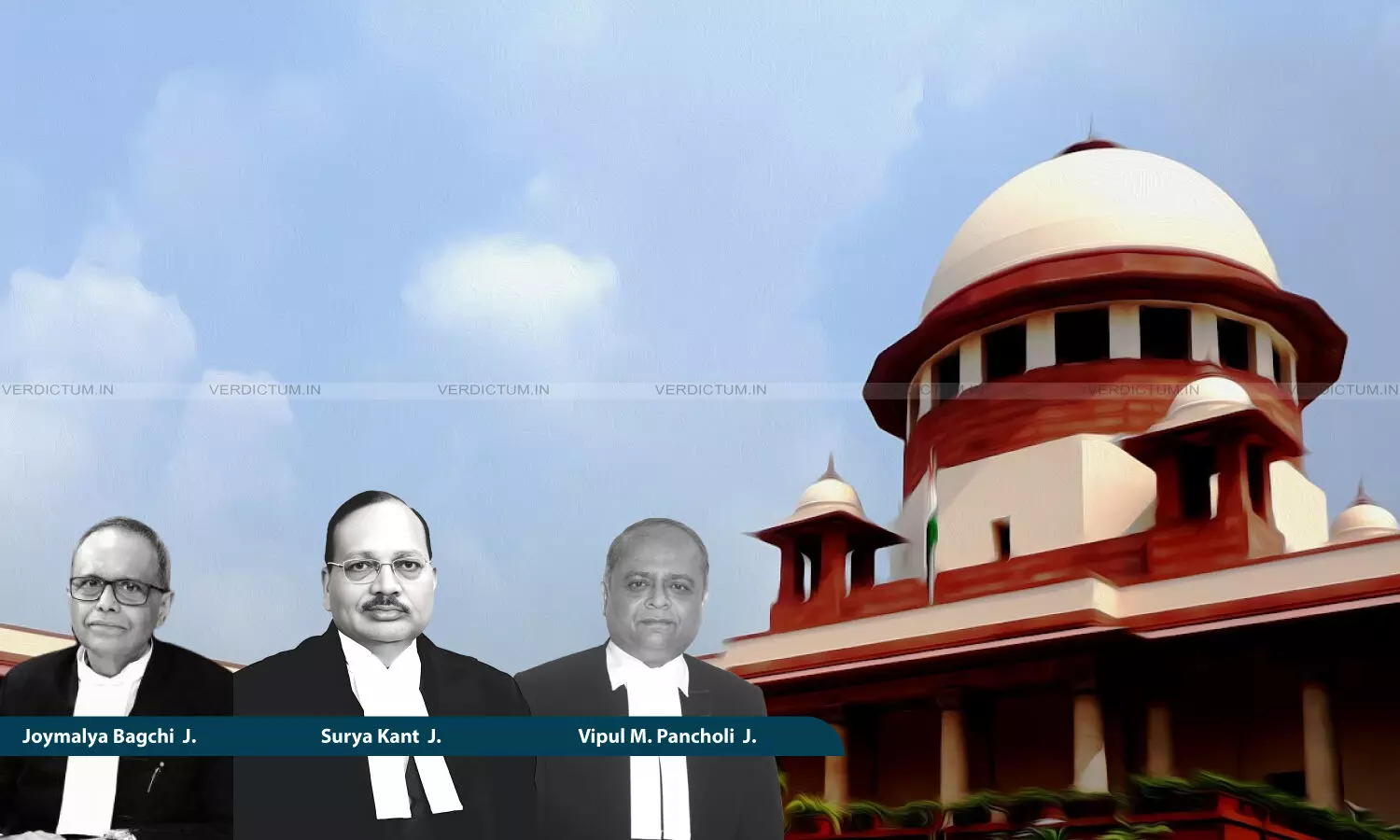
Supreme Court of India, Justice Surya Kant, Justice Joymalya Bagchi, Justice Vipul M. Panhcoli
Central Government Has Power U/S 3 Environment Protection Act To Formulate Bounded Amnesty Schemes For Non-Compliant Projects: Supreme Court
 |
|The Court affirmed that Section 3 of the 1986 Act grants the Union Government statutory power to issue notifications for time-bound amnesty schemes in supervening public interest.
The Supreme Court held that while the prior Environmental Clearance (EC) requirement under the 2006 EIA Notification remains mandatory, Section 3 of the Environment (Protection) Act, 1986, read with Section 21 of the General Clauses Act, 1897, equips the Central Government with ample statutory authority to carve out narrowly tailored, time-bound amnesty schemes.
It was observed that the decriminalization of regulatory contraventions under the 1986 Act via the Jan Vishwas Act, 2023, supplies a relaxed legislative space that reinforces the Executive’s power to amend the prior clearance regime.
The Court also held that the prior Environmental Clearance (EC) regime under the 2006 EIA Notification is mandatory and does not accommodate post-facto clearances without formal statutory amendments.
The Bench of Chief Justice Surya Kant, Justice Joymalya Bagchi and Justice Vipul M Pancholi held, "The decriminalisation of the regulatory contraventions under the 1986 Act through the Jan Vishwas Act, 2023 reinforces our conclusion that the Central Government has ample power under Section 3 to issue appropriate notifications formulating amnesty schemes with regard to such classes or categories of non-compliant projects whose sustainability is necessary to subserve larger public interest."
Brief Facts
The Environment Impact Assessment (EIA) Notification mandated prior Environmental Clearance (EC) before the commencement, construction, or expansion of specified project activities. Despite the statutory mandate, several project proponents commenced or completed projects, including public utility, industrial, and real estate projects, without obtaining prior EC.
The Ministry of Environment, Forest and Climate Change (MoEFCC) issued a Notification providing a limited, six-month amnesty window to appraise and regularise projects operating in violation of the prior EC requirement upon damage assessment, remediation, and payment of environmental compensation.
Subsequently, the Ministry issued an Office Memorandum (2021 OM) laying down a Standard Operating Procedure (SOP) to handle violation cases and grant post facto clearances on a continuous, open-ended basis.
Public interest litigations were preferred before the Supreme Court of India challenging the validity of the 2017 Notification and the 2021 OM as being ultra vires the Environment (Protection) Act, 1986, and destructive of the prior EC regime.
On April 1, 2026, the Court reserved its judgment in a review petition and a batch of writ petitions filed by the environmental organisation Vanashakti and other petitioners, which challenged the regulatory regime permitting post-facto environmental clearances.
The Supreme Court, with 2:1 majority, had recalled its Judgment dated May 16, 2025 passed in the case of Vanashakti v. Union of India (2025 INSC 718), in which it struck down the 2017 notification and the 2021 Office Memorandum (OM) issued by the Central Government, which provided for the grant of ex post facto Environmental Clearances (EC), declaring them as illegal.
Contentions of the Parties
The petitioners contended that the 1994 and 2006 EIA Notifications made prior EC a mandatory pre-requisite, giving statutory effect to the precautionary principle. It was submitted that ex post facto EC was alien to environmental jurisprudence and directly violated the fundamental right to a clean environment under Article 21 and equal treatment under Article 14 of the Constitution of India.
They asserted that the 2017 Notification was strictly a one-time measure with a closed window, and the 2021 OM created a parallel, open-ended regularisation regime that encouraged a "violate first, regularise later" approach. They further argued that an administrative order like the 2021 OM could not supersede, dilute, or amend delegated legislation like the EIA Notification.
The Respondents contended that neither the Environment (Protection) Act, 1986, nor the EIA Notification explicitly prohibited ex post facto clearance or provided the exact regulatory consequence for non-compliance. They submitted that the 2017 Notification and 2021 OM constituted a graded regulatory response aimed at bringing unappraised projects into the environmental discipline through the polluter pays principle, remediation, and civil penalties.
They argued that demolition and closure of completed or substantially progressed projects—including public infrastructure like hospitals, roads, and airports—would cause greater environmental degradation and economic harm than allowing them to operate subject to safeguards.
It was urged that the Central Government possessed broad powers under Section 3 of the Act to take all necessary measures to prevent, control, and abate environmental pollution.
Observations of the Court
Issue No. 1: The Prior Environment Clearance Regime and its Development
The Court observed that the requirement of prior Environmental Clearance under the 2006 Notification was a mandatory safeguard embodying the precautionary principle, and noted that while the statutory framework prescribed penal consequences for violations, it remained silent on the ultimate fate of offending projects.
Examining the regulatory responses, the Court held that while the 2017 Notification was a valid, strictly time-bound statutory amnesty measure designed to bring non-compliant projects under environmental discipline, the 2021 Office Memorandum impermissibly attempted to establish a standing, open-ended post facto regularization regime through mere executive instructions, which could not supplant or dilute delegated legislation.
Issue No. 2: Consequence of Breach and the Scope for Regularisation
The Court observed that the prior Environmental Clearance requirement was strictly mandatory and embodied the precautionary principle, holding that the statutory decriminalisation substituting prosecution with civil penalties did not dilute this imperative character. It held that an act committed without prior clearance was void ab initio, and that statutory penalties alone could not purge such illegalities, thereby implying that a breach could extend to closure, demolition, and restoration of status quo ante.
However, the Court further observed that the broad powers under Section 3 of the 1986 Act enabled the Central Government to formulate a strictly regulated violation-management mechanism. Such a mechanism could bring errant units into the regulatory fold not by excusing the breach, but by subjecting them to appraisal, penalties, remediation, and compensation, thereby avoiding automatic demolition in appropriate cases.
It was held, "The architecture of the 2006 Notification remains intact and its mandatory character unsullied. What the amended statutory scheme supplies is a relaxed legislative space. The altered scheme reinforces the view that Section 3 vests the delegatee Government with the power to amend the prior notification, so that, in appropriate cases, a breach need not invariably result in dismantling, demolition or closure, but may instead be addressed through penalty, remediation, restitution and future compliance."
Issue No 3: Ex post facto clearance in the decisions of the Court
The Court reviewed its precedent on ex post facto Environmental Clearances, noting that while earlier decisions like Lafarge Umiam Mining (P) Ltd. v. Union of India, (2011), Electrotherm (India) Ltd. v. Patel Vipulkumar Ramjibhai, (2016), and Electrosteel Steels Ltd. v. Union of India, (2023) allowed non-compliant projects to continue on grounds of proportionality and socio-economic impact, foundational decisions like Common Cause v. Union of India, (2017) and Alembic Pharmaceuticals Ltd. v. Rohit Prajapati, (2020) firmly established that prior clearance was mandatory and alien to retrospective approval. It observed that Electrosteel erred in stating that the 1986 Act did not prohibit ex post facto clearance, as that view ignored the mandatory nature of the unamended 2006 Notification.
Further, the Court held that Pahwa Plastics (P) Ltd. v. Dastak NGO, (2023) and D. Swamy v. Karnataka State Pollution Control Board, (2023) were not good law to the extent they upheld the 2021 Office Memorandum under the mistaken premise that it derived authority from the valid 2017 Notification.
Clarifying its jurisprudence, the Court concluded that while Common Cause (supra) and Alembic (supra) governed the unamended legal framework, any subsequent statutory amendment must be judged on the tests of reasonable classification and proportionality.
Issue No 4: The 2017 Notification
The Court upheld the 2017 Notification as a valid delegated measure enacted under Sections 3(1) and 3(2)(v) of the 1986 Act, holding that the Central Government possessed the statutory power under Section 21 of the General Clauses Act, 1897, to amend the prior clearance regime through proper rule-making procedure.
Examining the measure on the touchstones of Article 14 and proportionality, the Court observed that the Notification did not equate defaulters with law-abiding proponents, as it created a narrowly tailored, time-bound amnesty window closed at both ends that subjected non-compliant projects to centralized expert appraisal, uncapped damage assessment, and mandatory environmental compensation.
Further rejecting the challenge based on the international soft-law principle of non-regression, the Court held that the 2017 Notification successfully reconciled environmental enforcement with supervening public interest—such as protecting innocent homebuyers, workmen, and essential infrastructure—without destroying the foundational mandatory character of the prior Environmental Clearance regime.
Issue No. 5: The 2021 Office Memorandum
The Court quashed the 2021 Office Memorandum (OM) as impermissible executive instruction that attempted to supplant the mandatory 2006 Notification. It observed that while the 2006 regime mandated prospective screening, scoping, and public consultation, the 2021 OM operated retrospectively on built structures, converting an exceptional remedy into a perpetual "pollute-first-pay-later" mechanism.
The Court held that the OM failed the tests of reasonable classification and proportionality under Articles 14 and 21, as it lacked a cutoff date or supervening public interest threshold and placed deliberate defaulters on par with compliant proponents. However, to protect ongoing public utility projects and resolve regulatory uncertainty, the Court exercised its Article 142 powers to give the quashing prospective effect.
Directions and Final Conclusions of the Court
Reaffirming the validity of the 2017 Notification, the Court overruled Pahwa (supra), D. Swamy (supra), and Electrosteel (supra) to the extent they incorrectly validated the 2021 OM or suggested that the unamended legal framework permitted post facto clearances.
To ensure complete justice, the Court issued the following operative directions:
1. Environmental Clearances already granted under the 2017 Notification or 2021 OM were saved and declared valid, subject to individual merits challenges.
2. All pending applications under both instruments, including those previously dismissed or delisted due to interim stay orders, were directed to be processed to their logical conclusion.
3. A strict ban was imposed on entertaining any fresh applications under the 2017 Notification or 2021 OM.
4. The Central Government was restrained from granting future post facto clearances through administrative orders, permitting them only via valid statutory notifications.
Cause Title: Vanashakti v Union of India and other connected matters [Neutral Citation: 2026 INSC 761]
Appearances:
Petitioners: Senior Advocate Sanjay Upadhyay, Senior Advocate Madhavi Divan, Senior Advocate Gopal Sankaranarayanan, Senior Advocate A.R. Takkar, Senior Advocate Sanjay Parikh and Senior Advocate Shyam Divan
Respondents: Attorney General for India R. Venkataramani, Solicitor General Tushar Mehta, Additional Solicitor General Brijender Chahar, Additional Solicitor General Aishwarya Bhati, Senior Advocate Tapesh Kumar Singh, Senior Advocate Sanjay Upadhyay, Senior Advocate Devadatt Kamat, Senior Advocate Balbir Singh, Senior Advocate R. Verdrajan, Senior Advocate Vinay Navare, Senior Advocate Vipul Ganda and Senior Advocate Sanjay Parikh.