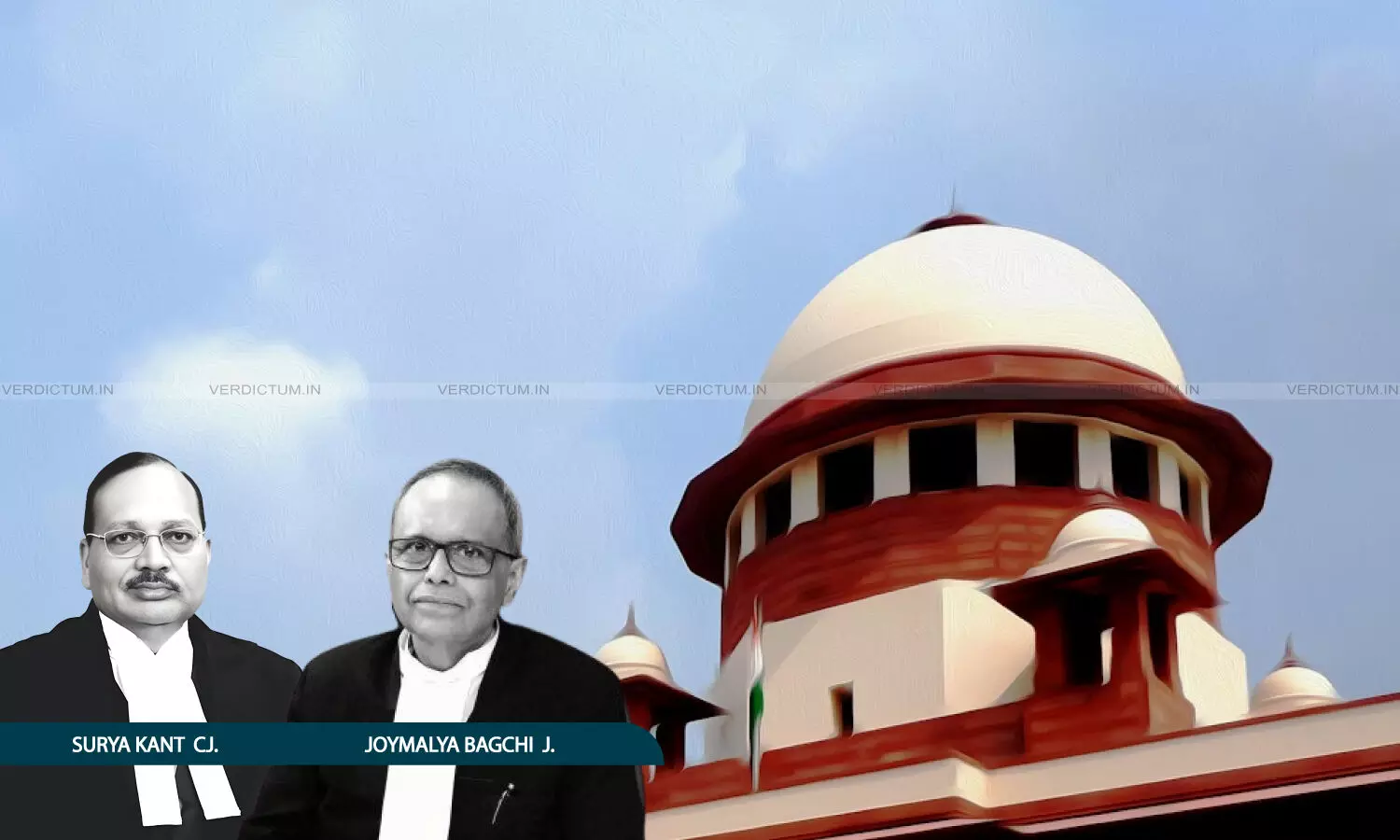
Breaking: Supreme Court Quashes 2021 Office Memorandum Allowing Post-Facto Environmental Clearance
 |
|The Court invalidated the perpetual 2021 Office Memorandum permitting ex-post-facto environmental clearances, while upholding the Central Government’s power to issue tailored amnesty schemes under Section 3 of the Environment (Protection) Act, 1986.
The Supreme Court held that the prior Environmental Clearance (EC) regime under the 2006 EIA Notification is mandatory and does not accommodate post-facto clearances without formal statutory amendments.
Addressing earlier precedents in Common Cause v. Union of India (2017) and Alembic Pharmaceuticals Ltd. v. Rohit Prajapati (2020), the Court clarified that observations ruling post-facto clearances alien to environmental jurisprudence arose from specific statutory contexts and do not bar the Central Government from issuing narrowly tailored amnesty notifications in supervening public interest.
The Court further observed that the decriminalisation of regulatory contraventions under the Jan Vishwas Act, 2023, reinforces the Union’s power under Section 3 of the Environment (Protection) Act, 1986, to formulate conditional amnesty schemes for non-compliant projects essential to public interest.
On April 1, 2026, the Court reserved its judgment in a review petition and a batch of writ petitions filed by the environmental organisation Vanashakti and other petitioners, which challenged the regulatory regime permitting post-facto environmental clearances.
The Supreme Court, with 2:1 majority, had recalled its Judgment dated May 16, 2025 passed in the case of Vanashakti v. Union of India (2025 INSC 718), in which it struck down the 2017 notification and the 2021 Office Memorandum (OM) issued by the Central Government, which provided for the grant of ex post facto Environmental Clearances (EC), declaring them as illegal.
The Bench of Chief Justice Surya Kant and Justice Joymalya Bagchi held, "The 2021 OM is an administrative order and envisages a perpetual regime for the grant of ECs to projects undertaken without prior EC. It substantially alters the nature of the enquiry as well as the criteria for the grant of EC under the 2006 Notification. The 2021 OM thereby supplants an earlier delegated legislation through an administrative instruction, which is impermissible in law. Even otherwise, being a perpetual amnesty scheme applicable to all permissible projects, it fails to lay down an intelligible differentia for the selection of projects for the grant of post-facto EC having a rational nexus to supervening public interest, and is thereby ultra vires the object of the 1986 Act, namely the preservation of the environment through a balanced approach between the precautionary principle and sustainable development."
The Court added, "Given these circumstances, the 2021 OM does not satisfy the test of proportionality and reasonableness and is violative of Articles 14 and 21 of the Constitution. Thus, the 2021 OM is quashed, but with prospective effect, keeping in mind the prevailing confusion with regard to the validity of the impugned instruments and supervening public interest. Consequently, we overrule Pahwa and Dhanjal to the extent they incorrectly treat the 2021 OM as valid and traceable to the 2017 Notification."
The Bench drew a sharp distinction between the time-bound 2017 Notification—which it upheld as valid delegated legislation under Section 3 of the 1986 Act read with Section 21 of the General Clauses Act—and the 2021 Office Memorandum (OM). The Court struck down the 2021 OM as ultra vires, observing that an administrative instruction cannot supplant delegated legislation or alter the core evaluation criteria of the 2006 Notification.
As a perpetual regime applicable to all projects without intelligible differentia, the 2021 OM failed the test of proportionality and violated Articles 14 and 21 of the Constitution by disregarding the precautionary principle and sustainable development. Overruling prior decisions in Power and Swami to the extent they validated the 2021 OM, the Court also noted that Electrosteel misconstrued the mandatory nature of prior EC requirements.
"All ECs granted under the 2017 Notification or the 2021 OM shall remain valid unless individually assailed in accordance with law. All applications for the grant of EC made under the impugned instruments—whether they remain pending or stand dismissed solely with reference to the stay order dated 02.01.2024 or the judgment in Vanashakti 1 —shall be dealt with in terms of the directions given in paragraph 79 of this judgment, where we have set out the criteria", the Court ruled.
To prevent widespread disruption, the Supreme Court quashed the 2021 OM with prospective effect, leaving all ECs already granted under the 2017 Notification or 2021 OM valid unless individually challenged on merits. Pending or previously dismissed applications under the impugned instruments are to be evaluated under specific criteria laid out in paragraph 79 of the judgment, while no fresh applications under these frameworks will be entertained.
The Central Government is permanently restrained from issuing administrative orders for ex-post-facto ECs without formal statutory notifications under Section 3.
The Court directed, "No further applications for the grant of ECs under the 2017 Notification and the 2021 OM shall be entertained. The Central Government is also restrained from passing administrative orders in the future to grant post-facto ECs to projects that commence in violation of the 2006 Notification, save and except by way of a valid notification in exercise of powers under Section 3 of the 1986 Act...It is clarified that our directions shall not constrain the powers of this Court to grant ex-post-facto EC under Article 142 to do complete justice in appropriate cases."
Finally, the Court affirmed that its ruling does not restrict its extraordinary powers under Article 142 of the Constitution to grant post-facto relief in exceptional cases to ensure complete justice.
During the course of the hearings, the Court examined whether judicial precedents could lay down an absolute or rigid prohibition against ex post-facto environmental clearances. The Bench further considered whether the legislature, or a delegated rulemaking authority, was entirely denuded of the power to formulate a regulatory framework providing for retrospective approvals.
The Court expressed significant concern regarding the practical consequences of permitting the regime under the impugned Office Memoranda for projects operating without prior environmental clearance.
The 2025 ruling initially barred the Centre from granting ex post facto (retrospective) clearances to projects that began operations without mandatory environmental approvals, but was later stayed to prevent the potential waste of thousands of crores in public investment.
On November 18 last year, a three-judge bench headed by the then Chief Justice of India (CJI) B R Gavai reversed by a majority of 2:1 its own verdict by an interim order and paved the way for retrospective environmental clearance to projects found violating environmental norms, saying that otherwise "thousands of crores of rupees would go in waste".
The Apex Court had held that numerous vital public projects constructed with nearly Rs 20,000 crore of the public exchequer money would be demolished if the May 16, 2025, verdict, which barred the Centre from granting retrospective environmental clearance to projects, was not recalled.
While dissenting over the recall of the judgment dated May 16, 2025, passed in the case of Vanashakti (Supra), Justice Ujjal Bhuyan remarked that the Supreme Court should not backtrack on the sound environmental jurisprudence.
Cause Title: Vanashakti v. Union of India and other connected matters [W.P.(C) No. 1394/2023]
Click here to read/download the Judgment
(This is a pronouncement story; the judgment was appended later)