Non-Issuance Of Integrity Certificate Does Not Vitiate Selection Committee Assessment Under IPS Regulations 1955: Telangana High Court
The Court held that the Selection Committee’s assessment is based on an independent evaluation of service records, and the absence of an integrity certificate affects only the nature of inclusion in the select list, not the grading itself.
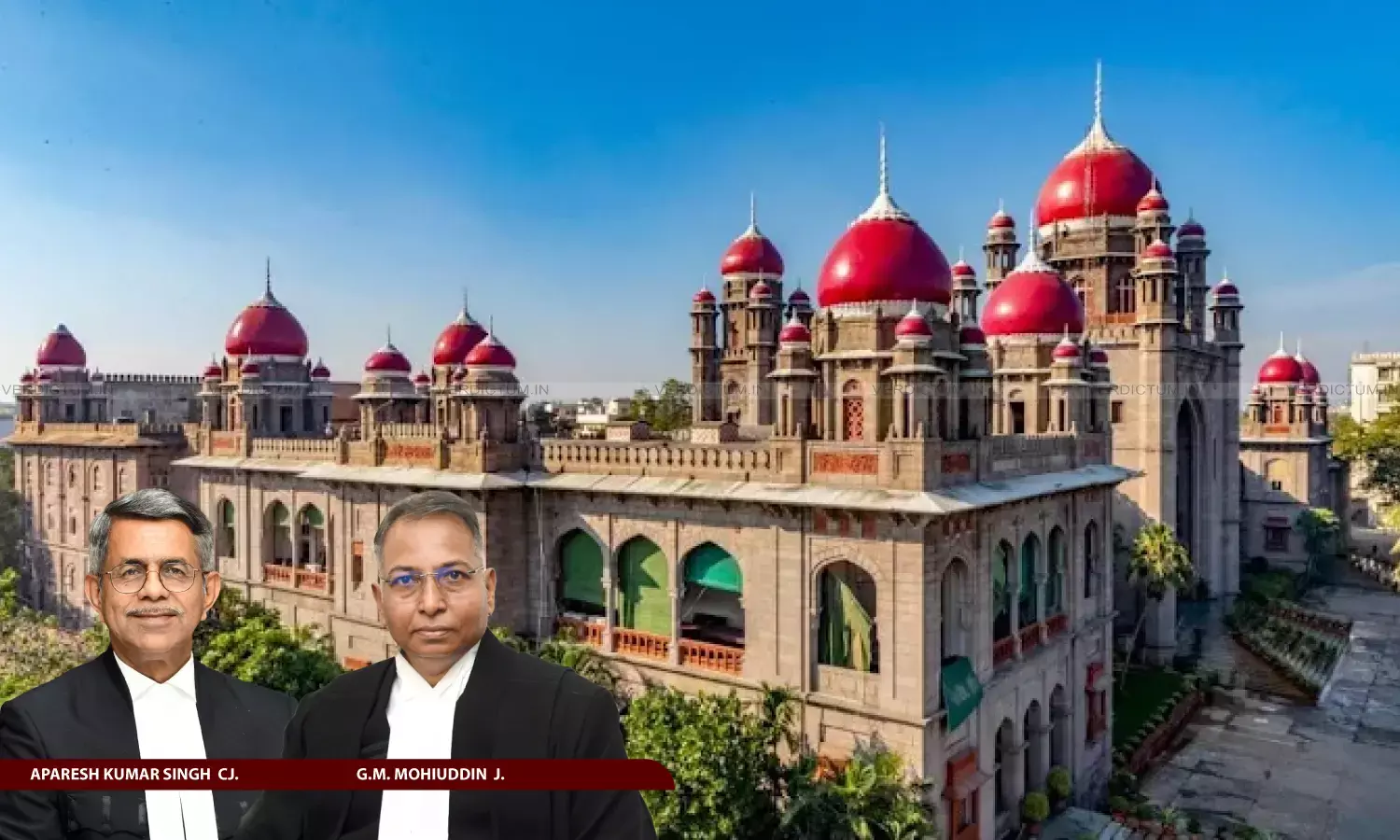
The Telangana High Court has held that non-issuance of an integrity certificate does not vitiate the assessment made by a Selection Committee under the Indian Police Service (Appointment by Promotion) Regulations, 1955, as the grading is based on an independent evaluation of service records and not influenced by such certification.
The Court was hearing a writ petition challenging the order of the Central Administrative Tribunal, which had upheld the petitioner’s non-inclusion in the select list for promotion to the Indian Police Service for certain panel years, despite finding procedural lapses in withholding his integrity certificate.
A Division Bench of Chief Justice Aparesh Kumar Singh and Justice G.M. Mohiuddin observed, “The Selection Committee comprised senior officers from different authorities, and there is nothing on record to demonstrate that the assessment was influenced by the withholding of the certificate, which, in terms of the 1955 Regulations, has no bearing on the grading of service records”.
Although the withholding of the integrity certificate may constitute a procedural lapse, it cannot be said that such a lapse, by itself, vitiated the assessment made by the Selection Committee. The grading assigned to the petitioner was the outcome of the Committee’s evaluation of his service records and not a consequence of the non-issuance of the integrity certificate”, the Bench added.
Senior Advocate T. Koteswara Rao appeared for the petitioner, while Additional Solicitor General B. Narasimha Sharma appeared for the respondents.
Background
The petitioner, a State Police Service officer, became eligible for consideration for promotion to the Indian Police Service for the panel years 2009-A and 2010 under the 1955 Regulations.
During the selection process, the State authorities withheld his integrity certificate on account of certain allegations, which were subsequently enquired into and culminated in a warning memorandum.
The Selection Committee nevertheless considered his case and graded him as “Good” based on his service records, but he was not included in the select list due to the availability of officers with higher gradings, such as “Very Good.”
Aggrieved, the petitioner approached the Tribunal, which noted procedural lapses in withholding the integrity certificate but declined to interfere with the selection process. The present writ petition challenged that decision.
Court’s Observation
The Court undertook a detailed examination of the scheme of the 1955 Regulations governing promotion to the Indian Police Service and the role of the Selection Committee in assessing eligible officers.
It was observed that the Regulations draw a clear distinction between the assessment of officers and their inclusion in the select list. The Selection Committee is required to classify officers as “Outstanding”, “Very Good”, “Good” or “Unfit” based on an overall relative assessment of their service records, particularly Annual Confidential Reports.
In this context, the Court noted, “the assessment of an officer as ‘Outstanding’, ‘Very Good’, or ‘Good’ is required to be made by the Selection Committee on the basis of an overall relative evaluation of the ACRs… the integrity certificate… does not preclude the Committee from assessing the officer.”
The Court further held that withholding of an integrity certificate affects only whether the inclusion in the select list would be provisional or unconditional, and does not influence the grading itself.
The Court analysed the petitioner’s service record and noted that the Selection Committee had before it the relevant ACRs and had undertaken a comparative evaluation of all eligible officers within the zone of consideration, ultimately grading the petitioner as “Good”.
Rejecting the contention that the absence of the integrity certificate influenced the grading, the Court held that there was no material on record to establish such influence and that the Selection Committee, comprising multiple senior officers from different authorities, acted independently.
On the allegation of bias arising from the participation of the Director General of Police in the Selection Committee, the Court examined the doctrine of bias as laid down in A.K. Kraipak v. Union of India (1969) and Ranjit Thakur v. Union of India (1987), and held that no real likelihood of bias was established.
It was observed that the DGP’s role in recommending withholding of the integrity certificate was administrative, and his participation in a multi-member Selection Committee assessing ACRs did not give rise to a reasonable apprehension of bias.
The Court also addressed the petitioner’s reliance on his subsequent selection in a later panel year, holding that each Selection Committee functions independently and that comparative grading across different years cannot invalidate an earlier assessment.
Further, the Court upheld the Tribunal’s finding that no substantive material was placed on record to establish discrimination or that the petitioner was more meritorious than selected candidates.
It also held that the writ petition suffered from non-joinder of necessary parties, as several selected candidates were not impleaded, and that there was no violation of principles of natural justice in relation to documents produced in sealed cover.
Conclusion
The Court held that the procedural lapse in withholding the integrity certificate did not vitiate the assessment made by the Selection Committee, which was based on an independent and comparative evaluation of service records.
Accordingly, the Court dismissed the writ petition and affirmed the order of the Central Administrative Tribunal upholding the selection process.
Cause Title: L.S. Chowhan v. Union of India & Ors. (Neutral Citation: 2026:TSHC:3744-DB)
Appearances
Petitioner: Senior Advocate T. Koteswara Rao
Respondents: Additional Solicitor General B. Narasimha Sharma; Deputy Solicitor General N. Bhujanga Rao; Advocate Ajay Kumar (for UPSC); Government Pleaders for the State of Andhra Pradesh and Services (Home)