

Administrator Cannot Assume RBI’s Regulatory Role & Write Down AT-1 Bonds After Reconstruction Scheme Omitted Write-Down Clause: Supreme Court In YES Bank Case
The Bench noted that “Before Reconstitution” In Clause 2.15 Of Basel III Master Circular means before the scheme takes effect; general savings clause cannot confer a power not specifically granted.

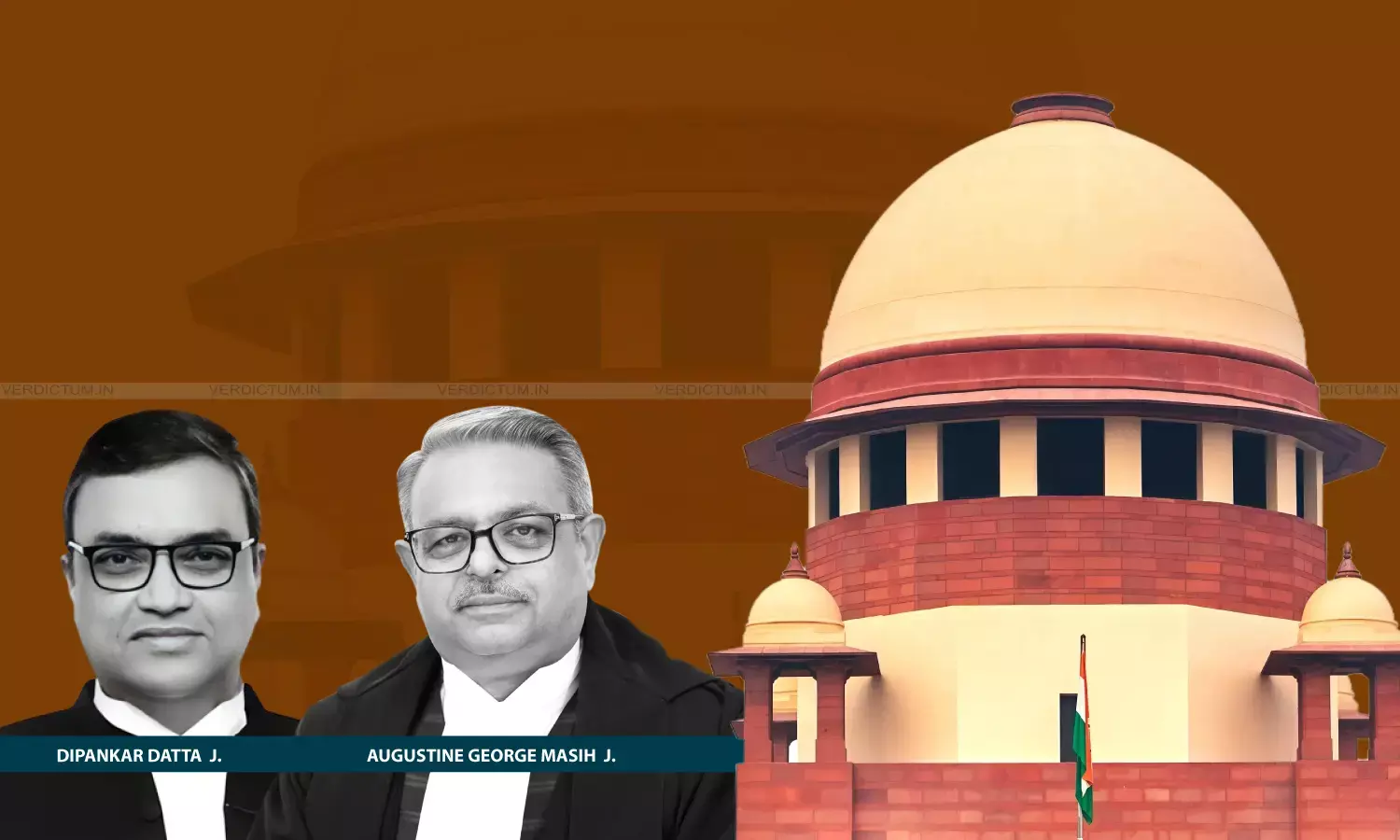
Justice Dipankar Datta, Justice Augustine George Masih, Supreme Court
The Supreme Court has held that an Administrator appointed under Section 36ACA of the Banking Regulation Act, 1949 cannot assume the regulatory role of the Reserve Bank of India and write down Additional Tier 1 bonds. The Court observed that the Administrator must act squarely within the four corners of the powers conferred on him, and that any act beyond them is illegal and void. It upheld the Bombay High Court’s decision setting aside the write-down of YES BANK’s AT-1 Bonds.
The Court clarified that the word “before” in Clause 2.15 of Annex 16 of the RBI Master Circular can only mean before the Reconstruction Scheme takes effect. It held that a general savings provision does not, by itself, confer the specific authority to write down the Bonds, since a power not specifically conferred cannot be implicitly vested through an omnibus clause.
A Bench of Justice Dipankar Datta and Justice Augustine George Masih observed, “…as per the Information Memorandum read with the Master Circular, there were 2 triggers for the bonds to be written down/written off. The first was for YES BANK to exercise; which it admittedly did not. The second was for the RBI to exercise which, not only did it express its intention not to—by eliminating the clause providing for writing down—but chose not to exercise it at all. The Administrator could not have assumed the regulatory role of the RBI and exercise a power which it did not have at all”.
“…an administrator appointed under the BR Act has to act squarely within the four corners of the powers conferred upon him under the statute. He acts as a substitute for the Board of Directors, to run the company in an efficient manner. Any act performed by the administrator beyond the powers clothed upon him would be wholly illegal and void”, it noted.
Tushar Mehta, Solicitor General, Senior Advocates Shyam Divan, Balbir Singh appeared for the appellants and Senior Advocates C.A. Sundaram, Dr. Abhishek Manu Singhvi and Neeraj Kishan Kaul appeared for the respondents.
YES BANK issued Basel III compliant AT-1 Bonds of Rs. 3,000 crore on December 23, 2016 and Rs. 5,415 crore on October 18, 2017. A moratorium was imposed on March 05, 2020 and an Administrator was appointed.
The Draft Scheme, published on March 06, 2020, provided for a full write-down of the Bonds. The final Reconstruction Scheme, notified on March 13, 2020, omitted that clause. On March 14, 2020, the Administrator wrote down the Bonds.
The challenge was allowed by the Bombay High Court by judgment dated January 20, 2023, which set aside the write-down. YES BANK, the RBI and the Union of India appealed.
The Court held that validity of an administrative action must be tested as on the date it was taken, so later developments were irrelevant. It found that the Central Government consciously deleted the write-down clause after considering objections, and the Administrator acted under a mistaken belief.
The Information Memorandum provided two triggers: the Pre-Specified Trigger, for the Bank to exercise, which it did not, and the Point of Non-Viability, for the RBI to exercise, which it chose not to. It rejected the argument that reconstruction is a continuing process, noting that the clause would otherwise have read “before reconstitution is complete”. It also observed that mere necessity cannot circumvent the manner of write-down prescribed by the Master Circular.
The appeals were dismissed and interim orders vacated. Payment of annual coupon shall remain unaffected, in terms of the Information Memoranda. Parties bear their own costs, and the observations will not influence pending proceedings.
Cause Title: YES Bank Limited & Anr. v. Axis Trustee Services Limited & Ors. (Neutral Citation: 2026 INSC 1132)
Appearances:
Appellant: Shyam Divan, Balbir Singh, Senior Advocates, Tushar Mehta, Solicitor General.
Respondents: C.A. Sundaram, Dr. Abhishek Manu Singhvi and Neeraj Kishan Kaul, Senior Advocates, and party-in-person L.V. Srinivasan.