

Quashing U/S. 482 CrPC Is Not Acquittal; Double Jeopardy Doctrine Will Not Bar Later Summoning U/S 319 CrPC: Supreme Court
The Bench quashed the proceedings against four in-laws & clarified that trial court may still summon them if cogent evidence emerges during husband’s trial.

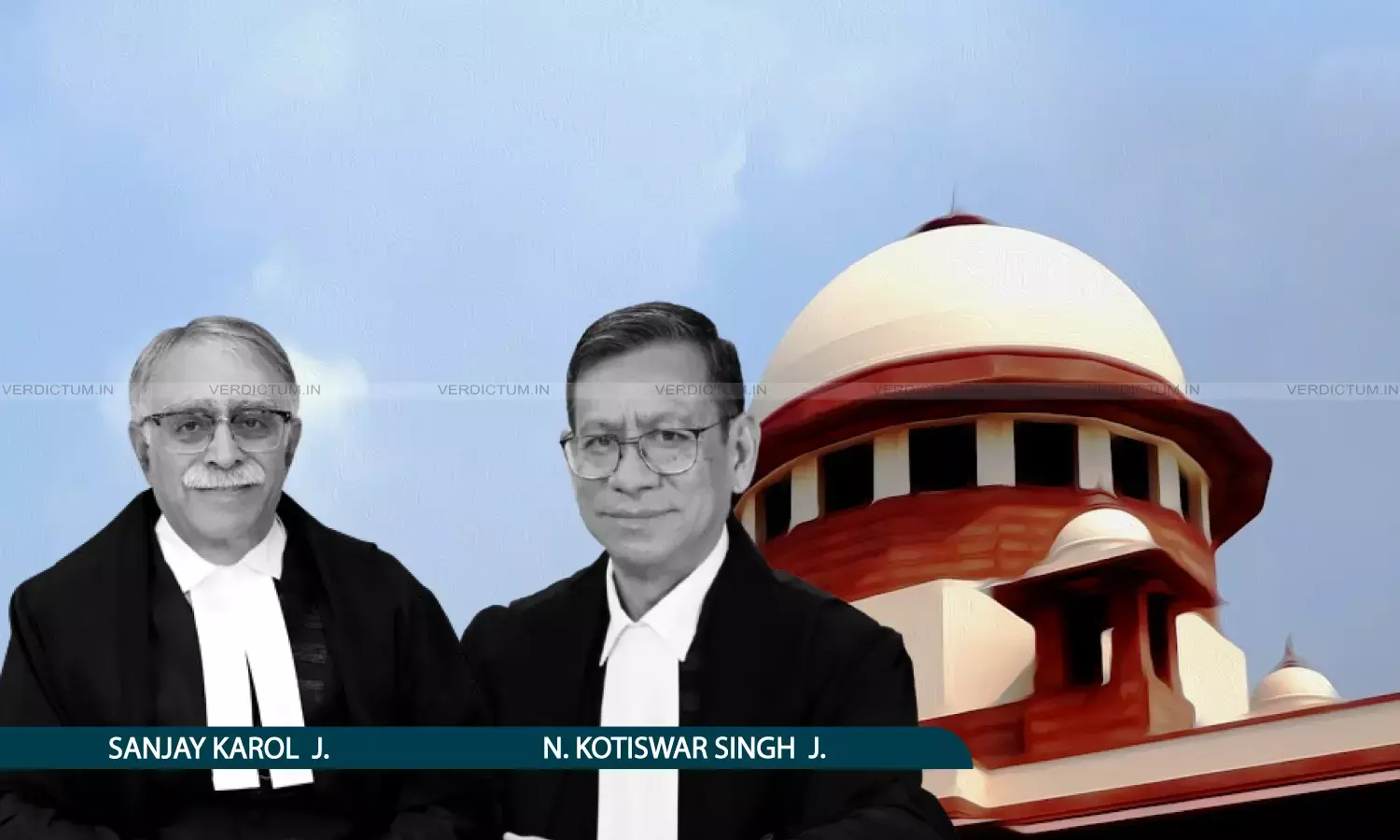
Justice Sanjay Karol, Justice N. Kotiswar Singh, Supreme Court
The Supreme Court has held that quashing criminal proceedings against a spouse’s relatives under Section 482 CrPC on the ground of omnibus and unspecific allegations does not amount to an acquittal on merits, and therefore does not attract the constitutional or statutory bar of double jeopardy under Article 20(2) of the Constitution of India or Section 300 CrPC.
Quashing FIR and domestic violence proceedings against four members of the husband’s family, the Court held that broad allegations that relatives supported the husband, failed to intervene, or asked the complainant to adjust, without specific overt acts or clear factual particulars, cannot justify continuation of criminal prosecution in matrimonial disputes.
At the same time, the Bench clarified that such quashing is confined to the allegations as they presently stand and does not permanently exonerate the relatives. If cogent evidence emerges during trial against the husband disclosing their active involvement, the trial court may invoke Section 319 CrPC (now Section 358 BNSS) to summon them, and no plea of double jeopardy would stand in the way.
Justice Sanjay Karol and Justice Nongmeikapam Kotiswar Singh observed, “…An order under Section 482 CrPC quashing proceedings unfastening any criminal liability operates on an entirely different plane from an order of acquittal or conviction rendered after a full trial on merits. The protection against ‘double jeopardy’ is activated only upon a verdict reached after trial, after the recording of evidence, appreciation of facts on merits, and a judicial determination of guilt or innocence. Where, as in the instant case, the proceedings are quashed at the threshold without any such trial having taken place, the constitutional and statutory bar against second prosecution is simply not engaged”.
“…Consequently, we observe that if, during the course of the ongoing trial against the remaining accused, cogent evidence emerges implicating the present appellants, the trial court shall be fully competent to exercise its power under Section 319 CrPC to summon them and proceed against them, and no constitutional or statutory bar of double jeopardy shall stand in the way of such proceedings. The protection of Article 20(2) and Section 300 CrPC will remain inapplicable unless and until the appellants are subjected to a complete trial culminating in a verdict of conviction or acquittal by a court of competent jurisdiction”, it further observed.
Advocate Nipun Saxena appeared for the appellant and Advocate Sankalp Sharma appeared for the respondent.
The Bench was dealing with appeals filed by the husband’s sister, mother, brother and sister-in-law challenging the refusal of the Madhya Pradesh High Court to quash an FIR under Sections 498A/34 IPC and Sections 3 and 4 of the Dowry Prohibition Act, along with proceedings under Section 12 of the Protection of Women from Domestic Violence Act, 2005.
The complainant had alleged persistent cruelty and harassment in her matrimonial home. The Court noted, however, that the detailed accusations, including physical assault, emotional neglect, surveillance through hidden cameras, restriction on movement, refusal to consummate the marriage and denial of companionship, were specifically directed against the husband.
In contrast, allegations against the present appellants were broadly worded and collective, lacking particulars of date, time, specific demand or overt conduct independently attributable to each accused.
The Bench observed that criminal law carries serious civil and personal consequences and cannot be permitted to become an instrument for venting personal grievances or drawing the entire family into litigation absent clear and sustainable allegations. At the same time, it acknowledged the social reality of genuine domestic violence and clarified that relatives can unquestionably be prosecuted where material discloses specific acts of cruelty, harassment or active participation.
“…it is hereby clarified that the quashing of the criminal proceedings against the present appellants under Section 482 CrPC shall not preclude the trial court, from exercising its jurisdiction under Section 319 CrPC to summon and proceed against them in accordance with law, in the event evidence adduced in the course of the trial of the remaining accused reveals material indicating the involvement of the present appellants in the alleged offences. The doors of justice shall remain open to the complainant insofar as the present appellants are concerned, if cogent evidence surfaces during trial establishing their active participation in acts constituting the alleged offences. The quashing of the proceedings at this stage operates only in respect of the allegations as they presently stand and does not foreclose the future operation of the law if evidence to the contrary emerges before the trial court. In this manner, the protective intent of the legislature underlying the relevant penal provisions is kept alive, at the same time ensuring that the present appellants are not subjected to the rigours of criminal proceedings in the absence of specific and legally sustainable material as of this date”, the Bench noted.
Addressing a consequential issue, the Court further held that quashing proceedings under Section 482 CrPC does not attract the constitutional bar against double jeopardy under Article 20(2) of the Constitution of India, since the appellants had neither been tried nor acquitted on merits.
“…Therefore, it can be observed that the appellants have not been “prosecuted and punished” within the meaning of Article 20(2) of the Constitution, nor have they been “tried” and “convicted or acquitted” within the meaning of Section 300(1) CrPC. The essential ingredients of the ‘double jeopardy’ principle are conspicuously absent in the present case…”, the Bench further observed.
Allowing the appeals, the Court quashed the FIR and domestic violence complaint qua the four appellants, while directing that proceedings against the husband shall continue uninfluenced by its observations.
Cause Title: X & Ors. v. State of Madhya Pradesh & Anr. (Neutral Citation: 2026 INSC 533)
Appearances:
Appellant: Nipun Saxena, Vidhi Pankaj Thaker, AOR, Prastut Mahesh Dalvi, Aadya Pandey, Adv. Ms. Deepali Dabas, B. D. Kundan, B.d. Kundan, Dev Nagar, Advocates.
Respondent: Sankalp Sharma, Nishant Verma, AOR, Amitabh Ranjan, Samiksha Sharma, Yashraj Singh Bundela, AOR, Arpit Garg, Advocates.