

General Obligation To Maintain Child Cannot Be Invoked In Execution Proceedings To Rewrite Discharged Consent Decree: Supreme Court
The Apex Court held that where a covenant in a matrimonial settlement has stood satisfied, execution proceedings cannot be used to revive the discharged term or substitute it with a fresh maintenance arrangement.
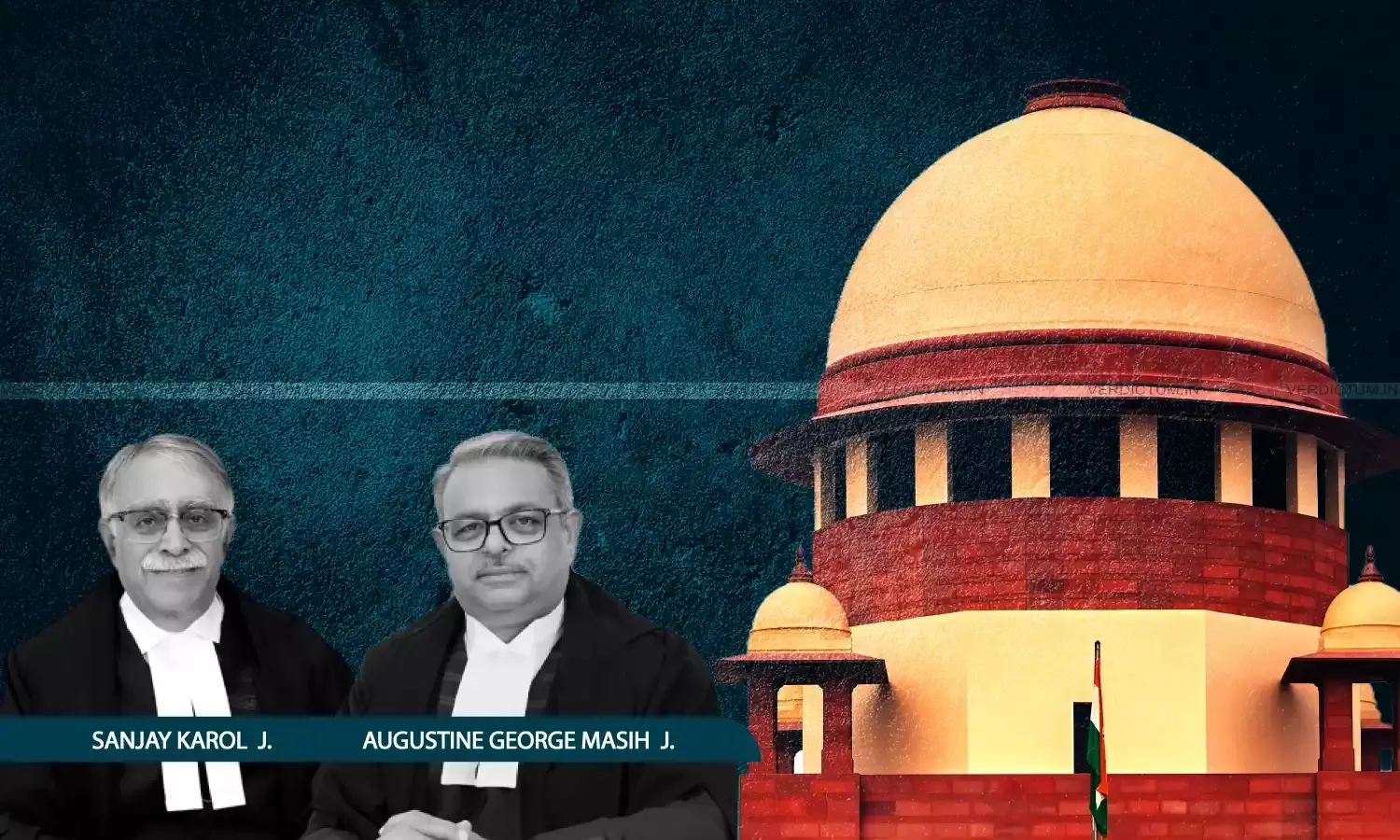
The Supreme Court has held that a general obligation of a father to maintain a dependent child cannot be invoked in execution proceedings to rewrite the terms of a concluded and acted-upon consent decree, once the specific covenant sought to be enforced has stood satisfied on its true construction.
The Court was hearing an appeal by a wife challenging concurrent orders of the Family Court and the Karnataka High Court, which had dismissed her execution petition seeking enforcement of a settlement clause requiring the husband to pay 20% of his annual income towards the son’s education, maintenance and other expenses.
A Bench of Justice Sanjay Karol and Justice Augustine George Masih dismissed the appeal, observing: “Where, on its true construction, the said covenant stands satisfied, a general obligation to maintain cannot be invoked in execution to revive a discharged term or to substitute therefor a fresh and larger provision. The general principle, whatever be its content, cannot be made a vehicle for rewriting the terms of a settlement which the parties themselves arrived at and acted upon.”
Senior Advocate Shoeb Alam appeared for the petitioner, while Advocate Shiraz Patodia appeared for the respondent.
Background
The dispute arose from a mutual consent divorce settlement. Under the settlement, the husband agreed to pay ₹2.20 crore towards the maintenance of the minor son. The settlement also contained an income-linked clause requiring payment of 20% of the husband’s annual income for the son’s education, maintenance and other expenses.
The wife later filed an execution petition seeking enforcement of the income-linked clause. The husband opposed it, contending that the clause was only an interim mechanism pending payment of the settlement amount, and that after payment of ₹1 crore, the settlement expressly provided that no further maintenance was payable.
The Family Court dismissed the execution petition. The High Court affirmed that view, holding that the settlement clauses had to be read together and that the income-linked obligation did not survive after payment under the settlement.
Court’s Observations
The Supreme Court first emphasised that the case arose from execution proceedings, not from an independent claim for maintenance. Therefore, the only question was whether the covenant sought to be enforced still survived under the consent decree.
The Court observed: “The Execution Petition was instituted for enforcement of a decree passed in terms of a settlement. It is well settled that the executing court cannot go behind the decree; it is to execute the decree as it stands and cannot embark upon a fresh adjudication of the rights of the parties. The enquiry, therefore, remains a limited one, namely, whether on a true construction of the settlement, the obligation stated to have been left unsatisfied subsists and remains enforceable, and not whether a larger or a different provision ought now to be made.”
Construing the settlement as a whole, the Court held that the income-linked payment clause was not an independent continuing obligation. It was an interim arrangement until the payment structure under the settlement reached the point of discharge.
The Court stated: “The language of Clause 10 is plain and admits of no ambiguity. Upon payment of the sum of Rs. 1,00,00,000/- out of the amount agreed under Clause 8, the Respondent-husband “need not pay any further amount towards maintenance”. The expression is comprehensive and unqualified. It is neither confined to maintenance of any particular description nor does it carve out the income-linked maintenance provided under Clause 9.”
The Bench added: “Clauses 8, 9 and 10, read together, disclose a single interlocking arrangement and not three independent obligations. Clause 8 fixes the total quantum of maintenance. Clause 9 provides an interim income-linked mechanism to secure maintenance of the son during the period over which the lump sum under Clause 8 was being paid in installments. Clause 10 identifies the point of discharge, namely, once Rs. 1,00,00,000/- stood paid, the interim mechanism came to an end and only the balance under Clause 8 remained payable.”
The Court also considered the parties’ conduct. It noted that the entire amount under the settlement had been paid, and no demand for the income-linked amount was raised for nearly five years.
The Court observed that this delay was not treated as a limitation bar, but as a circumstance showing how the parties themselves understood the settlement:
“The delay was noticed not as a ground of limitation but as a circumstance illuminating the common understanding of the parties with regard to the meaning and operation of the settlement. The question being one of construction and discharge and not of limitation, the period of twelve years available for execution is beside the point.”
The wife relied on Kirti Malhotra v. M.K. Malhotra (1995) and Jayvardhan Sinh Chapotkat v. Ajayveer Chapotkat (2014) to argue that a father’s obligation to maintain a dependent child survives. The Court held that those decisions did not assist her in execution of this specific consent decree.
The Bench held: “The decisions in Kirti Malhotra (supra) and Jayvardhan Sinh Chapotkat (supra), pertaining to the subsistence of the obligation of a father to maintain a dependent child, equally do not carry the case of the Appellant-wife any further in the present proceedings. The Execution Petition seeks enforcement of a specific covenant of a concluded consent decree.”
The Court refused to interfere with the concurrent findings of the Family Court and High Court under Article 136, holding that their construction of the settlement was natural, harmonious and supported by the conduct of the parties.
The Court observed: “It is well settled that this Court, in exercise of its discretionary jurisdiction under Article 136 of the Constitution of India, does not reappreciate the material or disturb concurrent findings merely because a different view is possible, and interference is called for only where the findings are shown to be perverse or founded upon a manifest error or misreading of the record.”
The wife’s alternative prayer for creation of a higher education corpus under Article 142 was also rejected.
The Court held: “Issuance of such a direction would, in substance, amount to recasting a settlement which stands performed and discharged, and undertaking, in execution, a fresh determination of the quantum of maintenance, a course not open in the present proceedings. The jurisdiction under Article 142 of the Constitution of India, wide as it is, cannot be employed to supplant the concluded and acted-upon terms of a consensual arrangement between the parties.”
However, the Court recorded that the husband had deposited ₹1 crore for the son’s higher education during the proceedings and had relinquished any right to seek its return. The amount was directed to remain available to the son and to be used solely for his educational expenses.
Conclusion
The Supreme Court held that the settlement clause requiring income-linked payments was an interim and transitional obligation that stood satisfied once payments were made under the relevant settlement clauses. It affirmed the concurrent findings of the Family Court and High Court, rejected the prayer to treat the clause as a continuing obligation, declined to create a fresh corpus under Article 142, and dismissed the appeal.
Cause Title: VR. v. CLB (Neutral Citation: 2026 INSC 731)
Appearances
Petitioner: Senior Advocate Shoeb Alam with Advocates Ahmad Ibrahim, Lzafeer Ahmad B. F., Ayesha Zaidi and Akif Abidi
Respondent: M/S. Dua Associates, AOR, with Advocates Shiraz Patodia, Divya Sharma, Ashish Singh, Juhi Chawla, Thapo Shreshta, Vimla Pinto, Adityaraj Patodia and Sugandh Shahi
