

Appeal U/S 374 CrPC Not Maintainable Against First-Time Conviction by Sessions Court Exercising Appellate Jurisdiction: Supreme Court
The Bench clarified that revisions arising from such first-time appellate convictions must be approached by High Courts with greater scrutiny than ordinary revisions.

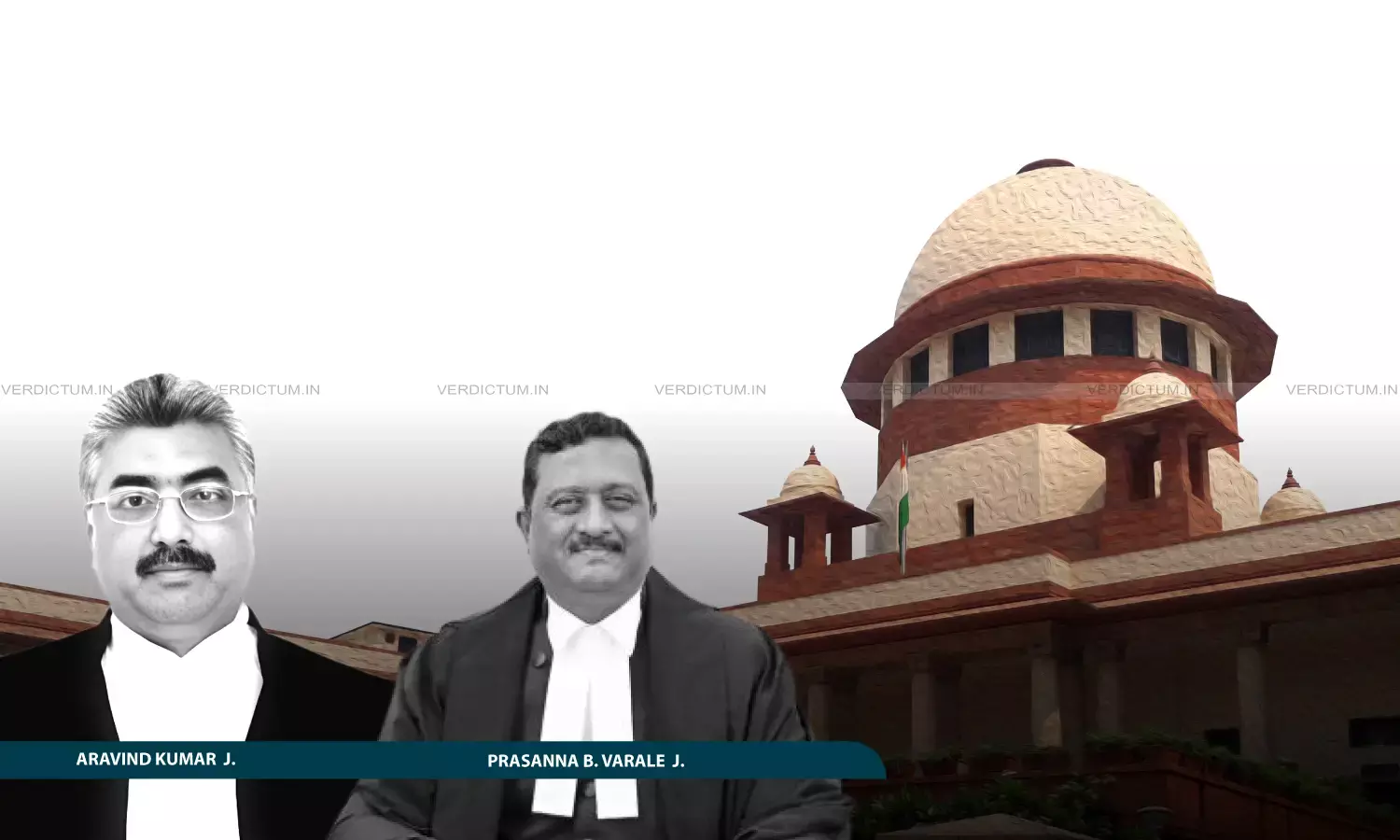
The Supreme Court has held that where a Sessions Court, while exercising appellate jurisdiction, reverses an order of acquittal and convicts an accused for the first time, such conviction cannot be further appealed under Section 374 CrPC (corresponding to Section 415 BNSS), and clarified that revisions arising from such first-time appellate convictions must be approached by High Courts with greater scrutiny than ordinary revisions arising from concurrent findings of guilt.
The Court further directed that in such exceptional cases, High Courts should adopt a more liberal approach while exercising revisional jurisdiction and, where warranted by the facts, invoke the power under Section 401(1) CrPC (Section 442 BNSS) to exercise the same powers available to an appellate court, thereby ensuring that an accused convicted for the first time by an appellate court is not left without meaningful judicial scrutiny, even though no independent right of appeal exists.
A Bench comprising Justice Aravind Kumar and Justice Prasanna B. Varale observed, “…an appeal under Section 374 of the Code of Criminal Procedure, 1973 (corresponding to Section 415 of the Bharatiya Nagarik Suraksha Sanhita, 2023) is not maintainable against a judgment of conviction recorded by a Sessions Court while exercising appellate jurisdiction and reversing an order of acquittal passed by a Trial Court. The only remedy which is available, is that of filing a revision under Section 397 r/w 401 (corresponding to Section 438 r/w 442 of the Bharatiya Nagarik Suraksha Sanhita, 2023)”.
“…The question is not whether a further appeal may be desirable, but whether the statute has created such a remedy. In the absence of a clear legislative provision conferring a right of appeal against a judgment of conviction rendered by the Sessions Court in an appeal against acquittal, the accused cannot claim such a remedy as a matter of right”, the Bench said.
Advocate A. Velan appeared for the appellant and Advocate Rajan Chourasia appeared for the respondent.
The Bench was hearing a criminal appeal arising from a Special Leave Petition, challenging a judgment of the Madhya Pradesh High Court at Gwalior which had dismissed the appellant's criminal appeal solely on the ground of maintainability.
The appellant, Vishnu Kumar Gupta, was acquitted by the Judicial Magistrate First Class, Bhind, of charges under Section 498-A and 323 read with Section 34 IPC and Sections 3 and 4 of the Dowry Prohibition Act, 1961, arising from his wife's complaint of matrimonial cruelty and dowry harassment. On appeal by the complainant under Section 419 BNSS (Section 378 CrPC), the Seventh Additional Sessions Judge, Bhind, reversed the acquittal and convicted the appellant, sentencing him to rigorous imprisonment.
When the appellant challenged this conviction before the High Court under Section 415 BNSS (Section 374 CrPC), the High Court dismissed the appeal as not maintainable, holding that no second appeal lies against a conviction recorded by a Sessions Court in appeal, and that the only remedy was revision. The High Court also relied on the appellant's failure to surrender under Rule 48 of the Madhya Pradesh High Court Rules, 2008.
Before the Supreme Court, the appellant contended that since his conviction was recorded for the first time by the Sessions Court, he was entitled to a first effective appeal, and that the expression "convicted on a trial" in Section 374 was wide enough to include a conviction arising from an appeal against acquittal, which itself constitutes continuation of the original trial. Reliance was placed on the Himachal Pradesh High Court's decision in Arun Sharma v. State of Himachal Pradesh, which had taken this view.
The Court, examining the meaning of "trial" across a long line of precedent and the statutory scheme of Chapters XVIII to XXI CrPC (governing trials) as distinct from Chapter XXIX (governing appeals), held that the expression "on a trial held by" in Section 374 refers only to the court that itself conducted the trial from framing of charges to judgment of conviction, and cannot be extended to a court exercising appellate jurisdiction merely because an appeal is a continuation of the original proceedings. The Court held that the doctrines of continuation of proceedings and merger determine legal consequences flowing from an appeal but do not alter the character of the jurisdiction being exercised. On this basis, the Court expressly overruled Arun Sharma, holding it does not lay down the correct law.
“The contention that a further appeal should nevertheless be held maintainable on the ground that the conviction has been recorded for the first time by the appellate court cannot be accepted. While such a circumstance may appear to warrant an additional appellate scrutiny as a matter of policy, it cannot furnish a legal basis for recognising a substantive right of appeal”, the Bench noted.
Accordingly, the Court answered the question of law in the negative, dismissed the appeal, but granted the appellant liberty to file a revision under Section 397 read with Section 401 CrPC (Section 438 read with 442 BNSS) against the Sessions Court's judgment of conviction. The Court declined to examine the constitutionality of Rule 48 of the Madhya Pradesh High Court Rules, noting the issue was independently pending before the High Court.
Cause Title: Vishnu Kumar Gupta v. State of Madhya Pradesh and Anr. (Neutral Citation: 2026 INSC 770)
Appearances:
Appellant: A. Velan, Advocate.
Respondent: Rajan Chourasia, Sankalp Sharma, Advocates.
Click here to read/download the Judgment