

Adverse Remarks Regarding Official Performance By Itself Can't Attract Offence Of Suicide Abetment U/S.306 Of IPC: Supreme Court Discharges IFS Officer
The Supreme Court was considering an appeal challenging the impugned judgment passed in a Criminal Revision Application by the Bombay High Court.

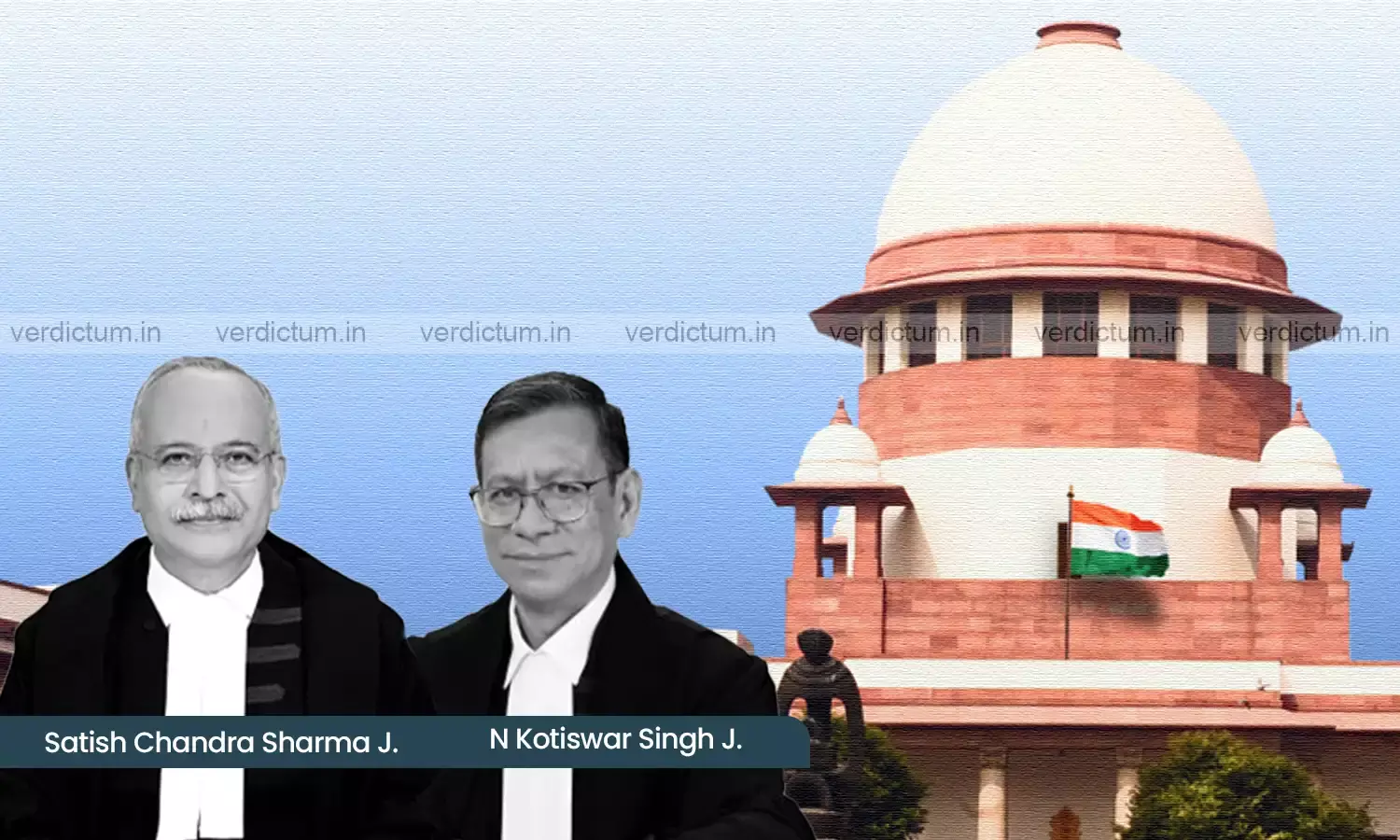
While discharging a Senior Indian Forest Service Officer who was booked in a suicide case of a Forest Range Officer, the Supreme Court has held that ordinary administrative directions, disciplinary supervision, adverse remarks regarding official performance, or even stern behaviour on the part of a superior officer, however unpleasant they may have been perceived by the deceased, cannot, in the absence of additional material demonstrating a conscious intention to drive a subordinate to commit suicide, be elevated to the status of abetment under Section 306 IPC.
The Apex Court was considering an appeal challenging the impugned judgment passed in a Criminal Revision Application by the Bombay High Court.
The Division Bench of Justice Satish Chandra Sharma and Justice Nongmeikapam Kotiswar Singh held, “Further allegations against the Appellant principally arise out of the discharge of his official functions as the superior officer of the deceased. It has been alleged that on 22/23.03.2021 the Appellant reprimanded the deceased for watering of a water hole and engagement of a JCB driver for official work. However, ordinary administrative directions, disciplinary supervision, adverse remarks regarding official performance, or even stern behaviour on the part of a superior officer, however unpleasant they may have been perceived by the deceased, cannot, in the absence of additional material demonstrating a conscious intention to drive a subordinate to commit suicide, be elevated to the status of abetment under Section 306 IPC.”
Advocate Varad Kilor represented the Appellant while Advocate Shrirang B. Varma represented the Respondent.
Factual Background
A Forest Range Officer had committed suicide in the year 2021, leaving behind three suicide notes. These suicide notes were addressed to the Additional Principal Chief Conservator of Forest, Amaravati, her mother and her husband. The deceased Forest Range Officer, who shot dead herself by the official weapon assigned to her, levelled allegations against the Appellant and stated that because of the Appellant, she was committing suicide. The record of the case further revealed that the First Information Report (FIR) was registered against the present Appellant and one Mr Reddy. FIR against Reddy was quashed by the High Court.
The Appellant had earlier approached the Bombay High Court for quashing the criminal proceedings and setting aside the charge-sheet filed for the offences punishable under Sections 306, 312, 504 and 506 of the Indian Penal Code (IPC). He restricted his claim to the extent of Section 312 IPC with the liberty to raise all his contentions at an appropriate stage before the High Court. The High Court quashed the FIR to the extent of Section 312 IPC. The Appellant’s application for discharge under Section 227 of the Code of Criminal Procedure (CrPC) was dismissed by the Additional Sessions Judge, Achalpur. The Appellant, being aggrieved by the order rejecting the discharge application, preferred a Criminal Revision Application, which was dismissed by the impugned order.
Reasoning
Referring to Sections 306 and 107 of the IPC, in order to explain the law relating to abatement of suicide, the Bench held that there must be direct or indirect instigation in proximity to the commission of suicide, along with a clear mens rea to abet the commission of suicide.
On a perusal of the suicide notes as well as the statements of the witnesses relied upon by the prosecution, the Bench stated that the allegations levelled against the Appellant essentially pertained to official reprimands and show cause notices issued in the course of discharge of duties, assignment of work relating to removal of encroachments and rehabilitation of villages, registration of an FIR under the Scheduled Castes and Scheduled Tribes (Prevention of Atrocities) Act against the deceased, allegedly in connivance with one Manisha Uike; and forcing the deceased to trek in the forest which caused her miscarriage.
The Bench held, “Even if the aforesaid allegations are accepted at their face value, they do not, in our considered opinion, disclose the essential ingredients of the offence punishable under Section 306 of the IPC. There is a complete absence of any proximate act of instigation immediately preceding the suicide that could be said to have driven the deceased to take the extreme step. All the incidents relied upon by the prosecution are remote in point of time.”
The Bench also found that the alleged miscarriage occurred in October 2020 and the charge founded thereon under Section 312 of the IPC already stood quashed by the High Court, whereas the suicide took place after over five months in 2021. It was also noticed that the allegations regarding removal of encroachments and the registration of the FIR under the Scheduled Castes and Scheduled Tribes (Prevention of Atrocities) Act pertained to March 2020, while the rehabilitation work concerning Village Malur had been undertaken over several months during the year 2020. “The material on record does not disclose any overt act of instigation, goading or intentional aid on the part of the Appellant immediately preceding the commission of suicide”, it added.
The Bench also held that the prosecution failed to prima facie establish that the Appellant had any intention to instigate, aid or abet the deceased to commit suicide. “The suicide notes undoubtedly reflect the anguish of the deceased, however, they do not disclose any act on the part of the Appellant from which the requisite mens rea can reasonably be inferred. There is also no material to suggest that the Appellant, by his words or conduct, intended to push the deceased into such a position that she was left with no reasonable alternative except to take her own life. No doubt, a young Range Forest Officer lost her life in an unfortunate incident. However, criminal liability under Section 306 IPC cannot rest upon the tragedy of the outcome alone; it must be founded upon the statutory ingredients of Section 306, which are absent in the present case”, it held.
Thus, allowing the appeal, the Bench set aside the impugned order and discharged the appellant
Cause Title: Vinod Shivakumar v. The State of Maharashtra (Neutral Citation: 2026 INSC 867)
Appearance
Appellant: Advocate Varad Kilor, AOR Anand Dilip Landge
Respondent: Advocates Shrirang B. Varma, Siddharth Dharmadhikari, AOR Aaditya Aniruddha Pande