

Externment Cannot Be Ordered Routinely Or On Mere Registration Of Multiple Cases: Supreme Court
The Bench noted that a District Magistrate has no power to review closed cases; an ex parte order striking at fundamental right under Article 19(1)(d) is void ab initio.

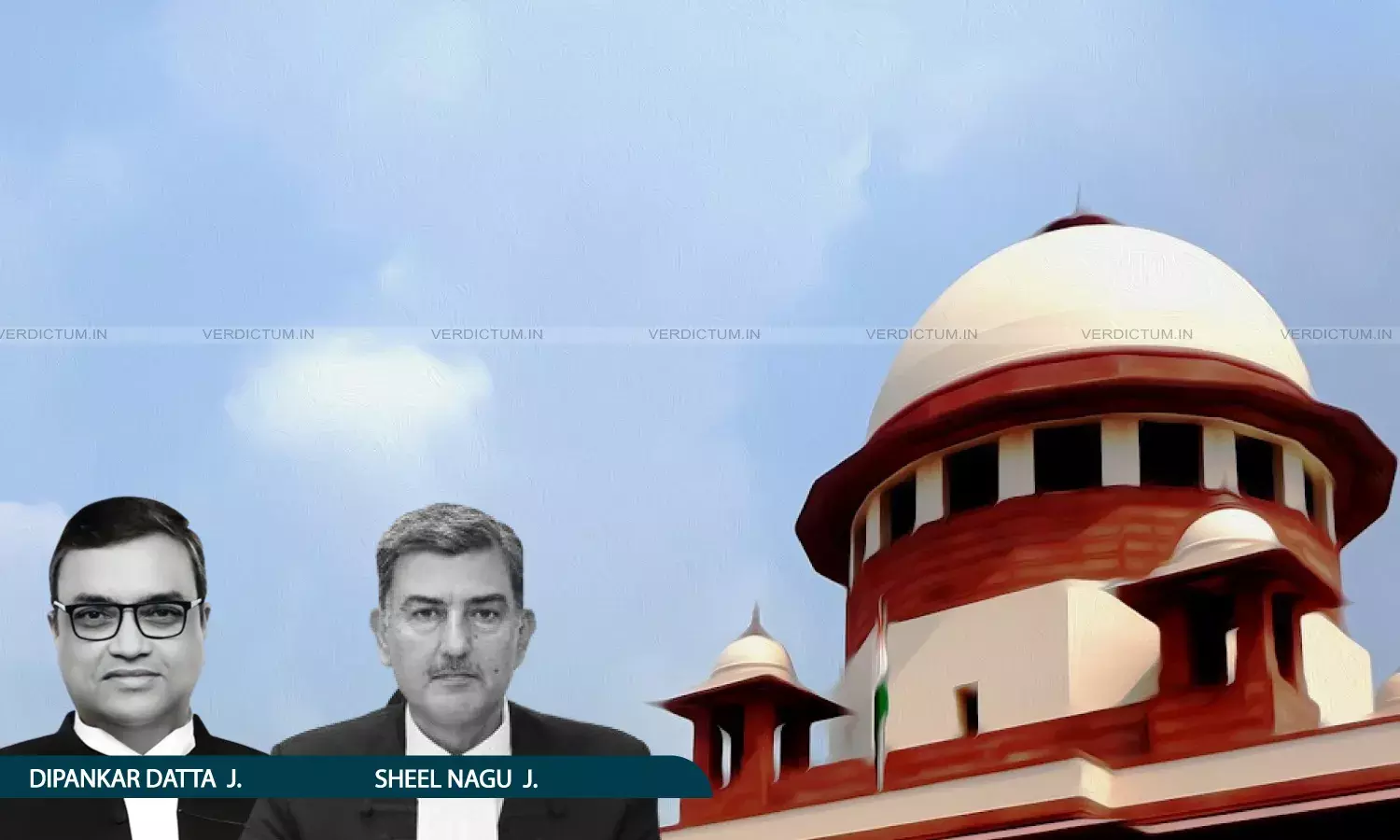
Justice Dipankar Datta, Justice Sheel Nagu, Supreme Court
The Supreme Court has held that the mere registration of multiple criminal cases against a person does not ipso facto justify an order of district banishment. Reaffirming that an order of externment directly impinges upon valuable fundamental freedoms guaranteed under Article 19(1)(d) of the Constitution of India, the Court held that such extraordinary measures cannot be passed as a matter of routine or on mere ipse dixit.
The Bench held that the Chhattisgarh High Court grossly erred in refusing to exercise its writ jurisdiction under Article 226 of the Constitution of India by turning away the petitioner to an alternative statutory appellate remedy under Section 9 of the Chhattisgarh Rajya Suraksha Adhiniyam, 1990, despite the externment order being passed without jurisdiction, without objective material, and in total breach of natural justice principles.
The Court observed that the District Magistrate possessed no statutory power of review to reopen an earlier closed externment proceeding based on a subsequent police report.
A Division Bench comprising Justice Dipankar Datta and Justice Sheel Nagu observed, “…An order of externment directly impinges upon valuable fundamental freedoms guaranteed to a citizen and, therefore, cannot be made as a matter of routine or on mere ipse dixit. Further, merely because multiple criminal cases have been registered against a person would not, ipso facto, be a ground for ordering externment. Before exercising such power, the District Magistrate is required to arrive at a bona fide and informed subjective satisfaction that the circumstances of the case warrant such an extreme measure and that externment is necessary to prevent the apprehended mischief. Although the authority is not expected to render a judgment in the manner expected of a court of law, the order must nonetheless disclose, at least in broad terms, the reasons which persuaded it to arrive at such satisfaction. The existence of objective material and a discernible nexus between such material and the conclusion reached are indispensable safeguards against arbitrary exercise of power”.
Advocate Pallav Mongia appeared for the appellant and Advocate Ankita Sharma appeared for the respondent.
The brief facts of the case indicate that an externment proceeding initiated against the appellant was officially closed by the District Magistrate, Raigarh, on October 6, 2025, after noting his acquittal in past criminal cases and letting him off with a warning. Following the registration of two subsequent FIRs, the police submitted a fresh report seeking reconsideration. Acting on this report while the appellant was lodged in judicial custody, the District Magistrate recalled the closure order and passed an ex parte externment order on November 4, 2025, banishing the appellant for one year.
The appellant challenged the ex parte externment order directly before the High Court of Chhattisgarh via a writ petition. The High Court dismissed the petition on January 22, 2026, maintaining a hands-off approach and holding that the appellant ought to exhaust the statutory appellate remedy provided under Section 9 of the Adhiniyam. The appellant subsequently filed a special leave petition before the Supreme Court.
The Supreme Court held that Section 8 of the Adhiniyam mandates prior notice and a reasonable opportunity of hearing as non-negotiable conditions precedent. The Court affirmed that administrative authorities enjoy no inherent power to review or reopen their earlier orders without express statutory empowerment. Additionally, the Bench held that the alleged offences did not fall within Section 5(b) of the Adhiniyam, nor did the order disclose objective material or reasons to sustain an order under Section 5(a).
"This happens to be one such case where the High Court grossly erred in not entertaining the writ petition of the appellant. Relegation of the appellant to the statutory remedy under Section 9 of the Adhiniyam is plainly demonstrative of an abject failure to exercise a jurisdiction vested in the High Court...Having held that the impugned externment order fails on both counts of non-adherence to the rule of a meaningful and effective hearing guaranteed by Section 8 of the Adhiniyam and the lack of jurisdiction of the District Magistrate to open a closed case, as if it were having the power of review and exercising it, we are surprised that in a case of such egregious violation of law the High Court chose to maintain a hands-off approach and relegated the appellant to the alternative statutory remedy under Section 9 thereof…”, the Bench noted.
“…We also hold that breach of the warning, if any, without anything more could not have clothed the third respondent with the power to reopen the closed case. Since a fresh report from the fourth respondent was received, the third respondent was statutorily obliged to repeat the procedure envisioned in Section 8 of the Adhiniyam. There being failure/omission/neglect in this behalf on the part of the third respondent, the impugned externment order cannot sustain law”, the Bench said.
In its operative directions, the Court allowed the appeal, set aside the judgment of the High Court, quashed the externment order dated November 4, 2025, and declared the appellant free to enter the districts from which he was externed.
Cause Title: Vijay Kumar Rajpoot alias Vijju v. State of Chhattisgarh & Ors. (Neutral Citation: 2026 INSC 926).
Appearances:
Appellant: Pallav Mongia, Advocate.
Respondents: Ankita Sharma, Advocate.