

Rectification Deed Cannot Substitute Subject Matter Of Prior Conveyance Without Original Transferor’s Participation: Supreme Court
The Supreme Court restored dismissal of a title suit, holding that a rectification deed cannot be used to replace the property conveyed under earlier sale deeds when the original transferor was not a party and the plaintiff failed to prove that both survey numbers referred to the same land.
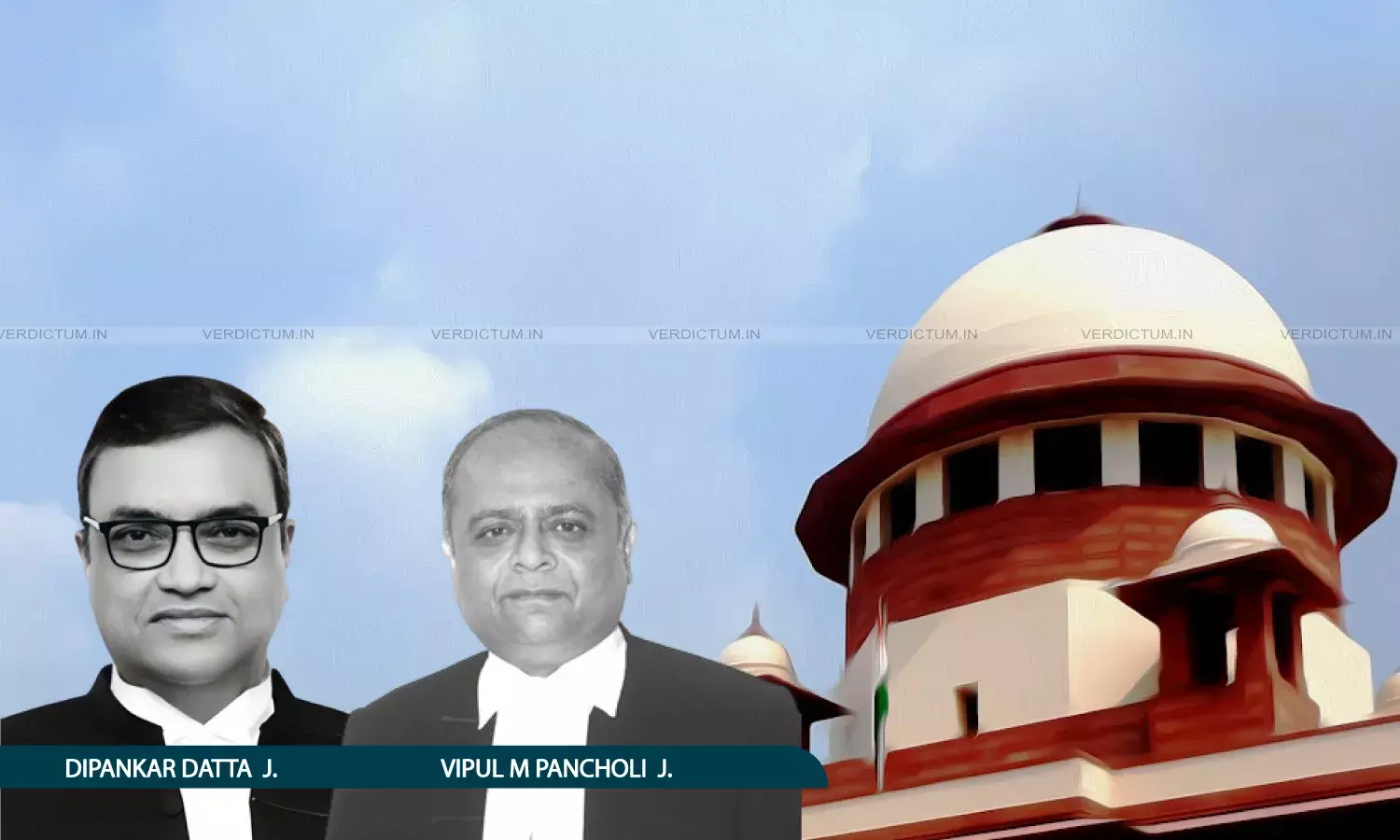
The Supreme Court has held that a rectification deed cannot, under the guise of correcting an error, substitute the very subject matter of an earlier conveyance without the participation of the original transferor, particularly where the plaintiff fails to plead and prove that the property originally conveyed and the property later claimed are the same.
The Court was hearing an appeal against a judgment of the Karnataka High Court, which had affirmed a first appellate decree declaring the plaintiff as the owner of the suit property. The Trial Court had dismissed the suit, holding that the plaintiff failed to establish ownership, possession, or identity between two different survey numbers.
A Bench of Justice Dipankar Datta and Justice Vipul M. Pancholi held: “A rectification deed cannot, in the guise of correcting an error, substitute the very subject matter of a prior conveyance without participation of the original transferor. What was sought to be achieved through the rectification deed was not correction of a clerical mistake simpliciter but substitution of one property having a specific survey number by another altogether distinct property. Such unilateral alteration could not divest the appellants of the rights flowing from the subsequent grant and partition.”
The Bench further observed: “If the very fulcrum of rectification is the common intention of the parties to the original transaction, the participation of the original executant assumes obvious importance. A transferee deriving title under an instrument cannot, together with his successor, lawfully alter the subject matter of a conveyance executed by another person. To hold otherwise would permit derivative holders of title to enlarge the estate conveyed by their predecessor without the predecessor's concurrence.”
Senior Advocate Kiran Suri appeared for the appellants, while Advocate M. Gireesh Kumar appeared for the respondents.
Background
The dispute arose from a chain of sale deeds executed in respect of one survey number. Years later, another survey number was re-granted to the original transferor. A rectification deed was then executed between a later transferor and the plaintiff, substituting the earlier survey number with the later one.
The plaintiff sought a declaration of title, possession, an injunction, and a declaration that a partition deed executed in favour of the appellants was not binding. The Trial Court dismissed the suit, finding that the plaintiff had not proved that both survey numbers represented the same property.
The First Appellate Court reversed the Trial Court by relying on a comparison of boundaries and decreed the suit. The High Court dismissed the second appeal and affirmed the first appellate decree.
Court’s Observations
The Court began by noting that all three sale deeds consistently described the property as one survey number, while the rectification deed sought to substitute it with another. The Court held that the plaintiff was required to plead that both survey numbers denoted the same property, but no such foundation had been laid.
The Court observed: “At the very outset, having regard to the chain of transactions in the present case, it is noticed that Sale Deed I executed by Thimmadasappa in favour of the defendant no.3, Sale Deed II executed by the defendant no.3 in favour of the defendant no.4 and Sale Deed III executed by the defendant no.4 in favour of the plaintiff, are consistent qua the description of the property conveyed as Sy. No.1/4. What was required to be pleaded by the plaintiff is that Sy. No. 1/4 and Sy. No.162 denoted the same property. Unfortunately, at the heart of the matter lies the lack of pleading by the plaintiff in the plaint to that effect, that is, Sy. No. 1/4 and Sy. No.162 are the same property.”
The Court further noted that the plaintiff’s own admission in cross-examination went against his case, since he admitted that the two survey numbers were distinct properties.
The Court faulted the first appellate court for proceeding on boundary comparison without pleadings or evidence that the boundaries had been interchanged or that the survey numbers referred to the same land.
Relying on Trojan & Co. Ltd. v. Nagappa Chettiar (1953) and Bachhaj Nahar v. Nilima Mandal (2008), the Court reiterated that relief cannot be granted on a case not pleaded.
The Court stated: “The first appellate court’s reasoning was premised upon assumptions not founded either on pleadings or on evidence. The court had concluded that the boundaries mentioned in the three sale deeds corresponded to the suit schedule property and, therefore, the survey number alone was erroneously mentioned. However, a conjunctive reading of the boundaries extracted in the record shows material variations. The court had, in fact, proceeded on the footing that there had been an interchange of northern and southern boundaries, although no amendment in this regard was effected in the plaint. A relief, which is premised on a case not pleaded, cannot be sustained in law.”
The Bench added that no survey records, village maps, sketches, commissioner’s report, expert evidence, or contemporaneous revenue documents had been produced to establish identity between the properties.
The Court held that the High Court erred in invoking Section 43 of the Transfer of Property Act, 1882, on its own, particularly when neither party had argued it and the factual foundation for its application had not been proved.
Distinguishing N. Venkateshappa v. Munemma (2016), the Court held: “In the present case, however, that foundational fact itself remains unproved. Plaintiff's title deed and the earlier sale deeds consistently describe the property as Sy.No.1/4, whereas the re-grant relates to Sy.No.162. Plaintiff neither pleaded nor proved that both survey numbers represented the same parcel of land; indeed, the evidence noticed above points otherwise. Once the identity of the suit schedule property itself is left in doubt, the legal consequences flowing from Section 43 of the ToP Act or from the law governing Inam re-grants do not arise for consideration at all. The High Court, by proceeding directly to apply those principles without first returning a clear finding on identity, in effect, placed the legal cart before the factual horse.”
The Court then examined Section 26 of the Specific Relief Act, 1963, and held that rectification is a limited equitable remedy meant to correct the expression of a concluded bargain, not to substitute one property for another.
The Court explained: “Does Section 26 of the Specific Relief Act, 196314 have any application here? The said provision embodies a limited equitable jurisdiction. The provision kicks into operation on the assumption that the parties to an instrument had arrived at a common intention which, by reason of fraud or mutual mistake, was inaccurately reflected in the document executed between them. Rectification, therefore, rectifies the expression of a concluded bargain; it does not substitute one bargain for another. The provision is intended to remove an error in recording the transaction and not to alter the essential subject matter of the transaction itself.”
Applying this principle, the Court held: “The said distinction assumes pronounced significance in light of the uniqueness writ large in the facts of the present case. Sale Deed I executed by Thimmadasappa conveyed Sy. No.1/4. Sale Deed II conveyed the very same property. Sale Deed III again described the property as Sy. No.1/4. The rectification deed executed in 1997, however, seeks to substitute Sy. No.162 in place of Sy. No.1/4. We repeat, this is not a case where an erroneous recital is corrected while preserving the identity of the property conveyed. It is a case where the identity of the property itself stands altered. Such an exercise traverses beyond the permissible confines of Section 26 of the SR Act.”
The Court also applied the principle that no person can convey a better title than he possesses. Since the original transferor had not conveyed the later survey number, the subsequent transferees could not acquire or pass title over it through rectification.
The Court observed: “The matter may also be examined from another perspective. The principle embodied in the maxim nemo dat quod non habet admits of no exception in the present case. No person can convey a better title than he himself possesses. If Thimmadasappa never conveyed Sy. No.162, the defendant no.3 acquired no title thereto. The defendant no.4 too could not, therefore, acquire any such title. It necessarily follows that the defendant no.4 could not convey Sy. No.162 to the plaintiff merely by executing a rectification deed. A derivative title cannot outvalue the title from which it is derived.”
The Court accordingly held that inclusion of the later survey number in the partition deed could not be faulted.
The Supreme Court further held that a plaintiff seeking declaration of title must establish his own case and cannot rely on weakness in the defence.
The Court stated: “Even as the very preliminary step, the plaintiff’s title over Sy. No.162 is nebulous. A plaintiff seeking declaration of title must succeed on the strength of his own case and not on the perceived weakness of the defence. It is trite that title cannot rest on surmises or probabilities. The burden squarely rested on the plaintiff to establish that the property conveyed under Sale Deeds I, II and III, though described throughout as Sy. No.1/4, was in reality Sy. No.162. Such burden remained undischarged.”
The Court also noted that even after execution of the rectification deed, no effort had been made for years to have revenue entries changed, while the entries continued in the name of the original transferor and later the appellants.
The Court held that the High Court, while exercising jurisdiction under Section 100 CPC, failed to test whether the first appellate court had legally displaced the Trial Court’s findings. Instead, it affirmed findings based on assumptions and even introduced new factual and legal premises.
The Court observed: “First, the substantial question of law framed at the threshold required the High Court to examine whether the judgment of the first appellate court, reversing the well-reasoned findings of the trial court, did not suffer from any perversity. However, instead of testing the legality of the reversal, the High Court too proceeded to re-affirm findings founded upon assumptions and conjectures. In doing so, the High Court overlooked that the first appellate court had travelled beyond the pleadings and had discarded material admissions without assigning cogent reasons.”
The Bench further held: “Secondly, the High Court also introduced an entirely new legal edifice by invoking Section 43 of the ToP Act, although the plaintiff never pleaded the ingredients thereof nor premised any of his reliefs on the said provision. A fortiori, neither the trial court nor the first appellate court had anchored their conclusions on the said provision. A conclusion based on a contention never advanced, in our considered opinion, renders itself perverse.”
Conclusion
The Supreme Court allowed the appeal, set aside the judgments of the High Court and the First Appellate Court, and restored the Trial Court decree dismissing the suit.
The Court concluded that the first appellate decree and the High Court judgment suffered from manifest errors of law and complete misappreciation of evidence, while the Trial Court had correctly dismissed the suit for failure to prove title, possession, and identity of the property.
Cause Title: Venkatesha and Anr. v. K.M. Venkatamuniyappa (D) Thr. LRs. & Ors. (Neutral Citation: 2026 INSC 705)
Appearances
Appellants: Senior Advocate Kiran Suri with Advocates S.J. Amith, S. Srikanth and Aishwarya Kumar, and Dr Vipin Gupta, AOR
Respondents: Advocates M. Gireesh Kumar, Ankur S. Kulkarni, Nirnimesh Dube, Debdeep Banerjee and Abhay Singh Yadav, with M/s Lex Regis Law Offices, AOR, and Advocates Sharanagouda Patil, Supreeta Sharanagouda, AOR, and Kotresh A.M.
