

Requirement U/S 81 RP Act Mandatory; Election Petition Not Maintainable When It Is Not Presented By Petitioner Himself: Supreme Court
The matter before the Supreme Court emanated from an election petition filed under the Representation Of People Act.

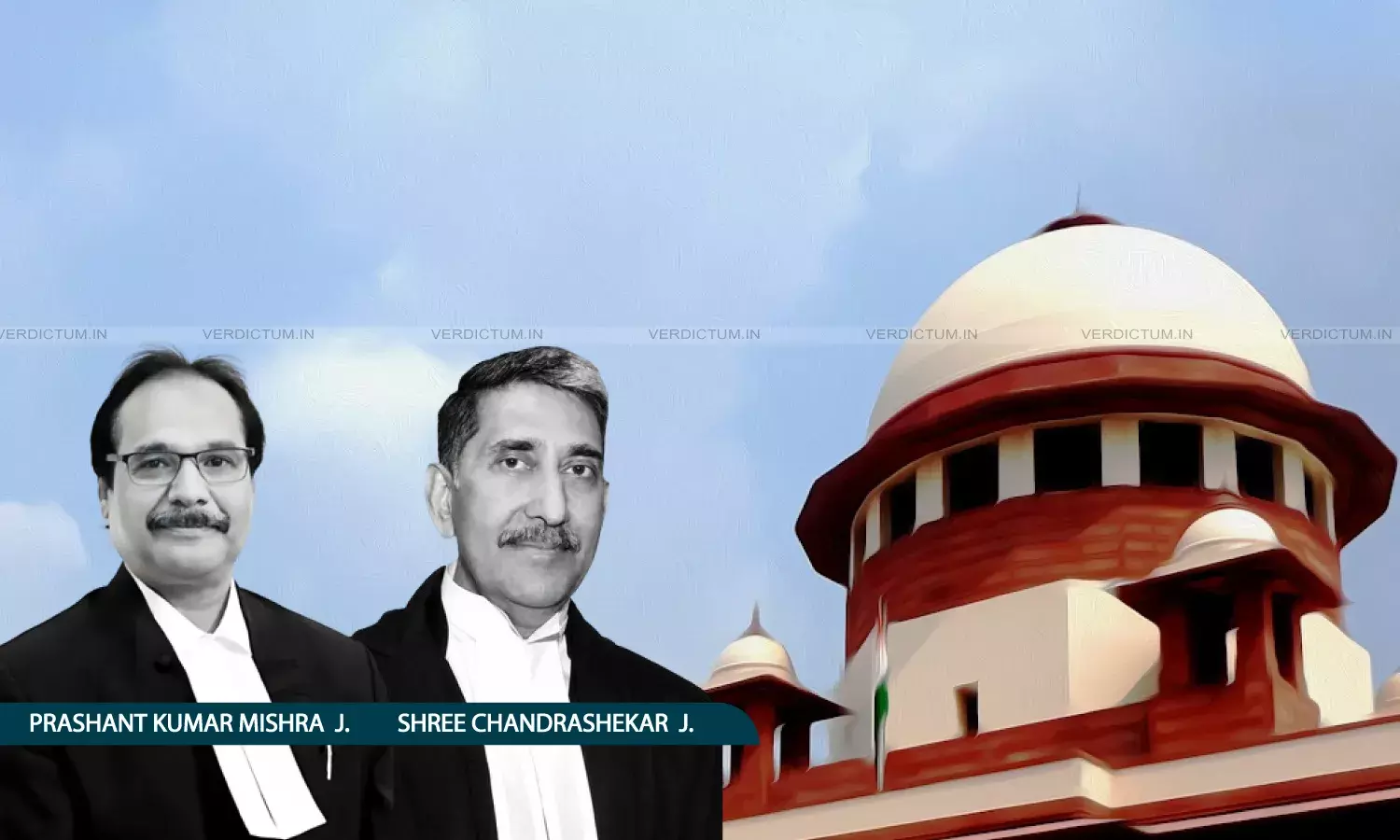
Justice Prashant Kumar Mishra, Justice Shree Chandrashekhar, Supreme Court
The Supreme Court has affirmed the dismissal of an election petition by the Madras High Court on the ground that the election petition had been presented by the petitioner’s counsel. The Apex Court held that the mandatory requirement under Section 81 of the Representation of the People Act, 1951, that the petition must be presented “by” the petitioner enables the High Court, at the stage of presentation itself, to undertake a preliminary verification
The matter before the Apex Court emanated from an election petition filed by the petitioner.
The Division Bench of Justice Prashant Kumar Mishra and Justice Shree Chandrashekhar observed, “It is also pertinent to emphasize the significance and the usage of the expression “by” occurring in Section 81(1) of the RP Act. In G.V. Sreerama Reddy (supra), this Court considered the underlying legislative insistence upon presentation by the election petitioner himself. This Court observed that an election petition is a serious proceeding which may result in the vitiation of an electoral process and that the procedure prescribed by an election statute must, therefore, be strictly followed. The requirement that the petition be presented “by” the petitioner enables the High Court, at the stage of presentation itself, to undertake a preliminary verification so as to ensure that the proceeding is not frivolous or vexatious.”
“Thus, the requirement of presentation under Section 81 cannot be viewed as a mere procedural formality divorced from the statutory scheme, as its compliance bears direct nexus with the maintainability of the election petition and a defect, if any, shall not be curable”, it added.
AOR Pranav Sachdeva represented the Petitioner.
Issue
The issue before the Bench was whether presentation of an election petition by the petitioner in person is a mandatory requirement under Section 81 of the Representation of the People Act, 1951, and whether non-compliance with such a requirement, if any, renders the election petition liable to dismissal at the threshold under Section 86(1) of the RP Act.
Factual Background
The election petition was filed by the petitioner under Sections 80, 80A, 81, 83,100(1)(b), 100(1)(d)(i) & (iv) read with Section 123(2) of the RP Act and Rule 2 of the Rules of the Madras High Court Election Petitions, 1967 read with Order II Rule 3 of the Rules of the High Court, Madras Original Side,1994 seeking a declaration that the election of the Respondent, S. Regupathy from 181- Thirumayam Assembly Constituency in the 2026 Tamil Nadu Legislative Assembly Elections declared on May 4, 2026 was null and void under Section 100(1)(b) and Section 100(1)(d)(i) and (iv) of the RP Act.
The High Court dismissed the petitioner’s election petition as not maintainable on the ground that the election petition had been presented by the petitioner’s counsel. The High Court referred to Rule 7 of the Madras High Court Election Petitions Rules, 1967, which mandated that every election petition should be presented by the petitioner in person before the II Assistant Registrar, Original Side, High Court or, in his absence, before such officer of the Court as the Registrar of the High Court may direct. Aggrieved thereby, the petitioner approached the Apex Court.
Reasoning
The Bench first dealt with Sections 81 and 86 of the RP Act, which deal with the requirements for presentation of an election petition and the consequence of non-compliance with the statutory requirements.
Considering that the RP Act is a special and self-contained code governing the disputes relating to elections, the Bench observed, “The statutory scheme which presently obtains is thus materially different from that which prevailed under the unamended provision. While the earlier Section 81(2) expressly recognised presentation through a person authorised in writing by the election petitioner and also by registered post, no such modes of presentation find recognition in the provision as it now stands.”
The Bench further stated that Section 86(1) of the RP Act, 1951, mandates that the High Court shall dismiss an election petition which does not comply with the provisions of Section 81 of the Act.
On a perusal of the facts of the case, the Bench noted that the CISF entry pass relied upon by the petitioner established his entry into the premises of the High Court but it did not establish anything remotely suggesting that he personally presented the petition. “Significantly, the receipt evidencing the security deposit under Section 117 of the RP Act was issued in the name of the petitioner’s counsel. As regards the CCTV footage, the petitioner asserts that it captured the presentation and his personal verification, the footage itself, can at the highest, establish the petitioner’s presence in the premises and nothing else”, it added.
Thus, concurring with the view of the High Court and finding no merit in the Special Leave Petition, the Bench dismissed the same.
Cause Title: V. Pon. Paneerselvam v. S. Regupathy and Others (Neutral Citation: 2026 INSC 1092)